“Metamorphoses” – Ovid, 102

you think I’ve got a big ego, I asked
a friend who’d just told me I had one,
not confrontationally but as a matter
of fact, I wasn’t offended, just curious,
I think I’m so humble, I answered,
usually, so deferential
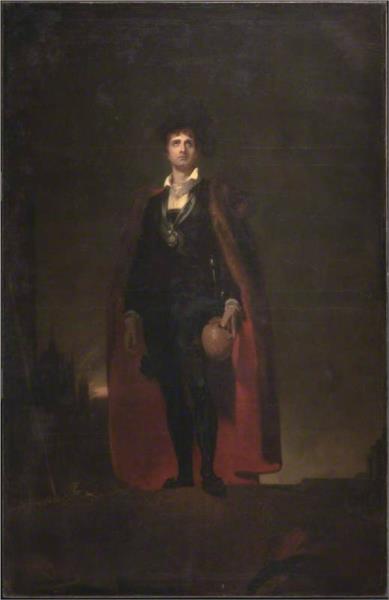
“John Philip Kemble as Hamlet“ (1801)
___________
if I’m to compare Beethoven’s 32nd
Piano Sonata, his opus 111, with
anything else you might be familiar
with, it would be Shakespeare’s
epochal contemplation, “To be, or
not to be“, both are, first, and
briefly, soliloquies, one performer
alone is on stage, both are
implicitly meditations, that will
augur, inspire, note, a new age
let me propound, for a moment, on
the Shakespeare, an introspective
piece set on resolving an existential
dilemma, To be, or not to be, that is
the question, it is pungent, forceful,
arresting, if only even rhythmically,
so much so that many still
pronounce the first line of that
trenchant aria with verily stentorian
conviction, without realizing that the
several concluding movements are
abysmally dire, indeed they
investigate, with improbably literate
fervour, a life and death situation
Whether ’tis nobler in the mind to suffer
The slings and arrows of outrageous fortune,
Or to take arms against a sea of troubles
And by opposing end them
should one, after contemplation,
bear the onslaught of life’s most
unacceptable tribulations, or,
most efficiently, cut all of it off
… To die – he says – to sleep,
No more; and by a sleep to say we end
The heart-ache and the thousand natural shocks
That flesh is heir to: ’tis a consummation
Devoutly to be wished
I’ve often been there
... To die, to sleep;
To sleep, perchance to dream – ay, there’s the rub:
the rub, which is to say, the problem,
what’s up once you’ve done yourself
in
For in that sleep of death what dreams may come
When we have shuffled off this mortal coil,
Must give us pause
indeed, there’s the respect, the angle,
the conundrum one must consider
that makes calamity of so long life
one ‘s stuck between the devil and the
deep blue sea
For who would bear the whips and scorns of time,
Th’ oppressor’s wrong, the proud man’s contumely
the demeaning disrespect a proud man ‘s
made to suffer
The pangs of dispriz’d love, the law’s delay,
The insolence of office, and the spurns
That patient merit of the unworthy takes
which is to say, life’s multifarious, and
beleaguering struggles
When he himself might his quietus make
With a bare bodkin?
quietus, silence, extermination
bodkin, a knife
… Who would fardels bear,
fardels, hardships
To grunt and sweat under a weary life,
But that the dread of something after death,
The undiscover’d country, from whose bourn
No traveller returns, puzzles the will,
And makes us rather bear those ills we have
Than fly to others we know not of?
we keep on grunting, in fear that
what comes after could be worse
a man considering his own demise,
his quietus, at the time of Shakespeare
would’ve been, only a generation earlier,
an heretic, one deserving of unforgiving,
and gruesome, censure, Hamlet was,
not incidentally, however, a prince, a
role model, though evidently controversial
but the Reformation had occurred,
a loosening of categorical strictures
in France, Descartes had, in his quest
for the true God, concluded, Cogito,
ergo sum, I think, therefore I am,
eclipsing the Catholic God as the
final arbiter, personal metaphysical
options were up for grabs, out in
the open, though yet not entirely
secular
which would happen, out loud, in
the Age of Reason, when God, as
we knew Him, lost His, by now
scattered, authority, among
Lutherans, for instance, Calvinists,
Anglicans, and a proliferation of
sprouting others, not to mention,
still, the stalwart, ever, Roman
Catholics
the Romantic Period needed a new
ethic, a personal evaluation of one’s
metaphysical position, Beethoven,
in a word, or in his 32nd Piano
Sonata rather, delivers, a piece no
less intense than Shakespeare’s
profound interrogation
briefly, there are two movements
here, merely, which demand your
attention, it isn’t music that one
listens to with just one ear, this
is Jesus on the Mount of Olives,
Gethsemane, not much different
from Shakespeare’s existential
soliloquy
war, peace, rebellion, resignation,
black, white, fast, slow, explosive,
extended, man, woman, yin,
indeed, yang, short, long,
irascible, submissive, all
paradoxical dichotomies, all
eventually, manifestly,
transcendent, all a subjugation,
a private prayer, eventually,
however fraught, however
nevertheless archetypal,
two movements that still
haven’t exhausted their
philosophical potential for
being assuaging, inspirational
R ! chard
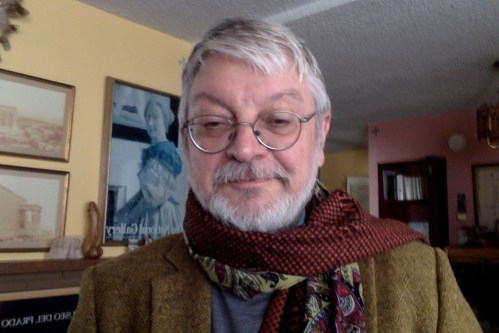
me, May 24, 2016
__________
I save all the New Yorker poems
to read after I’ve been through
everything else in the issue,
like dessert after a meal, icing
on the cake, sometimes too
heavy, sometimes too light,
sometimes too rich, sometimes
just right
today, I found my favourite poem,
period, this year, stepped right
into its shoes, like old slippers,
the only difference being my
walls are painted a variety of
contrasting colours, studded
with memorabilia, treasured
artefacts, see above
also, no one’s translating my
poems, though even our metre
is the same, try it, sing us out
loud, you’ll dance
R ! chard
_____________
Every time Gulliver travels
into another chapter of “Gulliver’s Travels”
I marvel at how well travelled he is
despite his incurable gullibility.
I don’t enjoy travelling anymore
because, for instance,
I still don’t know the difference
between a “bloke” and a “chap.”
And I’m embarrassed
whenever I have to hold out a palm
of loose coins to a cashier
as if I were feeding a pigeon in a park.
Like Proust, I see only trouble
in store if I leave my room,
which is not lined with cork,
only sheets of wallpaper
featuring orange flowers
and little green vines.
Of course, anytime I want
I can travel in my imagination
but only as far as Toronto,
where some graduate students
with goatees and snoods
are translating my poems into Canadian.
__________
psst: I said just recently to a poet
acquaintance that what poetry
needed in the 21st Century is
humour, the only art form not
catching up with the rest,
otherwise it’ll die of, indeed
succumb to, its own
lugubriousness
thank you again, Billy Collins
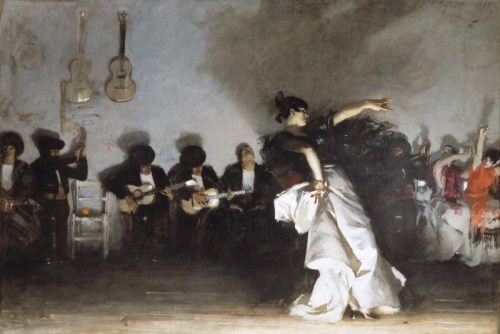
‘El Jaleo‘ (1882)
_________
After a history lesson, crash course in Buenos Aires
a hundred years before our time, we begin
at last. You gently place my arm over yours, my hand
on your shoulder, our bodies distant enough
to have an invisible body between us – this is open embrace,
you explain, abrazo abierto. We dare not dance in abrazo cerrado,
where our chests would nearly touch – I’m not single-
minded enough about learning these moves to unlock
what I fear might spill out, should I let myself fall
into your hazelnut voice – so rich and deep I might never
emerge from it. You teach me the new skill of following,
though your lead feels less like control and more
like stewardship, carving swans of negative space
that stretch their graceful necks along the diagonals
of our bodies. We’re in a conversation of pauses
and advances. I step too soon, but you are eminently patient,
your large hand over mine, poised mid-air, a paper crane
mid-flight. As you shift your weight from side to side,
I wait, trying to sense which way we are going,
and for a moment, I have the chance to look at you not
looking at me, your calm grey eyes fixed above my head.
On the small of my back, your warm hand –
a breathing orchid, cupped flame.
____________
for, especially, Tonyia
the clash of cultures is exposed to the light
here as a tango dancer teaches an English-
speaking novice how to dance
there is no evident metre in the verse, the
poem is in prose, contained within terse,
two-lined stanzas which act as constraints
on the forward flow, however ever fluidly
continuous, like tenutos in music, where
the note is held, dramatically, before a
return to the original rhythm
but slowly this prose develops its own
irresistible rhythms, an abandonment
to the metre of the whole, a languid
surrender to the pulse and propulsion
of the dance, and becomes, despite
its, ahem, flat feet, a poem
the very vocalic construction of
Romantic languages, abrazo abierto,
for instance, or abrazo cerrado,
propelled by vowels for their forward
motion, in imitation of the heartbeat,
preclude in natives unfamiliarity with
cadence, the tango is already in their
blood, the teacher here ineluctably
lives, breathes, hir ethnic identity
Anglo-Saxons and Teutons excel,
rather, at political science and
philosophy, more sober, cerebral
preoccupations, suppressing
gutturally in their glut of gurgled
consonants, the more carnal
allure or, from a primmer
perspective, temptations, of the
senses
which Romantic poets, incidentally,
pointedly sought out in the seductive
rhythms of the Mediterranean, much
as this very student succumbs to the
‘breathing orchid’, the ‘cupped flame‘
of this tantalizing tango
Richard
__________
happy poems about February are not
easy to find, nor are poems by any
poet written for each month of the
year
but here are Algernon Charles
Swinburne‘s “January” and “February”
from his “A Year’s Carols“
January
Hail, January, that bearest here
On snowbright breasts the babe-faced year
That weeps and trembles to be born.
Hail, maid and mother, strong and bright,
Hooded and cloaked and shod with white,
Whose eyes are stars that match the morn.
Thy forehead braves the storm’s bent bow,
Thy feet enkindle stars of snow.
February
Wan February with weeping cheer,
Whose cold hand guides the youngling year
Down misty roads of mire and rime,
Before thy pale and fitful face
The shrill wind shifts the clouds apace
Through skies the morning scarce may climb.
Thine eyes are thick with heavy tears,
But lit with hopes that light the year’s.
March’ll have to wait
most of us have never even heard of
Swinburne, I actually thought he was
German, he’s not, he was English,
and decadent, apparently, like his
compatriots then, Dante Gabriel
Rossetti and Oscar Wilde, who
thought Swinburne, however, was
a sham
though he never received a Nobel prize,
he was nominated for one in literature
each year from 1903 to 1907, then
again in 1909
to Swinburne
Richard
 Richibi's Weblog