Richibi’s Weblog

Just another WordPress.com weblog

Category: people to ponder

a short history of the waltz
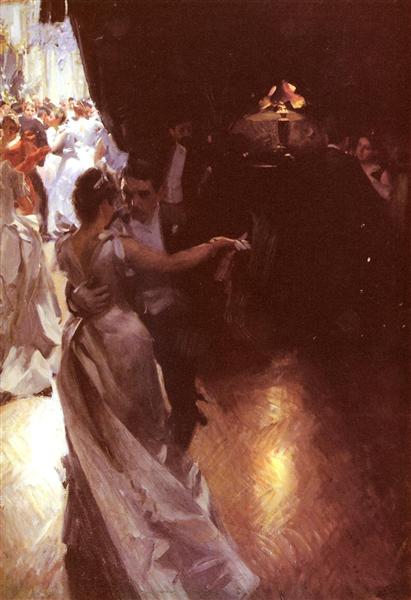
waltz-1891-1.jpg!Large

  “Waltz (1891) 

    Anders Zorn

       ________

inadvertently, during my last comments
I let slip, perhaps, prematurely – cause I
thought I’d explore earlier Romantic 
pieces first, more Beethoven, more 
Paganini – the word waltz, when I 
referenced the “Minute Waltz”, a dance 
which expressed a sea change in 
Western cultural history made 
manifest through music 

though the waltz was already the rage
in lowlier social circles in the late 
1700’s, the minuet still held sway in 
the more aristocratic salons, whose 
young swains nevertheless would 
skip out to ferret out the servants’ 
quarters, as young swains do

slowly the dance, for its more 
informal aspects, not to mention 
its sensuous intimacy, became so 
astonishingly mainstream as to 
define pretty well the very century, 
Chopin and the Strausses, Father 
and Son, would take care of that, 
the last two making a carnival out 
of very Vienna

but until the late 1820’s, not much 
was heard of the waltz in the 
musical curriculum, at which 
point it’ll come in with a vengeance  

not much from Beethoven, who, in 
his fifties, was probably about as ,
interested in waltzes as I am in hip 
hop, a ditty only, a trifle, this one,
1824, one of only two waltzes 
from him 

here’s Johann Strauss l, however, 
his Carnival in Venice, 1828, is a 
waltz in Carnival clothing, like 
cadenzas, for instance, in the 
guise of Paganini “Caprices”

here’s Johann Strauss ll, the son,
with his Wiener Blut“, “The Spirit 
of Vienna“, electrifying, 1873, the 
late already 19th Century

but here’s Chopin doing his stuff
1847, right in the middle of both, 
from far away Paris, which was 
going through its list of Empire 
changes right about then, his
Waltz in C-sharp minor

Chopin’s waltz is a more decorous 
composition, more courtly, more 
also introspective, contemplative, 
private, indeed Romantic

note how strongly the Classical 
unities still apply here, tempo, 
tonality and repetition, even more 
markedly than in Beethoven, Chopin 
is Mozart, but with more sentiment, 
and perhaps more rubato, stretching 
the rhythm in composition to 
accommodate a dancer’s presumed 
dip, in his otherwise meditational 
compositions 

the waltz will undergo trials and 
tribulations later, as the world 
turns, but I’ll keep those 
reflections for later

meanwhile, choose your partner


R ! chard
“Caprices” for Solo Violin – Paganini

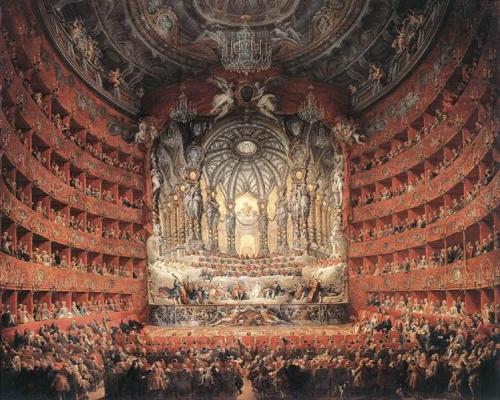
musical-f-te-1747.jpg!Large

    “Musical Fête (1747) 

           Giovanni Paolo Panini

                        ____________

though by now you must be assuming 
that Beethoven had been defining the
entire early Romantic Period all by 
himself, 1803, let’s say, to, say, 1810, 
when Schubert, 13 by then, started 
kicking in, however immaturely, with 
his D1 – D1, note, not D960, over a 
thousand compositions later, a work 
imbued, so early, not unexpectedly,  
with the irrepressible spirit of Mozart, 
and therefore, by thenincidentally, 
audibly outdated – but you would be, 
we would  be, overlooking the extraordinary  
influence of a maverick, a relic of the  
earlier Italian domination of the arts, 
from the Renaissance, at least, on – 
Paganini – the wizard of the 
violin, who’d sold his soul, like Faust,  
to the devil, it was susurrated, for his
extraordinary gift
 
Bach had not only changed the course 
of musical history, in the early 18th
Century, but shanghaied the very 
language of art as oracular expression,
and substituted music as the voice that 
spoke for the people, music will define 
henceforth, for a time, the period
 
there is the Italian Baroque, of course,
utterly masterful paintings, sublime
even, see abovebut it has been 
supplanted in our 21st-Century 
popular imagination by the Baroque 
of the German nations, their music, 
Bach’s, transcendental then, though 
ever so intricate, descriptions of his 
particular epoch 

this dominance will migrate to Paris, 
eventually, and back to art, painting, 
after over a hundred tumultuous, 
and impermeable, years, with the 
Impressionists, in the late 19th 
Century

meanwhile, Paganini will get in the 
way, 1780 – 1840, an exact, more or 
less, contemporary of Beethoven, 
1770 – 1827, and show off what 
Romantics can do, unleashed, 
before a newly enfranchised, and 
thrilled, as you will surely be, 
audience  

watch, be dazzled


R ! chard

psst: the Caprices are essentially
          cadenzas, the improvised solo
          sections in concertos, where 
          instrumentalists get to show 
          off their stuff, and riff, however
          exponentially, on their subject

          Paganini, makes an art form 
          of that, as do others, whom 
          I’ll bring up, trust me, later

          stay tuned


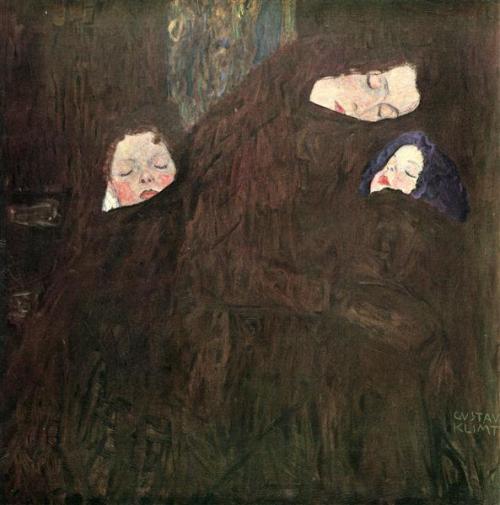
“Mother with Children” – Gustav Klimt

mother-with-children.jpg!Large     
     “Mother with Children (c.1909 – 1910)

             Gustav Klimt

                 _______

Gustav Klimt has long been one of 
my very favourite painters, a large 
reproduction of a detail of his 
masterpiece, Music“, hangs even 
on one of my walls

how much is that Klimt in the 
window, I’d asked the merchant 
when I saw it from the street in 
his shop’s display

later, I invited people over, to see
my Klimt, I’ve got a very large 
Klimt, I’d say – this is before 
anyone even knew of him, I was, 
I’ll admit, a bad boy

around all that, I’ve had the good 
fortune to see many of his works
during the several times I’ve been 
to Vienna, where most of his 
wonders reside, where they grace  
that immortal city, the great hall of
the Kunsthistorisches Museum,
the Art History Museum in English, 
for instance, the Beethoven Frieze 
at the Vienna Secession Building 
and, of course, at Belvedere, the 
summer palace, where among 
other paintings of his, you can 
still see the iconic The Kiss
their national treasure

but the painting above, part of a 
private, apparently, collection, is 
utterly new to me, and therefore 
striking,

note how stark the background is
here, above, compared to Klimt’s 
usually more ornamented 
constructions, how the subject is
starkly the gentleness, the 
intimation of peace, even serenity,
in the rosy cheeks of not only the 
children, but of also the mother,
the slumber and surrendermidst 
the imprecations of the 
surrounding, and portentous,
darkness, note the paradoxical, 
genetically determined even, trust 
and love, in the consonant colours, 
cherry blossoms blooming in all 
three sleeping faces, despite the 
threatening miasma of encroaching 
and engulfing primordial earth

Shostakovich also said something 
like that in his 15th String Quartet
a fundamental harmony develops, 
despite even strident distortions, 
disturbances, in otherwise 
unbearable situations, to provide 
some solace, redemption
 
listen, I urge you, if you dare

compare the crook in the mother’s 
neck, above, a nearly Baroque angle, 
to the same docile, though resilient,
bent in Klimt‘s lover in The Kiss 
for his provocative, maybe even 
enlightening, perspective on 
women


happy Mother’s Day, mothers, for all 
your invaluable attention


R ! chard

what’s up in Frankfurt – Piano Sonata in F minor, “Appassionata” – Beethoven

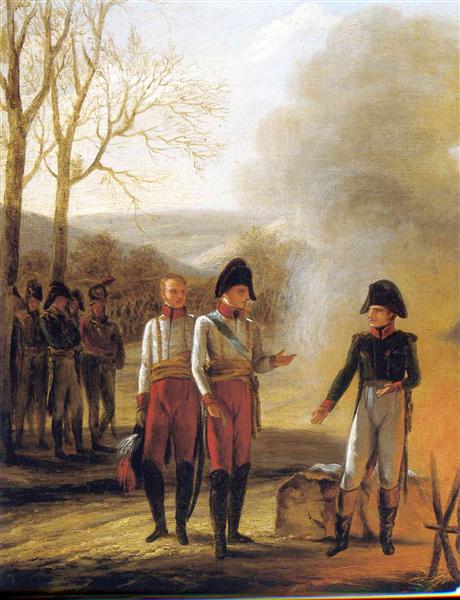
the-conversation-of-napoleon-and-francois-ii-1808.jpg!Large

  “The conversation of Napoleon and Francois II (1808) 

        Pierre-Paul Prud’hon

________

it’s 1804, Beethoven has entered his
Middle Period, left the more formal 
constraints of the Classical Period, 
Mozart and Haydn, behind, though
perhaps not essentially, the 
structure remains, hardwiredbut 
its spirit is entirely different, 
revolutionarily different, thanks to
Napoleon

and Beethoven is as opinionated 
as the revolutionaries, boisterous,
adamant, peremptory even, he is 
Zeus, and not undeservedly, at 
the top of Olympus’ musical 
mountain, where, incidentally, 
he still prevails, harmony’s very 
Homer

by his Opus 57, the Appassionata” 
– a name not of his own invention, 
but, however discriminately, ascribed 
later – he isn’t as metaphysical as 
Schubert is in that later poet’s D960
Beethoven is still writing descriptive 
texts, torrid novels, however 
masterfully illustrated, more than 
the philosophical stuff he’ll later 
undertake, even topping, when that
takes place, Schubert’s, ever, 
nevertheless, transcendental D960
if you can believe it

but Schubert remained a stripling, 
Beethoven, his elder, was given the 
grace to probe longer his humanity,
however might it have been equally 
cruelly benighted, and to stretch his 
speculative reach into previously 
unimagined dimensions, beyond 
the limited temporal scope of the 
surely shriven since Schubert 

all of whose wonders have defied 
the harsh indignities of time, and 
continue still to profoundly and
indelibly reverberate

listen, marvel


R ! chard

a Beethoven / Schubert piano recital

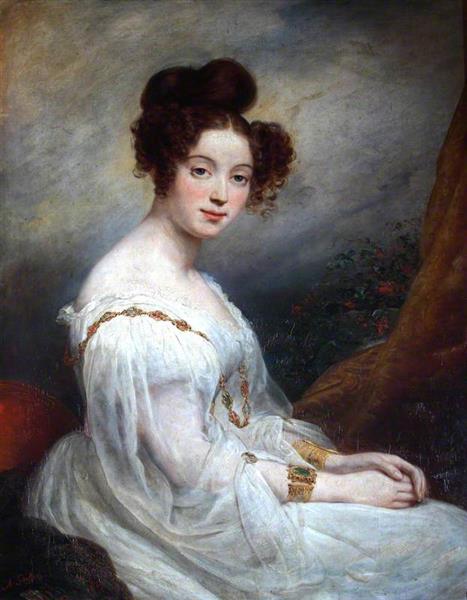
charlotte-rothsch-baroness-anselm-de-rothschild-1828.jpg!Large

 “Charlotte Rothsch, Baroness Anselm De Rothschild (1828) 

       Ary Scheffer

           _______

since Beethoven wrote nothing of any 
great consequence for four-hand piano,
I thought at first I’d head towards another 
kind of pairing, but upon listening to the 
complete recital here of the two Jussen 
brothers, where Beethoven’s “Variations 
on a Theme by Count von Waldstein”, 
1792, a trifle, and his later “Waldstein” 
Sonata, 1804, for piano solo, an infinitely 
more accomplished work of his Middle 
Period, both dedicated to the same good 
friend and patronbookend a flurry of  
enchanting Schubert compositions, 
the contrast between the two composers, 
if not starkly evident, is at least 
discernable if you listen with some 
degree of attention

the difference is in the tone, the intention, 
Beethoven is brash, assertive, Schubert 
remains ever respectful, even often 
courtly

you’ll note that after the fall of Napoleon, 
the monarchy was restored in France, 
therefore throughout the whole of 
Europe, which had resumed its more 
genteel pretensions, as had, for instance,  
even Chopin himself, you’ll remember, in 
very Paris, where he’d relocated from 
Poland because of its political unrest

I’ve often said that a distinct characteristic 
of Beethoven is that he writes against the 
beat, rather than stressing the first note 
of the air he is developing, he accentuates 
the second, or third, the next still, or the 
very last

don’t go, I wish you’d stay here, he, for 
example, beseeches, if you transpose 
his notes in the last movement of the 
Waldsteinthe one after the lugubrious 
adagio, into words, don’t go, he strikes, 
I wish you’d stay, don’t go, I wish you’d 
stay here, don’t go, wish you’d stay, 
wish you’d stay, wish you’d stay,
accent each time on the stay 

in Schubert’s Fantasie for four-hand 
piano, written a generation later, in 1828, 
and admittedly powerfully influenced by 
Beethoven, though no more derivatively 
than Mozart would’ve been of Haydn, try, 
I hear a bird sing, I hear it sing, I hear it 
sing, it sounds so lovely, to the lovely 
melody at its very beginning, one 
composer is peremptory, the other is 
more subservient, confessional

this is what I mean by intention, and the 
difference between these two towering 
geniuses, who shaped together the 
music of their era, however might they 
have been otherwise total strangers

they are both musical giants upon 
whose shoulders our Western culture  
still stands, and swoons, before such 
an utterly transcendent legacy

listen


R ! chard

Fantasia in F minor, D.940 – Franz Schubert

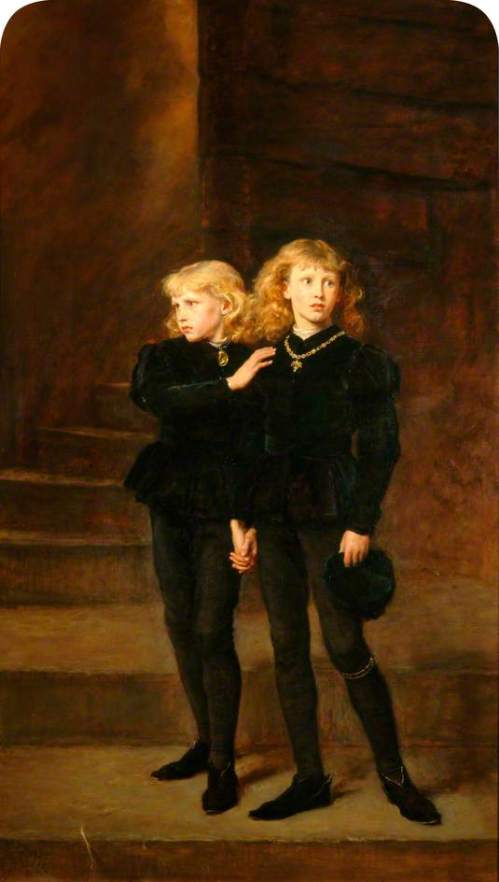
Millais, John Everett, 1829-1896; The Princes in the Tower


        Princes In The Tower (1878) 
 
               John Everett Millais
 
                     ___________
 
 
flipping through the suggested list of 
YouTube videos that always accompanies
the main feature for a quite specific other 
quintet of Schubert, a work to compare 
chanced upon, by the very gleam of what 
it promised on the label, a Fantasia, rather, 
of Schubert for four-hand piano, in other 
words, two people, pups of the same 
family, it appeared in this instance, 
according to both their names, and the 
still picture
 
I wasn’t prepared to find two veritable
cherubs, dressed alike in black and 
white, not unlike those in the painting 
abovesit at the piano and deliver the 
very music of angels
 
written in May, 1828, Schubert died 
that November, age 31
 
the Fantasia is essentially a sonata
with all the breaks removed, it is 
played without interruption, this 
video indicates the three traditional
separations of the movements as 
they occur
 
you’ll find again tonality, tempo, 
and recapitulation rule, but the 
idiom is searching, clusters of 
notes are broken down, explored,
dissected, looking for some kind
of metaphysical solution, which
of course, can only be the quest
itselfimperceptible to the 
beseecher, who can only ever 
find it in the mirror of his or her 
own creation, in other words, the 
answer is in the process, we are 
ourselves our own metaphysical 
solution according to the life that 
we individually create, which, in 
this case, Schubert’s, is utterly 
magical, the very utterances of 
angels, Schubert must’ve been 
an angel
 
note the return of the original 
theme in the final movement, 
like a memory of something 
that started long ago, before 
the tumult and anguish of the 
intervening moments, the sigh
at the end, the very last note, 
a surrender, a submission, an
exhausted, and I use the word
advisedly, capitulation
 
 
if I’ve twinned the painting above
it’s that they are both expressions
of absolute innocence, unclouded
emotions before their either fate,
in one case, the message of 
Schubert, a very Annunciation
played appropriately by apt 
messengers, the other, dread 
before their direst of plights  
 
Edward, heir to Edward lV, King of
England, and Richard, his brother,
disappeared from the Tower of 
London after Richard lll had them,
ages 12 and 9, held there, no one 
has determined the true course of
events, apart from the fact that
Richard lll got the throne, 
however illegitimately 


note that the painting above is 
manifestly Romantic, 1878, though
late, Impressionism was taking 
over, but Millais, English, and not 
as controversial as the French, 
nor the Austrians, for that matter,
still delivered utter masterpieces
in the, however outdated, 
perspective 
 
the painting, at five feet by three,
is nearly life size, standing beside 
it is unforgettable, it is in a sober, 
dare I say, Protestant style, quite 
different from the Catholic 
Schubert and his more Italianate
sensibilities, it is spare in both 
colour and filigree, a consequence 
of strict rules established upon the 
arts after Charles ll, under William 
of Orange and Mary, 1689 -1702
 
the British will pick up again, 
artistically, but only marginally, in 
the 19th Century, they shine,
however, in the area of philosophy, 
mostly political, Adam Smith, for 
instance, significant in the shaping 
of the American Constitutionor 
empiricist, what there is to learn 
directly from experienceHobbes
BerkeleyLockeuntil it returns to 
Germany in the 18th Century with 
Kantconcerns more existential
does God exist, all the way up to 
Nietzsche in the late 19th Century
puts an end to Him, and the West 
prepares for secularism, separation 
of Church and State

 
the Princes“, like Schubert, are 
manifest in their horror, not 
stylized, but overt, flagrant
 
Jane Grey“, Delaroche, for the 
combination of drama, pathos,  
for Romantic attention to the 
plight of even regal personalities
 
 
R ! chard


String Quintet in C major, D. 956 – Franz Schubert

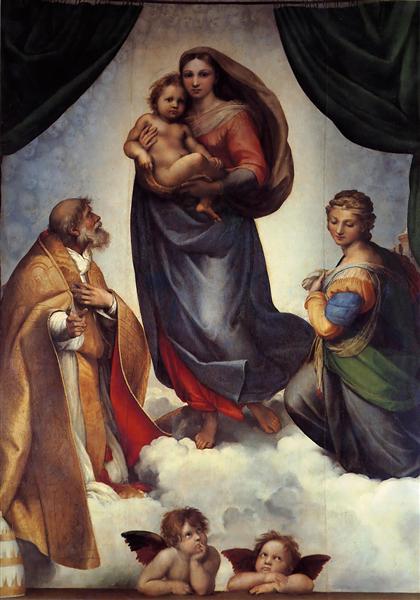
the-sistine-madonna-1513.jpg!Large

   “The Sistine Madonna (1513)
 
          Raphael


          __________ 


if you listen to only one piece of music  
this week, make it this one, Schubert’s 
a monument of Western culture, it’d be
like missing the Venus de Milo when 
you’re at the Louvre, or the Sistine 
Madonna of Dresden’s Zwinger 
the church of Saint Agnes Outside the 
Walls, transformative experiences

quartets, I couldn’t not next introduce
their very gold standard 
 
written in 1828, it was composed at 
the very height of the Romantic 
Period, just a little ahead of Chopin,
1810 – 1849, his other significant 
counterpart, apart from the ageing
Beethoven, 1770 – 1827, who still 
towered above all, despite his 
demise, and was universally 
admired 
 
but had Schubert lived longer than 
his 31 years, I suspect he might’ve 
been Beethoven’s equal, Schubert 
died even earlier than Mozart did, 
at 35, but of something that wasn’t
spoken of until much later, which 
is why we haven’t heard about the 
loss of this other musical giant
quite as grievously as we have 
about his somewhat more senior 
counterpart
 
but listen
 
it’s even hard to tell him apart from 
Beethoven, the passion, the urgency, 
the drama, even composing against 
the beat, a signature trait in 
Beethoven, like Alfred Hitchcock 
showing up in his own movies, or
Woody Allen, always introducing a 
work of art
 
a few things
 
though the frame is immaculately 
Classical, tonality, tempo, and 
recapitulation are not at all 
unobserved, the mood has changed 
from courteous, deferential, and 
respectful, to urgent, confessional, 
and private, the walls are there, but 
the furniture has changed, thanks 
of course here to Beethoven
 
and to the times
 
was writing her Sonnets from the 
Let me count the ways. – right about 
thenunfettered love poems to her 
beloved husband, Robertthe equally 
famous poet, who was remaining 
nevertheless, in his own work, more 
emotionally punctilious
 
I noted as well that the tempo in the 
second movement, one of the most 
beautiful adagios eversurely, 
lurches into an intemperate rebellion,
a second rhythm, up against the earlier 
mournful resignation of the poignant 
lament – note, in passing, that its 
stress of the dominant note is on the 
last beat not the first, like a weight 
that becomes, at every inching 
forward, intolerable, very path to a 
personal Calvary – before returning 
to that very fateful, though luminous, 
initial, stricken dirge

the next movement, the scherzo, does 
the reverse, fast, then slow, then fast 
again, to give the work in its entirety
eight rather than the four traditional 
tempi
 
the piece now has episodes, rather 
than merely a clockwork display,
drama has replaced the dance
entirely as the subtext for music
 
Schubert died two weeks after its
publication, for your info, I think 
his soul had been talking
 
 
R ! chard

psst: there’s a magical film I associate 
          with this music, The Company 
          of Strangers“, a Canadian 
          production, about several elderly
          ladies who get stuck in the 
          wilderness after their tour bus  
          breaks down in the middle of 
          nowhere
 
          you’ll never forget it


String Quartet in A Major, Opus 18, no 5 – Beethoven

adagio-1899.jpg!Large

      Adagio (1899) 
 
         Tom Roberts
 
            ________
 
 
                               for especially Kathy, who, 
                                   according to a mutual friend, 
                                       needs our prayers
 
                               please be generous 
 
 
from his Opus 18, among which there
are six, according to the Classical 
tradition, is still steeped in Classical
conditions, tonality, tempo, and 
reiteration, but is revolutionary for 
its brashness, its personal 
manifestation – hey, it says, I’m the 
Pied Piper, I’m not hiding in the 
courtly shadows any longer, my 
stage is now the concert hall, no 
more the aristocratic, however 
stately, chamber music, which has 
ceded, until now, to propriety and 
deference rather than, in a word,
genius, I’m Beethoven, Beethoven 
says, watch me
 
he doesn’t disappoint
 
written in 1801, is a very early work of
Beethoven, it’s nearly easy to confuse
him here with Haydn, with whom he’d,
incidentally, earlier studied
 
the era is still extricating itself from the 
Classical model, the Classical imperatives 
are there, tempo, tonality, and repetition 
remain rigid elements of musical 
construction in the 5th, they are nearly 
obsessive, though each movement 
imprints itself, by constant reiteration, 
on our minds, much like pop music
 
but I miss an adagio, the moral ground,
I think, of a piece of music, the place 
where your heart really takes over and 
begins to incorporate the work‘s 
humanity, I ascribe this unfortunate 
omission to Beethoven’s youthful 
exuberance, he would’ve been around 
30, and setting out, with verve and 
ambition, and he would be performing 
before general now, rather than 
aristocratic, audiences, he had a show 
to put on, not just background chamber 
music  
 
note that the second movement is a 
minuet, a sure sign of the Classical
Period, extinct in only a few further
years
 
note that the third movement, the 
andante cantabile, a leisurely walking 
pace, stepped up, rather than down, 
to a veritable clippety-clop in some 
instances, is a set of variations, to, 
incidentally, settle its theme into 
one’s very consciousness, I’ve been 
humming these movements for the 
past several days, not at all 
unprofitably
 
note also that you’ll probably soon 
be humming, too, this infectious
compositionin all its iterations, 
they are utterly captivating, after, 

still, even over two hundred years

enjoy 


R ! chard 

psst: thanks Collin, for Kathy

Cello Sonata no 2 in G minor, opus 5 – Beethoven

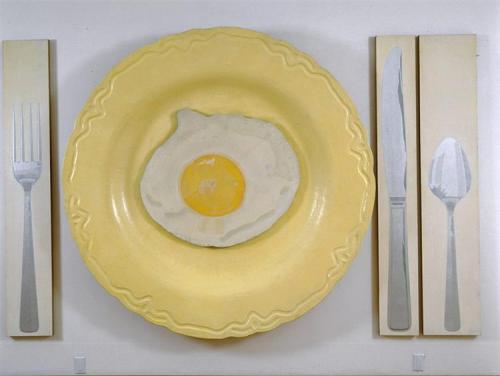
egg-on-plate-with-knife-fork-and-spoon-1964.jpg!Large

   Egg on Plate with Knife, Fork, and Spoon (1964) 

           Alex Hay

              ____

after my somewhat prolonged side trip 
into Bach country, though it is a land
of many more wonders, I’ll get back 
on track, more or less, here, with 
Beethoven’s Second Cello Sonata
the other half of his Opus 5

till then, the cello had served as 
accompaniment, essentially, for other 
more discursive, higher pitched, less 
sonorous, less stentorious  
instruments

but Beethoven puts the cello back 
into the hottest seat in the house, right 
next to the ubiquitous piano, a 
requirement in any instance following 
the neglect of the cello during the 
intervening Classical Period, despite 
Bach’s earlier luminous illustration of 
its incandescent potential

the Opus 5, no 2 starts, audaciously, 
with an adagio, not always a wise 
choice, as you’ve heard me repeat 
here before, it can be unentertaining

but Beethoven gives his adagio tension
by introducing breaks often, which,
rather than stultify, creates momentum,
therefore a narrative, a story to follow

the rhythm is no longer adjusted to 
dance essentially, such a spin as is
heard in the second and third 
movements, for instance, would 
surely sweep one off one’s feet

but the art is in the dance that 
Beethoven allows and creates between 
the piano and the cello, the first the 
filigree on the arm of the more grounded, 
more entrenched latter, the crystal, the 
silverware that adorn, symbolically, an 
however majestic oak table, the creamy
Hollandaise that makes an egg, however 
elemental, irresistible, the literary turns 
that might transform mere prose into, 
verily, poetry, icing on a cake, in a word,  
to complement, in stunning and equal 
cooperation, the inextricable 
counterpart

there is even a moral lesson transmitted
here

Beethoven can often be long-winded, 
I’ve found, but there’s always, always,
at the end of the road something 
entirely worth the extra minute, the 
even several extra minutes 

enjoy 


R ! chard

Cello Concerto no 1 in C major – Joseph Haydn

st-george-and-the-dragon.jpg!Large

     “St. George and the Dragon (c.1470) 

                Paolo Uccello

                    ________

it isn’t easy for me to leave Bach behind
whenever I start listening to him, I could 
ride his musical train forever

but the middle of the 18th Century did, put 
him aside, for about a hundred years, until 
Mendelssohn rediscovered him

Bach’s Cello Suites were themselves only 
reinstated in the 1930s by Pablo Casals,
the Classical 18th Century had considered 
Bach too fussy, his pieces, they thought, 
were technical exercises rather than 
actual entertainments, form was  
overtaking, for them, function 

there’s a wonderful book about all this,
The Cello Suites“, written by Eric Siblin, 
a Canadian journalist, which is not only 
amazingly informed and probing, but also 
beautifully written, it holds a place of 
honour on my bookshelf, along with other 
inspired, and inspiring, texts

not only was Bach set asunder, dismissed,
during the Classical Era, but all of the 
formative music also he had written, for 
cello, violin, keyboard, in other words,
the entire curriculum

which, since Bach’s reinstatement, has 
become, paradoxically, the very  
foundation for learning these instruments

imagine playing a tune with the right 
hand, then a few notes later, picking 
it up in the left hand while the right 
hand keeps on going, imagine what
that does to your fingers, never mind  
to your mind, that’s what his Two-Part
Inventions are all about, fifteen of 
them, eight in major keys, seven in
minor, consider the technical 
difficulties, intricacies, imposed 
both compositionally and upon 
the harried performer 

then Bach follows through with his 
Three-Part Inventions to top it all 
off, for the keyboard at least, and 
only for the moment – there’ll still 
be his transcendental Goldberg 
Variations” among other 
incandescent masterpieces – 
wherein one juggles three tunes at 
time, and all of them in the same 
assortment of fifteen contrasting, 
foundational, keys, the “Inventions
 – if you can do that, you’re on your 
way, one would think, to knowing 
entirely what you’re doing

but time marches on, the Classical
Era hits, Haydn takes over, not
unimpressively

the same thing happened in my 
generation to Frank Sinatra via 
the Beatles, not to mention, a little 
later, to either, with Pink Floyd

listen to Haydn’s First Cello Concerto,
note the bravura inherent in the 
composition, this is not Bach’s 
meditative music, the very Romantic 
Period is, through Classical reserve, 
expressing already its imminence, 
individual prowess is taking over 
from community, which is to say 
religious, affiliation, the same way 
the Renaissance artists, Duccio
GiottoFra AngelicoFilippo Lippi
Uccello had stood out, incidentally, 
from their brethren in the standard 
communal art schools dedicated to 
decorating the ever burgeoning 
churches sprouting out in the still
fervent European environment 

musical, though unaristocratic, 
talents, this time, were beginning, 
within German context, to flex 
their decidedly not unimpressive 
muscles, and gaining some 
significant purchase

and who wouldn’t when a Cello 
Concerto would’ve sounded like 
this, listen


R ! chard