Richibi’s Weblog

Just another WordPress.com weblog

Category: parsing art

“Europa’s Rape” – Ovid

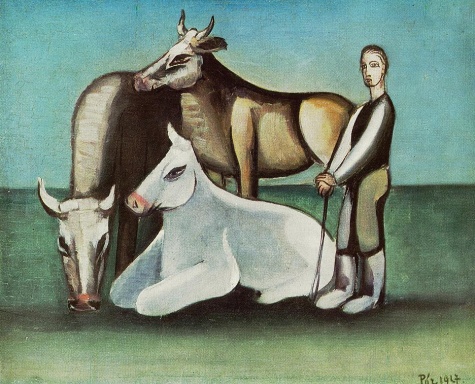
Bulls, 1948 - Bertalan Por

       Bulls” (1948)


               Bertalan Por


                           ____


though I’d heard, indeed, of the rape of

Europa, I wasn’t aware, I’d thought, of

the details, was loathe, therefore, to

read on, in the next segment of Ovid’s

Metamorphoseshaving been earlier

put off by such incidents in that text


as it turned out, Europa isn’t raped,

but, rather, abducted, more or less

willingly, however innocently, by

Jove / Jupiter / Zeus, and will even,

later, consensually, bear his children


who will then migrate, from their base

in Crete, to populate, to people, the

continent which we’ll come to know

as Europe, after their mum


but that’s a whole other story


meanwhile


           When now the God his fury had allay’d,

           And taken vengeance of the stubborn maid,

           From where the bright Athenian turrets rise

           He mounts aloft, and re-ascends the skies.


the God, Hermes / Mercury, if you’ll

remember, had just transformed

Aglauros, the stubborn maid, into a

statue for having been impudent

with him, and mounts aloft now,

re-ascends the skies over Athens,

where the damsel had lived


           Jove saw him enter the sublime abodes,


the sublime abodes, Olympus,

home of the gods


           And, as he mix’d among the crowd of Gods,

           Beckon’d him out, and drew him from the rest,

           And in soft whispers thus his will exprest.


Jove / Jupiter / Zeus wants something

from Hermes / Mercury


“My trusty Hermes, by whose ready aid

           Thy sire’s commands are through the world convey’d.


sire, Jove / Jupiter / Zeus is the father

of Hermes / Mercury, his sire


Hermes / Mercury, the messenger god,

patron of travellers, heralds, newscasters,

those who convey information

through[out] the world


           Resume thy wings, exert their utmost force,

           And to the walls of Sidon speed thy course;


Sidon, a city still in Lebanon


There find a herd of heifers wand’ring o’er

           The neighb’ring hill, and drive ’em to the shore.”

           Thus spoke the God, concealing his intent.


Jove / Jupiter / Zeus, the God, has

an ulterior motive, a conceal[ed] …

intent


           The trusty Hermes, on his message went,

           And found the herd of heifers wand’ring o’er

           A neighb’ring hill, and drove ’em to the shore;


mission accomplished


           Where the king’s daughter, with a lovely train
           Of fellow-nymphs, was sporting on the plain.


the conceal[ed] …intent is exposed,

Jove / Jupiter / Zeus, in character,

is on the prowl


           The dignity of empire laid aside,

           (For love but ill agrees with kingly pride)


power, empire, will not abide being

deprived, we’ve seen ample examples

of that in our, even most recent, past


           The ruler of the skies, the thund’ring God,

           Who shakes the world’s foundations with a nod,


Jove / Jupiter, Zeus, god, remember,

of Thunder


           Among a herd of lowing heifers ran,

           Frisk’d in a bull, and bellow’d o’er the plain.


Frisk’d, accoutered, dressed up as,

in the guise of, a bull


           Large rowles of fat about his shoulders clung,


rowles, rolls


           And from his neck the double dewlap hung.


dewlap, a looseflap of skin hanging

from the throat of some animals, or

birds, cattle, for instance, turkeys,

a wattle


           His skin was whiter than the snow


see above


                                                             that lies

           Unsully’d by the breath of southern skies;


breath of southern skies would

melt away white snow, revealing,

fatefully, ignominiously, patches

of [ ]sully’d earth


           Small shining horns on his curl’d forehead stand,

           As turn’d and polish’d by the work-man’s hand;

           His eye-balls rowl’d, not formidably bright,


rowl’d, rolled


           But gaz’d and languish’d with a gentle light.


as in doe eyes


           His ev’ry look was peaceful, and exprest

           The softness of the lover in the beast.


a wolf, if here a bull, in

sheep’s clothing


stay tuned


R ! chard

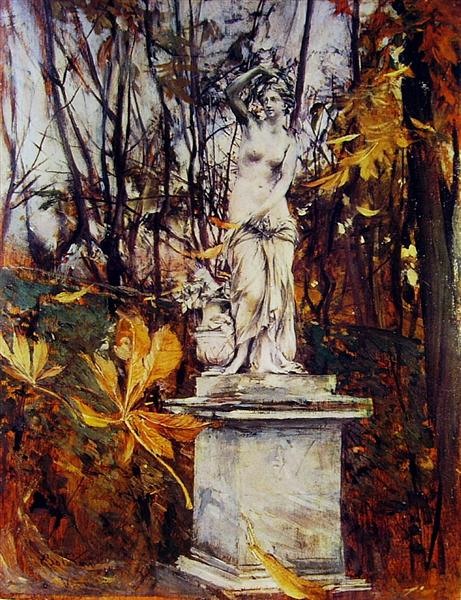
“The Story of Aglauros, transform’d into a Statue” (lV) – Ovid

statue-in-the-park-of-versailles.jpg!Large

       Statue in the Park of Versailles


                   Giovanni Boldini


                             ________


Envy, at the instigation of Minerva,

has flown towards the site of her

commissioned mischief, to hex

Aglauros, who’s miffed her


            When Athens she beheld, for arts renown’d,

            With peace made happy, and with plenty crown’d,


Athens, its glories, architectural,

literary, political, philosophical, would

have been impressive still, despite its

intervening decline, to the mind of a

Roman poet of the later First Century,

compare, say, a contemporary poet’s

evaluation of Great Britain’s grandeur

during its 19th Century supremacy, or

of the United States’ promise before

its late-20th-Century deterioration


            Scarce could the hideous fiend from tears forbear,

            To find out nothing that deserv’d a tear.


Envy, the hideous fiend, was upset

because she couldn’t find anything

to cry about, anything that deserv’d

a tear


            Th’ apartment now she enter’d, where at rest

            Aglauros lay, with gentle sleep opprest.


with gentle sleep opprest seems

to me oxymoronic, conflicting

definitions, how could a gentle

sleep oppress, but let’s continue


            To execute Minerva’s dire command,

            She stroak’d the virgin with her canker’d hand,

            Then prickly thorns into her breast convey’d,

            That stung to madness the devoted maid:

            Her subtle venom still improves the smart,


improves the smart, accentuates

the sudden pain


            Frets in the blood, and festers in the heart.


Frets in, unsettles, the blood, festers,

rots , becomes cankerous, in the heart.


            To make the work more sure, a scene she drew,

            And plac’d before the dreaming virgin’s view

            Her sister’s marriage, and her glorious fate:

            Th’ imaginary bride appears in state;

            The bride-groom with unwonted beauty glows:

            For envy magnifies what-e’er she shows.


Aglauros is not only struck with

subtle venom, but subjected to

psychological manipulation, if

you’ll excuse the reference to

modern analytical methods, is

made to see [h]er sister’s

marriage, Herse‘s, as well as 

her glorious fate


For envy magnifies what-e’er

she shows, an observation

worth remembering


            Full of the dream, Aglauros pin’d away

            In tears all night, in darkness all the day;


the dream, though Envy might’ve

envenomed Aglauros in her sleep,

the unwanted vision continues to

plague her throughout the following

days, and nights


            Consum’d like ice, that just begins to run,

            When feebly smitten by the distant sun;

            Or like unwholsome weeds, that set on fire

            Are slowly wasted, and in smoke expire.


the slow torture in the mind of

rancour there eating away at

the psyche


            Giv’n up to envy (for in ev’ry thought

            The thorns, the venom, and the vision wrought)


The thorns, the venom, and the vision,

all three, wrought, writhing, smouldering,

in ev’ry thought


            Oft did she call on death, as oft decreed,


decreed, resolved


            Rather than see her sister’s wish succeed,

            To tell her awfull father what had past:


her awfull father, Cecrops l, founder

and first king of Athens, according to

myth


awfull, as in inspiring awe, reverence


            At length before the door her self she cast;


the door, of her chamber, where the

God Hermes / Mercury had asked

Aglauros to speak in his favour to

her sister, Herse, whom he had

wanted, if you’ll remember, to woo


cast, set herself up awaiting the

God’s return


            And, sitting on the ground with sullen pride,

            A passage to the love-sick God deny’d.


Aglauros denies the God his wish,

she will not praise him to her sister


            The God caress’d, and for admission pray’d,

            And sooth’d in softest words th’ envenom’d maid.


caress’d, used endearing words


            In vain he sooth’d: “Begone!” the maid replies,

            “Or here I keep my seat, and never rise.”


I’ll stay here till you leave, Aglauros

tells Hermes / Mercury


            “Then keep thy seat for ever,” cries the God,


the impudence of vying with a god

has its consequences


            And touch’d the door, wide op’ning to his rod.


his rod, his caduceus, his winged

staff


            Fain would she rise, and stop him,


Fain,willingly


                                                             but she found

            Her trunk too heavy to forsake the ground;

            Her joynts are all benum’d, her hands are pale,

            And marble now appears in ev’ry nail.

            As when a cancer in the body feeds,

            And gradual death from limb to limb proceeds;

            So does the chilness to each vital parte

            Spread by degrees, and creeps into her heart;

            ‘Till hard’ning ev’ry where, and speechless grown,

            She sits unmov’d, and freezes to a stone.


Aglauros has become of stone,

a statue


            But still her envious hue and sullen mien

            Are in the sedentary figure seen.


still, though Aglauros might’ve been

rendered inanimate, it’s interesting

to note that she’s nevertheless

become immortal, immortalized


see, for instance, above


R ! chard

“The Story of Aglauros, transform’d into a Statue” (lll) – Ovid

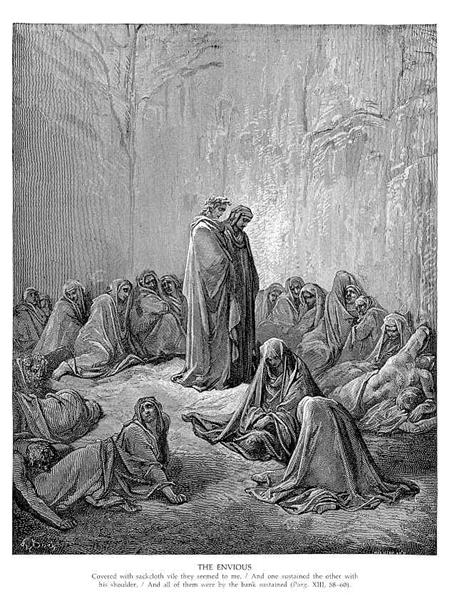
the-envious.jpg!Large

          The Envious


                  Gustave Doré


                             _______


all mythologies have their picture, their

rendition, their evocation of an afterlife,

states of either resignation, in earlier

traditions, perdition or bliss in the later

Christian view, manifest, these latter,

in Dante, his depictions of Hell,

Purgatory, and Heaven in his

Commediaare probably its most

explicit evocations


the Greek and Roman pictures of

their own representative Underworld,

available in Homer, Horace, Virgil,

notably, is less compartmentalized,

less extreme in its divisions, a gloom

pervades, but nowhere fire and

brimstone, nor the diametrically

opposed consolation of archangels

and trumpets, only an unending

sense of desolation, be one worthy

of it or not


limbo comes to mind


but Envy’s realm is actual, not

belated, in the Ancient Greek and

Roman traditions, it is of this world,

present, however horrid, a place

that lurks in the hearts of men, of

people, always, ever, accessible


Dante situates his nexus of Envy in

Purgatory, the afterlife, the nether

world, its Second Circle, of seven,

Wrath, Envy, Pride, Lust, Gluttony,

Greed, Sloth


for Ovid, you can reach Envy’s

dominion, in the nearby mountainous

areas, if only you’ll follow Minerva


the one course is transcendental,

the other, organic, note, physical,

carnate


            Directly to the cave her course she steer’d;

            Against the gates her martial lance she rear’d;

            The gates flew open, and the fiend appear’d.


the fiend, Envy herself


            A pois’nous morsel in her teeth she chew’d,

            And gorg’d the flesh of vipers for her food.


yech


             Minerva loathing turn’d away her eye;


as, incontrovertibly, would I


            The hideous monster, rising heavily,

            Came stalking forward with a sullen pace,

            And left her mangled offals on the place.

            Soon as she saw the goddess gay and bright,

            She fetch’d a groan at such a chearful sight.

            Livid and meagre were her looks, her eye

            In foul distorted glances turn’d awry;

            A hoard of gall her inward parts possess’d,

            And spread a greenness o’er her canker’d breast;

            Her teeth were brown with rust, and from her tongue,

            In dangling drops, the stringy poison hung.

            She never smiles but when the wretched weep,

            Nor lulls her malice with a moment’s sleep,

            Restless in spite: while watchful to destroy,

            She pines and sickens at another’s joy;

            Foe to her self, distressing and distrest,

            She bears her own tormentor in her breast.


the passage, without explication,

speaks for itself, I cede to its

manifest erudition


            The Goddess gave (for she abhorr’d her sight)


her sight, what she was looking

upon

 
            A short command: “To Athens speed thy flight;

            On curst Aglauros try thy utmost art,

            And fix thy rankest venoms in her heart.”


Minerva condemns, curs[es], 

Aglauros


            This said, her spear she push’d against the ground,

            And mounting from it with an active bound,

            Flew off to Heav’n:


Minerva reminds me of my own

generation’s Wonder Woman


meanwhile, the hag, Envy, with

eyes askew


            Look’d up, and mutter’d curses as she flew;

            For sore she fretted, and began to grieve

            At the success which she her self must give.


success, the humiliation of

Aglauros


            Then takes her staff, hung round with wreaths ofthorn,

            And sails along, in a black whirlwind born,


the picture of a witch on a

broomstick shouldn’t

here be unanticipated 


            O’er fields and flow’ry meadows: where she steers

            Her baneful course, a mighty blast appears,

            Mildews and blights; the meadows are defac’d,

            The fields, the flow’rs, and the whole years laidwaste:


the whole years, the yearly crops


            On mortals next, and peopled towns she falls,

            And breathes a burning plague among their walls.


the, not unfamiliar to us, season,

now, of the witch


R ! chard

“The Story of Aglauros, transform’d into a Statue” (ll) – Ovid

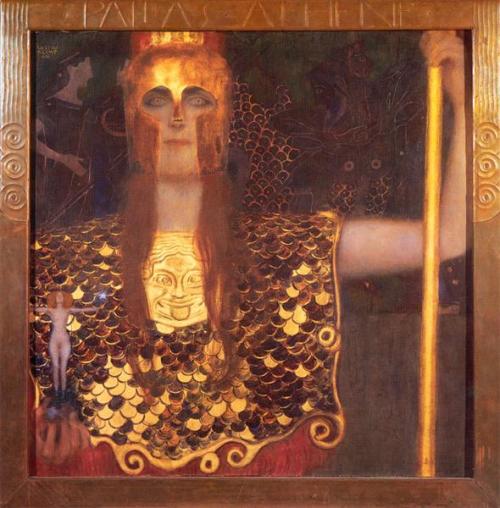
minerva-or-pallas-athena.jpg!Large


        Minerva or Pallas Athena” (1898)


               Gustav Klimt


                      _______


Hermes / Mercury, messenger god,

has spotted Herse, Greek princess,

from on high, the most beautiful

among a procession of shining

virgins and, fir’d, swoops down to

earth, to th’ apartment of the royal

maid, in order to seduce her


             The roof was all with polish’d iv’ry lin’d,

             That richly mix’d, in clouds of tortoise shin’d.


tortoise, tortoiseshell, either the

colour, or the substance itself,

are referenced here, or maybe

even both


             Three rooms, contiguous, in a range were plac’d,


contiguous, one beside the other


             The midmost by the beauteous Herse grac’d;

             Her virgin sisters lodg’d on either side.


Herse, you might remember, had

two sisters, Pandrosos and

Aglauros, daughters of King

Cecrops, they’d seen the child

Ericthonius, half man, half snake,

son of Minerva, who had been

given to them, into their care, 

cradled in a basket, a chest, of

twining osierswhich they were

categorically not to open, but did,

to their great, to their utter, indeed

mythic, chagrin


             Aglauros first th’ approaching God descry’d,


descry’d, witnessed, beheld


             And, as he cross’d her chamber, ask’d his name,

             And what his business was, and whence he came.

             “I come,” reply’d the God, “from Heav’n, to woo

             Your sister, and to make an aunt of you;


however unabashedly be he

forthright


             I am the son and messenger of Jove;

             My name is Mercury, my bus’ness love;

             Do you, kind damsel, take a lover’s part,

             And gain admittance to your sister’s heart.”


take a lover’s part, Mercury entreats,

be of help, he asks Aglauros, in this

amorous adventure, strategize a path,

gain admittance for me, to your sister’s

heart, to her serene acquiescence


             She star’d him in the face with looks amaz’d,
             As when she on Minerva’s secret gaz’d,


Minerva’s secret, her babe,

Ericthonius, half man, half snake,

whom Aglauros had earlier,

however treacherously, beheld


             And asks a mighty treasure for her hire;


sure, says Aglauros, I’ll help, but

what will you give me in return

for my service, my hire


             And, ’till he brings it, makes the God retire.


Aglauros will not assist till she

receives the mighty treasure she

requests for her hire


             Minerva griev’d to see the nymph succeed;


Minerva, is not happy to see Aglauros

get anything at all because of her

earlier indiscretion, disobediently

uncovering Ericthonius, the

goddess’ son


             And now remembring the late impious deed,

             When, disobedient to her strict command,

             She touch’d the chest with an unhallow’d hand;

             In big-swoln sighs her inward rage express’d,

             That heav’d the rising Aegis on her breast;


Aegis, the shield that Minerva wore,

fashioned by the Cyclopes, brothers,

one-eyed giants, in the workplace of

Hephaestus, god of Craftsmen, Fire,

Metallurgy, it bore the Gorgoneion,

the head of Medusa, which would

turn one to stone when looked upon


see above


             Then sought out Envy in her dark abode,

             Defil’d with ropy gore and clots of blood:

             Shut from the winds, and from the wholesome skies,

             In a deep vale the gloomy dungeon lies,

             Dismal and cold, where not a beam of light

             Invades the winter, or disturbs the night.


Envy, its personification, is a goddess

here, though the representative of

Envy is usually considered to be

Phthonus, a male deity


next stop, Envy’s dark abode


stay tuned


R ! chard


“The Story of Aglauros, transform’d into a Statue” – Ovid

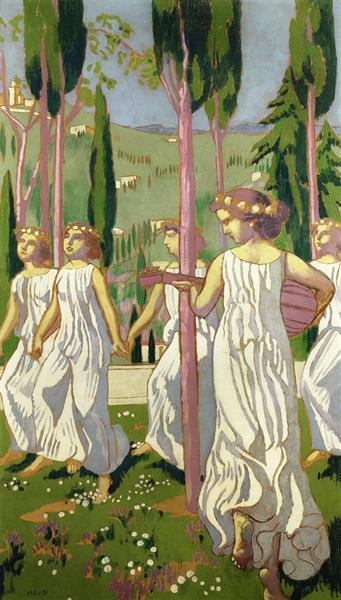
the-dancers-also-known-as-eternal-summer-wiesbaden.jpg!Large


      The Dancers” (c.1905)


               Maurice Denis


                          ________


            This done, the God flew up on high,


This done, Hermes, the God, had just

turned Battus to a Touch stone


                                                          and pass’d

            O’er lofty Athens, by Minerva grac’d,


Minerva, the Latin version of Athena,

was patroness of Athens, grac’d,

indeed, by the very Parthenon, then,

and still now, her temple


            And wide Munichia, whilst his eyes survey

            All the vast region that beneath him lay.


Munichia, the ancient name for a steep

hill, now called Kastella, in Piraeus, the

port of Athens


            ‘Twas now the feast, when each Athenian maid

            Her yearly homage to Minerva paid;


let me point out that during the period

when pantheism prevailed, which is to

say anything earlier than the Emperor

Constantine, 272 – 337 AD, who

established Christianity as the official

religion of the Roman Empire, and going

back to the very beginnings of recorded

history, but at the very least to the epics

of Homer, his Iliad, his Odysseythe 8th

Century BC, which tell of the Trojan War

and its aftermath, from the even more

distant 12th Century BC, homage was

paid, around the Mediterranean, to gods

and goddesses of Olympus, temples

were built, rituals performed in their

honour, much as in the Christian Era,

believers attend church, build cathedrals

to their preferred deity, feasts to Minerva

were as fervent then, in other words, as,

later, were those of devotees to their own

Christmas and Easter, say, celebrations


            In canisters, with garlands cover’d o’er,

            High on their heads, their mystick gifts they bore:

            And now, returning in a solemn train,

            The troop of shining virgins fill’d the plain.


see above


            The God well pleas’d beheld the pompous show,


The God, Hermes still


            And saw the bright procession pass below;

            Then veer’d about, and took a wheeling flight,

            And hover’d o’er them: as the spreading kite,


kitea bird of prey


            That smells the slaughter’d victim from on high,

            Flies at a distance, if the priests are nigh,

            And sails around, and keeps it in her eye:


her eye, the kite is given the feminine

gender here, perhaps following upon

the original Latin word’s grammar


            So kept the God the virgin quire in view,

            And in slow winding circles round them flew.


quire, archaic spelling of choir, a

group of instrumentalists or singers


            As Lucifer excells the meanest star,

            Or, as the full-orb’d Phoebe, Lucifer;


Lucifer, the Morning Star, the planet

Venus, as it appears in the East

before sunrise


Phoebe, pre-Olympian goddess

representative of the moon, thus

in the verse above the very moon


            So much did Herse all the rest outvy,

            And gave a grace to the solemnity.


Herse, a Greek princess


outvy, outvie, to surpass


            Hermes was fir’d, as in the clouds he hung:


fir’d, inflamed, aroused, thus

flung as would be a missile,

the word fir’d here shimmers

with both meanings


            So the cold bullet, that with fury slung

            From Balearick engines mounts on high,

            Glows in the whirl, and burns along the sky.


Balearick engines, slingshots,

the people of the Balearic Islands,

off the coast of Spain, were famous

in ancient times for their use of the

slingshot, or sling, especially as a

weapon


            At length he pitch’d upon the ground, and show’d

            The form divine, the features of a God.

            He knew their vertue o’er a female heart,


their vertue, the virtues of both [t]he

form divine and the features of a

God, however be these identical,

allow grammatically for the

possessive adjective their to be

used here


            And yet he strives to better them by art.


Hermes would rather seduce with

art, which is to say with charm 

and artistry, than by his august

credentials merely


            He hangs his mantle loose, and sets to show

            The golden edging on the seam below;

            Adjusts his flowing curls, and in his hand

            Waves, with an air, the sleep-procuring wand;

            The glitt’ring sandals to his feet applies,

            And to each heel the well-trim’d pinion ties.


pinion, the outer part of a bird’s wing,

including the flight feathers, which

Hermes applies to his sandals


            His ornaments with nicest art display’d,

            He seeks th’ apartment of the royal maid.


to be continued


R ! chard

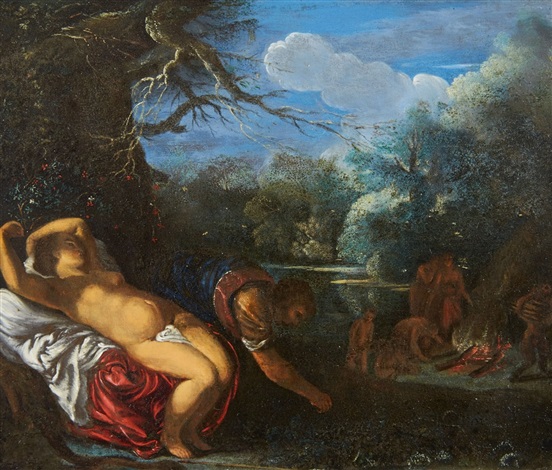
“The Story of Coronis, and Birth of Aesculapius” (IV) – Ovid

adam-elsheimer-apollo-and-coronis-2

   “Apollo and Coronis (1606 – 1608)


                Adam Elsheimer


                   __________


               On her incestuous life I need not dwell 
               (In Lesbos still the horrid tale they tell), 
               And of her dire amours you must have heard, 
               For which she now does penance in a bird, 
               That conscious of her shame, avoids the light, 
               And loves the gloomy cov’ring of the night; 
               The birds, where-e’er she flutters, scare away 
               The hooting wretch, and drive her from the day.” 


Nyctimene, daughter of Epopeus

king of Lesbos, a Greek Island in

the Aegean Sea, had been defiled 

by her father, Minerva, out of pity,

transformed her into an owl, the

above verses tell the story of

that owl, Nyctimene


               The raven, urg’d by such impertinence, 
               Grew passionate, it seems, and took offence, 
               And curst the harmless daw; the daw withdrew: 
               The raven to her injur’d patron flew, 
               And found him out, and told the fatal truth 
               Of false Coronis and the favour’d youth. 


the raven, Apollo’s own bird, having 

discovered Coronis to be unfaithful 

to their master, its and hers, remained

intentdespite the daw’s warnings,

earlier here reported, on informing

the god of the Sun 


               The God was wroth, the colour left his look, 


wroth, angry


               The wreath his head, the harp his hand forsook: 


[t]he wreath, … the harp, Apollo’s

usual attributes, symbols of his

harmony, concord


               His silver bow and feather’d shafts he took, 
               And lodg’d an arrow in the tender breast, 
               That had so often to his own been prest. 


though Apollo is not usually 

associated with bows and arrows,

his twin sister Diana, goddess of

the Hunt, always is, it would not 

be unusual to conflate the two 

deities for poetic, or indeed

mythological, purposes


               Down fell the wounded nymph, and sadly groan’d, 
               And pull’d his arrow reeking from the wound; 
               And weltring in her blood, thus faintly cry’d, 
               “Ah cruel God! tho’ I have justly dy’d, 
               What has, alas! my unborn infant done, 
               That he should fall, and two expire in one?” 
               This said, in agonies she fetch’d her breath. 


it is supposed here that the unborn

infant is indeed Apollo’s


               The God dissolves in pity at her death;

               He hates the bird that made her falshood known, 
               And hates himself for what himself had done; 
               The feather’d shaft, that sent her to the Fates, 
               And his own hand, that sent the shaft, he hates.


Apollo is suffused with regret, anger,

self-recrimination


               Fain would he heal the wound, and ease her pain, 


Fain, with pleasure, gladly


               And tries the compass of his art in vain. 


the compass of his art, the range 

of his ability, in this case vain, 

faulty, ineffective


               Soon as he saw the lovely nymph expire, 
               The pile made ready, and the kindling fire. 


pile, pyre


the sentence lacks a verb here, it 

should read The pile was made 

ready, just saying


               With sighs and groans her obsequies he kept, 


obsequies, funeral rites


               And, if a God could weep, the God had wept. 


I’ll have to watch out for gods

weeping, I suspect some have, 

some can


               Her corps he kiss’d, and heav’nly incense brought, 
               And solemniz’d the death himself had wrought. 


corps, body, corpse


wrought, brought about, made

happen


               But lest his offspring should her fate partake, 
               Spight of th’ immortal mixture in his make, 


Spight, in spite 


               He ript her womb, and set the child at large, 
               And gave him to the centaur Chiron’s charge: 


Chiron, first among the centaurs,  

half man, half horse, was highly 

revered as a teacher, having 

been raised by the twins, Apollo 

and Diana / Artemis, supremely

accomplished deities


               Then in his fury black’d the raven o’er, 
               And bid him prate in his white plumes no more. 


black’d, Apollo turned the snowy 

plume[d], [w]hite as the whitest 

dove’s unsully’d breast raven 

black


prate, babble, talk incoherently


R ! chard


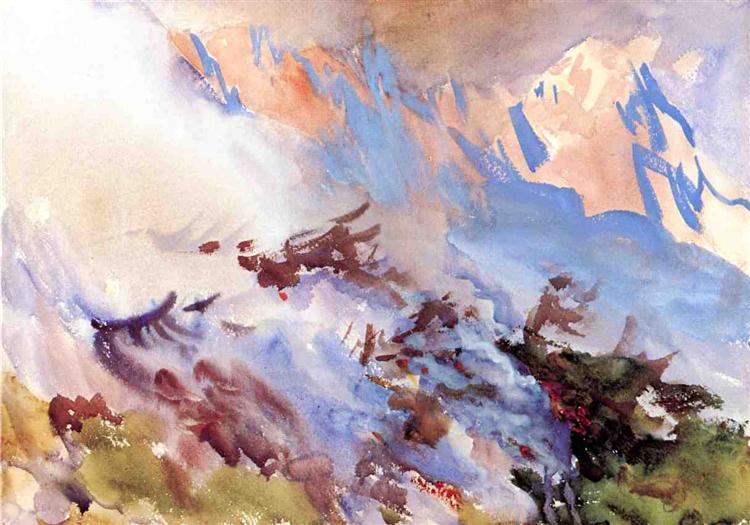
The Story of Phaeton (VI) – Ovid

mountain-fire.jpg!Large

    Mountain Fire (c.1903 – c.1908)


              John Singer Sargent


                       _________


because Phaeton was light, nor cou’d 

he fill the seat, the horses he would’ve

controlled forsake / Their stated course, 

and leave the beaten track


                What cou’d he do? his eyes, if backward cast,
                Find a long path he had already past;
                If forward, still a longer path they find:
                Both he compares, and measures in his mind;
                And sometimes casts an eye upon the east,
                And sometimes looks on the forbidden west, 


note the description of the movement 

of the eyes, backward, forward, east

and west, uncontrolled, erratic, nearing 

madness, despite attempts, however 

futile, to remain rational, steady, his 

very mind, comparing, measuring, is 

quickly losing its bearings


forbidden, once again, this should 

probably read forbidding


                The horses’ names he knew not in the fright,
                Nor wou’d he loose the reins, nor cou’d he hold ’em right. 


“Now, Dasher! Now, Dancer! Now, 

Prancer, and Vixen! / “On, Comet! 

On, Cupid! On, Donner and Blitzen!,

who drove another of the very few 

famous chariots in our Western 

cultural history


couldn’t help it


the only other one I could think of 

is that of the Four Horsemen of 

the Apocalypse, red, white, black, 

and pale horses, which I won’t get 

into, but to say that they have no 

names


the horses who drove the Chariot of

the Sun, meanwhile, were called

Phlegon, Aeos, Aethon, and Pyrios, 

though I fully admit that I had to 

look those up, then again I’ve never 

had to ride the Chariot of the Sun


it appears that Helios / Phoebus / 

Apollo had other steeds in his stable 

as well, for a rainy day, but they don’t 

feature in this particular story


                Now all the horrors of the Heav’ns he spies,
                And monstrous shadows of prodigious size,
                That, deck’d with stars, lye scatter’d o’er the skies. 


lye, lie


                There is a place above, where Scorpio bent
                In tail and arms surrounds a vast extent; 


Scorpio, the constellation Scorpius

visible only in the Southern hemisphere


Scorpio, represented by a scorpion,

thus has eight legs, or arms, and a 

highly distinctive tail


                In a wide circuit of the Heav’ns he shines,
                And fills the space of two coelestial signs. 


coelestial, celestial


                Soon as the youth beheld him vex’d with heat
                Brandish his sting, and in his poison sweat,
                Half dead with sudden fear he dropt the reins; 


vex’d with heat, from the wayward 

chariot, Scorpio [b]randish[es]

his sting


poison sweat, Scorpio, under the 

influence of the heat, sweat[s],

exudes, produces, characteristically, 

poison


                The horses felt ’em loose upon their mains, 


mains, manes, long hair


                And, flying out through all the plains above,
                Ran uncontroul’d where-e’re their fury drove;
                Rush’d on the stars, and through a pathless way
                Of unknown regions hurry’d on the day. 


hurry’d on the day, kept the day going

at its usual, however presently pathless, 

or uncharted, pace


                And now above, and now below they flew,
                And near the Earth the burning chariot drew. 


ever, and increasingly, ominously

                The clouds disperse in fumes, the wond’ring Moon
                Beholds her brother’s steeds beneath her own; 


wond’ring, confused, puzzled


Brother Sun, Sister Moon


                The highlands smoak, cleft by the piercing rays,
                Or, clad with woods, in their own fewel blaze. 


smoak, smoke


fewel, fuel


where the highlands are clad with 

woods, they blaze in the fires 

consuming their own trees


                Next o’er the plains, where ripen’d harvests grow,
                The running conflagration spreads below.
                But these are trivial ills: whole cities burn,
                And peopled kingdoms into ashes turn. 


an apocalypse

                The mountains kindle as the car draws near, 


the car, the chariot


                Athos and Tmolus red with fires appear; 


Athos, Mount Athos, Tmolus, Mount

Tmolus, both mountains in Greece,

both named after mountain gods


                Oeagrian Haemus (then a single name) 


Haemus Mons, an early name for 

the Balkan Mountains


Oeagria, Agria, a town in Greece


                And virgin Helicon increase the flame; 


Helicon, Mount Helicon, notable for

being the home of the Muses


                Taurus and Oete glare amid the sky, 


Taurus, the Taurus Mountains, a 

mountain range in southern Turkey 


Oete, Mount Oeta, a mountain in

Central Greece


                And Ida, spight of all her fountains, dry.
                Eryx and Othrys, and Cithaeron, glow,
                And Rhodope, no longer cloath’d in snow;
                High Pindus, Mimas, and Parnassus, sweat,
                And Aetna rages with redoubled heat. 


spight, in spite

Ida, Eryx, Othrys, CithaeronRhodope

Pindus, and the more familiar Parnassus

and Aetna, or Etna, are all mountains, or 

ranges, in the Mediterranean, Mimas, an 

island there, which is to say, a partially 

submerged mountain, all of them

sweltering


see above


                Ev’n Scythia, through her hoary regions warm’d, 


Scythia, a region northeast of Ancient 

Greece, barbarian to the more cultured 

people of Greek Antiquity, coarse 

forebears of the Cossacks 


hoary, sullied white, tired, withered 


                In vain with all her native frost was arm’d. 


even so frosty a region as Scythia

was not immune to, arm’d against, 

the running conflagration


                Cover’d with flames the tow’ring Appennine,
                And Caucasus, and proud Olympus, shine;
                And, where the long-extended Alpes aspire,
                Now stands a huge continu’d range of fire. 


the AppennineCaucasusOlympus

and Alpes, or Alps, are all mountain 

ranges throughout Europe, the 

representative part then of the 

known world


               Th’ astonisht youth, where-e’er his eyes cou’d turn,
                Beheld the universe around him burn:
                The world was in a blaze; nor cou’d he bear
                The sultry vapours and the scorching air,
                Which from below, as from a furnace, flow’d;
                And now the axle-tree beneath him glow’d:
                Lost in the whirling clouds that round him broke,
                And white with ashes, hov’ring in the smoke.
                He flew where-e’er the horses drove, nor knew
                Whither the horses drove, or where he flew. 


R ! chard


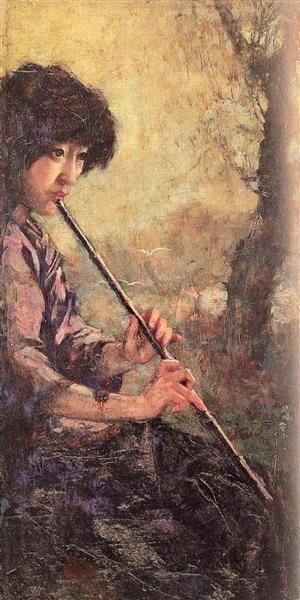
on Beethoven’s Symphony no. 6, the “Pastorale”

the-sound-of-the-flute.jpg!Large

      The Sound of the Flute 


               Xu Beihong


                 ________


                                    for Susan, who urges

                                               me ever to write


a friend wrote recently, extolling a

performance of Beethoven’s Sixth

Symphony he’d just seen, a 

noteworthy conductor conducting 


then again, how can you go wrong, 

I wrote back, with that already 

enchanting music, sent him, in

return, a version I’d ferreted out,

tried out for him, had been duly

enchanted, had laughed, had cried, 

taken shelter from the storm, come 

out the other side transported, again  


I wondered about the power of music, 

during my intermittent musings

throughout the variegated movements, 

as the peregrinations ambled on along 

their own magical explorations, long 

irrepressible arpeggios running up or 

down the scales, performing 

arabesques at their peaks, rumbling 

tremolos at their grumbling bottoms, 

before returning to the more stable 

middle ground of the melody


where, wondered, does it all find its 

source


sounds, individual sounds, would 

have been signals of danger, 

originally, a single note from a horn

warning of strangers on the way to

a community of otherwise peaceful

cohabitants if not only family, twig 

cracking in the forest when you 

believe you’re all alone


individual sounds would’ve picked

up meaning beyond their own pitch

and volume, resonance, reverberation,

rotundity, through Darwinian, even, 

time


a mother’s voice, for instance, 

identified immediately, upon a single

note, perenially, by any of her brood


it’s a long way from there to a symphony

but those are its roots, why we laugh, why

we cry, take shelter from the storm, and 

come out the other side transported


notes are written, emblazoned, on 

our consciousness, our lives depended,

depend still, on it 


listen


R ! chard


psst: interestingly, our Darwinian evolution

          has produced pitch as an identifying

          factor for our species, a female voice 

          is higher than a male’s, this has 

          allowed us, as a species, to sing

a juxtaposition of verb moods


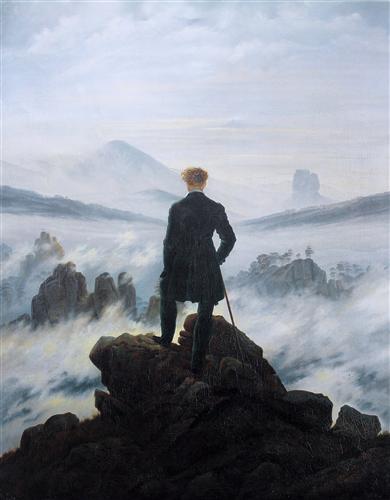
       the-wanderer-above-the-sea-of-fog.jpg!Blog.jpg

           The Wanderer above a Sea of Fog (1818) 


                   Caspar David Friedrich


                         _______________


a cardinal rule, the juxtaposition of two 

things of the same sort will exponentially

increase the information gleaned of either


therefore the following


The Impossible Dream“, listen 


       To dream the impossible dream

       To fight the unbeatable foe

       To bear with unbearable sorrow

       To run where the brave dare not go


       To right the unrightable wrong

       To love pure and chaste from afar

       To try when your arms are too weary

       To reach the unreachable star


       This is my quest, to follow that star

       No matter how hopeless, no matter how far

       To fight for the right

       Without question or pause

       To be willing to march

       Into hell for a heavenly cause


        And I know if I’ll only be true

       To this glorious quest

        That my heart will lay peaceful and calm

        When I’m laid to my rest


        And the world will be better for this

        That one man scorned and covered with scars

         Still strove  with his last ounce of courage

         To fight the unbeatable foe

         To reach the unreachable star


and Climb Every Mountain, listen again


        Climb every mountain

        Search high and low

        Follow every byway

        Every path you know


        Climb every mountain

        Ford every stream

        Follow every rainbow

        ‘Till you find your dream


        A dream that will need  

        All the love you can give

        Every day of your life

        For as long as you live


        Climb every mountain

        Ford every stream

        Follow every rainbow

        ‘Till you find your dream


        Climb every mountain

        Ford every stream

        Follow every rainbow

        ‘Till you find your dream


an initial similarity, they are both

inspirational


an initial divergence, the former is 

in the infinitive mood, which is to 

say that the lesson is for all time

in all places and for all people, 

while the second is an imperative,

in other words, an exhortation,

something only pertaining to the 

future, though the other conditions,

of place, and of person, can still 

apply  


note that the verse, in either, is in 

the indicative, in keeping with, in

each, the altered air, the second,

and contrasting melody, which in

both, note, personalizes, makes

the recommendation actual, no

longer merely idealized, the

indicative is the only mood which

deals in facts, the other moods

are all imagined, dreamed


let me point out that in comparison

with songs in the indicative, love

songs and the like, the show tunes

above find their source in medieval

religious music, hymns, liturgical

stuff, and more recently,

comparatively, specifically in

England after the Protestant

Reformation with Handel’s both

church and ceremonial music


in which England went on to

specialize, incidentally, while other

forms of music there, the racier,

secular European stuff, had been

demonized, deemed sinful, and

thus proscribed


England would only get its mojo back

in the 1960s with the Beatles


R ! chard


the indicative

grammar.jpg!Large

        Grammar 


              Gentile da Fabriano


                          ____________


since I’d only recently vaunted both the 

infinitive and the imperative moods of 

verbs in this venue, you might’ve 

expected that the indicative would 

soon follow


and here it is, the indicative, the mood 

of narratives, storytelling, the default 

mode, essentially, where most of our 

communication takes place, be it

oral or written


famous first lines of novels will attest

to that, lines you’ve probably heard 

before, however only incidentally, if 

not actually read


        It was the best of times, it was the worst of times,


from Charles Dickens’ A Tale of Two Cities


and the rest is so good, I can’t, in all 

consciousness, exclude it


        it was the age of wisdom, it was the age of foolishness, it was 

        the epoch of belief, it was the epoch of incredulity, it was the 

        season of light, it was the season of darkness, it was the 

        spring of hope, it was the winter of despair. 


or


        Last night I dreamt I went to Manderley again. 


from Daphne du Maurier’s eerily Gothic 

Rebecca“, heiress to not only Charlotte 

Brontë’s Jane Eyre“, but also to her 

sister Emily’s, to my mind, much more 

accomplished work, Wuthering“, and 

indeed wonderful, Heights“, whereupon 

I’ll refrain from continuing to follow the

sentences, however compelling, for 

lack of space and time


but


        I had a farm in Africa, at the foot of the Ngong Hills.


from Out of Africa“, Karen Blixen’s

unforgettable novel, however brilliantly

translated to film, must take its place

here among towering introductory

sallies 


       Longtemps, je me suis couché de bonne heure. 


Proust’s answer to Homer, his “À la 

recherche du temps perdu“, his

Remembrance of Things Past  


      For a long time, I’d go to bed early.


which, as I read on, no less than

changed my life 


but that’s another story, however

totally engrossing


everywhere above, let me point out, 

the mood has been indicative, to a 

very verb, so unobtrusive you 

probably didn’t even notice 


in music, a counterpart for the 

indicative would be the allegro, 

the baseline, not too fast, not 

too slow, the tempo listeners 

would most easily respond to


but more about that only later, after

a traipse through the speculative 

conditional, then  the aspirational 

subjunctive


meanwhile, check this out, The

Heart of the Matter“, the Eagles, a

ballad, mostly indicatives, but with

here and there an infinitive, and a

peppering of conditionals, however

might these be signal, to utterly break 

your heart


listen


R ! chard