Stefan Lochner

Stefan Lochner
(1400-1452)
“Madonna in the Rose Bower”
__________
for Christmas
I wish you faith in angels
Richard
________________________
__________
________________________

“Morning star”, 1940
Joan Miró
_____________
to prize Abstraction you need to feel its value, somehow make it relevant to your well-being, your soul, not an easy task for someone who hasn’t grown up with it, I see the same thing ‘s happened for instance for many with computers, the language is entirely foreign
I remember a sigh of relief, and unexpectedly delight, at the Queen Sofia after slogging through the history of art for a couple of weeks across the street at the Prado, before a roomful of Mirós
the Prado had been dripping in art
the Spaniards of course, Murillo, Goya, Zurbaran, were there, El Greco, the transplanted Doménicos Theotokópoulos, his great elongated figures depicting anguish, torment, ecstasies, edged unforgettably in charcoal black
the cheeky Velazquez – looking you straight in the face, where his subjects, the king and queen, also stand, reflected craftily albeit in a mirror at the back where you’d be too were this a real mirror – is a celebrated self-portrait, majesties no less have acquiesced to be merely backdrop here for the artist’s rendering of himself
and indeed who remembers these once almighty monarchs beside their now immortal subject, their lasting fame assured ironically by virtue mostly of his grace
royal children meanwhile cavort up front, while on the far left taking up most of that side there’s the canvas he’s working on, a brush in one hand, in the other a palette of assorted colours, considering their applicability
a triumph
the Dutch were there, the ubiquitous Rubens of course, the Rembrandts, the van Dycks, the Bruegels, but supreme for me among them was the unearthly rather “Garden of Earthly Delights“, I didn’t expect it there, it was awesome, Bosch representing pictorially the panoply of Christian mythological thought, from Eden to black and ignominious hell through, in the middle triptych, our earth, controversially carnal and cavorting, in pink and azure blue, for our sober edification and delight
and still there were the innumerable, the masterful, Italians
we left the Prado saturated, my mom and I, the Queen Sofia was an afterthought with time left on our hands, we expected nothing other there than baubles, trinkets
but Miró greeted us at the door with a roomful of light, air, fantasy, planets, comets, asterisks swirled in orbits of infinite phantasmagorical invention, fish flew where stars fell, and eyes looked out of spiderwebs, perspective gave way to dimensions
my mom breathed a sigh of relief, simultaneously enchantment, we’d entered another world
just as had in its own time, for that matter, the history itself of art
from there it was just a hop, skip and jump of course to the more abstruse maybe even abstractions of for instance even a Jackson Pollock
imagine
yours in the discovery of art richibi
psst: in thinking of Miró I was reminded of Chagall, he could be he for whimsy, I recalled an ekphrastic poem about a painting of his I thought I might’ve lost, all I could remember was the poem’s own mimetic whimsy, and a blue, I’d thought, violin
here it is
by Lawrence Ferlinghetti
Don’t let that horse
Don’t let that horse
eat that violin
cried Chagall’s mother
But he kept right on painting
And became famous
And kept on painting
The Horse with Vilolin in Mouth
And when he finally finished it
he jumped up upon the horse
and rode away
waving the violin
And then with a low bow gave it
to the first naked nude he ran across
And there were no strings attached
____________________________________

“Identical Twins, Roselle, N.J.“, 1967
Diane Arbus
1923 -1971
_______
with the camera the shutter becomes the brush, the art only a click away, the artistry, the creativity, debatable
where is the skill, the ingenuity, indeed the art
the snapshot is a picture of an imagination taken on the spot, the art must be in the very brain, not in, as one would expect, the dextrous fingers, the articulation, the prestidigitation, must be already sorted out, already calibrated, technical prowess not required, just able, artful observation
the shutter will do the rest
can a point of view then, a take, one will reasonably inquire, be art
Diane Arbus had been a fashion photographer, gave it up for something, it would appear, more meaningful, became thereby, in my estimation, unforgettable, broke down for me reservations about photography as art
witness
“Identical Twins, Roselle, N.J.“, 1967, is not about these twins, these unexceptional twins – otherwise merely a portrait, an indifferent even portrait – but about something much more relevant
two little girls in black and white – though this may be itself the kind of photography – look straight into the camera, you look to tell them apart
their little dress adorned by each the same white ruffle at the collar, recalling incidentally the Reformation Dutch, a witty touch, give no clue, they could be matching dolls, flat cut-outs, for that matter, given the minimal use of perspective
a matching hair band, the same hair, the same nose, the same mouth, don’t either, the eyes do but only just
they tell though the entire story, their different light, their different incandescence, though even ever so slight, though ever even so elusive, is what finally tells them apart
but the focus has switched, you’re observing something now immaterial, incorporeal, insubstantial, become simultaneously something mystical, metaphysical, transcendental, some might call God
Michelangelo’s did the same thing for Adam, another much wittier art history touch
two other girls, “Untitled“, 1970-71, speak even more clearly perhaps about this
note the angel come through in the girl on the left, in all its magnificent splendour

“Untitled“, 1970-71
Diane Arbus
1923 -1971
_______
Diane Arbus committed suicide on July 26, 1971, undoubtedly undone by what she’d sought to witness, perhaps the too bright light
psst: why is it that those who are “Untitled” would never think of taking their own life, perhaps they’ve been blessed with an extra measure of courage
_________________________________________________
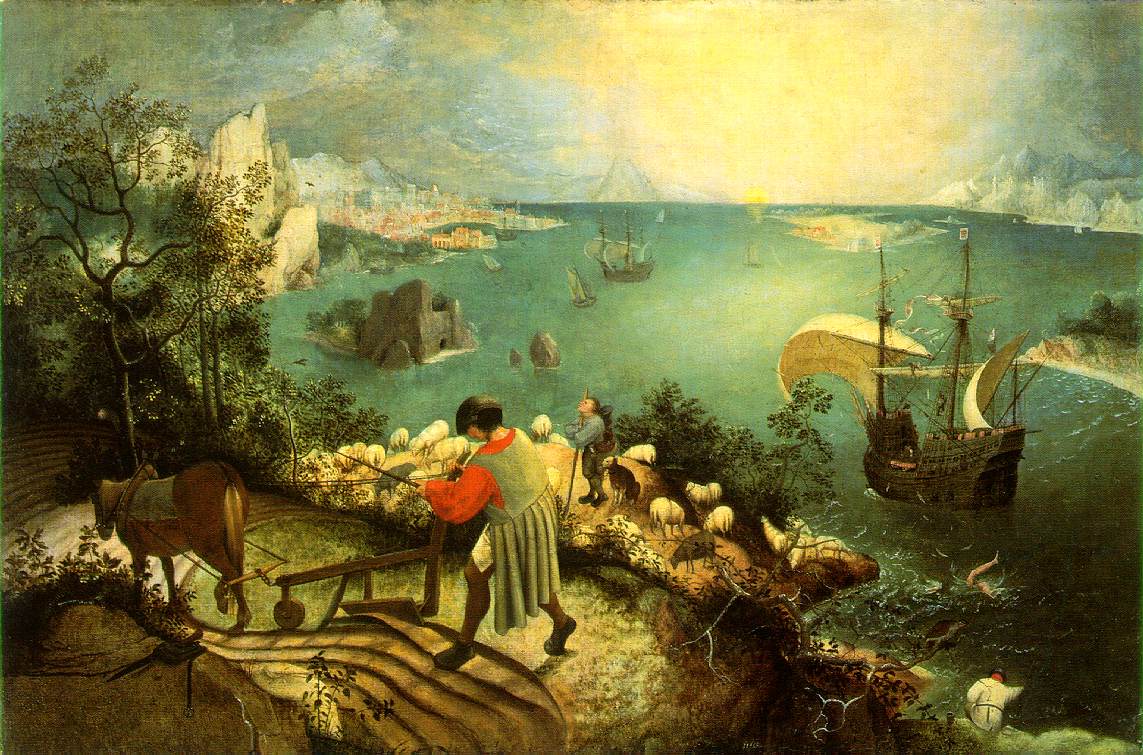
“Landscape with the Fall of Icarus”, c.1558
Pieter Bruegel, the Elder
(1525-1569)
__________
upon being asked to make a poem out of Pieter Bruegel the Elder’s “Landscape with the Fall of Icarus”
what is a poem, the question came up around my earlier errant composition, was what I’d written a poem, though one could be made out between the, dare I say, ivied even cracks
something that rhymes, my mom answered when I asked, which mine of course didn’t
though mellifluous and rhythmic maybe, and peppered here and there with inventive and artful devices – metaphors, alliteration, onomatopeia, the like, the meat and potatoes, the very stuff, I think, of poems – I still didn’t rhyme, don’t rhyme, and run a sentence on mostly much too long for a proper pentameter
like, I guess, a prose poem
or maybe even just prose
but about the Bruegel
at the back a radiant sun dominates the picture, sheds not only light but life on everything, the sky is thick with grays and blue and takes on actual dimension, whereas a more silken application of paint to the sun makes that orb evanescent, a portal into heaven, a source instead of a force, an opening instead of an engine
in the foreground a farmer ploughs his field, another tends his sheep, life is going on despite the splendour
no one notices Icarus either, the flailing figure in the waves, bottom right, drowning, despite the might of the myth, the potency, the poignancy, of the poetry
but who notices even poetry
across a stretch of water to the horizon and to at its edge the resplendent sun, ships with sails, indeed medieval galleons, sit in the placid harbour of a city in the blue crook of, upper left, a range of mountains, the City of God of Augustine maybe for its iridescent pastels, for its sunlit gold maybe the gilded Greek Atlantis
above the flailing Icarus a ship is setting joyful sail out towards the promise of the blazing sun, the way seems clear
there will be other, it appears, Icaruses
medieval caricaturization and perspective inextricably of course obtain throughout
__________________________________________
ekphrasis
poring among the possibilities the nearby university had to offer – they’re listed in a catalogue they seasonally send around – one on poetry, of course, how to make one out of a painting, stood out, how to make of something visual, a Monet, a Van Gogh, a Renoir, a poem
ekphrasis, there’s a word for that, I thought
and ate it up
the picture I got to ekphrase, my word for that, was one of a set the teacher sent around of Kobayashis, snapshots, I’d never heard of him, her, either, Milt Kobayashi, all of them intriguing
I quickly snapped one up, letting my instinct instead of my judgment pick it out – I find it’s usually more accurate – in order to keep the ball rolling, not slow things up
a waif in especially blue, the colour also of chairs behind her – like skies in winter, I thought, when the pressure’s up and the light is pale, colours aren’t crisp but muted – making that sort of association, hoping that wouldn’t be unintelligent
rudimentary roses, wine red, spotted here and there her blue skirt, more like patches than ornamental flowers, a black top the colour of her jet black hair was cut low in a U at her neck, she leaned against a wall, itself nondescript, at the right of the picture, her left, far to that side, and in her own black shadow there splashed upon the wall, a fathomless apparently abyss, seemed to find refuge, a respite, like a womb, pushing herself and it nearly right out of the picture
her arms were crossed, but one reached for her shoulder, lightly resting there, covering inadvertently, or not, her chest, and by my inference her soul, her modesty, her bosom, whereupon, like Michelangelo’s God touched Adam, with love, light and understanding, inadvertently again or not, she touched mine
and her black, plaintive eyes were looking right back
there’s next to nothing on the spartan walls, the table is somewhat set, but light reflected off some glasses there, and dishes, is gleaming, like in Dutch still lifes, artfully, and delightfully
“The Last Table” it’s called, though I’m not too sure what that’s about, a waitress calling it a day, a playful reference somehow to da Vinci’s “The Last Supper” maybe
that’s what I’d have to make into a poem, ekphrase
_____________________________________________

Girl Reading a Letter at an Open Window, 1657
Johannes Vermeer
(1632-1675)
______________________________________

“View of Dresden from the Right Bank of the Elbe with Augustus Bridge”
(1748)
_________________________________
these earlier “back tracks“, of which the following is one example, are pieces I consider still to be worth your while
_______________________


Sistine Madonna, c.1512-1514
Raphael
(1483-1520)
_______________________
in my search for what is beautiful, in my unending, my unyielding quest for the sublime, I’ve come upon many things that ‘ve been awesome, before the Venus de Milo I trembled, stood silent, reverent before her incandescent aura, in consternation before her shimmering grace, marvelled that time alone, I supposed, and magnificence could so irradiate, create actual energy
in Dresden the Sistine Madonna did the same, the only other work ever to so palpably illuminate
during the late Beethoven string quartets I cried, especially the fourteenth, but who wouldn’t, they are masterpieces
on first looking into Homer I confirmed indeed the promise of Keats, nearly subscribed to the gods of Olympus, would’ve converted to their convincing myths, but Proust finally remains my true religion, the reflection of all I believe, the poet aspiring to be a philosopher, the philosopher aspiring to be a poet, where Truth and Beauty inextricably intermix, interweave and inspire
for a while I had my doubts, art, music, literature seemed seductive enough, even important, but not urgent, not necessary, there would be life without art, I rued, but hadn’t been able to pursue it further
then in a revelation someone somewhere said, without art there would be no civilization, and I regained forthwith my faith
earnestly I’ve returned to its service
yours in art richibi
_______________________________
 Richibi's Weblog