Richibi’s Weblog

Just another WordPress.com weblog

Category: paintings to ponder

“The Tulip Folly” – Jean-Léon Gérôme‏

The Tulip Folly - Jean-Leon Gerome           
                            
                                                    The Tulip Folly” (1882)
 
                                                         Jean-Léon Gérôme
 
                                                          _______________ 
 
 
between the twin authorities of steeple and sworded 
supervisor bristles a field of obedient but effervescent  
flowers, transcending in their full and radiant bloom
their even regimented quadrangles with poetry and
multicolored enchantment in the very face of
overwhelming but presumptuous power, pointing to
the supremely existential act of just artfully being 
 
I am as well a flower
 
 
Richard
 
 
                   _______________________________


the dutch were so into tulips there was a depression caused when the value of tulips fell and they were developing the black tulip and all the breeding bulb secrets were highly guarded thus the importance of having guards literally doing the picking of the flowers so no bulbs could be snatched by others..good find Richard
Neil


Debussy’s “Études”

 Man with a Guitar - Georges Braque
 
                    Man with a Guitar (1914)
 
                               Georges Braque 
 
                                       ______
 
 
while we’re on the subject of études, listening to 
hundred years later, 1830s to 1915, would prove
instructive, I deemed 
 
picture me deeming, August 3, 2012, my brow
just slightly pensively constricting 
 
 
if the basis of music as defined by the Classical
period depended on beat, tonality, and the repetition
of the tune, usually of both musical statements, these
apparently essential components of course would be
the first places to bear the scrutiny of probing musical
minds, seeking to find, seeking to set more expansive,
more profound dimensions to the areas of their quest,
that’s what artists do 
 
and this of course is exactly what happened starting
with Beethoven, by the time of Chopin music had
relaxed its stricter Classical rhythmic precision,
allowing great expansive gestures in the more
malleable tempi, tempos, producing the effect of
more compassion and soulful examination than
the earlier less indulgent, more disciplined code
 
the fact of having musical tapestries, sound patches,
take the place of melody, narrative, in the musical
presentation of Chopin also suggests a more
diversified, dare I say prismatic, telling, than the 
linear account of for instance Mozart‘s solitary
tuneful wanderer
 
it also evokes incidentally the vagaries of the
inconstant heart rather than its unflinching
condemnation, a repudiation of atavistic
Christian ecclesiastical intolerance 
 
 
by the time the old order was about to be extinguished,
in 1915, at the onset of the First World War, Debussy’s
Études, like Chopin 12 of them per set, had seen
social injustice – see Charles Dickens, see Émile Zola,
see Karl Marx – the improbable discoveries of science –
Darwin, Freud, Einstein – the car, the airplane,
photography were changing everything, the old
paradigms no longer applied, were irrelevant, even
harmful, in this new context, the First World War 
would prove all that 
 
in the language of music, tempo, melody, repetition
would be inevitably subverted
 
Debussy produces erratic tempi, foregoes melody for
harmonic exploration, combining incidentally the
musical patches of Chopin with the intellectually
driven investigations of Beethoven for a more
cerebral understanding of music, a music for the
head, with expert displays of pianistic skill, indeed
prestidigitation, for, along with the intellectual
rigour, spectacle  
 
is this then still music 
 
is Post-Impressionist painting still art  
 
what would 1915 have said
 
 
above is Georges Braque‘s nearly contemporary, 1914,  
 
man with a guitar, who’d a thunk it
 
 
Richard


“La Forêt de Paimpont” – René Magritte‏

Forest of Paimpont - Rene Magritte      
 
 
                                          La Forêt de Paimpont(1963)
 
                                                             René Magritte   
 
                                                                   _________ 
 
 
                                                        for Jami, my ekphrasis teacher,
                                                             who opened my ears to my
                                                                   eyes and both consequently
                                                                          to my heart 


this painting, my latest desktop, is for me about
childhood and fairy tales, the sunrise is about the
possibility of wisdom, not only adventure, the trees
are the poetry, their slight shiver, shimmer, tremor
in any cool, bracing breeze, they are also my spears,
potential weapons, to either aid or threaten me, as
I wander towards the horizon, pink with my fantasies, 
no less vivid for me than for Don Quixote his windmills, 
I am aware, but beautiful nevertheless in the colors
of those dreams, which I would have no other 
 
I am of course the knight riding towards the
undifferentiated sunset or sunrise, and I have
no clock      
 
 
Richard


Mozart Concerto for Two Pianos and Orchestra, K365‏

  Blind Man's Bluff - Jean-Honore Fragonard

                               Blind Man’s Bluff(1769-70)

                                               Jean-Honoré Fragonard
 
                                                      _______________
 
 
the spirituality that is everywhere in Bach, the
sense of musical exploration and ultimate solace,
will not be found again in the history of music
for another hundred years, in Anton Bruckner
then, 1824 – 1896, a profoundly devout Catholic
organist – Bach, 1685 – 1750, was Lutheran –
then for another hundred years again, in Olivier
Messiaen, 1908 – 1992, again a profoundly
devout Catholic organist, perhaps a
reincarnation, like a Dalai Lama 
 
already in his day Bach was being considered
old-fashioned, gasp, the new age was revelling
in courtly extravagance, see also for instance
François Boucher, and Fragonard, featured for
your convenience above
   
Mozart would fit right in, for a good time call
Wolfgang Amadeus  
 
 
Mozart takes the tools that Bach created, the
newly installed well-tempered clavier and does
what kids do with their parents heritage, play
with it, Mozart doesn’t explore, he entertains,
notes are the toys in his sandbox, and he makes
the very most of it, never leaving his kindergarten
sanctum, nor would anybody be as effervescent
again for, this time, another 150 years, with
Prokofiev, 1891 – 1953, even more outrageous,
though ultimately not for that more famous,  
being perhaps for many too out there, fun like
jack-in-the-box, too unnervingly unpredictable, 
still 
 
Mozart, though eminently delightful, is
appropriately predictable for his epoch
 
 
of all of his works my favourite, is what I put
on for instant exhilaration
 
it never fails me
 
 
enjoy
 
Richard 


“Pink Bunch” – Raoul Dufy

Pink bunch - Raoul Dufy

                                          “Pink Bunch  (1940)
 
                                                 Raoul Dufy 

                                              _____________ 

 
the line between abstraction and representation, impressions of flowers becoming real flowers   in the imagination, with colour, texture, and nearly even dew
 
 
have a great day 
 
Richard


Olivier Messiaen – “Et exspecto resurrectionem mortuorum”

just in time for Easter here is something from
Olivier Messiaen, whom I consider to be, after
Shostakovich, the most important composer of
the Twentieth Century, and may one day, with
more distance, prove to be, of the two,
preeminent 
  
Messiaen, a devout Catholic, wrote specifically
to the glory of the Catholic God, an interesting
return to the music of the Baroque period, and
earlier, when the Church sponsored essentially
all the arts  
 
perhaps Messiaen is also a precursor – the Et
exspecto resurrectionem mortuorum“, which
I’m presenting, or, in my humble Latin,”In 
is from 1964 – of the resurgent fundamentalism
we’ve been witnessing in all churches,
synagogues, mosques, in our own times
 
Et exspecto resurrectionem mortuorum“, is
not at all Romantic, not even Impressionistic,
two world wars have been fought since, man  
has stepped on the unglorious moon, God even
died in the early sixties leaving us to reinvent
our own future, a time of youth and flowers,
and great indeed expectations, as it turned out  
 
the even profound assumptions of the earlier
order however, in the language of music
represented fundamentally by beat and tonality, 
hadn’t worked, couldn’t work anymore, having
been manifestly discredited, women had received 
the vote, financial and sexual independence,
traditional authority had been categorically
overthrown, there was no going back
 
 
Richard Strauss had already suggested this new
broader horizon, in 1896, with his “Also Sprach 
Zarathustra, a mighty work, made famous, even
unforgettable, by the movie  “2001: A Space   
Odyssey“, when the very sun bursts upon the
intergalactic universe to its interstellar strains
 
but Messiaen takes you even further into the
reaches of the infinite 
 
I couldn’t help thinking of a more adult Miró –
the individualized elements – but more profoundly 
metaphysical, I have rarely seen, heard, something
so transfixing, powerful, even the silences between
movements, there are five, are riveting
 
 
happy Easter

 
Richard 


“Le sacre du printemps”, then, and later

 Russisches Ballett (I) - August Macke

                            Russisches Ballett (I)  (1912)

                                          August Macke

                                                        ____________  
 
 
Le sacre du printemps”, Stravinsky’s original, French,
title for “The Rite of Spring”, was choreographed by
Vaslav Nijinsky, a legendary ballet superstar of the
time, to sets, costumes and story by Nicholas Roerich,
a name essentially now forgotten 
 
Sergei Diaghilev, the equally legendary impresario,
produced the show for his hot then Ballets Russes,
which opened at the Théâtre des Champs-Élysées
in Paris, May 29th, 1913, a hundred years but one
since, nearly to the hour
 
minus of course the Ballets Russes
 
here a celebrated alternate version, 1970, from
highly regarded choreographer mid Twentieth Century,
with dancers to prove it – this effort now considered
 
 
may springtime bring you also meanwhile myriad
other roses
 
Richard  

“Man at the Window” – Gustave Caillebotte‏

             Man at the Window - Gustave Caillebotte

                                  “Man at the Window”  (1875)
 
                                            Gustave Caillebotte  

                                                                  __________ 
 
 
it’s hard not to think of Caspar David Friedrich (1818) or
Norman Rockwell (1962) upon viewing now this painting,
which came up today in a lecture I was viewing on the
Impressionist Gustave Caillebotte1848-1894, halfway
between both 
 
they are, all three of course, all about contemplation,
but all explore a different aspect of that phenomenon
 
let me suggest that Friedrich‘s concerns are patently
metaphysical, he casts his eyes, which we do not see,
incidentally, upon a horizon that looks like destiny,
ours by extension, murky yet imbued with possibility,
even the improbable
  
or maybe this is just what I see
 
 
Rockwell‘s perspective is instead aesthetic, a view
of the world as expressed by others, the capacity to
understand and relate to other voices, opinions, within 
our social construct, allegorized here by the exhibition
room
 
it is a closed speculation, circumscribed by the limited
dimensions, physical or conceptual, of any other
counterpart, contained therefore metaphorically, and
concisely, within a frame  
 
that frame represents the physical limits imposed on
a painter, but also the conceptual limitations of the
viewer him- or herself, it works both ways, for some
this will be a man merely looking out a window, for
others an opening on an epoch
  
 
Caillebotte1848-1894, looks inward to his isolation,
alienation, from his luxurious interior, black as a cave,
upon a confined avenue where nothing but an impossible
communication, with the lone woman crossing the
street, surely a furtive eye, gives way necessarily to
resignation, and a kind of existential yield to ineluctable
fate, a sensibility beginning to burgeon at the time, see
Nietzsche, 1844-1900, and nihilism  
 
then again this is only my impression, this is what I got
 
and a picture is worth, we say, a thousand words
 
 
Richard  


“The Connoiseur” – Norman Rockwell‏

The Connoiseur - Norman Rockwell

The Connoiseur (1962)

Norman Rockwell

____

serendipitously trolling Rockwells after sensing his spirit in a
poem I’d just been reading I happened upon this marvelous
piece, an homage of course to Jackson Pollock, perhaps the
most successful of the Abstract Expressionists

but lurking behind the obvious surface of this painting it was
easy to recognize also another glaring, though not as explicit
maybe, tribute, misted perhaps by the transformational
permutations of context and time, wherein a seed becomes
a tree, a caterpillar becomes a butterfly, to no less an iconic
masterpiece than Caspar David Friedrich‘s Wanderer Above
a Sea of Fog
“,
the work we just, a blog or so ago, explored

both look upon their own idea of a new horizon

and a Pop Art stab at an Abstract Expressionist through a
High Romantic is a cute trick, witty, wonderful, wise

it’s an easy step to a literary counterpart from there, Keats’
On First Looking into Chapman’s Homer nearly automatically
comes to mind, another iconic Romantic new dawn

Much have I travell’d in the realms of gold,
And many goodly states and kingdoms seen;
Round many western islands have I been
Which bards in fealty to Apollo hold.
Oft of one wide expanse had I been told
That deep-brow’d Homer ruled as his demesne;
Yet did I never breathe its pure serene
Till I heard Chapman speak out loud and bold:
Then felt I like some watcher of the skies
When a new planet swims into his ken;
Or like stout Cortez when with eagle eyes
He star’d at the Pacific—and all his men
Look’d at each other with a wild surmise—
Silent, upon a peak in Darien.

Beethoven, were I to go to music, is always, especially in his
later works, contemplating new dimensions, new worlds, he
more than any other composer is a metaphysical explorer

maybe also Pink Floyd

who’ve taken me to their own also exalted musical galaxies,
awesome commanding perspectives, transcendental heights,
to my own “wild” indeed “surmise / Silent, upon a peak in”
my version of “Darien”

Richard

psst: Chapman’s “Homer”

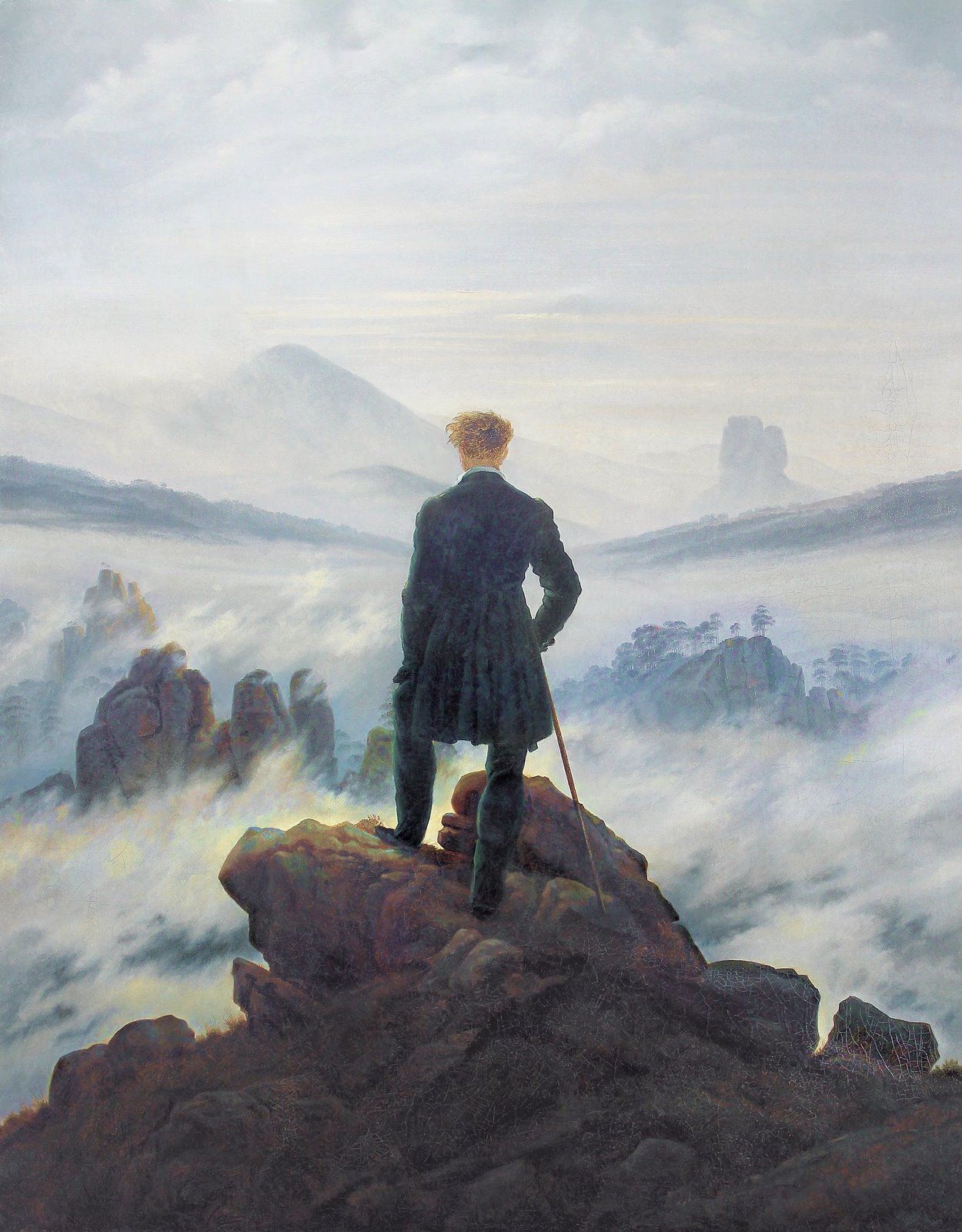
“Wanderer Above a Sea of Fog” – Caspar David Friedrich


                                   “Wanderer Above a Sea of Fog”  (1818)  
 
                                              Caspar David Friedrich
 
 
                                                     __________ 


upon further reflection I realized that the painting above had also “the same power, the same clarity and precision” to describe the Romantic Era as the first chord of Beethoven’s “Pathétique” Sonata, it is an equally powerful representation of the spirit of that highly introspective time
 
the Romantic Epoch championed nature, patriotism on the political heels of the French Revolution – and explorations of the soul, following the latter’s calls to liberty, equality, fraternity, the natural groundwork for what followed, our own period of reverence for human rights
 
we look with Caspar David Friedrich here upon a nebulous perspective, onto daunting horizons, reflecting, with him, through the painter’s psychological ingenuity and art, upon our own daunting choices, our own murky landscapes, our own obscure and imposing destinies, both physical and philosophical, a profoundly Romantic conception 
 
it was a time when the heart and its irreverent passions took centre stage, stood, in all its permutations, under the light
 
 
please excuse my egregious oversight
 
and of also the inspired Caspar David Friedrich I’ve begged pardon, expressed my heartfelt, humble compunction, and regret, for a not insignificant slight  
 
 
cheers
 
Richard