Richibi’s Weblog

Just another WordPress.com weblog

Category: paintings to ponder

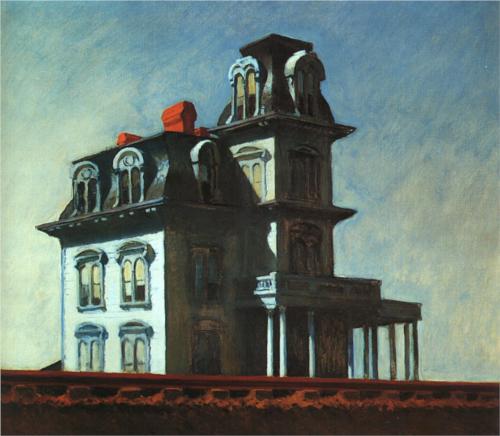
“Edward Hopper and the House by the Railroad” (1925) – Edward Hirsch‏

"House by the Railroad" (1925) - Edward Hopper

House by the Railroad (1925)

Edward Hopper

______

Edward Hopper and the House by the Railroad (1925)

Out here in the exact middle of the day,
This strange, gawky house has the expression
Of someone being stared at, someone holding
His breath underwater, hushed and expectant;

This house is ashamed of itself, ashamed
Of its fantastic mansard rooftop
And its pseudo-Gothic porch, ashamed
of its shoulders and large, awkward hands.

But the man behind the easel is relentless.
He is as brutal as sunlight, and believes
The house must have done something horrible
To the people who once lived here

Because now it is so desperately empty,
It must have done something to the sky
Because the sky, too, is utterly vacant
And devoid of meaning. There are no

Trees or shrubs anywhere–the house
Must have done something against the earth.
All that is present is a single pair of tracks
Straightening into the distance. No trains pass.

Now the stranger returns to this place daily
Until the house begins to suspect
That the man, too, is desolate, desolate
And even ashamed. Soon the house starts

To stare frankly at the man. And somehow
The empty white canvas slowly takes on
The expression of someone who is unnerved,
Someone holding his breath underwater.

And then one day the man simply disappears.
He is a last afternoon shadow moving
Across the tracks, making its way
Through the vast, darkening fields.

This man will paint other abandoned mansions,
And faded cafeteria windows, and poorly lettered
Storefronts on the edges of small towns.
Always they will have this same expression,

The utterly naked look of someone
Being stared at, someone American and gawky.
Someone who is about to be left alone
Again, and can no longer stand it.

Edward Hirsch

___________

Edward Hopper seems to have had
a profound influence on American
poets, this is the third poem around
one of his paintings I’ve encountered,
one by Joyce Carol Oates, a great lady
of not only poetry but of letters, having
been prolific in all literary forms, in each
nothing short of exemplary, another by
Brice Maiurro
, a budding poet of the
greatest, to my mind, merit, of whom
we will surely hear more if there is any
poetic justice

you can read about both of them right
here
in my blog, or just click their
individual names above

Edward Hirsch, by the way, stands
no less tall here, I submit, than the
other two in this coveted company

Richard
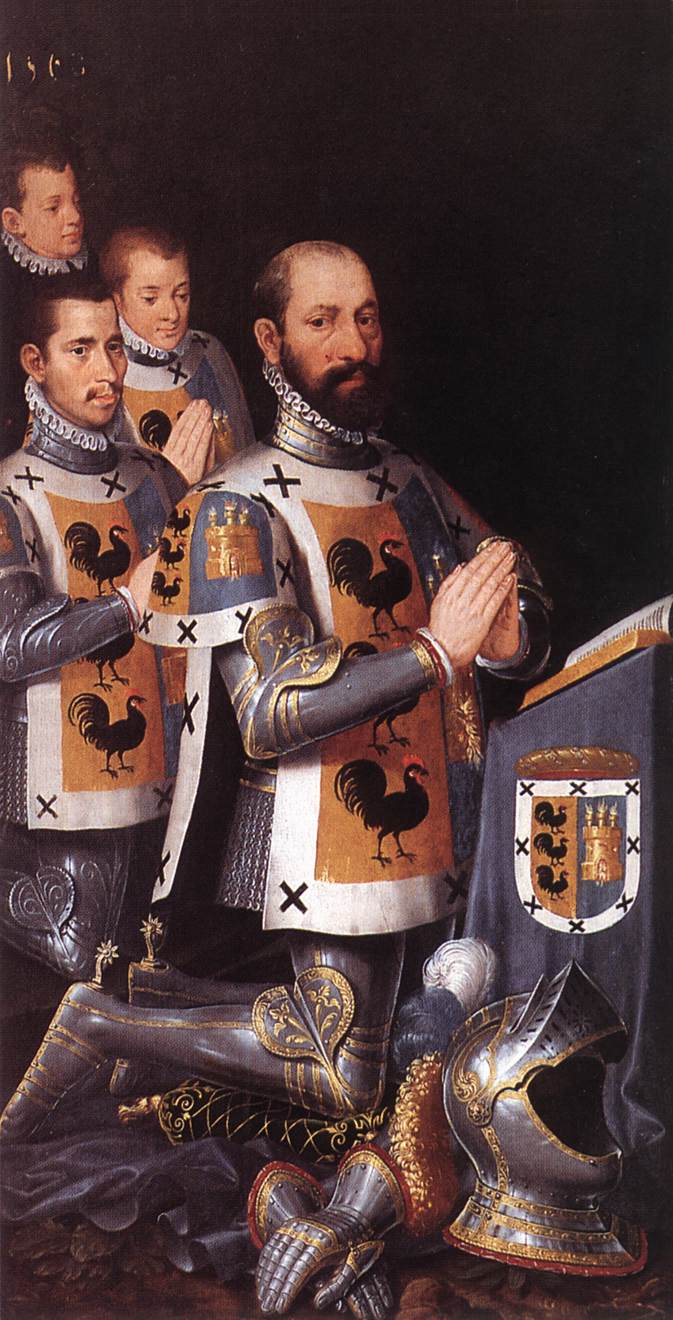
my Bruges, December 24, 2013‏ (the Groeningemuseum)

Pieter Pourbus - Portrait of Jan Lopez Gallo and His Three Sons (1568)

“Portrait of Jan Lopez Gallo and His Three Sons” (1568)

Pieter Pourbus

________

if Proust had his little patch of yellow wall
from Vermeer’s “View of Delft” to enchant
him, I’ve succumbed rather to blues that
I’ve found now in three paintings, van Eyck’s
Madonna and Child with Canon Joris van
der Paele
“, both of them, years ago at
London’s National Gallery the ultramarine
of the extraordinary Wilton Diptych, just
click, then again just click for a wonderful
presentation of it
, then the steel blue of the
one above, the “Portrait of Jan Lopez Gallo
and His Three Sons
” by Pieter Pourbus,
also like the van Eyck at the
Groeningemuseum in Bruges, a bargain
there therefore in unforgettable blues

the Groeningemuseum is Bruges’ most
impressive museum, despite both the
Picasso and the Dali nearby, though
nothing is very far in Bruges, except,
of course, the outskirts

we had wandered across the wrong
bridge our final day, confusing our
canals, and diligently marched forward
along a street perpendicular to our
purpose, heading out into what appeared
to be only countryside, though not
especially unduly cause we’d been
looking for Bruges’ famous windmills

but there were no windmills at all in
the distance, only open fields, and the
unending length of the wrong canal, it
transpired, had it been ever so
nevertheless idyllic

about a mile out a young man on a bike
passed us by with his dog and replied
when we asked that the windmills had
been all the time behind us, directly
to the left of our original bridge,
right there behind a tree which had
obstructed our view of the first of
them

that’s what you get maybe, I guessed,
for chasing, even famous, windmills

meanwhile back at the
Groeningemuseum, set along a path
along other medieval buildings, stone
instead of brick as later, then over a
bridge and beyond a small garden,
the door opens to especially early
Flemish art of very transcendental
qualifications, see again, for instance,
above, more profound than either the
brash Picasso, his fine though not
essential museum there, and the
flamboyant Dali, great fun however
ubiquitous ever, his museums seem
to pop up in countless cities

later, up the street, we ate at the
Maria van Bourgondië again, cause
nowhere could we find for Mom some
pasta, and where I could still savour
their Stroganoff sauce from the
previous night, and where, last but
not least, we could rest after a long
day our tired, tried indeed, feet

the Stroganoff was again sublime

so was their fireplace

Richard

“good news from Ghent”‏

the only thing that rang in my ears ever
about Ghent until contemplating the van
Eyck Altarpiece was Robert Browning‘s
poem about it, “How They Brought the
Good News from Ghent to Aix
“, the
idea, like in his “Pheidippides“, of
dying valiantly for a cause had mightily
impressed me

that cause is incidental, of course,
dependent on the beliefs and situation
of that particular stalwart person

it might make you unforgettable, that
unfettered and irevocable devotion, as
it did for me, for instance, the heroes
of these two poems, such an exalted
mission is an ambition for lots of folks,
very much for a young boy, especially,
such as I was when I read these

Rose Valland rose indeed to the occasion
when it came to saving priceless art before
the onslaught of ruthless Naziism, wherein
the very van Eyck Altarpiece, and also even
Raphael‘s incandescent “Sistine Madonna“,
to my utter horror, from another, and opposite,
corner of Europe, Dresden, could’ve been
forever lost

but the “good news” was in kind returned
to Ghent, eventually, in this fascinating
documentary, “Hitler’s Museum: The Secret
History of Art Theft During World War II”,
part 1, part 2, just click, from its hiding place
in Altaussee, a mountain fortress in Austria

The Adoration of the Lamb” now resides in
its rightful Ghent, even more, after so fraught
a trek, a wonder

also returned to Dresden, incidentally, the
Sistine Madonna“, that city’s own defining
artwork

it is to be noted that a task force had been
set up by no less than the Americans to
save the purloined art of Europe in that
however fraught time

this hasn’t been at all the case in their
recent military forays, what do you gain,
I ask, if you lose your ideals, what exactly
do you conquer

Richard

psst: Browning‘s “news”, if you’re wondering,
was of the “Pacification of Ghent“, 1576

my C***mas card‏

          Madonna and Child with Canon Joris van der Paele - Jan van Eyck

           Madonna and Child with Canon Joris van der Paele” 

                                                (1436)

                                          Jan van Eyck

                                                           _______

 
though I’ve long professed to not being
a Christian, having opted for the more
colourful pageant of Ancient Greece’s
Olympian divinities, and its attendant
metaphysical perspective, wherein
nature is honoured for its bounty
rather than saddled with the guilt of
Original – I ask you – Sin, I nevertheless
revere the spirit that spurred great
painters to such spectacular, even
exalted, heights  
 
in Bruges we saw van Eyck‘s Madonna
the blue of the prelate’s cape on the left
still reverberates in my subconscious
 
as though I’d discovered a new colour
 
 
the blue on the right on St George, the
patron saint of van der Paele, who
commissioned the painting, rendered
appropriately humble, even kneeling, 
in white, is only slightly less impressive
for being not less pungent but more pale,
noble yet understated, gold armour doing
the definitive rest
 
the ecclesiastic is St Donatian, patron
saint of Bruges, who knew how to
dress, apparently, for so vaunted an 
occasion  
 
 
merry C***mas
 
may your capes ever be as eloquent 
 
may your blues be ever as sublime   
 
 
Richard


my Ghent, December 6, 2013‏

 The Ghent Altarpiece - Jan van Eyck

                            “The Ghent Altarpiece (1432)

                                                    Jan van Eyck  

                                           ________

 
our room at the Ter Brugge was called
the van Eyck, after, of course, the most
impressive, perhaps, of the Flemish
painters, if you’ll put aside the
magnificence of the impish Bruegel,
the ubiquitous Rubens, and the
masterful van Dyck, for instance,
among countless other inspired 
artists of their rightly celebrated,
and wondrous, golden age  
 
what’s “Ter”, Mom asked, we see it
everywhere, “Ter” here, “Ter” there,
“Ter”, as I said, everywhere, and every
day of course at the Ter Brugge  
 
it means “at”, Staf said, as in “at the
bridge” for “Ter Brugge“, ever ready
to shower us with courtesy and 
attention
 
how obvious, I thought, and faulted
myself for not having already figured
that out
 
much like Kerkstwat, in Amsterdam, or,
more accurately, Kerkstraat, instead of
the more pungent pet name I had given
it, turned out to be Church Street, a
breeze when I’d set my mind to it
 
 
books then even followed, fresh fruit by
the handful, beer, voted the best in the
world, from a monastery in Belgium, he
said, and verily presented us with proof
of that high accolade, our favourite
Classical music over breakfast, not to
mention transportation back and forth
to the bus stop, for us too impracticable 
a distance 
 
we met him or Annemie at 8:11 every
evening there after our Brugesfest, they
were never, nor we either ever, late   
 
 
Staf had urged us to go to Ghent, a more
Romanesque city than the Gothic Bruges,
and putting two and two together I
remembered the GhentAltarpiece, The 
 
duh, chided myself
 
 
once there we had been given a proposed
route to follow to witness the sights, but
winds, cobblestones, and too short a time
for the visit halted us in our tracks at the
 
no, I don’t want to go up to the top, Mom
said, she’d climbed both the Frauenkirche
in Dresden and the Dom in Cologne,
Königstein even in Königstein, a few years
earlier, indeed so had I, but would not
undertake so steep again, and arduous,
an ascent
 
nor would I
 
 
we went next door instead to the Cathedral
we spent an hour marvelling, it is profoundly
inspired, a vision in complexity, colour, and
execution, all multiplied exponentially by
devotion, in all connotations of that word  
 
we were too, however, profoundly inspired,
and foreshortened, therefore, our tour of
Ghent, Ghent went   
 
 
later in Bruges we ate at what became there
our favourite restaurant, Maria of Something-
or-Other* – right beside Maria-of-Somewhere-
Else**, my next favourite restaurant, if you’ll
excuse my faltering memory, – on cordiality,
fine wine and hearty victuals before making
our way back home for 8:11, having indelibly
taken in Ghent  
 
no one was late


Richard 
  
 
** Maria van Bourgondië, read the menu, take
     the virtual tour, just click


sharpening one’s pencil‏

  Cottage and Woman with Goat - Vincent van Gogh

                     Cottage and Woman and Goat (1885)

 
                                       Vincent van Gogh 
 
                                            __________


  Village Street in Winter - Gustave Courbet

                               “Village Street in Winter(1865) 

 
                                     Gustave Courbet  
 
                                         __________


having considered that I’ve just spent
hours and days in some of the world’s
finest museums, you’ll perhaps pardon
my ebullience, I’ve never to date
juxtaposed two art works, I think, for
your consideration
 
but I scream, essentially, at everyone
with whom I visit a museum ever,
juxtapose, juxtapose, juxtapose, it
is the truest path to aesthetic erudition,
should you be so inclined, I call it,
sharpening one’s pencil 
 
 
having been overwhelmed by very
miracles of art, my mom and I, throughout
our European visit, in, specifically, Bruges,
Ghent, Amsterdam and Frankfurt, the
two above, van Gogh‘s Cottage“, called
at the Städel Museum in Frankfurt, and
some of, therefore, our last, burn for me
especially bright, standing naturally
together as comparable works of art,
though choosing between them is like
deciding between oranges and apples
 
but that’s the point, your aesthetic
sensibility says more about you than
it says about art, if you’ll surrender to 
that exploration 
 
and like apples and oranges, it depends
on your mood that day
 
which is also the point
 
 
Farmhouse” for me was a surprise, I’d
never seen this particular, wonderful, 
van Gogh, the Courbet, also a wonder,
stuck more to an anticipated style, where
van Gogh‘s more rural settings had never 
been for me his most successful, I’ll have
to change my mind about that
 
we’d visited the Städel for the splendid
Courbet exhibition we saw there the last
time we were there, when he became, 
along with Rembrandt – wow, Rembrandt – 
one of Mom’s now two favourite painters
 
right now for me it’s still, maybe, Canaletto,
either of them, or Chagall, Klimt, Schiele,
Monet, Avercamp, Filippo Lippi, and too
many others to really remember, I’ve
given up to merely enjoy 
 
here’s hoping you do too  
 
 
Richard  
 
        and follow the icon to enlarge it (+), for an
        alternate, more exact, if I remember, view of 
        Cottage“, which I couldn’t copy for this page,
        you’ll notice a remarkable difference


my Amsterdam, November 7, 2013‏

    Canal in Amsterdam - Claude Monet

                                      Canal in Amsterdam(1874) 

 
                                          Claude Monet
 
                                                 ____
 
 
in the morning we sit by the large
paned double windows that frame
the masterpiece that sits before our
eyes, beyond a little cement and
wrought iron bridge that crosses
our canal another canal runs 
perpendicular and away from us
between a row on either side of 
trees, their leaves pale yellow
mostly, from late fall, with patches
here and there, like incidental
brushstrokes, of less vivid, or
weathered, if you like, greens 
 
cobblestone paths along either bank,
charming but precarious, serve
pedestrians, cyclists in their dozens,
and the occasional adventurous car 
willing to tackle the more lackadaisical
pace and unpredictability of bicycles,
people and everywhere watery
roadblocks, Renaissance gingerbread
houses hold the fort on either side of
the canvas, geometrically ceding to,
and doing a master class in,
perspective
 
in the distance, of course, the obligatory
steeple, infallably sounding on the quarter
hour
 
   
this morning a flight of what looked
to me like doves, so I’ll call them
doves, to touch up anyway with white
and peaceful thoughts my story, cast
magic by fretting in flocks vertiginously
between the parallel lines of trees, just 
ahead of our front row seats   
 
a symphony, I said to my mom, though
for the birds it must’ve been tumultuous,
a  rash, maybe, anthropomorphismbut
their tumult has only ever translated for
me as immutably grace
 
people were taking pictures with their
smartphones, whirling skyward to the
avian poetry
 
we counted our blessings as we 
breakfasted on coffee, bread and
cheese  
 
 
later we’re off to the Rijksmuseum 
to witness other visual wonders
 
 
Richard


something creative

                                   (click on the picture should it fail)

                         “Vase of Flowers, after van Gogh” (2009)
 
                                     Apollo
 
                                       ____


with my suggestion neatly tucked under
his arm, of asking for it $1200.00, 
Apollo 
set off to sell his painting, “Vase of Flowers,
after van Gogh”, the one which has been
gracing my
 living room wall for several
years now
, a convenient place where he
could store it, maybe even indefinitely, 
while he made room for other paintings
 

the deep rust table, upon which rests the

white marbled vase which holds the

signature sunflowers, matches a somewhat 

lighter shade of it on my wall,
Burning Bush
it’s called, a colour I chose recently for its
associations with the miraculous, to freshen
up that particular corner  
 
to also see a burning bush every morning,

however metaphorically, as I start my day 


not having any idea what it might fairly cost

when
Apollo asked for my opinion, something
he couldn’t do by himself for being too intimately

connected, at
an opera evening the following
night at my place I asked my three opera guests,

who were sitting, of course, before the very item,

what they thought


the next day in an e-mail I wrote 
 
        “since we’re all, you, me, my mom, Claude

          and Yolande, whom I’ve included in these 

          deliberations, in the same position,

          stumped with regard to a price, I thought 

          I’d simply put all our uninformed opinions

          together and divide by 5 


          Claude,     2000

          Yolande,   1200 

          my mom,    700

          me,           1000,  recently upped from 800 

          you,               ?,  which is to say abstention,

                                     so that 5, to be fair, 
                                     becomes 4
 
                            ____ 
                           4900 / 4 = 1225


          but I’ll accept 1200, should you honour

          my call 


          after all, it’s my wall 


          love


          me” 


perhaps“, he’d asked, “you can make a suggestion 
 
towards a solution …
 
I’ll hear from you with something creative
 
as is your usual style“, he’d written from his own
computer in his own idiosyncratic manner, after
the prospective buyer had been up to my place,
viewed dispassionately, I thought, the painting,
though he’d warmly admired my apartment, then
left with Apollo to, ultimately inconclusively at
that point as it turned out, talk cost
     
 
I thought I’d been accordingly creative, not
without some commensurate glee
 
and quivered at what might be the result of my
creation, though the work might, sadly, leave
its now impressive standing on my wall  
 
which I knew, however, Apollo, would never
leave deficient
 
nor, for that matter, would I    
 
 
I’m not ready to set a price on it if you can’t 
come up with one, the collector had told
 
which left Apollo in a fix, until the
serendipitous $1200.00 
 
this is what Richard said, he told the buyer,
who’d indeed fretted, with noteworthy
consideration, about my having
to lose the painting, unaware that
everything turns to dust, to my mind, little
by little dries up, even in one’s imagination,
if it is to be transformed into other magic
 
  
I’d countered that at the right price the
exchange would be a spur to the
burgeoning painter, ready to pursue his
muse with just a little even inspiration,
inspiration an admirer could express in,
notably, dollars  
 
but I’ll discount down to 900, Apollo said, 
ceding to his insecurities, since I know you 
 
I’ll buy it for 1000, the man said, I would’ve
payed 2000, and showed him a work they 
both deemed inferior for which he’d payed
that much 
 
do not, he said, underestimate yourself,
you are a talented artist
 
 
later, looking over the entire transaction,
I asked Apollo, when will you acquire more
than tremulous confidence
 
I’m working on it, he replied
 
what about now, I said, you’ll only be an 
artist when you call yourself one, own it,
do it, now
 
okay, he said, today I am an artist, and
raised his arms wide to the open sky,
appropriately, I thought, surrendering
himself, with giddy determination, to
inscrutable heaven       
 
 
Richard


“Self-Portrait” (1901) – Raoul Dufy, revisited

                    Self-Portrait - Raoul Dufy

                                              Self-Portrait  (1901)  

                                                       Raoul Dufy 

                                                          _______


someone suggested that what one saw when

one looked into Dufy’s eyes was a reflection

of oneself, this seems to me to be nearly

incontestable, think about it 


Richard


psst: thanks Dorothy


“Self-Portrait” (1901) – Raoul Dufy‏


                             Self-Portrait - Raoul Dufy


                                          Self-Portrait”  (1901) 
 
                                            Raoul Dufy  
 
                                               _______

 
this Dufy completely undoes me, if you
look into his eyes he’ll soon see right
through you, more intently than you
could ever give back, it’s as though
you’re the one being dissected 
 
or is it just me
 
 
Richard