Richibi’s Weblog

Just another WordPress.com weblog

Category: paintings to ponder

“Six Pictures for Piano” – Arno Babajanian‏


Paul Gauguin "Poèmes barbares" (1896)

Poèmes barbares (1896)

Paul Gauguin

_______

if you thought that Arno Babajanian was
done with synesthetic investigations,
seeing sounds, hearing colours, here’s
his Six Pictures for Piano“, which he
plays, all of them, himself

can a piano paint, take pictures

you tell me

something else interesting is happening
here, the six are individual pieces despite
being part of a common whole, as the title
suggests

this is the opposite of trying to integrate
movements to a continuous and unfolding
conception, something Beethoven, for
instance, pursued, indeed ardently, in his
own sublime music

dissociation seems a context, a XXth-,
a XXlst-Century, context, in our presently
more polarized world, according to, of
course, Babajanian

what might hold us together then

maybe music

incidentally, the movements to the
Six Pictures here are

1 – Improvisation
2 – Folk Song
3 – Toccatine (a little toccata)
4 – Intermezzo
5 – Choral
6 – Sasoun Dance (don’t ask),

should you not be able to read Russian

note, none of these themes are
photographic

don’t either miss Babajanian‘s
Sonata for Violin and Piano
as played by, here again,
himself, it’s rapturous

Richard

psst: see Gauguin above paint poems
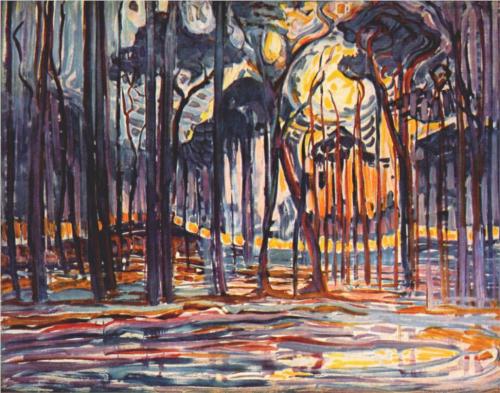
“Essay on Wood” – James Richardson


Piet Mondrian - "Woods Near Oele" (1908)

Woods Near Oele (1908)

Piet Mondrian

______

if my last entry was about an Étude
in the Form of a Waltz
“,
an unlikely
combination, here’s an essay in the
form of a poem, kind of like my
own stuff

Richard

______________

Essay on Wood

At dawn when rowboats drum on the dock
and every door in the breathing house bumps softly
as if someone were leaving quietly, I wonder
if something in us is made of wood,
maybe not quite the heart, knocking softly,
or maybe not made of it, but made for its call.

Of all the elements, it is happiest in our houses.
It will sit with us, eat with us, lie down
and hold our books (themselves a rustling woods),
bearing our floors and roofs without weariness,
for unlike us it does not resent its faithfulness
or question why, for what, how long?

Its branchings have slowed the invisible feelings of light
into vortices smooth for our hands,
so that every fine-grained handle and page and beam
is a wood-word, a standing wave:
years that never pass, vastness never empty,
speed so great it cannot be told from peace.

James Richardson

“Monet Refuses the Operation” – Lisel Mueller‏

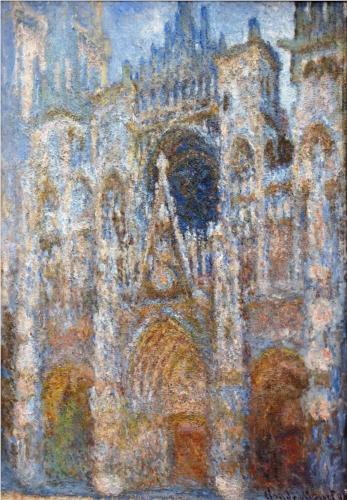
Claude Monet - "Rouen Cathedral, Magic in Blue"

Rouen Cathedral, Magic in Blue (1894)

Claude Monet

______

up until now I’ve presented dramatic
monologues
, but only to music, on my
blog
, referring to Robert Browning as
their originator, but not ever producing
any representative spoken work, never
mind any of, themselves, the poet’s
seminal masterpieces, My Last
Duchess
“, “Fra Lippo Lippi“, “How
They Brought the Good News from
Ghent to Aix
“,
for instance, which,
granted, can be daunting now in their
breadth and erudition, the Romantics
didn’t have television, they had to
entertain themselves

here’s a poem for our time, written
in 1996, only two decades ago, gasp,
Lisel Mueller imagines herself Claude
Monet
, an easier concept, after all,
who’s been to Ghent or Aix, why
would anyone want to run there,
whereas Monet‘s another story, who
doesn’t today know Monet

Monet was blind at the end of his life,
one learns from the website where I
got this
, a blog with plenty of breadth
and already considerable erudition, he
received corrective surgery to be able
to continue with his work

there was, however, a limit

Monet Refuses the Operation

Doctor, you say there are no haloes
around the streetlights in Paris
and what I see is an aberration
caused by old age, an affliction.
I tell you it has taken me all my life
to arrive at the vision of gas lamps as angels,
to soften and blur and finally banish
the edges you regret I don’t see,
to learn that the line I called the horizon
does not exist and sky and water,
so long apart, are the same state of being.
Fifty-four years before I could see
Rouen cathedral is built
of parallel shafts of sun,
and now you want to restore
my youthful errors: fixed
notions of top and bottom,
the illusion of three-dimensional space,
wisteria separate
from the bridge it covers.
What can I say to convince you
the Houses of Parliament dissolve
night after night to become
the fluid dream of the Thames?
I will not return to a universe
of objects that don’t know each other,
as if islands were not the lost children
of one great continent. The world
is flux, and light becomes what it touches,
becomes water, lilies on water,
above and below water,
becomes lilac and mauve and yellow
and white and cerulean lamps,
small fists passing sunlight
so quickly to one another
that it would take long, streaming hair
inside my brush to catch it.
To paint the speed of light!
Our weighted shapes, these verticals,
burn to mix with air
and change our bones, skin, clothes
to gases. Doctor,
if only you could see
how heaven pulls earth into its arms
and how infinitely the heart expands
to claim this world, blue vapor without end.

Lisel Mueller

Richard

psst: thanks Brain for this beautiful poem

“The Unwritten” – W.S. Merwin

Mickail Vrubel - "Pencils' (1905)

Pencils (1905)

Mickail Vrubel

_______

below is a poem wherein the poet,
W.S. Merwin, confronts his pencil,
any pencil, which each contains
all the words which will never be
written, it is a great spur to the
creative imagination, an evocation
of the infinities of possibilities
available to any artist, any
person, indeed, who dreams

but in the 21st Century, will
anyone soon wonder what’s
a pencil, when was the last
time, ask yourself, you even
used one

Richard

___________

The Unwritten

Inside this pencil
crouch words that have never been written
never been spoken
never been taught

they’re hiding

they’re awake in there
dark in the dark
hearing us
but they won’t come out
not for love not for time not for fire

even when the dark has worn away
they’ll still be there
hiding in the air
multitudes in days to come may walk through them
breathe them
be none the wiser

what script can it be
that they won’t unroll
in what language
would I recognize it
would I be able to follow it
to make out the real names
of everything

maybe there aren’t
many
it could be that there’s only one word
and it’s all we need
it’s here in this pencil

every pencil in the world
is like this

W.S. Merwin

“Music”

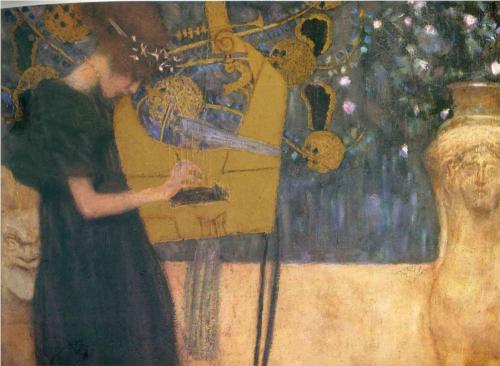
Gustav Klimt's "Music"

Music (1895)

Gustav Klimt

______

not for lack of imagination, lately, but for,
rather, lack of confidence, the complaint
of any would-be poet, the complaint of
any proponent of oneself, one’s persona,
one’s own, however benign, however even
benevolent, ideas, I retreated into myself,
surrendering to forthright inspiration for
any, elusive enough, courage

inspiration, through its usual unsuspected
channels, and as ever categorically, gave
me, reliably, Music“, Klimt‘s ineluctable
masterpiece, not even for its iconic image,
but for its transcendental comment on
art’s interpretive counterpart, music

world’s meld

a “magical mystical miracle” happens, as
Katharine Hepburn, in her utterly
enchanting movie, Summertime“,
would have it, irrepressible as ever

I had to share

Richard

psst: note the juxtaposition of contrasting
colours, patterns, impressions, note
the Baroque presentation of Classical
imperatives, touched with Romantic
sensibilities, kicking off, not
incidentally, Modernism

“No 7” (2014) – Apollo‏

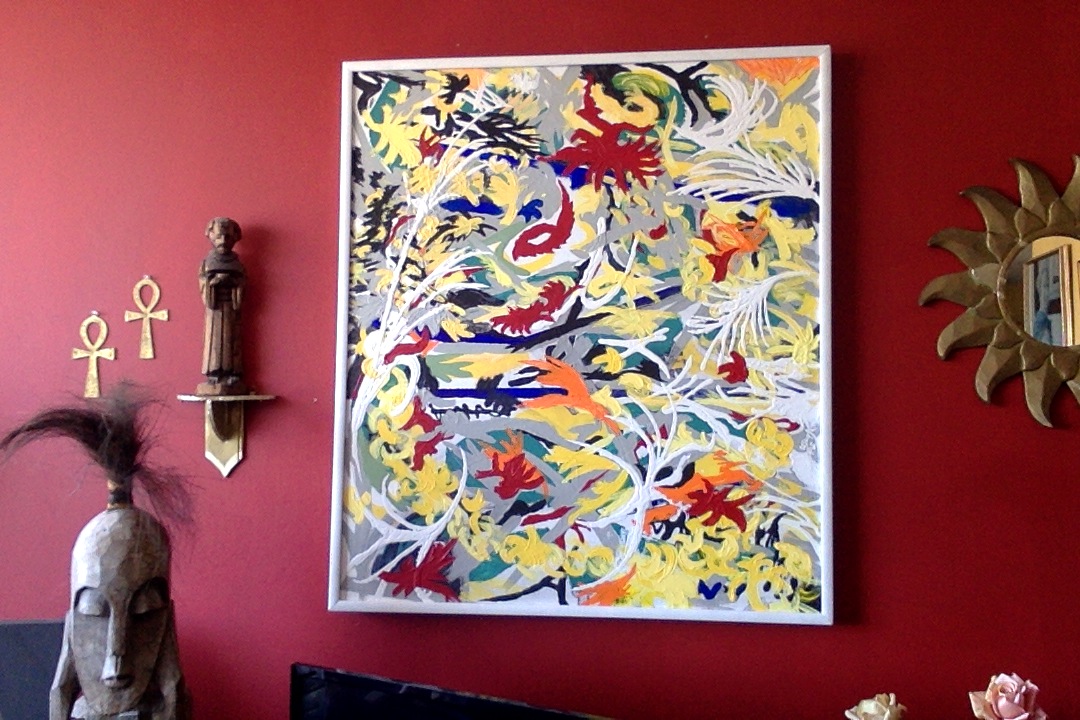
Photo on 2014-05-13 at 12.09 PM

“No 7” (May, 2014)

Apollo

_____

Apollo, my Charioteer of the Sun, God of Music,
God of Poetry, God of Countless Other Things,
is also a painter

just recently he graced my wall, newly painted
Burning Bush in a spirit of springtime
regeneration, a colour I hadn’t been able to
resist for its beatific implications, with his
“No 7”, so named in order not to influence
the journey taken to interpret it

call it what you will, he said, and I’m still
working on it

but the other evening at his place, four of us
together for a glorious indeed dinner, I created
a party game that could offer suggestions

what would you call it, I asked, what would
you call it, I’m still asking

“Splash”, “Flurry”, and “I Don’t Know”, are
out, for being already taken

have fun

thanks

Richard

psst: the solar mirror, incidentally, is also his
invention, that’s a Manet in its reflection,
a print of course

the question of genitalia in art‏

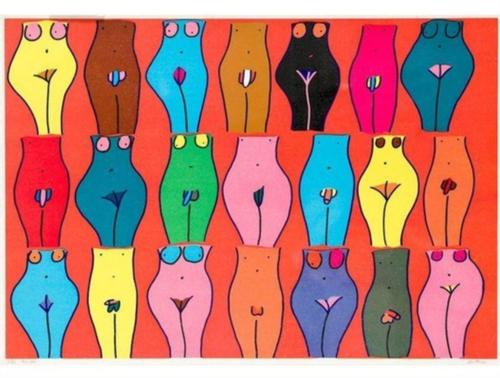
"Nudes"- Walter Battiss

Nudes

Walter Battiss

_______

genitalia, of course, had become overt,
even flagrant, by the start of the 20th
Century, the many reclining Venuses,
the Olympias, had led to Courbet‘s still
notorious The Origin of the World
open, I warn you, at your own risk –
and by 1911 Egon Schiele in Vienna
had exhibited his self-portrait
masturbating
, entitled, appropriately,
Masturbation – open again at your
own risk, though once again the work
is brilliant

I have ceded to courtesy and proprieties
in not reproducing here these potentially
offensive renderings, though modesty at
this point doesn’t stand a chance, the
world is determinedly uninhibited, fig
leaves are a thing of the very remote
indeed past

but I’ll tell of my mom and I, partners
in unflappable artistic appreciation,
visiting the Leopold Museum in Vienna
and having never even heard of Schiele,
whose work is supremely represented
there

moments after our arrival and turning
innocently a corner, we came upon one
of his overt pudenda
brazenly exposed,
I hadn’t ever experienced such stuff,
and there was nowhere in the stark
white hall to hide

my mom stood beside me not saying
a word, nor expecting me to comment
this time, what do you say about an
unadorned vagina anyway, I ask, even
one admirably exposed, to anyone,
never mind to your mom

we cleared our throats, probably
harrumphed, and discreetly moved
along

later we saw some of his more
conservative piece
s, idiosyncratic
and marvellous, and had to revise
our impressions, declare Schiele
categorically glowing, a master
at his art, and eventually a very
favourite, right up there with the
equally sublime Courbet, man,
can these guys colour

though I still prefer to view their
pubic stuff, however publicly,
on my own

Richard

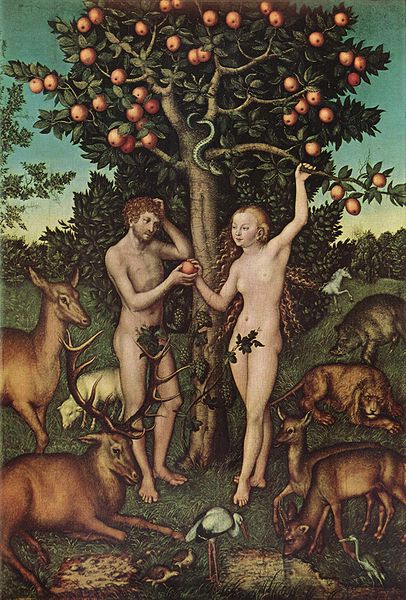
“Adam and Eve” – Lucas Cranach the Elder

Cranach Adam Eve

Adam and Eve (1596)

Lucas Cranach the Elder

____________

from The New Yorker, January 27, 2014

Adam and Eve” by Lucas Cranach the Elder, 1526

She seems a mere girl really,
small-breasted and slim,
her body luminescent
next to Adam, who scratches
his head in mild perplexity,
So many baubles hang
from the tree
it didn’t hurt to pick one.
The snake is a quicksilver curve
on a branch she is almost
young enough to swing from.

The garden bores her anyway:
no weedy chaos among
the flowers and vegetables;
the animals so tame
you can hardly tell the lamb
from the lion, the doe from the stag
whose antlers outline Adam’s modesty.
She is like that teen-age girl
who wandered from the mall last week
not to be seen again, the world before her
glittering and perilous.

Linda Pastan

______________

yesterday on a mission to buy socks,
finally – I had only a pair left and one
of those with a hole in it – I wondered
about clothes, why hadn’t we evolved
fur or feathers or, heaven forbid,
scales, like all other creatures,
without exception

cherry trees were in blossom, birds
sang along my path, despite an
inoffensive drizzle as I went along

perhaps, I thought, by standing erect
our private parts were too much in
evidence for even indiscriminate
Nature to bear, though apes in all
their varieties walk on two legs and
seem to cavort happily, indeed
lasciviously, though ever
unsheathed, I objected, everywhere

the only difference I could muster
between us and them was that we’d
eaten from the Tree of Knowledge,
the fruit, apparently, of our
apocalyptic decadence, while they’d
never had ever an Eve, nor, for that
matter, an, equally complicit, note,
Adam, no matter what the, mostly
male, elders might say

therefore apes gambol in their
Garden of Eden still, as you can
see in the Cranach above, serenely
uncontrite, while we buy socks in
the jungle next door, and berate,
burdened, our bedevilled lubricities,
what’s under those strategically
positioned, and obliterating, leaves

Tree of Knowledge indeed

Richard

psst: from the Courtauld Gallery in
London, more on Cranach’s
painting
, just click

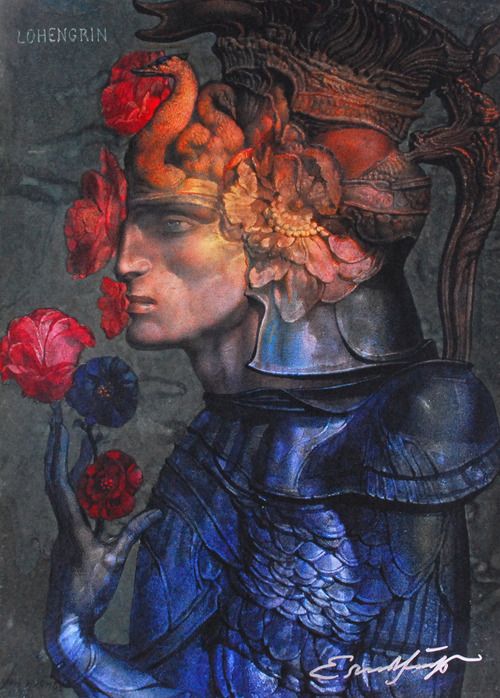
“Lohengrin”, Act 1‏

"Lohengrin" - Ernst Fuchs

Lohengrin (1977)

Ernst Fuchs

_______

this morning, requiring especially strong
medicine to get me through my day, I put
on Lohengrin, Wagner’s masterpiece,
directed by the thorny and unpredictable
Werner Herzog, from Bayreuth, the high
temple of that music, its very Acropolis,
1990, to lighten my load, to give me
mythic, maybe even Sisyphean,
perseverance, it didn’t disappoint

Elsa of Brabant is accused by Friedrich
of Telramund of having killed her brother,
who stood before both of them in line to
the throne, Ortrud, Friedrich’s wife, stands
silent throughout the first act looking
positively Machiavellian, Lady,
incontrovertibly, Macbeth

Elsa, summoned to plead her corner, tells
of a shining knight who appears to her in
her dreams, calls upon him to defend her
honour, he shows up at the very last
moment, on no less than a swan

he’ll only fight for her, he says, after she’s
offered him her anticipated kingdom, her
throne, her very honour and chastity, to
do with what he will, should he win for
her her cause, if she’ll pledge to never
ever ask about his origins, despite his
extraordinary entrance

she accedes, of course, though no other
knight, critically, has shown up to redeem
her

the shining knight conquers, of course,
but Ortrud, during the celebrations,
lurking ominously nearby, doesn’t give
the impression that anyone’s going to
live happily ever after, so long as
she can help it

it was the end of Act 1, I got up, made
a sandwich, I’d watch the following act
tomorrow, and so on, until the distant
end of that four-hour saga, to which
the epithet “Wagnerian”, for “epic”,
also, manifestly, belongs

wistfully I wondered about my own
knights in shining armour, who might
be my own guardian angels, entering
on fabled, maybe, even, swans,
concluded one of them had just been
Wagner, who’d turned, from heavy to
at the very least wistful, my day
around

wishing you Wagners

Richard

Beethoven – piano sonata no 7, in D major, opus 10, no 3‏

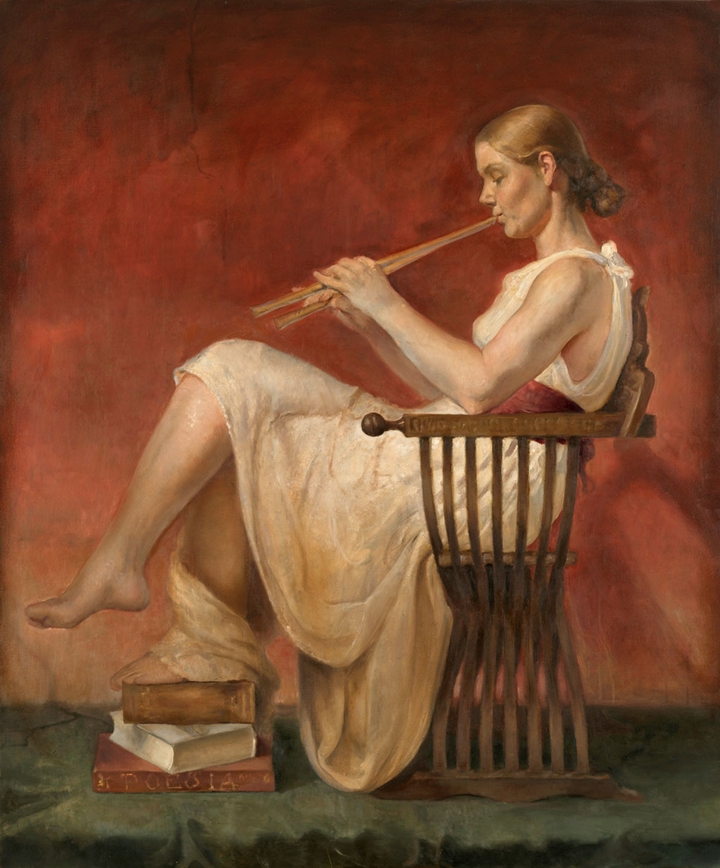
Euterpe - Apollo and the Muses - Helene Knoop 1979 - Norwegian Figurative painter - Tutt'Art@

EuterpeApollo and the Muses (2008 – 9)

Helene Knoop

________

if the piano sonata no 4 of Beethoven,
in E flat, opus 7, was academic, an
exercise, a display of technical
dexterity and some, admittedly,
even mighty, compositional verve,
it lacked, in my estimation, a centre,
a convincing motivating factor, a muse,
though ever ardent, ever entertaining,
it is ultimately arid, I think, trite, I’m
not, one is not, keen on returning to it

but in the piano sonata no 7, in D major,
opus 10, no 3
, Beethoven hits, I submit,
his stride, this sonata is enchanting

note the similarities of structure
between the two, the order of the
movements with identical, essentially,
tempo patterns, notably the middle
slow movement, in the first a largo,
con gran expressione,
slow with
great expression, in the latter, a
largo e mesta, slow with sadness,
where Beethoven plumbs, evidently,
the limits of pacing, the time lapse
between two notes, the capacity for
silence of this new instrument, the
pianoforte, of which he’ll look into
also, and even vigorously, its
capacity for volume, the crashing
introduction to his celebrated 8th,
for instance, to establish the
instrument’s new perimeters

you’ll note you can listen to the later
largo, the opus 10, no 3, forever, you
can get lost in its aural world, I can’t
think of anywhere else right now a
more profound largo

the other movements are dazzling
in their thrilling prestidigitation, all
organically sound, and, crucially,
motivationally centred, I think, this
is indeed music, magisterial music,
Beethoven’s not just kidding
anymore, he’s hitched onto his
proper inspirational deity, his own
private Euterpe, music’s muse, and
we’re in for something, from here
on, of a ride

note the cool riff closing off the last
movement, Beethoven in the guise
of Gene Kelly stepping in for a
breezy good-bye, prefiguring, of
course, XXth-Century music, and
the serendipitous extrapolations
of jazz

Richard

psst: incidentally, the headings, largo,
con gran expressione, largo e
mesta,
are entirely Romantic
musical notions, notations,
Classical composers would’ve
been too sedate, formal, courtly,
for such flagrant sentiment