Richibi’s Weblog

Just another WordPress.com weblog

Category: paintings to ponder

watching water boil‏

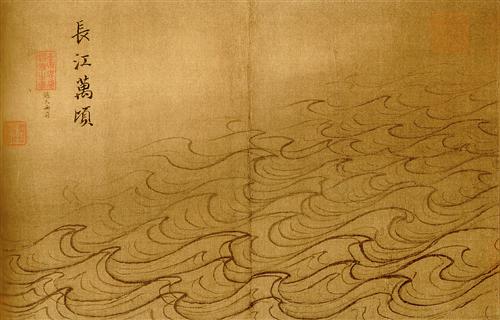
 "Water Album - Ten Thousand Riplets on the Yangzi" - Ma Yuan

Water Album – Ten Thousand Riplets on the Yangzi

Ma Yuan

____

I’ve got something for you, I said to
a friend when she fretted again about
a condition, one of several, dare I say,
eating away at her, though from the
inside, I believe, instead of the outside,
if you know what I mean

my tremor, she explained, something
I’d indeed earlier noted, and
commented on

my doctor said it wasn’t Parkinson’s
and I want a second opinion, she said,
he’s referred me to a neurologist

what did your doctor say it was, I
asked

just nerves, she answered

I’ve always thought it was just
nerves, I said, stress

but I don’t think I’m stressed, she
replied

you’re stressed right now, I retorted

have you been meditating, I asked,
like I suggested

no, she said, I just can’t get into it

I know, I know, I responded, listen,
this is why I called, I just figured
this out, I’ve been boiling water to
rinse my dishes for a while now,
ever since the water alert several
years ago when the water went
brown, I’ve got one or even several
pots behind me on the stove heating
while I’m washing the dishes, most
often I’m finished before the water
boils

I still have my plastic gloves on, I
don’t want to take them prematurely
off, so I either watch the water boil
or look at the mountains from my
window, both of which can get
tiresome

the mountains mostly win out but
then I have to turn back to check
on the water, and I’m back where
I started, watching the water boil

a watched pot never boils, this’d
be great for your condition

excuse me, she said

watch a pot of water boil, I said,
you probably won’t watch it from
start to finish, but

she started to laugh

you can start watching after several
minutes, you don’t even have to

she continued to laugh

watch it till it boils, every day you
can add minutes

she didn’t stop laughing

doesn’t that sound logical, I asked,
all she’d need was will, which’d get
rid of her tremor, I concluded

later I could’ve added that if you’re
diligent, which is to say patient, calm
you’ll start to more precisely define
the word “boil”, have 32 names for
it like Eskimos do for snow

from simmer, shimmer, steam and
hover, stir, roil, ripple and shudder,
to “Double, double, toil and trouble,
Fire burn, and cauldron bubble”,
for instance

a note to myself, do the same thing
with “mountain”

Richard
“Macbeth” – William Shakespeare‏

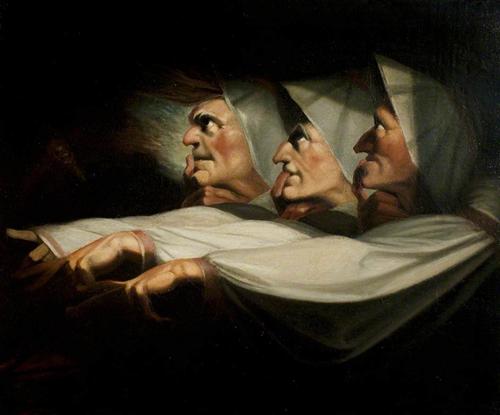
Henry Fuseli - "'Macbeth', Act I, Scene 3, the Weird Sisters"

‘Macbeth’, Act I, Scene 3, the Weird Sisters (1783)

Henry Fuseli

_______

Judy Dench is Lady Macbeth, Ian McKellen
her consort, in this superb production by
Trevor Nunn

also great witches

watch

Richard

walking in beauty – January 11, 2015 (for Terry)

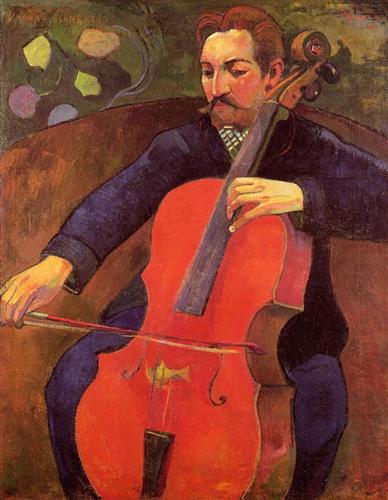
Paul Gauguin - "The Cellist (Portrait of Upaupa Scheklud)"

The Cellist (Portrait of Upaupa Scheklud) (1894)

Paul Gauguin

_______

what are you reading, Terry asked,
I’d been riffling through the pages
of a book I’d just finished, trying to
find a particular bit I wanted for
firm ground later in conversations

a man in Sarajevo during the siege,
July 5, 1992 to February 29, 1996,
the bit I’d been looking for, had seen
neighbours, 22 of them, killed when
a mortar from the surrounding hills
had, as they waited in line for a much
depleted market, a consequence of
the siege, obliterated them, arms,
feet everywhere, as well as the
wounded

the man, a cellist with a Sarajevo
symphony, probably its finest, had
resolved, in honour of the victims,
to come out to play each day, at
the very time, in the very place of
the atrocity, for 22 days, one for
each of the victims, despite being
each time in the very eye of a
sniper’s bullet, Albinoni’s haunting
Adagio
, listen

he made it out eventually to Ireland,
it is later indicated

The Cellist of Sarajevo“, I replied,
I’m taking it back to the library, I
needed to check some dates, I
write, I want to talk about it

I’ve been talking about walking in
beauty, I said, incorporating it into
one’s life, this man overcame his
fear of death so profoundly as to
deliver a very dirge, an act of
prodigious, even transcendental
meditation, to sit and play midst
the rubble and ashes of his friends
this tribute, how sound must’ve
been his conviction

walking in beauty, I said, it’s a
Navajo prayer

Wordsworth has a poem like that he
said, and recited it word for word

“She walks in beauty, like the night
Of cloudless climes and starry skies;
And all that’s best of dark and bright
Meet in her aspect and her eyes;
Thus mellowed to that tender light
Which heaven to gaudy day denies.

One shade the more, one ray the less,
Had half impaired the nameless grace
Which waves in every raven tress,
Or softly lightens o’er her face;
Where thoughts serenely sweet express,
How pure, how dear their dwelling-place.

And on that cheek, and o’er that brow,
So soft, so calm, yet eloquent,
The smiles that win, the tints that glow,
But tell of days in goodness spent,
A mind at peace with all below,
A heart whose love is innocent!”, he said

I was flabbergasted, I had only my
few lines of Shakespeare to compare

I’m Richard, I said

Terry, he retorted

I can’t talk now, I’m off, if you can
believe it, to read Shakespeare with
a friend, we’ll meet again, you’re easy
to spot, you’ve got no shoes, you’re
barefoot, my mom has talked about
you, you always say hello, she says,
she thinks you’re a nice man

Terry had his sandals in his hand,
he stood under his umbrella, I
hadn’t opened mine, he was trying
to shield me also from, for me, the
merely mist, not rain, despite a
rod stretched unhooked from his
otherwise sufficient cover from
the wet

can you remember my e-mail, he
offered, it’s easy

I wrote it on the battered flyleaf
of my Shakespeare

that’s a relic, he said

my International Collector’s Library,
I answered, that’s where I got my
literature when I was a boy, in my
little town of Timmins, an outpost,
I’d get a classic every month, each
bound distinctively, their gimmick

you could get money for that, he
suggested

not, like this, I said, it’s in tatters

I’ll tell my mom I talked to you, I said,
she’ll be delighted

Tony, right

Terry, he corrected

Richard, I said

Richard

later he thought I’d been Michael

Richard

psst: it turns out the poem is by Byron,
not Wordsworth, not surprising,from
this distance all the Romantic poets
sound alike, except for, of course,
the Brownings, an inconsequential
gaffe

walking in beauty – January 10, 2015‏

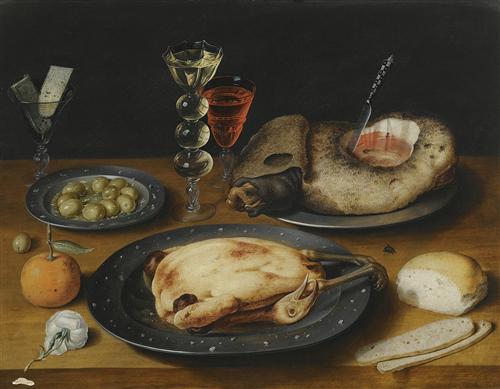
 Osias Beert  - "Still Life of a Roast Chicken a Ham and Olives on Pewter Plates with a Bread Roll an Orange Wineglasses and a Rose on a Wooden Table"

Still Life of a Roast Chicken, a Ham and Olives on Pewter Plates
with a Bread Roll, an Orange, Wineglasses and a Rose on a
Wooden Table

Osias Beert

______

it didn’t take long before I realized that
walking in beauty is not an exterior thing
but interior, it happens on the inside,
what there is to see out there is indifferent,
neutral, beauty is, indeed, in the eye of the
beholder

one graces the object, the situation, the
passing of time and space, with one’s
perspective, actually calling a thing
beautiful makes it so, making it so
defines who you are, so does not making
it so, succumbing to what life has to give
you instead of touching up the cracks,
beauty is the colour you paint the house
you live in, you choose the paint

Ahh, but there is beauty in those ‘grey bleak uninviting days’..at least in the eyes of this beholder. I think of it as shades of silver and blue. And like the song says, “where the sun always shines, there’s a desert below..” la la la.

a friend writes, who’s chosen her paint,
turned grey into silver and blue

today my paint smells like chicken
roasting in the oven, in garlic and
ginger, with soya sauce, breadcrumbs
and butter

also fresh laundry

also still not being out of my pyjamas

thanks, Lynne

Richard

walking in beauty – January 9, 2015‏

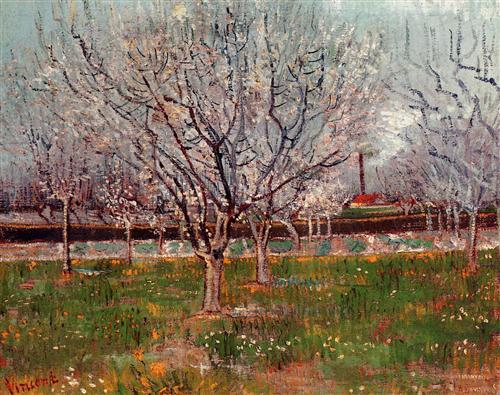
Vincent van Gogh - "Orchard in Blossom (Plum Trees)"

Orchard in Blossom (Plum Trees) (1888)

Vincent van Gogh

__________

walking in beauty must be a conscious
thing, you don’t wake up doing it in the
morning unless you train yourself to

for the past few days I’ve incorporated
the prayer, am intending to learn it
through, not just its kernel, however
itself highly inspirational

In beauty I walk.
With beauty before me I walk.
With beauty behind me I walk.
With beauty around me I walk
With beauty above me I walk.
With beauty below me I walk
In beauty all is made whole.
In beauty all is restored.
In my youth I am aware of it, and
In old age I shall walk quietly the beautiful trail.
In beauty it is begun.
In beauty it is ended.

during the past several days the weather
has been grey, bleak, uninviting, there
was beauty only in the candles I lit, the
pyjamas I never took off, and, truth be
told, the chicken I broiled with soya
sauce, lemon juice and honey, with
baby carrots to dip, and carrot cake to
top it all off, with lots of icing

nor do I ever run out of wine

what’s not beautiful about that, I needed
to conclude after all those days moping,
feeling sorry for myself

I said the same to a friend today over
lunch, at presently the best restaurant
in Vancouver
, there she sat poised,
dripping in grace, a tailored olive
jacket, an ochre pendant with a light
brown scarf wrapped loosely around
her neck, stretched towards me with
just the right amount of both discretion
and attention, presenting her Mona Lisa
smile
, as she’d herself called it

she had crossed her defunct great love
inadvertently somewhere, his jaw had
dropped, she had smiled that mysterious
smile, she told me, and slipped beyond
his ken

should I go to Australia, she asked,
where her nephew’s daughter is
getting married, it’s hot, it’s humid,
it’s a long trip, I could die on the
way

every time I go downtown, I think I
might not make it, I retorted, but I do,
and I don’t

when was the last time you saw your
nephew, I asked

four or five years ago, she replied

you love him, he loves you, he would
be so honoured, I said, and if you die
on the way he’ll still be honoured,
they all will

this is how you walk in beauty, I said,
you latch onto the poem as it passes,
they’re fleeting, be they ever so many,
we let them go by, they would’ve been
our memories, instead of our default
position, where you could die anyway

today I left home, I said, saw my first
cherry blossoms of the season, midst
the gnarled van Gogh branches of the
other trees lining both sides of the
street, emerald moss growing already
along their trunks

a woman selling wares mouthing the
words to Billy Holiday’s “God Bless
the Child”
so that I thought she’d
been the one singing

beside her someone selling wooden
marionettes he was dangling, grinning,
trying to look enchanting in his Charlie
Chaplin clothes, looking more like
Ebenezer Scrooge, a wolf in sheep’s
clothing

but a cover of You, You’re Driving
Me Crazy
I sent Apollo, my Sun God,
for ukulele, megaphone, and of course
voice, inspired me more than anything
else today, I continued, turned my
frustration into poetry, how not to
mope, he’s been gone since before
C***mas, much too long

beauty is in the eye of the beholder, in
beauty all is made whole

to walking in beauty, we toasted

Richard

“How I Didn’t Get Myself to a Nunnery” – Suzanne Lummis‏

"Ophelia" - Arthur Hughes

Ophelia (1852)

Arthur Hughes

_________

according to Suzanne Lummis Ophelia
“g[o]t outta town”

Suzanne Lummis is Ophelia here, this
is a dramatic monologue, I can’t tell you
how much I find that exciting

you’ll want to run to the source, of course,
to find pertinent references, so I’ve linked
a few for you from the text below to their
counterparts in Hamlet“, if it’s coloured,
just click, otherwise a couple of asterisks
explain two probably too obvious items,
in which case you’ll forgive me my
infelicitous impertinence, my unintended
and hapless presumption

thanks

How I Didn’t Get Myself to a Nunnery

That girl they found ensconced in mud and loam,
she wasn’t me. Small wonder, though, they jumped.
To a conclusion. Water puffs you up,
and we pale Slavic girls looked much alike—
back then. Deprivation smooths you out.
Yes, that was the season of self-drowned maids,
heart-to-hearts with skulls, great minds overthrown.
And minds that could be great if they could just
come up for air. Not in that town. Something stank. *

But me, I drifted on. I like rivers.
And I’m all right with flowers. I floated
on a bed of roses—well, O.K., rue
and columbine
. It bore me up not down.
That night I made a circle with my thumb
and finger, like a lens, and peered through it
at the moon—mine, all mine. My kissed-white moon.
“Moon River wider than a . . .” Mancini/
Mercer wrote that, sure, but I wrote it first.

You wonder where I’m going with all this?
Where water goes. It empties into sea.
Sold! I’d take it—the sea or a fresh life.
Some other life. A good man—good enough,
fair—fished me out. He’d come to quench his thirst.
No sun-god prince,* of course, like him I’d loved,
still loved. (Some loves don’t die; not even murder
kills them.) I married his thatched hut, hatched chicks—
kids running underfoot. Don’t cry for me,

Denmark. I’d learned the art of compromise
back there, in the black castle—then came blood,
ghosts. Something in me burst. If not lover,
father, king, ** then whom can you trust? Alone,
I took up some playing cards. I played them
into skinny air. A voice said, Swim or drown.
It said: Your house caught fire, flood, caught fear—
it’s coming down. No one loves you now, here.
By land or water, girl, get outta town.

Suzanne Lummis

* i.e. Hamlet, of course, prince of Denmark
** Hamlet, Polonius, Claudius

our debt to Shakespeare in literature
is enormous, after even 400 years –
“Hamlet” was written in 1602 – his
literary form, his countless neologisms,
his stories, his blueprints, transformed
into ballets, paintings as above, operas,
have become our myths, our moral and
philosophical standard, our modern
Olympus, the measure of our time,
our epoch, Shakespeare is our Iliad

only Beethoven in music has ever
matched this, in the visual arts, no
one

you’ll notice that the poem itself is a
monologue, in answer, in homage, to
Shakespeare, it’s in iambic pentameter,
also his wont

mine too, incidentally

Richard


on numbers

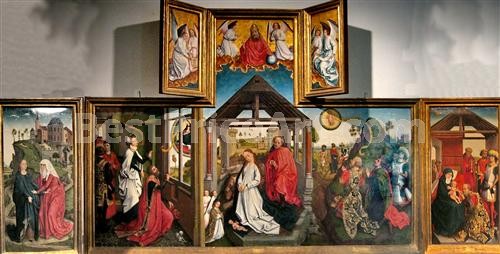
Rogier van der Weyden - "Polyptych with the Nativity"

Polyptych with the Nativity

Rogier van der Weyden

____________

one is a lonely number

but let there be four – 11:11 – and the
angels are passing, a.m. or p.m.

two is the natural minimum from which
grows three, a pyramid, also a trinity,
or even a Trinity

then four, which is solid, foursquare,
even cubic, therefore a house

five, a pentagon, authority

many is a polyptych, representing a
multiplicity, metaphysically a polis, a
community, from the Greek for “many
folds”, or, extrapolating, manifold

twelve, a dozen, and so forth

numbers, in other words, talk, signify
within a context something specific to
that context that is not stated but
instinctively ever understood, animals
flee when confronted with uncomfortable
numbers

but countless they also shimmer, like
stars, a panoply, a myriad

also like works of art

therefore the polyptych above, do click,
for a magnificent reproduction, see it
bring together parts of a whole, in one
place, at one time, and transcending
imaginatively even earthly dimensions,
for our contemplation

therefore also Vingt regards sur l’Enfant
Jésus
“,
which I spoke of in my last posting,
my first to this, my second day of C…mas

you get art and music through the senses,
instinctively, unlike the murkier medium
of words, which can be cryptic

numbers speak louder, which is to say,
than ever words

read my lips

Richard

“Vingt regards sur l’enfant Jésus” – Olivier Messiaen‏

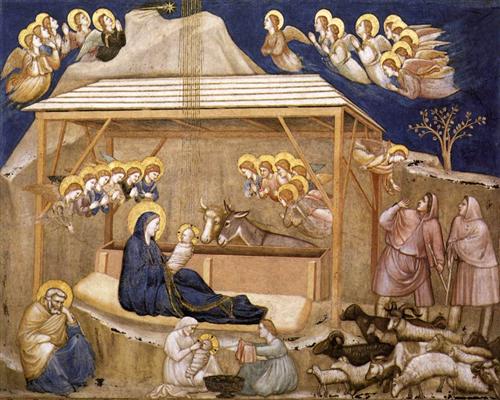
Giotto - "Nativity" (1311-1320)

Nativity (c. 1311)

Giotto

____

just in time for C***mas, a sublime
piece on the Nativity of Christ as
profound, dare I say, as any High,
or even Midnight, Mass

Olivier Messiaen, one of, to my mind,
the greatest composers of the XXth
Century, was also a devout Catholic,
the organist at the Église de la Sainte
-Trinité
in Paris, his music is imbued
with Catholic sentiment, the idea of
holiness

he seems to me a reincarnation, nearly,
of the great organist at the Augustinian
monastery of Sankt Florian
in Upper
Austria, Anton Bruckner, no other
composers, after Bach, have been so
inspired specifically by their religious
faith

Bruckner builds cathedrals with his
music, notably out of his eleven
symphonies

Messiaen, a century later, performs,
instead, sacraments, attends to the
intricacies of their consecrations

Vingt regards sur l’Enfant Jésus is
a succession of twenty perspectives
upon the child Jesus, linked by their
intention rather than by a common
musical theme, as would be the case
in a set of variations, the only other
form that would contain so many
movements

it is atonal, arhythmic, and does not
present the evident repetitions that
Classically would have given the
music a sense of structure, it seems
to me to be trying rather to describe
the iridescence of starlight, the
majesty of the enveloping night,
the gathering, and worshipful
confederation, of the host angels

Richard

psst:

the 20 movements –

1. Regard du Père (“Contemplation of the Father”)
2. Regard de l’étoile (“Contemplation of the star”)
3. L’échange (“The exchange”)
4. Regard de la Vierge (“Contemplation of the Virgin”)
5. Regard du Fils sur le Fils (“Contemplation of the Son upon the Son”)
6. Par Lui tout a été fait (“Through Him everything was made”)
7. Regard de la Croix (“Contemplation of the Cross”)
8. Regard des hauteurs (“Contemplation of the heights”)
9. Regard du temps (“Contemplation of time”)
10. Regard de l’Esprit de joie (“Contemplation of the joyful Spirit”)
11. Première communion de la Vierge (“The Virgin’s first communion”)
12. La parole toute-puissante (“The all-powerful word”)
13. Noël (“Christmas”)
14. Regard des Anges (“Contemplation of the Angels”)
15. Le baiser de l’Enfant-Jésus (“The kiss of the Infant Jesus”)
16. Regard des prophètes, des bergers et des Mages (“Contemplation of the prophets, the shepherds and the Magi”)
17. Regard du silence (“Contemplation of silence”)
18. Regard de l’Onction terrible (“Contemplation of the awesome Anointing”)
19. Je dors, mais mon cœur veille (“I sleep, but my heart keeps watch”)
20. Regard de l’Église d’amour (“Contemplation of the Church of love”)

songs of some birds‏


untitled-1939-1.jpg!BlogPablo Picasso - "Untitled" (1939)

Untitled (1939)

Pablo Picasso

_________

having wondered only recently about
bird song, whale song
, can these be
considered singing when they are
essentially language, we think, and
not codified, technically constricted,
I see pertinently appear a study
suggesting birds follow a pentatonic
scale, our own musical basis,
harmonics between birds and
humans are apparently identical

this suggests that harmonics in
nature are as fundamental as
mathematics, we have somehow,
humans, diverged from what we
think of as singing, left rhythm
and tonality from our conversation
to produce uninflected prose and
monotony, language at the level
of atonal, arhythmic expression,
for better or for worse, corruption,
or refinement, evolution

I wonder, again, if prose is not
bad poetry, or has poetry evolved
into prose

should we feel shame or ingenuity,
do birds have their own divergent
degrees of poetry, do some, most
maybe, veer also towards the less
exacting prose

do some birds not sing, in other
words, or only sometimes maybe,
when mating, for instance,
something like how we croon
when we’re dating, put on our
very best airs

Richard

“Nude Descending a Staircase” – Duchamp / Kennedy‏

Marcel Duchamp "Nude Descending a Staircase, No.2" (1912)

Nude Descending a Staircase, No.2 (1912)

Marcel Duchamp

________

Nude Descending a Staircase

Toe upon toe, a snowing flesh,
A gold of lemon, root and rind,
She sifts in sunlight down the stairs
With nothing on. Nor on her mind.

We spy beneath the banister
A constant thresh of thigh on thigh—
Her lips imprint the swinging air
That parts to let her parts go by.

One woman waterfall, she wears
Her slow descent like a long cape
And pausing, on the final stair,
Collects her motions into shape.

X.J. Kennedy

_________

in my class on Modern Poetry on the
Internet they complained that both
Duchamp and Kennedy were
objectifying women

maybe I too am

read my response

“I thought the poem was hot, and I’m not even a heterosexual, it renders voluptuous the female body, as the female body should be rendered, and, again, I’m not even a heterosexual, how can a heterosexual man not tremble at the “snowing flesh, / a gold of lemon, root and rind,”, the “constant thresh of thigh on thigh”, the very “swinging air / that parts to let her parts go by.”, by the time she gets to the “final stair” you’re jelly

women have their own pornography, have you seen The Bridges of Madison County

I also love Duchamp’s painting, all shimmering gold and glittering, all panels of incandescent light, his “Nude” could descend my staircase any day, despite my counterintuitive position, for which information you can again read above

cheers, Richard”

cheers, Richard

psst: poets are supposed to defy conventions,
watch me, poets know we’ve got nothing
to lose