Richibi’s Weblog

Just another WordPress.com weblog

Category: paintings to ponder

at the XVth International Tchaikovsky Competition – Dmitry Masleev‏

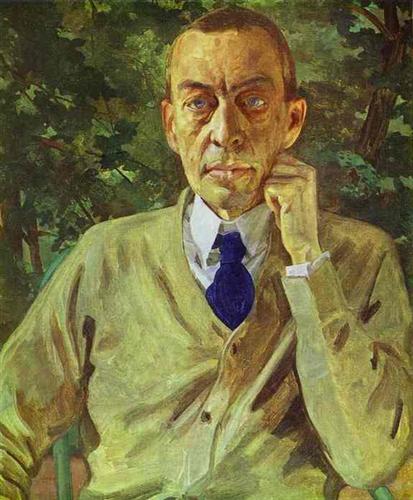
"Portrait of the Composer Sergei Rachmaninov" -  Konstantin Somov

Portrait of the Composer Sergei Rachmaninov (1925)

Konstantin Somov

_____________

after two superb performances on
the last day, June 20, of the Round
1 competitions, I expected to close
up shop, not listen to another
deserving competitor, skipped a
trio of competent but otherwise
uninteresting contenders, and
readied to quickly go on to the
second round nominations

Dmitry Masleev, the very last
performer, wasn’t to go down,
however, without a fight, wowed
me, despite my initial sceptical air
he delivered from the beginning an
unimpeachable Bach, followed by
a “Farewell” Sonata to rival Shino
Hidaka
‘s, my queen, from there it
was nowhere but up, his final
Rachmaninov dotted the i’s,
crossed the t’s, of his brilliance,
a fitting hiatus to a powerful
and significant showdown

listen

Richard

at the XVth International Tchaikovsky Competition – Shino Hidaka

  "The Musical Contest" -  Jean-Honoré Fragonard

The Musical Contest (1754-5)

Jean-Honoré Fragonard

______

with only four contestants to go,
I already crown Shino Hidaka the
winner of the XVth Tchaikovsky
Competition
, this kind of affinity
only comes around once in a
lifetime, her Bach was not only
perfect but inspired, probing,
her ensuing Chopin,
mesmerizing, the Beethoven
that followed aptly, though ever
unexpectedly, transcendental,
transcendence not ever
happening without absolute
mystical concentration, her
Tchaikovsky, an evocation
rather than a mere description
of a Russian village, her
Rachmaninov, on utter fire

Dmitry Shishkin, before her,
neither was un-brilliant, a
consummate technician,
however, rather than an outright
revelation, his spirited Bach was
a turning point for me, finally
someone who got it, his Mozart,
as frivolous and delightful as
Mozart would’ve wanted it to be,
the rest appropriately everywhere
dazzling, second, therefore, ever
so illustrious, nevertheless,
prize, bravo

neither, incidentally, milked any
of their notes, just played what
was written

Richard

psst: compare Fragonard, above, to
Mozart, a synaesthetic match,
where sight and sound are
interwoven, giving you social
intimations of the mid-18th
Century

July, 2015‏

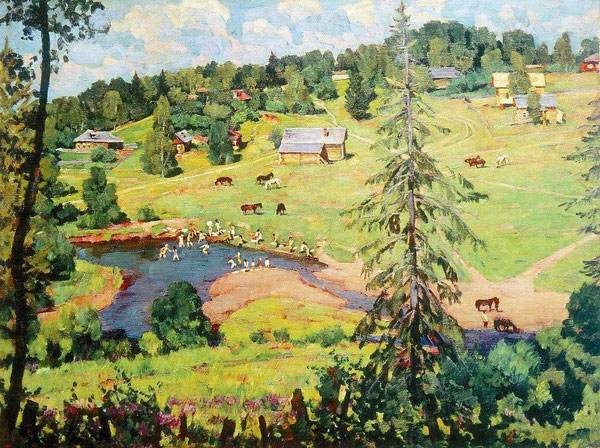
"July Bathing" - Konstantin Yuon

July Bathing (1925)

Konstantin Yuon

_________

the most wonderful thing I learned
about Tchaikovsky’s “The Seasons”
recently, watching the Tchaikovsky
Competition
, was, first of all, that
they even exist, and secondly, that
they are comprised of months,
January, February, March, and so
on, not seasons

so Vivaldi, Tchaikovsky would’ve
thought, so XVlllth-Century, been
there, done that

my favourite month is June to date,
of course, my birth month, July,
though more accurate here,
seems somehow inappropriate
on account of its unfortunate title,
“Son of the Reaper”

you’ll like June, a barcarolle
in G minor, and imagine the music
of July to be the music of June all
over again, no reapers but of wheat
and money

listen to Moye Chen, however,
deliver not only the first formal
glimpse I had of Tchaikovsky’s
masterwork, including months, like
“April: Snowdrop in E-flat major”,
do you love it, but also a noteworthy
Bach and, not un-coincidentally,
a quite competent Mozart

all entirely worth your time

may your July be blessed

by whoever might be your deity

Richard

at the XVth International Tchaikovsky Competition – Bach‏

"J.S. Bach, Wohltemp. Klav. Bd. I, No. IV. (Extrait) / (Duo de Tristesse)" -  Robert Strûbin

“J.S. Bach, Wohltemp. Klav. Bd. I, No. IV. (Extrait) / (Duo de Tristesse)” (1957)

Robert Strûbin

________

if I’ve been getting on their backs
about their Bachs at the Tchaikovsky
Competition
, it’s that they’re playing
Bach as though he were mediocre
Beethoven, it’s like asking Duke
Ellington to be Pink Floyd, it’s just
a completely different generation,
era

Bach wrote for the harpsichord, a
precursor to the piano, it could not
control the volume, nor the length
of a note, the pianoforte came
along to resolve both issues

therefore before Beethoven, who
made full use of the new invention
and worked hard the pianissimos
and the fortissimos, to degrees that
often became either inappropriate
or too authoritative, indelicate or
obnoxious if you’re not in the mood
– I remember wanting to play his so
solemn 111 at my father’s funeral,
but realized late that the first
movement was not especially in
that situation warranted, nor even
parts of the transcendental, but not
always not obstreperous, adagio –
and thumbed thus his nose at the
aristocracy, who earlier, before
the citoyens had demanded their
rights and when the world had
been considered to be of a
rational, logical order, a clock,
and as regular, would never have
tolerated such impudence

Bach and Mozart do not sway
much from strict rhythm, neither
do they alter volume much at all

so that the constant display of
heartfelt Bach and passionate
Mozart becomes cloying, and
not at all what these Classical
and Baroque masters would
have approved of

nor Beethoven, nor Chopin, for
that matter, whose strict tempo
markings didn’t include much
rubato, ritardandos, which you
could think of as milking a note,
putting velvet on your canvas,
it doesn’t work, the composition
itself unaided by bathos, pathos,
delivers, check out, of course,
Glenn Gould

Andrei Korobeinikov sat me right
down the other night with his
arresting BWV868, thrilling,
followed by more dazzling
pyrotechnics, though he fizzled,
and fractured his Beethoven, the
very 111 I care so much for, I
couldn’t even finish, you don’t
need a velvet canvas behind the
111, neither cloying ritardandos,
just skill, nor tangles of notes,
for that matter

Richard

at the XVth International Tchaikovsky Competition – the program‏‏

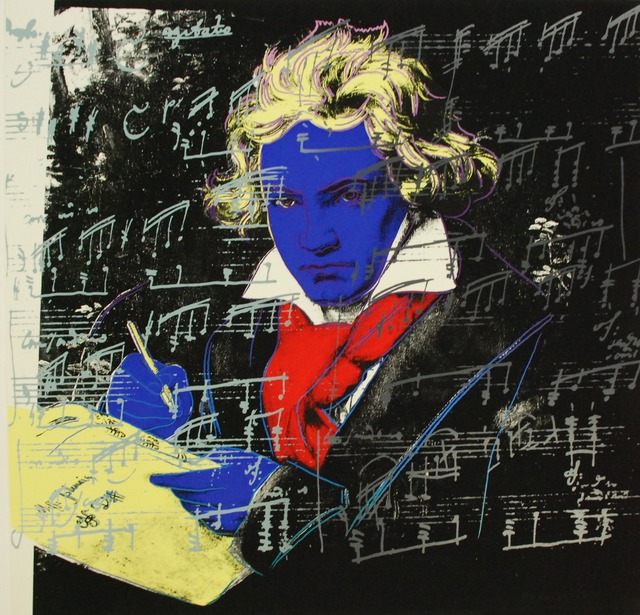
"Beethoven, 1987" -  Andy Warhol

Beethoven, 1987 (1987)

Andy Warhol

______

you’ll probably have noted, if you’ve
been following the Tchaikovsky
Competition
, that, unlike the
Rubinstein, the selection of works
is much more constrained, though
the mighties nevertheless
predominate

after the third day and into the
fourth, only one contestant has
started with anything other than
Bach, a Tchaikovsky

but unfortunately none of them but
one had given us a Bach worthy of
his name, then followed through
with, not surprisingly, a quite
competent Mozart, the cultural
conditions being not yet all that
different, aristocrats were looking
for their own music instead of the
church’s, secular instead of
ecclesiastical, therefore a tune
rather than an oratorio, Beethoven
and the Revolution would change
all that

afterwards a sonata of Mozart,
Haydn or Beethoven, the Classical
triumvirate, after which Tchaikovsky,
appropriately at this competition,
then études, either “-tableaux”,
“transcendentales”, or plain and
simple, by Rachmaninov, Liszt, or
Chopin, that’s it, you get to hear
the “Appassionata” or the “Grandes
études de Paganini”
several times
that way, sharpening discernibly
your musical ear

one was riveting, Andrey Dubov‘s

another, Lukas Geniušas transfixed
me with his opus 2, no 3, of
Beethoven, a work I usually only
ever tolerate, sending it soaring
into the bard’s later mature, and
revelatory, period

others have been competent, even
admirable, several, however, not
ready for this trial, they’ve come
without adequate preparation for
the ball

though I’ve been watching it in
my pajamas, I should talk

Richard

the flow (with a representative performance of Bach)

"The Kitchen"  - Pablo Picasso

The Kitchen (1948)

Pablo Picasso

________

having forgotten that I’d left a candle
in the kitchen, I thought, is that what
you’re going to strike me with,
Alzheimer’s

and then I thought, who’s you

certainly not some Creator with a
white beard and a vengeance, or
even, for that matter, without a
vengeance, even empathy, a
buddha, a guardian angel

no, “you” would be the order of
things, the flow

I spread my arms, and ceded to
it

to be one with the flow, I thought,
that’s the Force, there was no
getting around it

to be at one with the Force,
listen

then I remembered the chicken
drumsticks in the ginger cherry
sauce I’d left in the oven

which turned out nevertheless
perfect

Richard

psst:

for perfect coconut rice,
1 cup of coconut milk,
available in most high-end
food stores, one of water,
one of rice, of course, your
pick, bring to a boil, lower
heat, simmer covered for
45 minutes, an hour, or as
soon as you remember
you left it on the stove,
turn off heat, add a
tablespoon of butter, lime
juice

serve with chicken
drumsticks in ginger
cherry sauce

and, of course, wine

“Schubert at dinner” – me‏

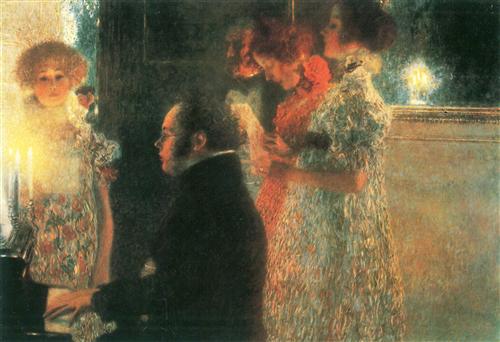
"Schubert at the Piano, ll" -  Gustav Klimt

“Schubert at the Piano, ll” – Klimt (1899)

Gustav Klimt

_______

June has been too hot for words
here, therefore my hiatus, along
with other physical and emotional
tribulations

but someone sent me something
today that made me think I should
return to my literary preoccupations

I’ve been fussing about my kitchen
rather, making soups, biscuits,
muffins, learning about basic, and
trying out unusual, taste
considerations

coconut rice with lime, for instance,
perfect for seafood and summer
presentations

pan-roasted pork tenderloin in a
whisky, mustard preparation, for
one’s incontrovertible delectation

you need to sear the tenderloin in
oil first, salt and pepper of course,
turning to brown all indentations

then smear with a whipped up
mustard and butter blend, lower
heat, cover, listen to this Schubert,
meanwhile, revelation

one of several transcendental
sonatas he wrote before he died,
a too early death, considering his
sublime cultural donations

he was 30, too young to die, to
produce what would’ve surely
been otherworldly musical
creations

when the meat’s cooked, set it
aside, keep warm, loosely
covered, increase heat, add
diced shallots, soften for
several fragrant inhalations

add as much whisky as you
want, though too much, I
found, will defeat your taste
expectations, though not, of
course, your degree of
inebriation

bring to a boil, reduce to a glaze,
lower heat, add cream to the
mustard, butter, shallot, whisky
agglomeration

gently cook sauce till it clings
to a spoon, I add the pork then
to the pan to return it to my own
doneness specifications

with coconut rice, you’ll serve
an unadulterated celebration

with Schubert’s D894, whether
cooking or dining with it, an
utterly existential affirmation

have fun

Richard

psst: serve with wine
June, 2015‏


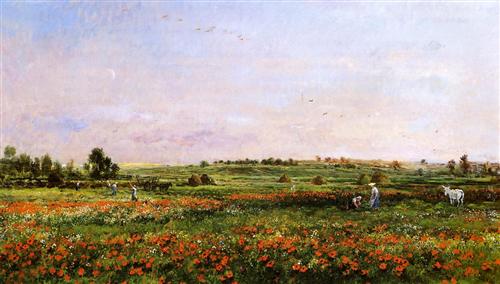
 "Fields in the Month of June" - Charles-François Daubigny

Fields in the Month of June (1874)

Charles-François Daubigny

___________

there were no poems not tawdry
about the month of June when I
looked, I read of the moon a lot,
of blossoms everywhere blooming,
troubadours crooning, couples
spooning, ubiquitously and
indiscriminately, none enough to
warrant my further attention

but this lyric, serendipitously,
finally, touched on what I thought
June might bring up

June, it said, is busting out all
over
, to corroborate, just click

incidentally, Monet, a year earlier,
1873, had painted his Wild
Poppies, near Argenteuil
, the
month of June in his conception
being addressed here perhaps
merely peripherally

but it seems Daubigny and Monet
must’ve known each other

again just click

Richard

“fried bread” – me

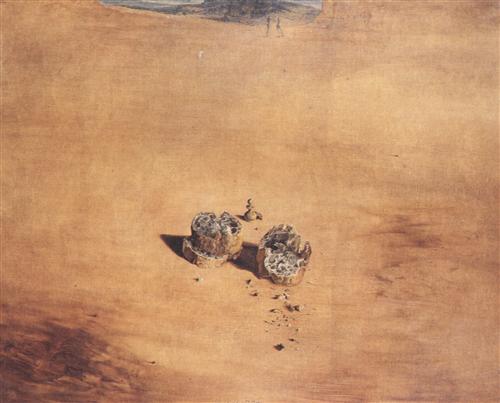
  "Two Pieces of Bread Expressing the Sentiment of Love" - Salvador Dali

Two Pieces of Bread Expressing the Sentiment of Love (1940)

Salvador Dali

_____

for my mom, who wanted the recipe

fried bread

to

1 1/2 cups of flour, pick a flour, any
flour

add

1/2 tsp salt, and
1 1/2 tsp of baking powder

I would think that eliminating salt
would give you merely a blander
bread, therefore salt is not
essential

and not adding baking powder
would simply produce a flatter
fry, therefore, theoretically, also
optional, but I’ve yet to test
these suppositions

though the recipe calls for 1 cup of
warm water, I’ve found that so much
water added to 1 and 1/2 cups of
flour makes the dough too limp and
unmanageable, so I recommend

1/2 cup of warm water

though water density, hard, soft,
probably depends on where you live

knead in more water by degrees if
your dough remains too dry

I also added

1/4 cup of grated Romano cheese, and
1 ample tbsp of fresh thyme

to the mix last night, though I’d
considered fresh basil, let it rise 20
minutes in a warm spot under a dry
cloth while I watched Sweden win
Eurovision 2015 from Vienna, rolled
out circles between two sides of a
piece of sealing wrap, folded over,
with extra flour between if needed,
the wrap helps to not make a mess
of your counter, made three large
rounds of dough out of my mix for
hearty slices, though less robust
portions would be, I’m sure, just
fine

fried each patty in up to

1/4 cup of oil, avocado had been
recommended, also coconut or
grape seed since, but I introduced
it only as needed not to overwhelm
either myself or the pan

flipped the cake once when the
top was becoming plump and
seemed to be breathing, when
the underside had become
golden brown

let the other side fry till equally
crusty and golden

had some last night with
Kaiserschinken, Kaiser’s ham,
and a firm Italian cheese,
Parrano Robusto

also a glass of cheap white wine

delicious

Richard

the late sonatas of Beethoven‏

"Music" - Gustav Klimt

Music (1895)

Gustav Klimt

______

the last three sonatas of Beethoven have
always seemed to me a progression, the
first two being sketches for the third,
however accomplished these earlier ones
might’ve individually nevertheless been

they are not often heard chronologically,
pianists will usually play the full 32 in a
more representative order, some early,
some middle, some late Beethoven, as
they do, not unreasonably, in even less
comprehensive performances

but it’s instructive to hear them played
in a row

let me point out that the Hammerklavier“,
the piano sonata right before them, opus
106
, had already pronounced, with the
authority of the very Ten Commandments,
the purview of the piano, and by extension
the possibilities inherent in Western music,
or any music, for that matter, yet there was
more to come from this prophet, this
Nietzschean superman

the last sonata, the 32nd, the opus 111, is
his testament, a work of the utmost majesty,
humanity, and reflection, not only a
masterpiece but a prayer, a transcendence,
a musical rendition of the resurrection

this is what I heard one recent Sunday
night at a recital in the city

here are the three by, however, another
pianist, for the performer I saw wasn’t
available on the Internet, but these are
equally, if not even more, effective,
though the player, a youth still, is a boy
putting on a man’s shoes, audibly, they
are not, however, save for that karmic
insufficiency, a bad at all fit, bad is
never so inspiring

note the short, fast, explosive second
movements in both the 109 and 110,
prefiguring the first movement of 111

note how the last movement of the last
sonata
, instead of merely rendering
what had been considered beautiful
music, as in 109 and 110, breaks
through into a quite other dimension,
an irresistible level spirituality, a
transcendental elevation, an ascension,
a sublime trajectory for the secular age
which ‘d follow

there still hasn’t been heard anything
quite as profound

Richard