Richibi’s Weblog

Just another WordPress.com weblog

Category: paintings to ponder

“The Iron Age” – Ovid
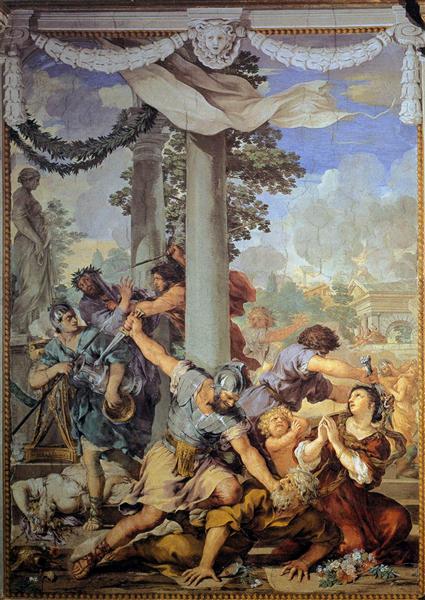
 

the-age-of-iron-1641-1.jpg!Large.jpg

                                “The Age Of Iron (1637-1641)

                                          Pietro da Cortona

                                               __________

The Iron Age

Hard steel succeeded then: 
And stubborn as the metal, were the men. 
Truth, modesty, and shame, the world forsook: 
Fraud, avarice, and force, their places took. 
Then sails were spread, to every wind that blew. 
Raw were the sailors, and the depths were new: 
Trees, rudely hollow’d, did the waves sustain; 
E’re ships in triumph plough’d the watry plain.

Then land-marks limited to each his right: 
For all before was common as the light. 
Nor was the ground alone requir’d to bear 
Her annual income to the crooked share, 
But greedy mortals, rummaging her store, 
Digg’d from her entrails first the precious ore; 
Which next to Hell, the prudent Gods had laid; 
And that alluring ill, to sight display’d. 
Thus cursed steel, and more accursed gold, 
Gave mischief birth, and made that mischief bold: 
And double death did wretched Man invade, 
By steel assaulted, and by gold betray’d, 
Now (brandish’d weapons glittering in their hands) 
Mankind is broken loose from moral bands; 
No rights of hospitality remain: 
The guest, by him who harbour’d him, is slain, 
The son-in-law pursues the father’s life; 
The wife her husband murders, he the wife. 
The step-dame poyson for the son prepares; 
The son inquires into his father’s years. 
Faith flies, and piety in exile mourns; 
And justice, here opprest, to Heav’n returns.

                                        Metamorphoses – Ovid

just saying

Richard


what is poetry

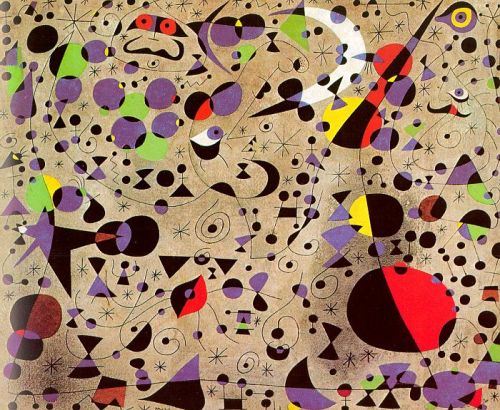
the-poetess

     “The Poetess (1940)

           Joan Miró

                 _____

when Aristotle proceeds to declare the 
parameters of “Poetry” for the ages“, his
definitions of the various poetic 
manner[s] or mode[s] of imitation” 
have already been established, his 
categorizations are not unlike Darwin’s 
categorizations of the species during
a much later age, Aristotle was a natural 
scientist much more than he was our 
notion of an abstract philosopher, he 
traded in facts rather than in the 
esoteric musings that Platofor 
instance, pursued, Virtue, Justice, 
the Good, his conclusions were more 
verifiable

Kant, incidentally, is also famous for 
following a similar form of investigation
as he attempted, nearly, for most, 
inscrutably, to categorize the elements 
of our faculty of understanding

a side story

Kant had stated that at birth we already 
have within our perceptual framework 
implicit understanding of space and 
time, these are not learned through 
experience but are already 
incorporated within us, he said

many years ago, coming out of a 
week-long coma, not knowing where
I was but alone, at that point even
just my consciousness, cause my 
body, were it there, would’ve been 
under the immaculate white sheets 
I could see that would’ve been 
shielding my legs

I looked around, could gather motes 
upon rays of light that were entering 
from what appeared to be a window 
on the right, behind sheer white 
curtains stirred by a soft breeze,  
whirling the shimmering particles 
alive in the light before me like 
miniature spinning galaxies moving 
at the pace of their own infinity

there was no sound

white walls around me stood utterly
still in the purview of my perception,
a door, also white, stood opposite 
me on the opposite wall

where am I, I wondered, could this 
be heaven, an afterlife, I might’ve 
died, I thought, marvelling, no fear, 
regret, nothing other than curiosity, 
absorption, fascination

I tried to answer my question, where 
am I, two dimensions, I figured
after having watched Terence Stamp 
exiled by Marlon Brando to a flat 
intergalactic window pane in 
Superman“, I hadn’t excluded this 
eventualityhowever ingloriously 
transcendental, as a possible 
outcome, I might be in a world with 
only two dimensions, height and 
width, no depth yet without more 
investigation, experience 

ergo, Kant, I concluded, was wrong, 
our knowledge of space is not inborn 
but a product of time and thought like 
everything else 

later, the white door on the far wall
opened, and a nurse walked in, also, 
incidentally, in incandescent white,  
and understood I was alive

Aristotle suggested that our original 
double instincts towards poetry were 
our propensity to imitate, children 
imitating their parents’ even 
idiosyncratic mannerisms, for
instance

and rhythm, repetition, preludes to 
order, coherence

those two

poetry, I read, is expression
reflecting the heartbeat, essentially,
in all its myriad representations

Richard  

“To One Who Loved Not Poetry” – Sappho

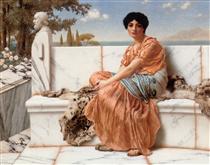
in-the-days-of-sappho-1904-jpgpinterestsmall

  “In The Days Of Sappho (1904) 

        John William Godward

                    _________

if I digressed towards “Tragedy” in my
most recent chat about poetry, I perhaps
blurred the fact that there were several 
kinds of poetry Aristotle was speaking   
about, but that all had the essential 
elements of both rhythm and 
representation, the idea that a poem 
was a reproduction of something 
that was not itself, a retelling

some of these rhythmic utterances 
were tragedies“, others were mere,  
indeed, verses without much of an 
agenda other than being the replication 
of something with rhythm the poet
wanted to promote

o, what a beautiful morning, two dactyls
and a trochee, for instance, the poetic 
meters that describe – ta da da, ta da da, 
dah dah – the natural music of that 
exclamation

and that can be a poem

here’s one of Sappho‘s, who lived 
sometime between 630 and 612 BCE
to around 570 of the same, of course,
era, famous for being from the island  
of Lesbos, yes, Lesbos 

it is To One Who Loved Not Poetry

    Thou liest dead, and there will be no memory left behind
     Of thee or thine in all the earth, for never didst thou bind
     The roses of Pierian streams upon thy brow; thy doom
     Is now to flit with unknown ghosts in cold and nameless gloom.”

so there, she says, I think, and all in iambic 
octameter, eight times ta dah

I preferred not to use one of her more
flirtatious, therefore controversial,
utterances, for fear of skewing to  
another, however compelling,
discussion

maybe next time

Richard

psst: the Pierian Spring was a spring in 
          Macedonia sacred to the Muses,
          the source of inspiration for 
          science, then, as well as the arts

Aristotle on poetry

aristotle-jpglarge

      Aristotle” (1653)

        Luca Giordano

          ___________

so what’s a poem

in an attempt to get a clearer picture 
of what a poem should be, rather 
than trust only my own, however 
informed perhaps, opinion – though 
it must be added that we all bring 
something to that word’s definition, 
mine no less worthy than yours, 
yours no less worthy than mine – 
thought I’d go back to authoritative 
sources to see what they might 
have said

and it doesn’t get any earlier and 
authoritative than Aristotlewriting 
in 350 B.C.E., at the height of 
Ancient Greek preeminence, 
dissecting the term in his 
penetrating and perspicacious, 
ahem, Poetics” 

I propose to treat of Poetry in itself and of its various kinds,
noting the essential quality of each, to inquire into the
structure of the plot as requisite to a good poem; into the
number and nature of the parts of which a poem is
composed; and similarly into whatever else falls within
the same inquiry.“, he says in Part 1 of his 
magisterial treatise

and proceeds to declare the parameters 
of “Poetry” for the ages  

Poetry in general seems to have sprung from two causes“, 
he proceeds, imitation and rhythm 

by imitation I think it best to think of 
representation, which is another way, 
anyway, of saying imitation, but 
much more evocative in this instance,
more attuned to our sense of his word 

a poem is a representation then, a 
reproduction of something other than 
itself 

while its rhythm is what George
Gershwin‘s got, and by extension, as  
you can see from this videoGene Kelly

and yes, that means that “Epic poetry and Tragedy, Comedy also
and Dithyrambic poetry, and the music of the flute and of the lyre in
most of their forms, are all in their general conception modes of
imitation.” 

so, according to Aristotle, is dance 

all, therefore, poems

an interesting elaboration about “Tragedy” 
states that it should have the three unities 
that I grew up with during my French 
Canadian upbringing, the unity of time, of
space, and of action the famous French 
Classical dramatists, Racine and Corneille,
applied under the aegis of Louis XlV

not to mention Tragedy’s use of iambic 
pentameter, Shakespeare’s ubiquitous 
beat, a beat that persevered into the very 
Nineteenth Century, in France with 
Rostand‘s Cyrano de Bergerac“, for 
instance, and into the Twentieth Century 
with Eliot‘s Murder in the Cathedral“, 
about the assassination of Archbishop
Thomas Becket at Canterbury in 1170 
under Henry the Second‘s own aegis,
all written as poetry 

the most famous play to follow the 
three unities in the modern era is 
Who’s Afraid of Virginia Woolf?“,
the play which I think defines the 
Twentieth Century, which takes 
place overnight somewhere in 
New England college town, mid-
century, at George and Martha’s 

though followed closely by O’Neill‘s 
Long Day’s Journey int Night“, 
which transpires from morning, one 
day in August, 1912, till midnight, at 
the home ofunity of space, note, 
the dysfunctional Tyrones

so it appears not much has changed
about poetry, Aristotle got a lot of 
mileage out of his early definition, 
nearly 2500 years 

makes you wonder  why so much 
attention was paid instead to 
Platohis contemporary, the 
mystic, who would’ve banned
poetry, he thought it was 
subversive
 
Richard

psst: for a modern day application
          of the three unities, watch 
          In Treatment“, a television
          series, which takes place 
          in a psychotherapist’s office,
          each episode a session,  
   

“Dido and Aeneas” – Henry Purcell

1024px-sir_nathaniel_dance-holland_-_the_meeting_of_dido_and_aeneas_-_google_art_project

         “The Meeting of Dido and Aeneas (1766)

                       Nathaniel Dance-Holland

                            _________________

despite difficulties with the presentation – 
a French production of an English opera 
supplying Spanish, I think, subtitles – this
Dido and  Aeneas is not only the best
version of it I’ve found, but one of the 
very best opera productions I’ve come
across, period

Dido is the queen of Carthage who, having 
fallen in love with Aeneas, a prince of Troy
bent on creating a new commemorative city, 
forsakes her very husband for this heroic 
suitor

Aeneas in turn will leave her, to follow his 
mission of founding Rome, Dido will not 
survive his departure 

ah, Belinda, I am pressed with torment not
to be confessed,  she cries, when she fears
her entanglement with so mighty a hero
will come to an unfortunate end, peace 
and I are strangers grown, she determines

figures in dark clothes in the production
are obviously up to no good, one most
evidently a sorceress, they cast a spell
on the fraught conjunction that the 
lovers cannot at all resist

away, away, Dido exclaims, enraged by
Aeneas’ mere hesitation, no, faithless
man, thy course pursue, she cries, for
’tis enough, no matter whate’er you 
now decree, that you had once the  
thought of leaving me, though Jove,
god of gods, had himself ordained that 
Aeneas pursue his original intention, 
to found the Eternal City, the Rome  
he would choose over her  

for Dido, there is no turning back

thy hand, Belinda, she of her trusted
confidante in those final moments 
requests, darkness shades me, on 
thy bosom let me rest, more I would 
but Death invades me, Death is now 
a welcome guest 

the asp has, in a metaphorical word, 
been cast

remember me, she thereupon moans 
and that for the very ages, remember, 
me, but, ah, forget my fate

last night I was Dido, watch, so can 
you

angels then appear, in the form of, 
granted, extras here, to accompany
her to a peaceful and immortal end,  
much as they did our own Princess 
Diana when she suffered a similar
misfortune

may they both inform our progress

Richard

psst: a spoken preamble is not part of the 
         original text, nor did I find it especially 
         pertinent, however splendidly it might
         have been executed

what is a poet

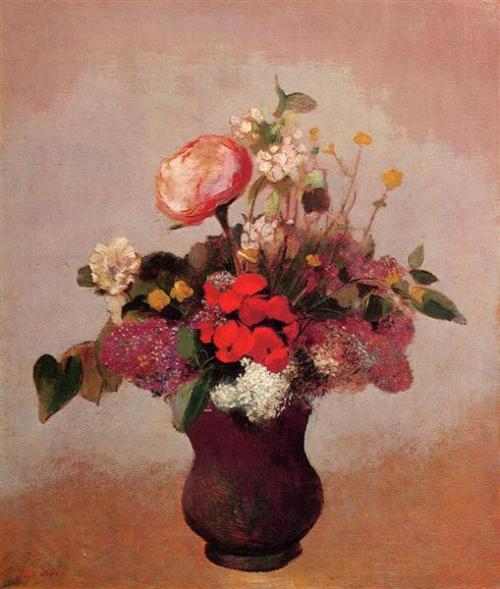
flowers-in-aa-brown-vase.jpg!Large.jpg

                            Flowers In a Brown Vase (1904)

                                            Odilon Redon

                                                 _______

if I imagine myself to be a poetwhat 
is a poet, I have to ask, or, more 
accurately, what do I imagine a poet 
to be

cause this is a two-way street, I am
defined by the word I inhabit, but I 
define the word as well, redefining 
it, essentially, to fit my etymological 
purpose   

my moral purpose I leave to myself,
in a completely other ideological
dimension

if I can

a poet then is one who writes, paints,
composes, manifests, in a word, 
creates, poems

what is a poem

a poem is where beauty and truth 
combine to create harmony, 
coalescence, to the point of one’s
admiration, enchantment, wonder, 
enlightenment, in incremental steps 
leading to very transcendence, the 
feeling that something has moved 
in your heart

just a bouquet of flowers will do it,
for instance

that’s what I think

Richard

on art, its purpose

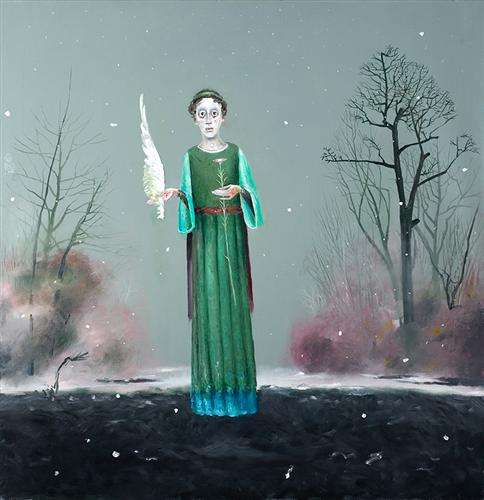
poet-with-flower-2008-jpgblog

                                Poet With Flower (2008)

                                          Stefan Caltia

                                                 _____

wherefore art, I’ve long and often wondered,
with only a wink to Juliet’s Romeo, for my
question dug deeper, why, indeed, itself art

we build our souls on the stories we’ve 
heard, the impressions we’ve received
from voices that spoke directly to our 
senses, painters with paint, musicians
with music, writers with words, poets 
with poems

it started with fairy tales, which told of
right and wrong, good and bad, courage,
kindness, responsibility, and dire 
consequences for discord

Biblical stories also took up a lot of my own
childhood, Jesus, Adam and Eve, Moses
and the Ten Commandments, this last 
reinforced by Cecil B. DeMille’s epic

but soon enough it was Oliver TwistLittle
Nell, and by an inescapable authorial leap, 
since these were all by an irresistible 
Charles Dickens for a guy my age, Sydney
Carton, who valiantly stands in for his
friend, Charles Darnay, at the guillotine, a 
quantum, even existential, leap from 
Peter Pan and Mary Poppins 

though I had the good fortune to learn to 
read and write music as a boy, play music, 
learn about Bach, Brahms and Beethoven, 
it didn’t take anyone else much more than
their enthusiasm to see what the Beatles
were similarly doing, the Rolling Stones, 
the Supremes, they were not only singing, 
but making history, shaping it, and us, we 
followed the questions they rose, their 
responses, the effects upon ourselves
for nothing is considered until it’s 
mentioned, spoken, made clear, and they
were those prophets

the same goes for art, we see as we see
cause Monet, Picasso, Warhol showed 
us how to see, what to look at

and of course poets, Shakespeare, 
RostandDanteGoethe, to inform, each,
their individual language, and culture

I have been Philip CareyScarlett O’Hara, 
Blanche DuboisGary Cooper in High
Noon“, both Martha and George in 
Who’s Afraid of Virginia Woolf“, lately 
I’ve been even Hank Williams

as Babette would say, a French doll who 
gets abducted in Raggedy Ann and Andy:
A Musical Misadventure“, an animated 
movie from the Seventies, – oo aahrr yoo 

Richard

psst: all of them have been me too,
      incidentally

” Shakespeare and Politics”- Professor Paul Cantor

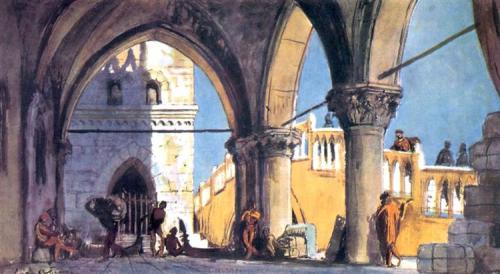
on-the-waterfront-set-design-for-shakespeare-s-drama-the-merchant-of-venice(1).jpg!Large.jpg

 On The Waterfront. Set Design For Shakespeare’s Drama

   “The Merchant Of Venice” (1920)


      Alexandre Benois


                 ________


though this recommendation might seem 

erudite, esoteric, indeed eccentric, if not

even improbable, I vaunt this invaluable 

series to the stars, Professor Paul Cantor

of the University of Virginia, speaking from 

Harvard, however, here, shines such 

glorious light on the already extraordinary 

Shakespeare so as to make him the equal 

of very  Beethoven, poets of nearly 

supernatural ability 


Professor Paul Cantor views Shakespeare 

through Shakespeare’s understanding of  

politics, comparing his political settings – 

commercial Venice, imperial Rome, 

medieval and Renaissance England, 

Denmark under a Christian king – to not 

only shed light on those individual 

political systems alive at a time when 

democracy was being born, but as well 

on Shakespeare’s own unexpectedly 

probing philosophical insights in the 

matter of governance, right up there 

with John Locke and Machiavelli


who’d ‘o thunk it 


the professor is engaging throughout, his  

information entirely absorbing, you’ll come 

out a new wo/man


the lectures are not short at an hour, twenty
minutes, I break to powder my nose, get a
a glass of wine, even answer the phone to,
of course, preferred only parties, but have 
been returning addictively daily 

 it’s a heady indeed addiction


Richard   

to Socrates – on monotheism‏

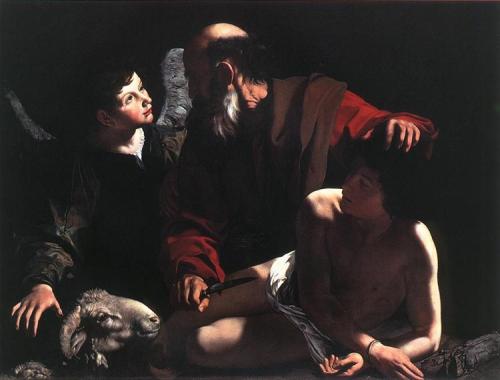
sacrifice-of-isaac(1).jpg!Large

      “The Sacrifice of Isaac (1598)

                        Caravaggio

                               ________

by very definition, the inevitable
result of monotheism, Socrates,  
is war, if there is one authority it  
will eventually be opposed by a 
contrary, however picayune, 
however trivial, opinion, see the 
Protestant Reformationsee Islam, 
for instance, now
 
after which there is disintegration
 
before Christianity, there were gods, 
a pantheon of them symbolically
alive among the rivers, the trees, 
the mountains, read Ovid for an
exhilarating description, wars were 
waged for territory, not conscience  
 
Judaism, the religion of the Jews,
evolved for their own existence a
deity, Yahweh, who was their one 
god, disdainful of foreign others,
an uncharacteristic attitude among 
other religions then, becoming one 
of the very first monotheistic, and
consequently existentially 
compromised faiths, if not the 
first
 
the intent was to rally ideological 
support among its adherents so 
that they could protect the lands 
of Israel and Judahtheir ancestral 
homesas they would have it, a 
sanctification of the territorial 
principle
 
their Bible, the Torah, a vengeful 
work, and the basis for the 
Christian Old Testament, 
demanded of its followers 
unblinking and cruel allegiance,
the sacrifice of Isaacfor instance,
a father required to sacrifice his 
own son, however might it ‘ve
been at the last minute averted by 
the intercession of an angel sent 
by that very Lord
 
Christ came along to turn the other
cheek
 
which didn’t last long 
 
indeed Montesquieu, an early 
philosopher of the French
Enlightenment, tells of the 
King’s librarian of Chinese 
texts, who had been converted 
to Catholicism in China, but 
who was nonplussed upon his 
arrival in Christian France to find 
that the French did not do onto 
others as they would have them 
do unto themselves, nor did they, 
more catastrophically, turn the  
other cheek
 
for that matter see what Christian 
Europe did to the Americans
 
Christ’s own followers, once they’d 
achieved political prominence, after, 
admittedly, 300 years of persecution 
by the prevailing Roman authorities, 
set their own deity, God, on high, 
indeed beyond the rivers, the 
mountains, the trees into the very 
ineffable, the inscrutable abstract, 
and squelched any opposition for  
the next thousand and some years,
the philosophical underpinnings of 
which was the work of your 
contemporary, Plato, Socrates, his 
ideal of the Ideal
 
Augustine signed those recalibrated 
papers with his City of God“, it took 
the Renaissance to make a dent in its 
armour, and another several centuries 
to declare the Christian God dead, 
Time magazine in the ’60s, on the 
heels of Nietzsche‘s nihilistic  
pronouncement some 70 years earlier, 
that God had exited history
 
what we are left with, Socrates, is every 
wo/man for hirself, therefore the Age of 
Human Rights, for better or for worse
otherwise many of us would’ve been 
guillotined, burnt at the stake, stoned 
to death, by now
 
what do you think
 
I’ll bet I can tell, you think that every 
wo/man owes allegiance to what s/he 
believes in, even to inexorable death, 
however impractical, unfortunate, or 
fateful, if your exemplary life has  
anything to say about it 
 
 
cheers
 
Richard

in recognition of Prince

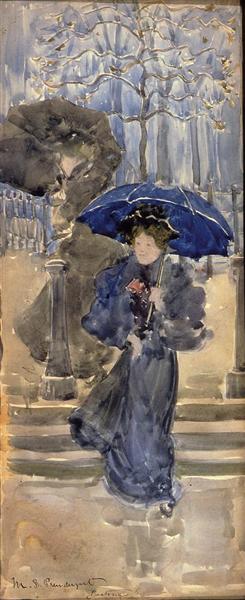
ladies-in-the-rain.jpg!Large

Ladies In The Rain (1893-1894) 
 
         Maurice Prendergast
 
                _____________
 
 
trying to find a musical representation

of me for a love recently lost, but with
whom the interaction is nevertheless
cordial, for a letter I was writing him,

cordially, and which I would sign me,

I hit upon Prince’s Purple Rain“, I never  
meant to cause you any trouble, never 
meant to cause you any pain, perfect, I 
thought, I only want to see you laughing 
in the purple rain
 
how else can one love
 
I remembered that Prince was a hero, 
an angel, a prophet, an epiphany of the 
late Twentieth Century, some voices are
indelible, incandescent, illuminating,
avatars of love
 
 
note the pace of Pink Floyd, the 
hypnotic, messianic even, tempo,  
note the elements of the prophet


Richard