Just another WordPress.com weblog
Category: paintings to ponder
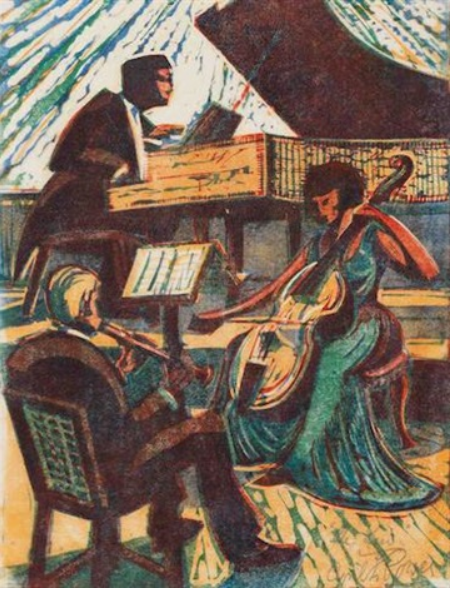
“Trio“ (c.1936)
______
November, 2023, but I still abide by the
belief that a sonata a day keeps the
doctor away, so I’ve continued, more
or less, my medicine
but a sonata exceeds its definition, a
piece of music, consisting of more
than one segment, called movement,
for one or two instruments, the second,
should it be included, being harmony
for an instrument that can play only
one note at a time, which is to say,
everything except the piano
but a piece of music written for three,
instead of just one or two, instruments
is also called a trio
a work consisting of more than one
movement, but performed by three,
instead of just one or two, usually
different, instruments, is as well
called a trio, just to confuse you
here’s one, for violin, cello, and piano,
by César Franck, a Romantic composer,
I didn’t expect much, it being, manifestly,
his first composition, Opus 1, No. 1, but it
was part of the program I got tickets for
coming up at our recital society here in
February, I had to investigate
to my surprise, it was, is, magical
R ! chard
________
Beethoven’s Opus 111 is, to my mind,
the equivalent of the Sermon on the
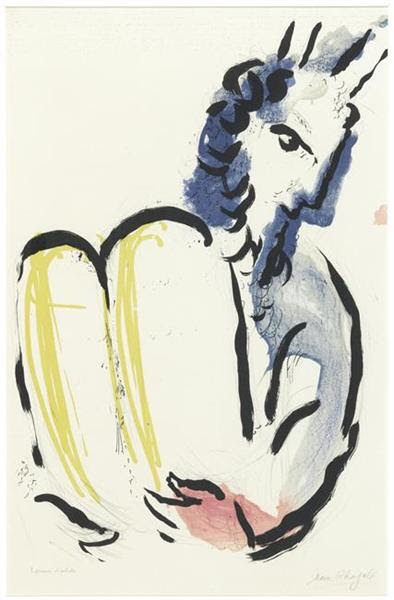
Mount, or Moses’s rendering of the
Ten Commandments, see above, in
our post-Christian world, the world
where God is dead and where we’re
all left to our own devices for better
or for worse
Beethoven confronts a Listener,
who is, or is not, there, pleading
for meaning, purpose
the first movement is rebellious,
despite, ever, his reverence for
his abstract Interlocutor, bowing
before, heeding, this self-anointed
Adjudicator, the Deity we fashion
for ourselves
we are witness to this interchange
the second movement is more
subservient, pleading more
rationally, less explosively, his
case, we hear this too
there are only two movements,
dichotomies, war, peace, man,
woman, chaos, order, none of
them a choice
Beethoven says to exist, to be,
itself, encompasses its own
glory, that is our grace,
whether or not there is a
hereafter
R ! chard
psst: thank you so much for your
participation, however
intermittent, in my Month
of Sonatas, I am not only
grateful, but honored, by
your presence
_______
from the very first few notes of Beethoven’s
we understand we’ve entered an entirely other
reality, the melody is unorthodox, not a lyric,
but, talking against the grain, the beat,
become a sentence, we are witness to
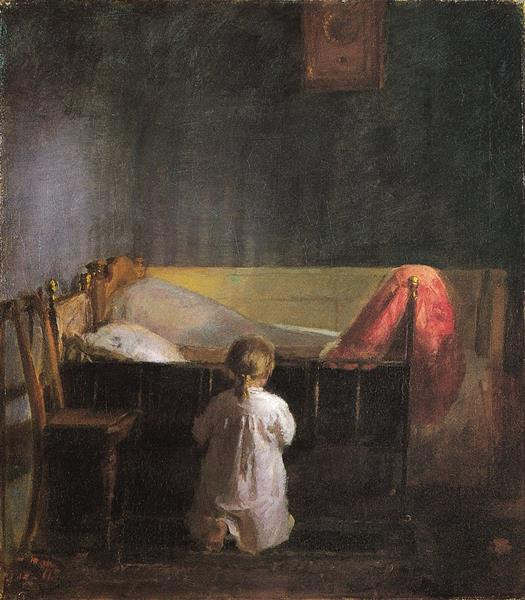
Beethoven addressing the infinite,
Beethoven at prayer, see above
the notes are clear, concise, naked,
happening, again, against the beat,
profoundly intimate, arhythmic,
unadorned, unadulterated, they are,
consequently, prophetic, not only
entertaining, but a moral code, a
metaphysical example of our role
in the shared fate of our nebulous
universe
Beethoven says we must believe
in our own beauty, our worth, it is
our only salvation
it is a mighty revelation
R ! chard
_______
we’re reaching the end of November, with
only three sonatas to go, which will be
devoted to Beethoven’s last three, they
exist in their import, impact, beyond
whatever’s been since, or before,
recorded
treatise on the physical possibilities
of a piano, its breadth of tonal range,
the scope of possible volumes, soft,
loud, not to mention its ability to, in
one instrument, play all the scales,
his following three sonatas, evolved
from the physical to the metaphysical,
“To be, or not to be”, he might as well
be asking, much like Shakespeare
there’d been metaphysical works before,
Bach’s cantatas, Handel’s Messiah, but
this metaphysics was of another order,
there’d been a revolution in France, the
Christian God had been there even
made illegal, Christians sent to the
guillotine, see Poulenc’s formidable
of that
Beethoven’s prayer, his evocation, in
his last three works for solo piano,
were to the Entity that might, or might
not be, out there, “To be, or not to be,
that [remained] the question”
the miraculous is that Beethoven, with
profound humility and respect, notes
that are clear, concise, and
straightforward, confronts the Entity
with nothing but his unadorned self,
at a loss in a sea of meaning, even
suffering despair, presenting, as an
argument the evidence of his life,
his art, his manifest and irrevocable
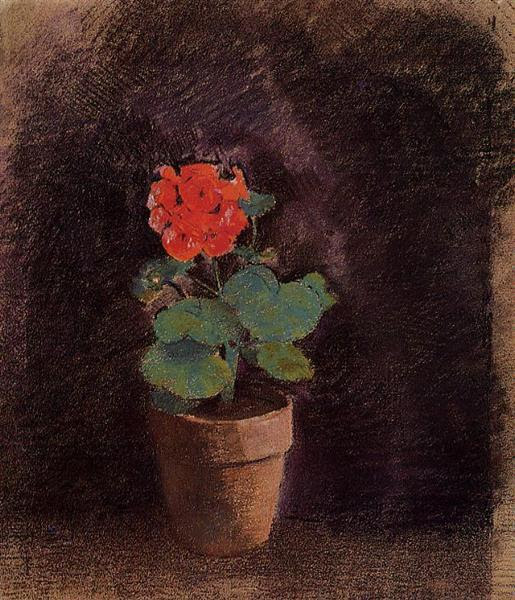
being, much as a flower would,
could it speak, no more, admittedly,
no less, but nevertheless a flower,
see above, and there is, Beethoven
says, glory in that
ponder
R ! chard
______
a sonata can be written for any instrument,
some just more prevalent than others,
here’s one for clarinet, Brahms’ Opus 120,
after the distortions of later composers
you might remember from these pages,
it’s nearly quaint to return to the
traditional templates for the sonata,
more than one movement, no more
than two instruments, and attention
to the Classical imperatives of tempo,
tonality, and repetition
Brahms doesn’t put a foot wrong, all
of the requirements are observed
punctiliously, you could even sing
or dance to this music, something
you couldn’t later do, unless with
choreography, see, for instance,
Nijinsky
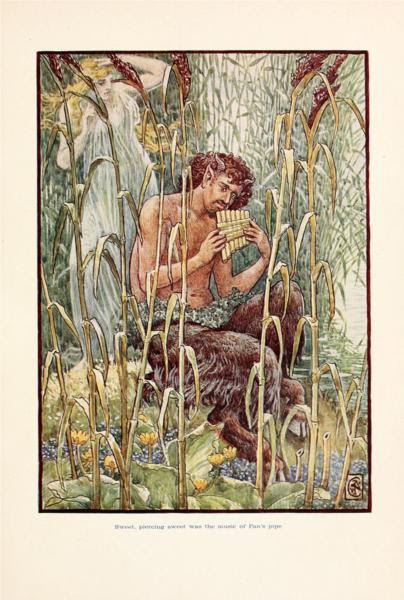
talking about Nijinsky, the clarinetist
here is as feral as the faun Nijinsky
version, in his homage to Debussy’s
The Afternoon of a Faun, 1912, he
even seems, the clarinetist, the very
god Pan, come down from Olympus
to frequent the backwoods of Ionia,
to beguile those who would be
beguiled, with his flute, see above
his accompanist is equally hot
R ! chard
________
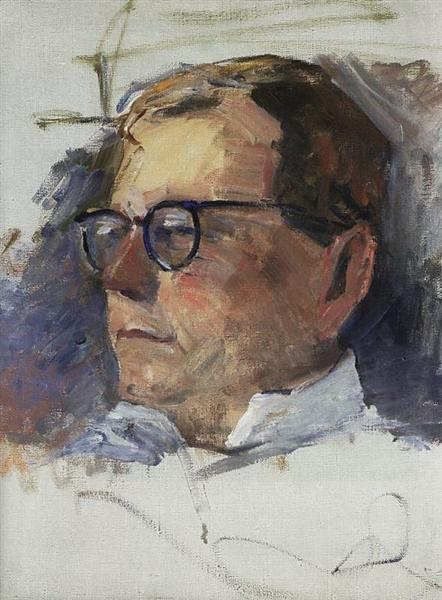
Shostakovich is especially interesting
for being a political composer, caught
up in the Soviet experiment, his soul
is Russian, you can hear it in the folk
music that grounds his compositions,
strict tempo, an aspiration towards
melody
but the tonality is off, the singer sings
off key, the dancer’s legs are broken
Shostakovich describes a people,
an exuberant people, lusty,
warm-hearted, whose spirit has
been broken, you can hear it
had there been a Nobel prize for music,
Shostakovich would’ve won it, along
with his contemporary, and compatriot,
phenomenon, back in the 1960s
both were, incidentally, persecuted
by their government
Opus 134, 1968, written for his friend,
for his sixtieth birthday
R ! chard
_____
if I object to sonatas consisting of only
one movement, I can also object to
sonatas consisting of more than two
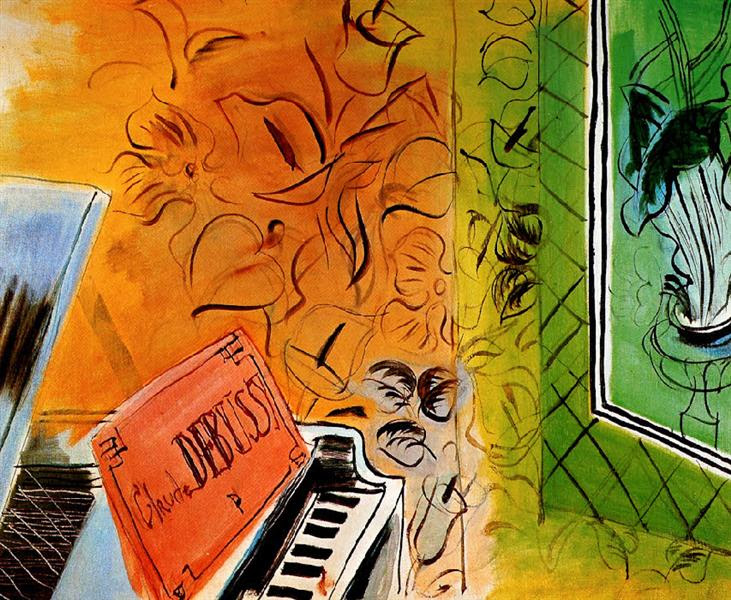
instruments, but here’s Debussy’s
which should more accurately have
been called a trio, a trio is a sonata
with three instruments
note also in the Debussy the breakdown
of all the Classical imperatives, tempo,
tonality, and repetition, another blow to
established authority
but the test is, does it work, at which
point, if it does, terminology becomes
moot, and meaning changes
today, I pondered the word love, its
myriad meanings, and how we still
call that infinite variety of emotions
the same thing, the word sonata
doesn’t hold a candle to the word
love for disinformation
I thought, okay, just make it work,
I’ll define it for myself later, each
one of us being the final arbiter
of our own aesthetic sensibility
the question
R ! chard
______
Alban Berg isn’t the only composer to
write a sonata with only one movement,
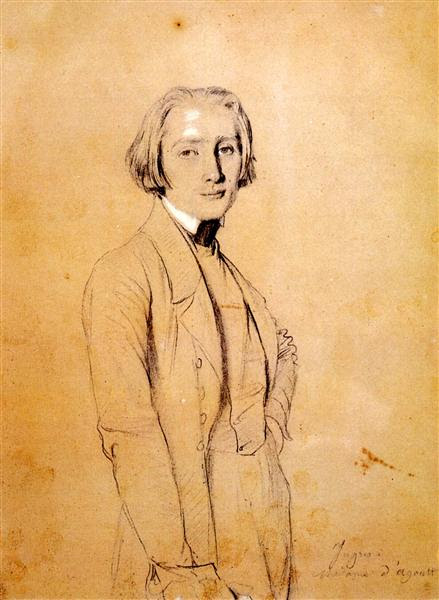
nor even the first, Franz Liszt, some
sixty years earlier, 1853, wrote this one,
Franz Liszt was an entertainer, more
performer than poet, you’ll hear more
bravado in this piece, to my mind,
than substance
but then again, sometimes, that is
the substance
though the finger work here is magical,
entirely worth the price of admission
earlier still, during the Baroque era,
sonatas had consisted of only one
movement, but the term had referred
to, then, the structure of the piece, its
inner workings, not so much the form,
the intention, the change happened
during the Classical Era, starting
around the middle of the Eighteenth
Century, the mid-1700s, which has
been the focus of this month’s
investigation, therefore excluded
from my survey, not being of the
modern era
1685 to 1757, an exact contemporary,
incidentally, of Bach, 1685 to 1750,
except for the extra seven years,
who wrote over five hundred of
them, all available on the Internet
contextually peripherally, you’ll
be utterly enchanted, the Baroque
is not an era to be easily overlooked
R ! chard
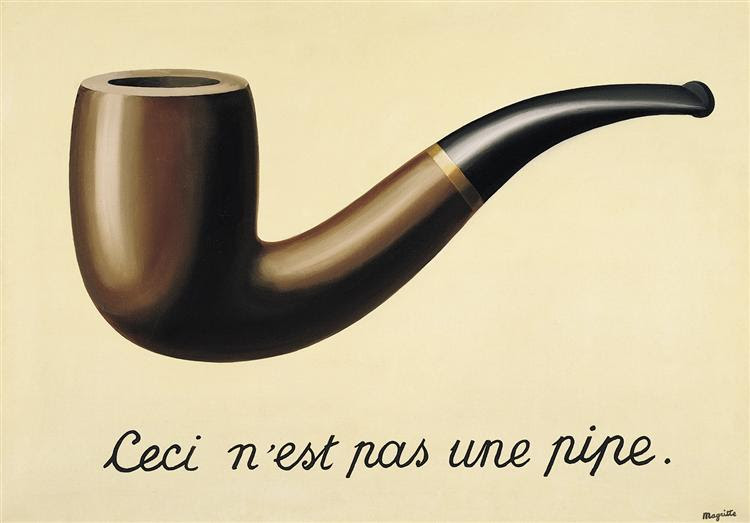.jpg!Large.jpg "The treachery of images (This is not a pipe), 1928 - 1929 - Rene Magritte")
_______
when is a sonata not a sonata, when,
to my mind, it has less than two
movements, but here’s Alban Berg
Alban Berg was a student of Arnold
Schoenberg, the composer who did
the most to break down the pillars
of Classical music, tempo, tonality,
and repetition, you’ll here it all here
Berg was working on a piece he
expected would be a sonata, but
after the first segment, he couldn’t
find the inspiration to continue,
Schoenberg replied that that must
mean his work was complete,
and Berg went along with that,
calling it, nevertheless, a sonata,
playing fast and loose with the
definition, poets do that, also
pianist I believe the greatest who
ever lived, Gould admired the
Berg, how could I argue with that
R ! chard
_____
having heard Stravinsky’s Concerto for
Two Pianos already, if you’ve taken in
the most instructive of any of my
suggested comparisons to hear beside
first, written in 1935, the second, 1781,
you’ll hear the passage of time fly by
both here are played by the same two
performers, brothers, incidentally, an
extraordinary couple, making your
aesthetic decision that much more
contained, straightforward
utterly unexpected, even disarming,
he’s evidently much more in tune
with the Twentieth Century, even
the 21st, than the more bucolic
music of, energetic as it is, Mozart,
who is not of our era, however still
entirely relevant
with Stravinsky, you hear the traffic,
the hustle and bustle of modern life,
the pulse and frenzy of a more
frenetic century, though it must be
remembered that Mozart wrote his
piece between the American, 1776,
and the French, 1789, Revolutions,
a couple of historically seismic
events, not at all not turbulent
if you listen, you can hear it all in
the music, art is like that
enjoy
R ! chard


 Richibi's Weblog