sonatas, continued (Rachmannov – “Rhapsody on a Theme of Paganini”)
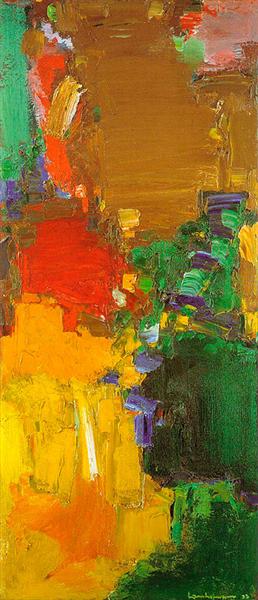
“Rhapsody“ (1958)
Hans Hofmann
________
“Rhapsody“ (1958)
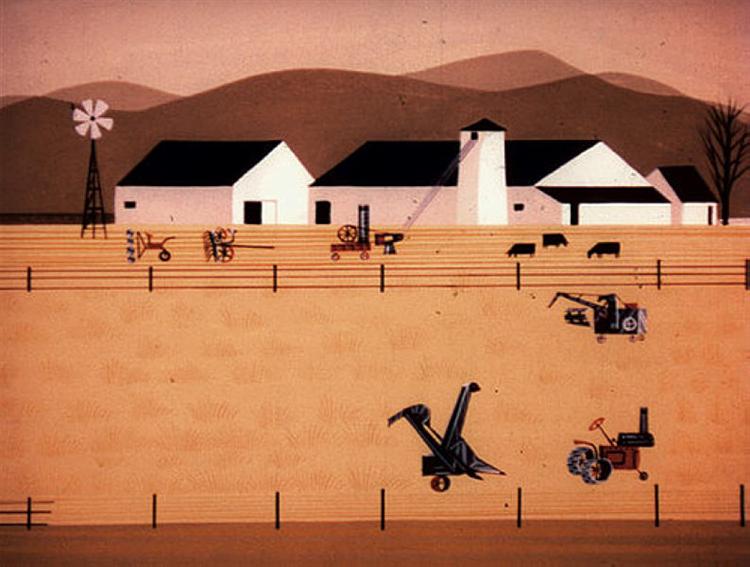
“Rhapsody of Steel“ (1959)
________
so what’s a rhapsody
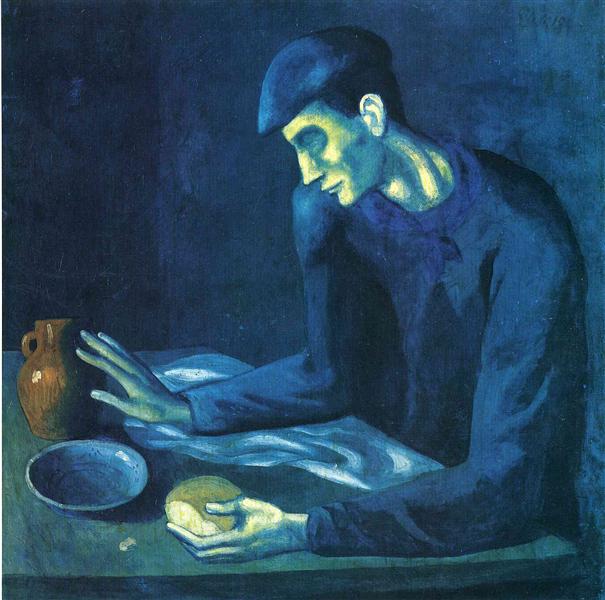
“Blind Man’s Portion“ (1903)
________
though you’ll have to actively listen
to Christopher King rather than
merely hear him here, as you might
have been doing with many of my
suggested musical pieces, should
you be at all interested in the history
of music, he is fascinating, dates his
investigations back millennia to very
Epirus, Ancient, nearly primordial,
Greece, to mirologia there, ancient
funerary chants
some have survived, and have been
recorded for posterity, one, in 1926,
by a Greek exile fled to New York City,
Alexis Zoumbas, a year later, however
improbably, by an American, a blind
man, his own story inspirational, akin
to that of Epictetus, one of the two
iconic Stoic philosophers, the other,
incidentally, an emperor, though the
blind man here, Willie Johnson, was
never himself a slave, but only, by a
historical whisker, the emancipations
of the American Civil War
Christopher King‘s comparison
of an Epirotic miralogi with an
American one brings up, for me,
the difference between Mozart
and Beethoven, notice how the
Willie Johnson version is more
rhythmic, the cadence is much
more pronounced than in the
Greek one, Johnson would’ve
got that from the musical
traditions Europeans had
brought over from their native
continent, probably also from
Africa, Africans
Beethoven would’ve been
surrounded, meanwhile, by Roma,
perhaps called gypsies then, their
music ever resonant in his culture,
not to mention later Liszt‘s, and
the Johann Strausses’ even, for
that matter, Paganini also seems
to have been imbued with it, it
having come up from Epirus
through, notably, Hungary – not
to mention, later still, that music’s
influence, and I’ll stop there, on
late 19th-Century Brahms
Christopher King, incidentally,
sounds a lot like someone you
already know, I think, from his
eschewing – Gesundheit – cell
phones, for instance, to his
enduring preoccupation with
death, not to mention his
endearing modesty, indeed
his humility, his easy
self-deprecation, despite his,
dare I say, incontestable, and
delightful, erudition
makes one wonder why that
other hasn’t become also
famous yet
what do you think
R ! chard
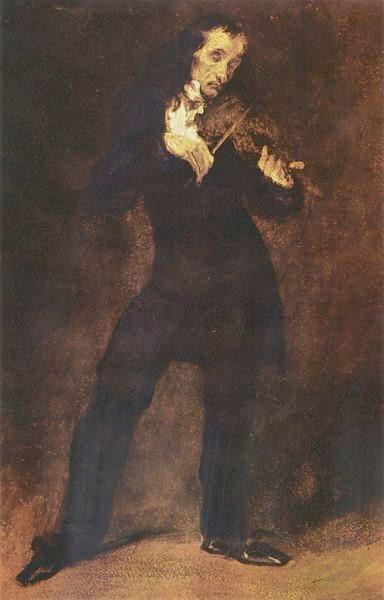
“Portrait of Paganini“ (1832)
___________
before you start thinking that, because
of my recent comparisons, Paganini is
a nobody, look what I found, had
stupidly forgotten about, among the
multiplicity of wondrous examples
concertos have to offer
this will attest, as well, to my fallibility,
which I unreservedly confess, in many,
even familiar, matters, I used to not
much remember the last time I was
wrong, but writing makes one more
aware of one’s even egregious
insufficiencies, I love, I must say,
that it makes one humble
meanwhile, Paganini’s First Violin
Concerto has absolutely no faults,
it’ll run through your cultural veins
like water, you’ll probably be able
to sing all the notes, apart, of course,
from the cadenza, which, in this
instance, is the soloist’s, not
Paganini’s, a not unusual occurence,
indeed a common one, though it’s
nice when they tell you who wrote it,
the composer or the player, as they
do in this case, cause unless you’re
a total nerd you mostly wouldn’t be
able to tell the difference
the cadenza is the part, incidentally,
where near the end of a movement,
any movement, though usually not
the slow one – think about it – the
soloist struts hir improvisational
stuff, independently from the
orchestra, till s/he signals it back in
I’ve said before that Paganini’s
“Caprices“ are a series, essentially,
of cadenzas, not at all such shabby
stuff
meanwhile, I think Paganini is back
in the running, what do you think
R ! chard
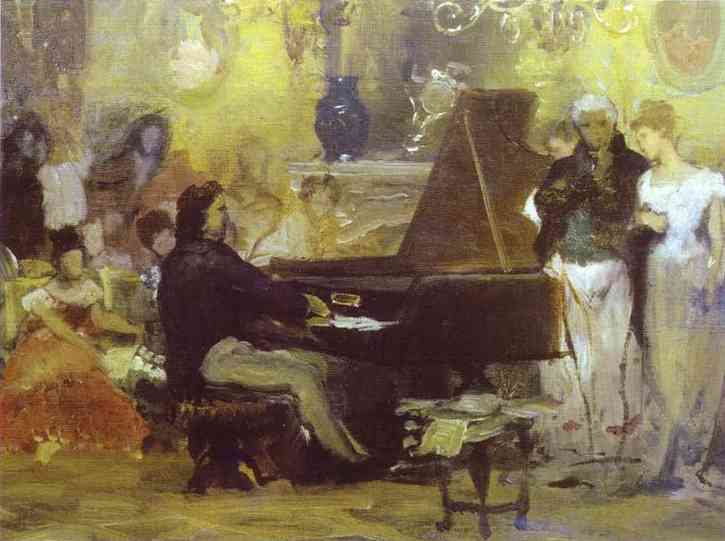
“Chopin Performing in the Guest-Hall of Anton Radziville in Berlin in 1829”
(1887)
________
Chopin’s Piano Concerto no 1, written
in 1830, is in the same mold as both
the Beethoven Violin Concerto, 1806,
and Paganini’s 5th, a synchronous
1830, three movements, fast, slow,
fast, a long symphonic introduction,
followed by miracles of articulation
by the virtuosic soloist, with, however,
differing degrees of emotional impact
Beethoven is evidently the source,
and model, for both later compositions
having clearly preceded them by a
number of years, but neither Chopin
nor Paganini have the chops to match
his magisterial orchestration
Chopin, like Paganini, was confined to
essentially one instrument, of which,
however, both were utter masters, and
manifestly and profoundly there inspired,
but in either, once the solo part takes
flight, the symphony is merely
packaging, no longer an equal partner
Beethoven has parts for all his players,
his is a conversation, not a declamation
but Chopin, 1830, had learned by then,
and integrated from Beethoven the
lesson of how to incorporate drama
into his high wire act, the constant
repetition of a melting air, a musical
motive, which Paganini hadn’t, Chopin
not only could fly, but also knew how
to dress for it, to become a virtual
angel of mercy and compassion up
there under the biggest of tops, his
immortality
don’t take my word for it, though,
you’ve probably heard already Chopin‘s
work, a very emblem of 19th Century
Romanticism, somewhere in your
subconscious you know this melody,
heard it before, it’s part of our Western
culture
not so the Paganini
what’s kicked
see above
you’ll hear your senses talking, the
language of music and art, more
accurate eventually than any of my,
however erudite, however informed,
but merely ruminative, words, art
being, once again, in the eye, the
ear, in this case, of the beholder,
or here, the be-hearer
listen
R ! chard
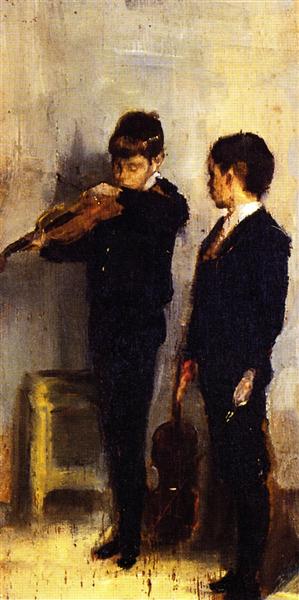
“The Violin Lesson“ (1889)
_______
to juxtapose two things for consideration,
to my mind, is the best way to sharpen
both one’s aesthetic and, therefore,
spiritual personality, here, thus, are
two contemporaneous, essentially,
violin concertos, concerti, if you like,
Paganini’s 5th, 1830, Beethoven’s
Only, 1806
let me point out that the Classical Era
is over at this point, this isn’t music
for the courts any longer, but music
as spectacle, you can hear it, it’s like
moving from Frank Sinatra‘s
nightclubs to David Bowie’s stadiums
noteworthy about these two pieces is
that the structure in each is identical,
the same lengthy introduction in the
first movement, followed by an
articulate, and eventually mesmerizing,
elaboration on the initial melody by
the soloist, with divergent, however,
intentions, Paganini starts with a
fanfare, promises histrionics, delivers
fireworks, Beethoven begins with
portent, goes instead for drama,
which is to say, your heart, as well
both their second and third movements
are essentially, then, indistinguishable
conceptually, their last movement in
either is even a rondo
the challenge in the Paganini is physical,
the glory is in the player’s technical
prowess
with Beethoven the requirements are
both physical and emotional, he
punches for the heart, which the
player must, therefore, with equally
astounding panache, incidentally,
also conquer
style, in other words, over substance,
substance over style, which is to say
“The Phantom of the Opera“, for
instance, or Cirque du Soleil,
Rachmaninov, maybe, versus
Liberace, you are the judge
history has sided, however, with
substance, Beethoven’s Violin
Concerto is everywhere, it isn’t at
all easy, conversely, to come up
with any of Paganini’s, despite
their incontestable magnificence
maybe it’s time for a Paganini
revival, they did that several years
ago for the inimitable Rossini, an
effervescent light in an otherwise
mostly dour 19th Century, listen,
with counts and countesses here
in attendance, at very, can you
believe it, Versailles, wow
R ! chard

“Waltz“ (1891)
________
inadvertently, during my last comments,
I let slip, perhaps, prematurely – cause I
thought I’d explore earlier Romantic
pieces first, more Beethoven, more
Paganini – the word waltz, when I
referenced the “Minute Waltz”, a dance
which expressed a sea change in
Western cultural history made
manifest through music
though the waltz was already the rage
in lowlier social circles in the late
1700’s, the minuet still held sway in
the more aristocratic salons, whose
young swains nevertheless would
skip out to ferret out the servants’
quarters, as young swains do
slowly the dance, for its more
informal aspects, not to mention
its sensuous intimacy, became so
astonishingly mainstream as to
define pretty well the very century,
Chopin and the Strausses, Father
and Son, would take care of that,
the last two making a carnival out
of very Vienna
but until the late 1820’s, not much
was heard of the waltz in the
musical curriculum, at which
point it’ll come in with a vengeance
not much from Beethoven, who, in
his fifties, was probably about as ,
interested in waltzes as I am in hip
hop, a ditty only, a trifle, this one,
1824, one of only two waltzes
from him
here’s Johann Strauss l, however,
his “Carnival in Venice“, 1828, is a
waltz in “Carnival“ clothing, like
cadenzas, for instance, in the
guise of Paganini “Caprices”
here’s Johann Strauss ll, the son,
with his “Wiener Blut“, “The Spirit
of Vienna“, electrifying, 1873, the
late already 19th Century
but here’s Chopin doing his stuff,
1847, right in the middle of both,
from far away Paris, which was
going through its list of Empire
changes right about then, his
Waltz in C-sharp minor
Chopin’s waltz is a more decorous
composition, more courtly, more
also introspective, contemplative,
private, indeed Romantic
note how strongly the Classical
unities still apply here, tempo,
tonality and repetition, even more
markedly than in Beethoven, Chopin
is Mozart, but with more sentiment,
and perhaps more rubato, stretching
the rhythm in composition to
accommodate a dancer’s presumed
dip, in his otherwise meditational
compositions
the waltz will undergo trials and
tribulations later, as the world
turns, but I’ll keep those
reflections for later
meanwhile, choose your partner
R ! chard
“Variations in Violet and Grey – Market Place“ (1885)
___________
strolling through my virtual musical park
today, in, indeed, the very merry month
of May, I was taken by surprise by, nearly
tripped over, in fact, a Beethoven work,
written in the very year, 1806, of the
“Razumovsky”s
I’d overlooked it cause it is without an
opus number, is listed, therefore, as
WoO.80, and is, consequently, easily
lost in the wealth of Beethoven’s
more prominently identified pieces,
but it is utterly miraculous, I think,
and entirely indispensable
I’d said something about it in an earlier
text, back when I was somewhat more
of a nerd, it would appear, perhaps even
a little inscrutable, though it’s
nevertheless, I think, not uninformative,
you might want to check it out, despite
its platform difficulties
the 32 Variations in C Minor are shorter,
at an average of 11 minutes, than Chopin’s
“Minute Waltz”, relatively, a variation every
half minute, where Chopin’s nevertheless
magical invention takes twice that to
complete its proposition
but in this brief span of time, this more
or less 11 minutes, Beethoven takes
you to the moon and back
a few things I could add to my earlier
evaluation, could even be reiterating,
Beethoven in his variations explores a
musical idea, turns it in every which
direction, not much different from what
he does in the individual movements of
his string quartets, his trios, his
symphonies, concertos and sonatas,
with their essential themes, motives,
they’re all – if you’ll permit an idea I got
from Paganini’s “Caprices” – cadenzas,
individual musings inspirationally
extrapolated, which, be they for
technical brilliance, or for a yearning
for a more spiritual legacy, set the
stage for a promise of forthcoming
excellence
this dichotomy will define the
essential bifurcated paths of the
musical industry, during, incidentally,
the very Industrial Revolution, their
mutual history, confrontation, for the
centuries to follow, which is to say,
their balance between form and
function, style versus substance,
Glenn Gould versus Liberace, say,
or Chopin, Liszt
before this, it’d been the more
sedate, less assertive evenings at
the Esterházys, to give you some
perspective, mass markets were
about to come up, not least in the
matter of entertainment
Beethoven was, as it were, already
putting on a show
R ! chard
psst: these alternate “Variations” put you in
the driver’s seat, a pilot explains the
procedures, it’s completely absorbing,
insightful, listen
“View from the Small Warmbrunn Sturmhaube“ (1811)
_____________
for Joselyn
because I hadn’t been that enthralled with
Beethoven’s Middle Period string quartets,
when Joselyn called and asked me what I
was up to, I answered, a hiatus, honey, I’m
experiencing a hiatus
I’d heard the first movement of Beethoven’s
Opus 59, no 3, the last Razumovsky, and had
been less than impressed, the next movement
could, if she could entice me, wait
well, she said, get your hiatus right down
here, let’s have a game of Scrabble, she
lives in the building a few floors down
she beat me, as she always does, often
trounces me, but it is a distraction from
my other more philosophical, intellectual,
pursuits, however much it might inform
them
the Opus 59, no 3, is not, for me,
especially convincing, as are none of the
string quartets until the 14th, but they are
historically significant, having changed
the very course of music since, they’re
worth, consequently, a visit
you’ll note that you don’t sit back to listen
to Beethoven, you sit up, this is not
entertainment, it is a proclamation,
Beethoven arrests your attention, doesn’t
court it, this is not, in the new era, chamber
music, as we call it still, it is music for the
stage, an audience, see Paganini for more
proof, if you need it, of that
Beethoven takes a trinket and explores it,
a motive, if you will, applies volume to it,
changes of pace, changes of tonality,
eccentric rhythms, to eventually lose one
in a world of, if not confusion,
enchantment, usually, with a few deft
musical turns, enchantment, a somnolent
adagio, for instance, becomes a profoundly
seductive tune, for an however brief moment
later, he will utterly, and constantly, inspire,
during his, indeed oracular, Late Period
but other miracles will transpire before that,
of which I’ll, assuredly, keep you posted
R ! chard
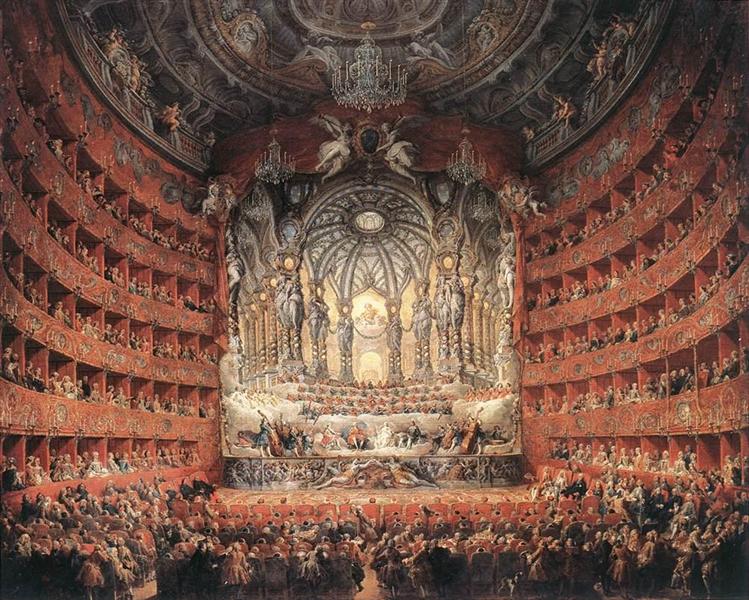
“Musical Fête“ (1747)
____________
though by now you must be assuming
that Beethoven had been defining the
entire early Romantic Period all by
himself, 1803, let’s say, to, say, 1810,
when Schubert, 13 by then, started
kicking in, however immaturely, with
his D1 – D1, note, not D960, over a
thousand compositions later, a work
imbued, so early, not unexpectedly,
with the irrepressible spirit of Mozart,
and therefore, by then, incidentally,
audibly outdated – but you would be,
we would be, overlooking the extraordinary
influence of a maverick, a relic of the
earlier Italian domination of the arts,
from the Renaissance, at least, on –
Paganini – the wizard of the
violin, who’d sold his soul, like Faust,
to the devil, it was susurrated, for his
extraordinary gift
Bach had not only changed the course
of musical history, in the early 18th
Century, but shanghaied the very
language of art as oracular expression,
and substituted music as the voice that
spoke for the people, music will define
henceforth, for a time, the period
there is the Italian Baroque, of course,
utterly masterful paintings, sublime
even, see above, but it has been
supplanted in our 21st-Century
popular imagination by the Baroque
of the German nations, their music,
Bach’s, transcendental then, though
ever so intricate, descriptions of his
particular epoch
this dominance will migrate to Paris,
eventually, and back to art, painting,
after over a hundred tumultuous,
and impermeable, years, with the
Impressionists, in the late 19th
Century
meanwhile, Paganini will get in the
way, 1780 – 1840, an exact, more or
less, contemporary of Beethoven,
1770 – 1827, and show off what
Romantics can do, unleashed,
before a newly enfranchised, and
thrilled, as you will surely be,
audience
R ! chard
psst: the “Caprices“ are essentially
cadenzas, the improvised solo
sections in concertos, where
instrumentalists get to show
off their stuff, and riff, however
exponentially, on their subject
Paganini, makes an art form
of that, as do others, whom
I’ll bring up, trust me, later
stay tuned
 Richibi's Weblog