Fantasia in F minor, D.940 – Franz Schubert


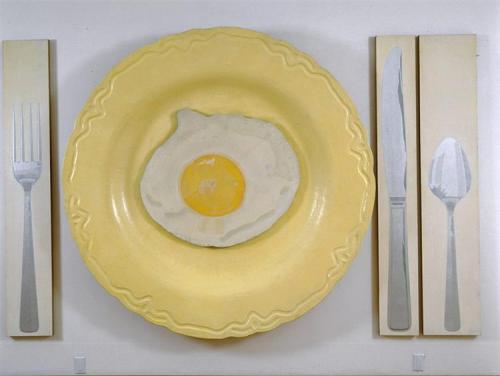
“Egg on Plate with Knife, Fork, and Spoon“ (1964)
____
after my somewhat prolonged side trip
into Bach country, though it is a land
of many more wonders, I’ll get back
on track, more or less, here, with
Beethoven’s Second Cello Sonata,
the other half of his Opus 5
till then, the cello had served as
accompaniment, essentially, for other
more discursive, higher pitched, less
sonorous, less stentorious
instruments
but Beethoven puts the cello back
into the hottest seat in the house, right
next to the ubiquitous piano, a
requirement in any instance following
the neglect of the cello during the
intervening Classical Period, despite
Bach’s earlier luminous illustration of
its incandescent potential
the Opus 5, no 2 starts, audaciously,
with an adagio, not always a wise
choice, as you’ve heard me repeat
here before, it can be unentertaining
but Beethoven gives his adagio tension
by introducing breaks often, which,
rather than stultify, creates momentum,
therefore a narrative, a story to follow
the rhythm is no longer adjusted to
dance essentially, such a spin as is
heard in the second and third
movements, for instance, would
surely sweep one off one’s feet
but the art is in the dance that
Beethoven allows and creates between
the piano and the cello, the first the
filigree on the arm of the more grounded,
more entrenched latter, the crystal, the
silverware that adorn, symbolically, an
however majestic oak table, the creamy
Hollandaise that makes an egg, however
elemental, irresistible, the literary turns
that might transform mere prose into,
verily, poetry, icing on a cake, in a word,
to complement, in stunning and equal
cooperation, the inextricable
counterpart
there is even a moral lesson transmitted
here
Beethoven can often be long-winded,
I’ve found, but there’s always, always,
at the end of the road something
entirely worth the extra minute, the
even several extra minutes
R ! chard
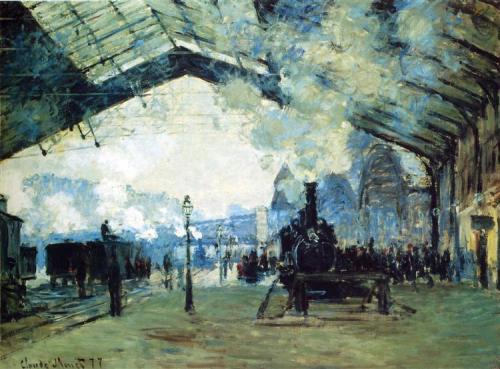
“Saint-Lazare Gare, Normandy Train“ (1887)
________
since I’m on the subject of trains, let me
once again highlight a piece that, to my
mind, is one of the most significant
works of the 20th Century, Steve Reich’s
“Different Trains“, an extraordinary
homage to the victims of the Holocaust
it is in three movements, “America –
Before the War”, “Europe – During the
War“, and “After the War“, Reich
recounts his impressions of train trips
that marked him throughout, therefore
this is an autobiographical work, as
well as being an historical document,
and add to that a profoundly moving
musical meditation on a pivotal
moment in our history
I used to say that if you’re going to
open your mouth, you should be
either entertaining or informative,
preferably both, otherwise keep
your mouth shut, many took
offense, I must’ve been
insufferable
but, I would opine, life is short,
you’ll have to, I’m afraid, deal
with your own shortcomings
Reich here has no shortcomings,
though at first you think this might
be a long trip, with so many
repeated musical clusters, not to
mention the strident atonality, it
soon becomes evident that this
piece is amazing, a personal and
powerful evocation of a particular
transformational event seen
through the eyes of an innocent,
an American child, a poet,
experiencing, however
metaphorically, the horror of this
defining moment
style and content, information and
entertainment, indissolubly gel to
deliver an unforgettable experience,
my own such pivotal moment
would’ve been the Cold War air raid
shelters, the nuclear threat
Reich holds on to Classical
conditions by a mere thread, tempo,
however variable, is solid throughout
as a rock, dictated by the prepared
tape that the instrumentalists must
follow rhythmically like a clock
another divergence from the
Classical model is that tonality
and recapitulation, apart from the
repetition of musical clusters, is
entirely jettisoned
note, however, the same use of
repeated clusters in Bach, to
simulate propulsion, the
minimalism of the 20th Century is
already prefigured in Bach’s stuff
plus ça change, as we say in French,
there is nothing really new, in other
words, under the sun
in the spirit of juxtaposing items
to discover much more than the
sum of their parts, listen to Bach’s
Second Suite, in D minor, for
inspirational clarification
R ! chard
psst: there were no trains at the time
of Bach, I should note, they were
a product of the later 19th-Century,
its Industrial Revolution, see, for
instance, here, or above

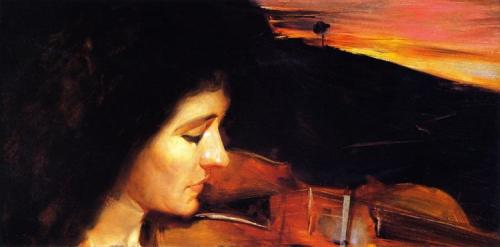
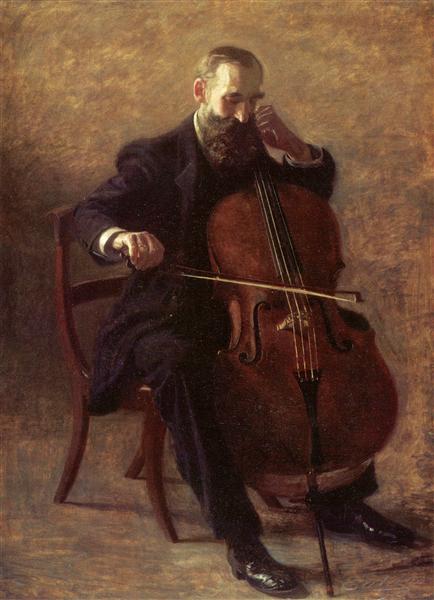
“The Cello Player“ (1896)
________
though I’d considered presenting all six
of Bach’s Cello Suites – your one stop
shopping for these extraordinary
compositions – even one only of these
masterpieces floored me each time I
individually listened
why the Suites, cause I couldn’t follow
up on Beethoven’s Opus 5, for cello
and piano accompaniment, without
saying more about the cello, by then
an instrument of some significance,
and who could argue, it’s resonance
thrills you in your bones, in your very
being
Frederick ll, King of Prussia, played it,
earning for him tailored compositions,
however controversial, from both
Mozart and Haydn, but even earlier,
Bach had composed definitive pieces
for it, much as he’d done for the
harpsichord, precursor to the piano,
students of either still go to Bach for
their basics, their intricate, exquisite,
technical proficiency
the cello can play one note only at a
time, which means that, like a voice,
you’re working without harmony,
you need to make your own,
otherwise your performance is
boring, no one else, as far as I know,
has ever written anything else for
unaccompanied cello, not even
Beethoven
I find most performers lend Bach a
more Romantic air, torrid emotion,
excesses of volume, pauses to the
pace, ritardandos, rallentandos,
which aren’t appropriate to the
more genteel Baroque period,
something I usually find
unwelcome
but in this performance, I’m sure
not even Bach would object
I’m offering up first the Sixth Cello
Suite, D major, played by Jian Wang,
someone I’d never heard of, in a
dazzling performance in Pyeongchang,
a place I’d neither ever heard of, until
only very recently
it appears both of these new kids on
the block ought to be on the map
R ! chard

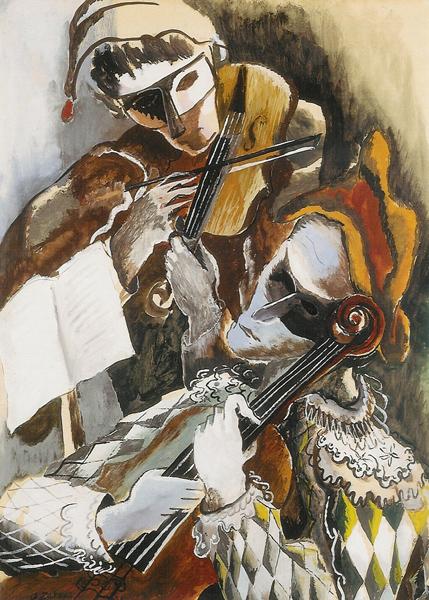
“Masked Harlequin Violinists“ (1944)
________
the Opus 77, no 2, of Haydn is the last
full string quartet of his, his very last
remaining unfinished, the Opus 103,
written in 1803
Haydn died in 1809, the Opus 77, no 2
was composed in 1799, he would’ve
been 67
but by then, he had established the
form that music would take for the
next over two hundred years
call, response, and recapitulation is
the house that Haydn built, and verily
cemented, you can hear it in our own
period’s “Love Me Tender“, for
instance, if you’ll also permit me here
its irresistible elaboration, to today’s
top hits, like my own most recent
favourite such contemporary iteration,
released in 2014, “Photograph“
we could be listening otherwise to
Bach right now, counterpoint,
fugues, intricate, linear music,
however powerfully transcendental,
instead of recurring music, call,
response, as I said, and
recapitulation, something like how
a clock works
but already Haydn is testing the
waters, in the Opus 77, no 2, the
andante, a step up from an adagio,
is in third place, something we
haven’t heard before, and not, to
my mind, especially effective, like
his mixture of tempos in the Opus
54, no 2, which was disconcerting,
however masterfully resolved we
find those to be in this very Opus
77, no 2, notably in the second
movement’s “Minuet, Presto – Trio”,
where the tempo change is nearly
imperceptible
art works on contravention, but
the affronts are to established
conventions, which are very
hard to overturn
watch Haydn here continue to
do just that, for better or for
worse
R ! chard
psst: listen to Bach here, incidentally,
put his largo, or slow movement,
right where he wants to, at the
very top of the bill, does it work,
you tell me, a trivial pursuit,
you’ll ask, I say not, you are
defining your own aesthetic
sensibility, something
profoundly, I think, important,
who it is, with perspective, you
want to be

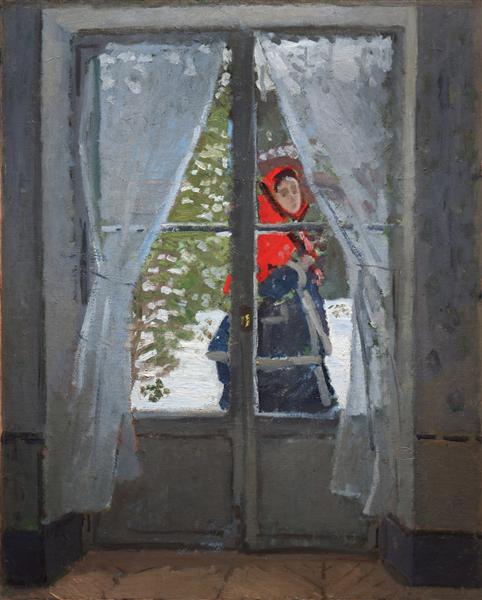
“The Red Cape (Madame Monet)“ (c.1870)
_______
for my mom
that’s a lot of Haydn, I said to my mom,
when I saw the list of my transmittals in
her hotmail, hm, I wondered, maybe it’s
too much
then I said, but it’s like when we’ve
toured, for instance, our European
art galleries, me propounding on
the paintings, as I am wont, however
incorrigibly, to do, but now, note, you
can tell the difference between your
Monets and your Klimts, however
similar their perspectives
or like your tour guide taking you
recently through Argentina,
highlighting spots, in the space of
a month only, the same amount of
time I’ve spent for the music of
Haydn
pronounced, incidentally, I specified,
like “hidin'” in English, not “maiden”,
just sayin’
I gathered that she’d ‘ve sensed by
now, if she’d been listening, which she
said she had, mornings over her
coffee, what a string quartet is, four
movements, different tempos, fast
at first, a joyful introduction,
followed by a lament, then a spirited
third movement, for countereffect,
then a big fourth movement finish
also, the internal structure of each
movement would’ve been internalized,
a theme, a counter theme, a
recapitulation of both, or either, all of
it, probably unconsciously, which is
how art fundamentally works till you
meticulously deconstruct it
the string quartet is the work of Haydn,
the house that Haydn built, from
peripheral aristocratic entertainment,
like modern day artists sporting their
wares in noisy restaurants, to the
glamour of taking on, in concert halls,
Europe, Brunelleschi did a similar,
sleight-of-hand thing with his dome
in Florence for its oracular Cathedral
remember that the string quartet lives
on as a form, where no longer does
the minuet, for instance, nor the
polonaise, nor even the waltz, not to
mention that concertos, and
symphonies have become now
significantly subservient to movies,
secondary players
watch the instrumentalists here live
out, in Haydn’s Opus 77, no 1, their
appropriately Romantic ardour,
something not at all promoted in
Haydn’s earlier Esterházy phase, to
raise their bow in triumph, as they
do at the end of most movements
is already an indication, not at all
appropriate for the earlier princely
salons, that times have changed
Haydn was a prophet, but also an
elder, with an instrument to connect
the oncoming, and turbulent, century
to the impregnable bond of his
period’s systems, the legitimacy of
the autocratic, clockwork, world,
Classicism, the Age of Reason, the
Enlightenment, for better or for
worse
we are left with its, however ever
ebullient, consequences
R ! chard

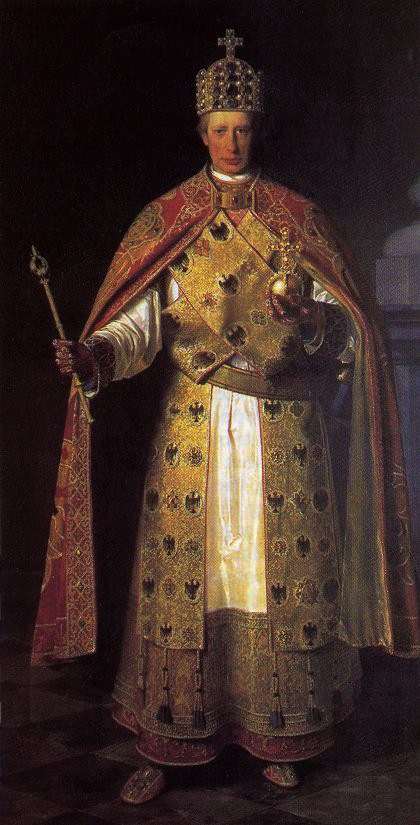
“Francis II as Holy Roman Emperor“ (1874)
_____________
Haydn’s String Quartet, opus 76, no 3,
is nicknamed the “Emperor“ cause the
second movement, the poco adagio;
cantabile, is a recapitulation of an
anthem Haydn had earlier written for
Francis ll, the Holy Roman Emperor
– not, incidentally, for Napoleon, the
Emperor of the moment, who was to
defeat Francis ll, eventually, at the
Battle of Austerlitz, December 2, 1805,
thereby dissolving that Holy Roman
Empire, which had been established
by Leo, the very Pope, lll when, on
December 25th, 800, which is to say
preceding Austerlitz by a thousand
years, he crowned Charlemagne its
Emperor
Haydn must’ve been a monarchist
you’ll recognize that second movement
as the present day anthem of Germany
but listen to how Haydn makes it glisten,
explicitly, with articulations and filigree
that render it utterly irresistible
the adagio is usually the moment that
remains immutable, if the composer
is doing hir stuff, it’s the one you walk
home singing, the faster movements,
however histrionic, are nearly a dime
a dozen, though ever nevertheless
often dazzling
this adagio is utterly Romantic, though
I’m sure Haydn didn’t know what he
was doing, cause despite their push
against the democratic surge, even
monarchists, princes, dukes, dutiful
composers, were finding, and voicing,
their personal, and individual, which
is to say, their democratic, opinions,
however aristocratic their pedigree
artists had done a similar thing when
their personalities began to single
themselves out as especially gifted
when the Renaissance was
happening, it was now music’s hour,
individual voices were staking their
claim, Haydn’s manifestly superior
based on talent and, after widespread
economic affluence, audience appeal,
Haydn’s commercial boots were made
for walking, and he filled them both
magnificently and incontrovertibly
the poco adagio; cantabile is not
courtly music, it reaches for not
merely elegance, but the heart,
we’ve entered another
transformational generation,
something like the revolution
that triggered change in the
cultural upheaval of the1960s
our first step then was the Beatles,
theirs was Haydn, or rather Elvis
Presley shoring up the Beatles,
Beethoven was more aptly John,
Paul, George and Ringo
but watch the rapture on the players’
faces, Francis ll would’ve been
appalled, much like parents in my
generation facing the pill, drugs,
unorthodox sexual couplings, and,
of course, raucous and unruly rock
music
today, under the spell of the
Romantic Period, and encouraged
by that very Sexual Revolution, the
Calidore String Quartet’s Elysium,
their evident bliss, emotionally
manifest, and utterly arresting, sells
tickets, for better or, hopefully not,
for worse
but you call the shots, to decorum or
not to decorum, that is the question
R ! chard