Richibi’s Weblog

Just another WordPress.com weblog

Category: on string quartets

String Quartet in F minor, opus 95, “Serioso” – Beethoven
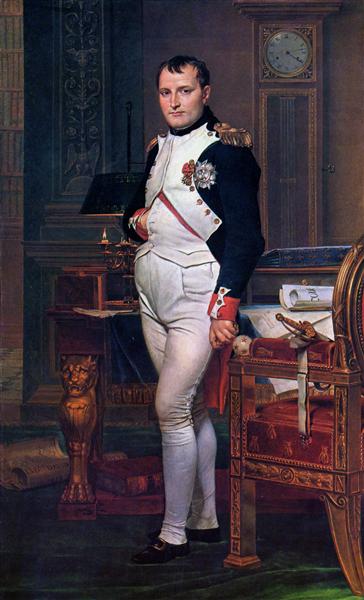
napoleon-bonaparte-in-his-study-at-the-tuileries-1812.jpg!Large

Napoleon Bonaparte in his Study at the Tuileries (1812) 

      Jacques-Louis David

              __________

first of all, let me resolve an issue I’d 
brought up recently, can there be music 
without repetition, recapitulation, of an 
initial musical idea 

no, I emphatically now state, otherwise 
one has a sentence, prose, thus 
reiteration must define as we 
understand it, music

until, of course, I’m made to eat my 
words

secondly, and to the present point
Beethoven’s 11th String Quartet, was 
nicknamed Serioso“, imagine how 
far that label would get one nowadays
but it was a different era, where fun,
levity, wasn’t, creatively, an essential 
component, that only began to happen, 
modestly, in the mid-19th Century, then 
full on in the 20th, after the First World 
War, see the Charlestonfor instance, 
Charlie ChaplinFred Astaire and
Ginger Rogers  

the 11th is the last string quartet of 
Beethoven’s Middle Period – and if 
you think this one is serious, wait
till you hear his Late ones

but don’t let me scare you, they are 
transcendental, very epiphanies,
you’ll verily leave the planet 

note that the music you’re listening 
to in the Serioso is not initially 
cadenced, a line of notes deliver, 
rather, a sentence, which is later 
restated, there are more than the 
four Classical tempi, also, to divide 
the movements, but several, which 
display, nearly indiscriminately, 
much like in literature, or movies, 
variety of emotions, here
however, without the words, one, 
even, specifically called serioso”,
delivered, expressed, spoken, in 
the language of, however, music

listen

I hope you’ll enjoy  


R ! 
chard

psst: note that there are no words in
          the Charlie Chaplin either, but 
          the information is transmitted 
          through the eyes, not the ears
a “Musical Offering” – Bach

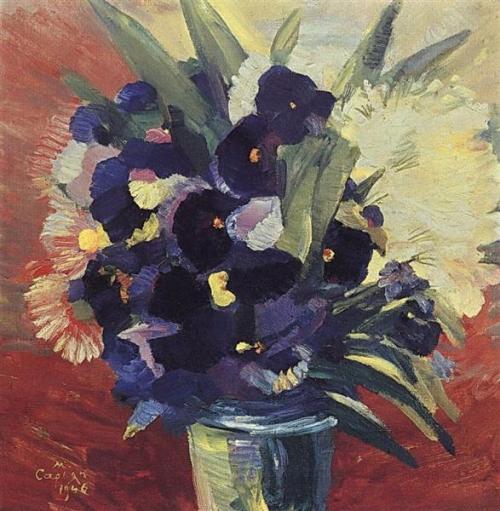
bouquet-of-flowers-1946.jpg!Large

    “Bouquet of Flowers (1946) 

            Martiros Sarian

                _________

                                      for Collin

a friend, who lives too far from me 
to visit, but who is too close to my 
heart for me to do nothing, has just 
had a stroke, “His body, smile, motor functions are improving.The most affected area is his speech center. He is filling in the gaps, has surrendered to his situation, but is operating at about 25% comprehension and memory. He has to rebuild his language, and is getting his ideas across with a lot of help in translation. He will be doing a lot of speech therapy. His uncanny resilience will serve him well.“, 
I’ve been advised

should I continue to write to him,
I’ve wondered, maybe just a few 
cheery words a day, does he 
take the time to read his mail, 
can he, does someone do it for 
him, should I call, or when  
I thought, if not anything else, why 
not music, something I can easily 
send, something he can hear, 
surrender to, rather than pay any 
more cerebral attention 

yesterday, I sent him Bach, Bach’s 
Musical Offering“, 1747, Bach is
from a much more serene period
in music than Beethoven, my 
recent area of investigation here
Bach wrote a lot of ecclesiastical 
stuff, cantatas and such, masses, 
was indeed music director for the 
Lutheran churches in Leipzig for 
a time, the combination makes for 
reflective, often even transcendental 
music, Beethoven wouldn’t at all, 
in this case, ‘ve done, with all of
his Sturm und Drang

I’m lighting a candle a day for my
friend, I’ll also be sending him
internet flowers, till I think of 
what else I can do but pray, for 
his speedy recovery


thanks for dropping by

R ! chard 

String Quartet no 10, opus 74, “The Harp” – Beethoven

primavera-1478(1).jpg!Blog

   “Primavera (1478) 

         Sandro Botticelli 

                 ___________

it’s 1809 and Beethoven rules, essentially,
the musical environment, he’s setting the 
standard, the tone, for the century to 
come and no one is anywhere close to 
challenging his authority, music students 
will remember Carl CzernyMuzio Clementi
for instance, but none of these, however 
noteworthy, contemporaneous composers, 
are even part of, anymore, the recital 
curriculum, think of Salieri and Mozart, 
for instance, without their mischief, who’s 
heard recently of any Salieri 

we’re not in Kansas anymore, this is the 
start of the Romantic Era, four movements,
but not one of them is a minuet, a signature 
element in a Classical composition, nor 
could you, would you want to dance to 
any of them

and this is where Beethoven starts to talk
rather than sing, music that you don’t just
listen to but read, note the disjointed 
rhythms that interject rather than court,
if you’ll pardon the Classical reference, 
from the very beginning of each 
movement, of each, indeed, recapitulation, 
music that is not at all genteel, but rousing, 
commanding

how does he do this

note that his rhythms don’t fall on the 
anticipated beat, they’re off, and 
therefore disconcerting, you need to 
get your bearings

then a motive, a musical idea that, as 
the word suggests, motivates, like a 
key to start an engine, will have an
odd, rather than an even, number of 
notes, like trying to fit a square into   
a circle, or a circle into a square, a 
tricky combination for balanced, by
definition, bar lines, one’s intellectual 
functions are thus activated, one 
doesn’t rest in the comfort of a 
prescribed cadence, but confronts 
the rocky, though constantly 
astonishing, even miraculous, road 
of Beethoven’s invention, adventure, 
if, of course, one’s into that 

instead of Mary had a little lamb, in
other words, we’re hearing, little  
lamb has Marie, accent on the 
wrong syllable, though here we 
might call her Mary, she calls her 
lamb Mouton, not unsurprisingly, 
and it’s always, day after day, 
beside her, which Beethoven then 
sets, as idiosyncratically, to music

he’s, in other words, toying with 
tempo – note the caesurae, the 
pregnant pauses in a melody, the 
multiplication of tempi throughout 
the work as a whole, which imply  
a narrative, a story, especially 
without the traditional, and 
diversionary, dance element 

tonality remains essentially stable, 
despite unusual juxtapositions, odd
intervals – the tonal reach along the 
musical scale, A to G, between two
successive notes – which is to say, 
we’re not yet at Stravinsky

but I find it interesting to observe 
that recapitulation, the third 
Classical imperative, along with 
tempo and tonality, remains 
uninterrupted, not even 
questioned, indeed forcefully 
reinvented 

can there even be music without 
recapitulation, I wonder, whereas 
the other two have since lost their 
immutability – I’m not sure, I’ll have 
to check


thanks wholeheartedly for stopping 

by

R ! chard

32 Variations in C Minor, WoO.80 – Beethoven

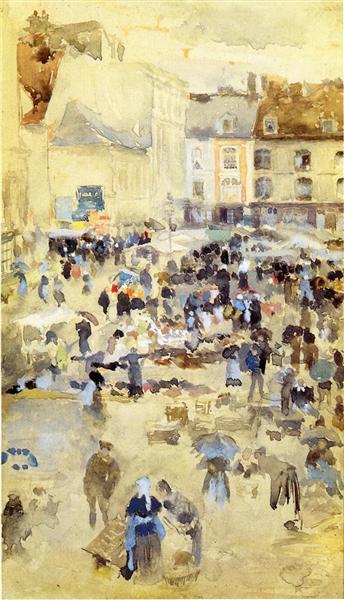
variations-in-violet-and-grey-market-place.jpg!Large.jpg

Variations in Violet and Grey – Market Place (1885) 

               James McNeill Whistler

                          ___________

strolling through my virtual musical park 
today, in, indeed, the very merry month 
of May, I was taken by surprise by, nearly 
tripped over, in fact, a Beethoven work
written in the very year, 1806, of the 
“Razumovsky”s

I’d overlooked it cause it is without an 
opus number, is listed, therefore, as 
WoO.80and is, consequently, easily 
lost in the wealth of Beethoven’s 
more prominently identified pieces,
but it is utterly miraculous, I think, 
and entirely indispensable 

I’d said something about it in an earlier
text, back when I was somewhat more 
of a nerd, it would appear, perhaps even 
a little inscrutable, though it’s 
nevertheless, I think, not uninformative, 
you might want to check it out, despite 
its platform difficulties

the 32 Variations in C Minor are shorter,
at an average of 11 minutes, than Chopin’s
“Minute Waltz”relatively, a variation every 
half minute, where Chopin’s nevertheless
magical invention takes twice that to 
complete its proposition

but in this brief span of time, this more 
or less 11 minutes, Beethoven takes 
you to the moon and back

a few things I could add to my earlier
evaluation, could even be reiterating, 
Beethoven in his variations explores a 
musical idea, turns it in every which
direction, not much different from what 
he does in the individual movements of 
his string quartets, his trios, his 
symphonies, concertos and sonatas, 
with their essential themes, motives, 
they’re all – if you’ll permit an idea I got
from Paganini’s “Caprices” – cadenzas,
individual musings inspirationally 
extrapolated, which, be they for 
technical brilliance, or for a yearning 
for more spiritual legacy, set the 
stage for a promise of forthcoming 
excellence 

this dichotomy will define the 
essential bifurcated paths of the 
musical industry, during, incidentally, 
the very Industrial Revolution, their 
mutual history, confrontation, for the 
centuries to follow, which is to say, 
their balance between form and 
function, style versus substance, 
Glenn Gould versus Liberace, say,
or Chopin, Liszt 

before this, it’d been the more 
sedate, less assertive evenings at 
the Esterházys, to give you some 
perspective, mass markets were 
about to come up, not least in the 
matter of entertainment

Beethoven was, as it were, already  
putting on a show


R ! chard

psst: these alternate “Variations” put you in  
          the driver’s seat, a pilot explains the
          procedures, it’s completely absorbing, 
          insightful, listen

String Quartet, Opus 59, no 3 – Beethoven

view-from-the-small-warmbrunn-sturmhaube.jpg!Large

    “View from the Small Warmbrunn Sturmhaube (1811) 

           Caspar David Friedrich

                  _____________

                                               for Joselyn

because I hadn’t been that enthralled with 
Beethoven’s Middle Period string quartets,
when Joselyn called and asked me what I 
was up to, I answered, a hiatus, honey, I’m 
experiencing a hiatus

I’d heard the first movement of Beethoven’s
Opus 59, no 3, the last Razumovsky, and had
been less than impressed, the next movement 
could, if she could entice me, wait 

well, she said, get your hiatus right down
here, let’s have a game of Scrabble, she 
lives in the building a few floors down

she beat me, as she always does, often 
trounces me, but it is a distraction from 
my other more philosophical, intellectual, 
pursuits, however much it might inform
them

the Opus 59, no 3, is not, for me, 
especially convincing, as are none of the 
string quartets until the 14th, but they are 
historically significant, having changed 
the very course of music since, they’re 
worth, consequently, a visit

you’ll note that you don’t sit back to listen
to Beethoven, you sit up, this is not 
entertainment, it is a proclamation, 
Beethoven arrests your attention, doesn’t 
court it, this is not, in the new era, chamber
music, as we call it still, it is music for the 
stage, an audience, see Paganini for more  
proof, if you need it, of that

Beethoven takes a trinket and explores it,
a motive, if you will, applies volume to it,
changes of pace, changes of tonality, 
eccentric rhythms, to eventually lose one
in a world of, if not confusion, 
enchantment, usually, with a few deft 
musical turns, enchantment, a somnolent
adagio, for instance, becomes a profoundly
seductive tune, for an however brief moment 

later, he will utterly, and constantly, inspire, 
during his, indeed oracular, Late Period

but other miracles will transpire before that, 
of which I’ll, assuredly, keep you posted


R ! chard

String Quartet Opus 59, no 1 – Beethoven

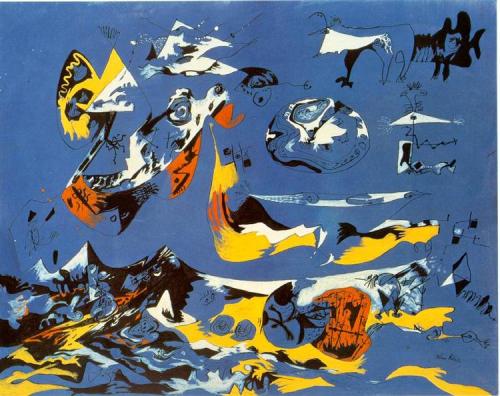
blue-moby-dick(1).jpg!Large

     “Blue (Moby Dick) (1943) 

            Jackson Pollock

                  _________

                                                            for Gail

my story is nearly incredible, as Herman
Melville would say around his Moby-Dick,
but there you have it, today, I levitated

I’d been leery about broaching the
“Razumovsky” Quartets, their never having
been my favourites, for being both too 
groundbreaking, and not enough, strident
passages with insufficient philosophical 
exploration, and opted all but instinctively   
for the more probing stuff, Beethoven’s  
later transcendental revelations

but how could I talk about string quartets,
I reasoned, the actual focus of my, however, 
apparently peripheral, subject, here, without
tackling, and decidedly, the very best example
of Beethoven’s Middle Period, his Opus 59

there are three works in the “Razumovsky”s,
but after a veritable epiphanyI chose 
the First

my housekeeper had arrived, Proust’s
Françoise, in my poetic imagination, 
a lady who knows my most intimate 
secrets, but tends merely, and 
respectfully, and dutifully, indeed 
blessedly, but to her mission, though 
I entrust her, by extension, I guess,
with aspects, even unconsciously,  
of my very soul

I’d delighted in the second movement
of Beethoven’s 7th String Quartet, the
Allegretto vivace e sempre scherzando“,
was even singing along, told her I’d get 
the notes right next time, even did a
second turn that she thought better
than the first 

then I realized, after a break, for 
refreshments, that the adagio was about 
to come up, the Adagio molto e mesto“, 
not to mention its unanticipated attacca 

o my god/dess, I cried, you’re not going
to be ready for this, though I remembered 
nothing of this particular, however 
miraculous, eventually, movement

she remained throughout composed, 
continued diligently her purposes, 
while I, progressively, levitated, left, 
I tell you, the sofa, transcended

wow, I kept exclaiming, as I held on, 
however enthralled, to my seat, Gail,
I screeched, I’m not even touching 
the sofa

she kept on, imperturbably, steadily, 
and conscientiously passing the 
vacuum, while I up and soared


the last glorious movement, the 
“Allegro”, carried me comfortably 
to a satisfying conclusion, 
enough 
to settle me down enough to touch
the ground in order to pay her
 
which she, ever as graciously and 
discreetly as Françoise might’ve
done, acknowledged

I’ll send you the transcript of my
impressionsI said to her, you’ll 
want to listen, you’ll love it 

listen, you’ll love it


R ! chard

Mozart / Haydn piano sonatas

Portrait_of_Princess_Friederike_Luise_of_Prussia_(1714-1784),_Margravine_of_Brandenburg.jpg

    Princess Friederike Luise of Prussia (1714-1784), Margravine of Brandenburg

              ____________

if you had trouble distinguishing your
Schubert from your Beethoven, you’ll
probably have trouble as well telling
your Mozart from your Haydn, though
you won’t find it difficult, if you listen,  
to tell the earlier two from the latter

both the Haydn here, and the Mozart,
were written in 1789, the year of the 
French Revolution, something akin 
to our 9/11, the world changed from
one moment to the next 

the first two were still doing parties,
which is to say, salon music, stuff 
for elites, you can hear it, frivolities,
with, however magical, elaborations
– Liberace, I thought – nothing ever 
as confessional as the two later 
composers, who, with the new 
fervour around individual opinion, 
in the wake of questions even about 
the validity of God, would create the 
very Romantic Era 

Mozart and Haydn explore songs,
ditties, Beethoven and Schubert 
investigate very fundamental 
musical constructions, they’re 
down to the very essence of 
tonal possibilities, something 
that happened to the pictorial 
arts in the 1950’s, as artists 
probed the cerebral implications 
of colour, see for instance, 
Rothko

their probe itself becomes more 
powerful than their apparent 
subject, the tune, though the 
melody proves to be, ever, the 
cement that keeps the meditation 
together

what it says, what they say, is
that confronting our destiny, 
we remain the only arbiter, its
outcome will be as beautiful 
as we make it, for better or for 
worse, the creation of 
something beautiful, a work 
that can be so beautiful, much
like a life, seems to be a reply 
that can somewhat, at least, 
existentially satisfy a sense 
of purpose 

what, otherwise

  
R ! chard

psst: Mozart’s piano sonata was written 
          for Princess Friederike Luise of
          Prussia, pictured above 

what’s up in Frankfurt – Piano Sonata in F minor, “Appassionata” – Beethoven

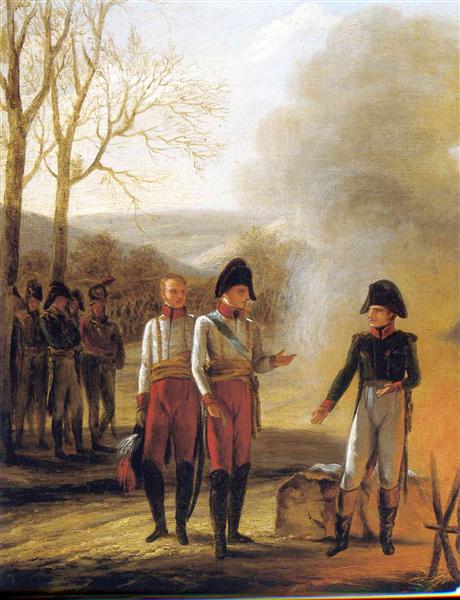
the-conversation-of-napoleon-and-francois-ii-1808.jpg!Large

  “The conversation of Napoleon and Francois II (1808) 

        Pierre-Paul Prud’hon

________

it’s 1804, Beethoven has entered his
Middle Period, left the more formal 
constraints of the Classical Period, 
Mozart and Haydn, behind, though
perhaps not essentially, the 
structure remains, hardwiredbut 
its spirit is entirely different, 
revolutionarily different, thanks to
Napoleon

and Beethoven is as opinionated 
as the revolutionaries, boisterous,
adamant, peremptory even, he is 
Zeus, and not undeservedly, at 
the top of Olympus’ musical 
mountain, where, incidentally, 
he still prevails, harmony’s very 
Homer

by his Opus 57, the Appassionata” 
– a name not of his own invention, 
but, however discriminately, ascribed 
later – he isn’t as metaphysical as 
Schubert is in that later poet’s D960
Beethoven is still writing descriptive 
texts, torrid novels, however 
masterfully illustrated, more than 
the philosophical stuff he’ll later 
undertake, even topping, when that
takes place, Schubert’s, ever, 
nevertheless, transcendental D960
if you can believe it

but Schubert remained a stripling, 
Beethoven, his elder, was given the 
grace to probe longer his humanity,
however might it have been equally 
cruelly benighted, and to stretch his 
speculative reach into previously 
unimagined dimensions, beyond 
the limited temporal scope of the 
surely shriven since Schubert 

all of whose wonders have defied 
the harsh indignities of time, and 
continue still to profoundly and
indelibly reverberate

listen, marvel


R ! chard

what’s up in Amsterdam – Piano Sonata in B flat major, D.960 – Franz Schubert

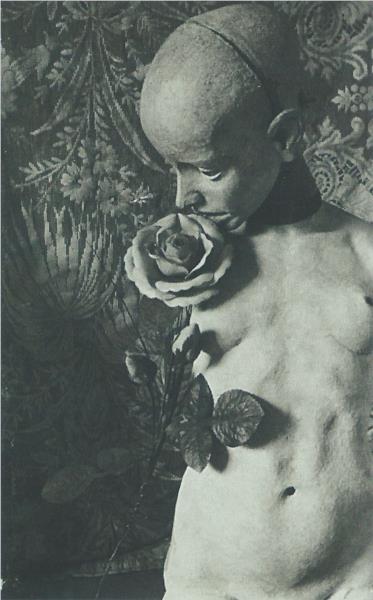
the-doll-1934-5.jpg!Large

      “The Doll / Die Puppe (1934) 

                 Hans Bellmer

                     ________

should you be concerned about telling 
your Schubert from your Beethoven,
don’t fret, I myself, though considered 
by some in this area to be omniscient, 
however manifestly, as you’ll note here, 
erroneouslyupon watching a film last 
night – the splendid Ex Machina”,  
about a robot in the form of Alicia
Vikanderviscerally commanding in 
neon blue, which is to say, incandescent, 
with stainless steel and wires for body 
parts – arms, legs, stomach – as part of 
her more human, and curvaceous, 
attributes – face, chest, and pelvis – who 
fears she might be disassembled when 
her purpose is served, and a new, and 
better robot might not only take her 
place, but also her very physical and 
metaphysical components, and concocts 
to save her life, if that’s what you’d call it, 
however convincing, sophisticated, might 
be her replication – confused the Schubert
sonata that filtered through the score for 
one of Beethoven’s, though can you 
blame me, when the sci-fi tale had been 
so otherwise gripping 

the D960, Schubert’s 23rd and last piano 
sonata, was written in 1828, shortly before 
he died, it is extraordinary, and entirely 
worthy of being compared to Beethoven,
of being held, indeed, in equal 
consideration

but you be the judge 

you’ll note again Schubert’s reserve, his 
courtesy, he is philosophical, rather than 
combative, his reply to Fate is acquiescent, 
though never subordinate, his response to 
the challenge of Life is to display the 
colours, sounds, and other, however 
humble, ephemeral, perhaps even
inconsequential, attributes of his existence, 
with the grace of a very flower, whose 
essence we still, today, have not ceased
to acknowledge, and to profoundly admire 

this is our only answer, he states, our 
ever so resplendent, however individual, 
humanity, which it is our very salvation 
to recount, to relate 

Beethoven would surely have agreed,  
and applauded

listen


R ! chard


a Beethoven / Schubert piano recital

charlotte-rothsch-baroness-anselm-de-rothschild-1828.jpg!Large

 “Charlotte Rothsch, Baroness Anselm De Rothschild (1828) 

       Ary Scheffer

           _______

since Beethoven wrote nothing of any 
great consequence for four-hand piano,
I thought at first I’d head towards another 
kind of pairing, but upon listening to the 
complete recital here of the two Jussen 
brothers, where Beethoven’s “Variations 
on a Theme by Count von Waldstein”, 
1792, a trifle, and his later “Waldstein” 
Sonata, 1804, for piano solo, an infinitely 
more accomplished work of his Middle 
Period, both dedicated to the same good 
friend and patronbookend a flurry of  
enchanting Schubert compositions, 
the contrast between the two composers, 
if not starkly evident, is at least 
discernable if you listen with some 
degree of attention

the difference is in the tone, the intention, 
Beethoven is brash, assertive, Schubert 
remains ever respectful, even often 
courtly

you’ll note that after the fall of Napoleon, 
the monarchy was restored in France, 
therefore throughout the whole of 
Europe, which had resumed its more 
genteel pretensions, as had, for instance,  
even Chopin himself, you’ll remember, in 
very Paris, where he’d relocated from 
Poland because of its political unrest

I’ve often said that a distinct characteristic 
of Beethoven is that he writes against the 
beat, rather than stressing the first note 
of the air he is developing, he accentuates 
the second, or third, the next still, or the 
very last

don’t go, I wish you’d stay here, he, for 
example, beseeches, if you transpose 
his notes in the last movement of the 
Waldsteinthe one after the lugubrious 
adagio, into words, don’t go, he strikes, 
I wish you’d stay, don’t go, I wish you’d 
stay here, don’t go, wish you’d stay, 
wish you’d stay, wish you’d stay,
accent each time on the stay 

in Schubert’s Fantasie for four-hand 
piano, written a generation later, in 1828, 
and admittedly powerfully influenced by 
Beethoven, though no more derivatively 
than Mozart would’ve been of Haydn, try, 
I hear a bird sing, I hear it sing, I hear it 
sing, it sounds so lovely, to the lovely 
melody at its very beginning, one 
composer is peremptory, the other is 
more subservient, confessional

this is what I mean by intention, and the 
difference between these two towering 
geniuses, who shaped together the 
music of their era, however might they 
have been otherwise total strangers

they are both musical giants upon 
whose shoulders our Western culture  
still stands, and swoons, before such 
an utterly transcendent legacy

listen


R ! chard