Richibi’s Weblog

Just another WordPress.com weblog

Category: not just for eggheads

Clarinet Quintet in B minor, Op. 115 – Johannes Brahms
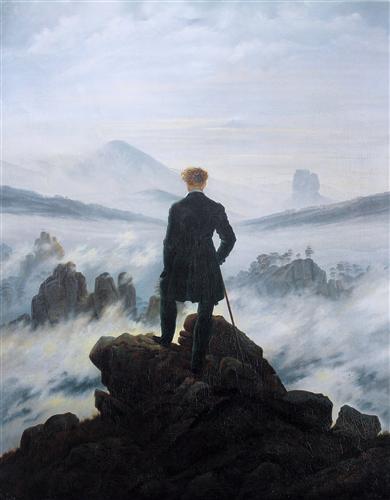
the-wanderer-above-the-sea-of-fog.jpg!Blog

    “The Wanderer above a Sea of Fog / 

            “Der Wanderer über dem Nebelmeer (1818)   

          Caspar David Friedrich

                     ___________

                              for Collin, who’ll appreciate
                                        especially, I’m sure, the 
                                             Chopin


while I’m on the subject of clarinet quintets,
since there are so few significant ones, let 
me pull Brahms’ out of my hat and celebrate 
it, a worthy challenge to Mozart’s own utter
masterpiece

but over a century has gone by, it’s 1891, 
Beethoven, the French Revolution, the 
Romantic Era is reaching its end, ceding 
to Impressionism, after the disruptions of 
rampant industrialization, and its 
consequent effects on the social contract

Marx has proposed a theoretical master 
plan to equitably protect the rest of us 
from the 1%, however too politically 
fraught, eventually, such a system – see
Communism

furthermore, Darwin had suggested that 
we weren’t all descended from Adam and 
Eve, but from larvae, which is to say, 
millennially morphed, modified, through
time, genetically, leading to festering still 
ideological  objections

Elizabeth Barrett Browning had written 
her unadulterated love poems to her 
husband, RobertCaspar David 
Friedrich had shown us his wanderer’s 
back while facing the mountainous 
challenges of the upcoming world, 
godless now after NietzscheAnna 
Karenina had thrown herself in front 
of a train, Madame Bovary had taken 
poison, and Ibsen‘s Nora had left her 
husband for a fraught, if not even 
dangerous, life on her own, to escape 
his safe but insufferable dominance, 
while Jane Eyre was finding ghosts
in her cobwebbed, and insufferable, 
to my mind, though admittedly  
aristocratic, attic 


you’ll note the clarinet is not sitting
centre stage, but has nevertheless 
a place at the table, by this time, 
though not not honoured, familiar,
and is more integrated to the 
conversation, the idea of democracy 
has taken hold, with everyone having
an equal, and even a vociferous, say

Brahms modelled his Clarinet Quintet,
on Mozart’s, the Classical structure is 
still the same, movements, tonality, 
musical recurrence, all to wonderful 
effect

that he would do that is not a given, 
but a tribute to the power of that form, 
take the waltz for instance, alive from 
even before Strauss, not to mention 
Chopin, to approximately the middle 
of the Twentieth Century

think about it, who waltzes anymore,
though they might’ve enchanted still, 
residually, the  50’s – see Patti Page
for instance – its lustre having 
dissipated, with the wind, as it were, 
the gust, before us, of the unending 
ages 


R ! chard
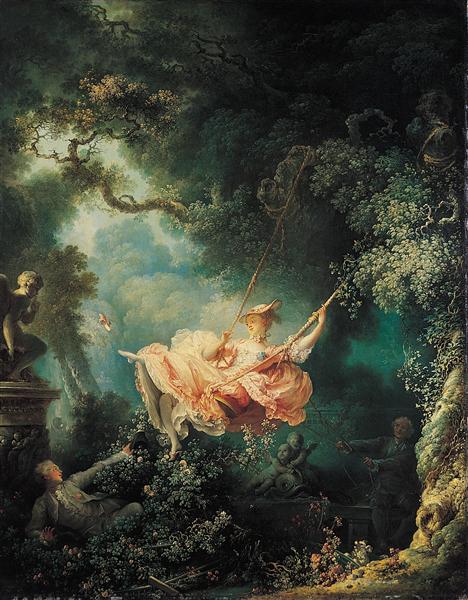
Clarinet Quintet in A major, K581 – Mozart

the-swing-1767.jpg!Large

The Swing / Les Hasards heureux de L’Escarpolette (1767) 

       Jean-Honoré Fragonard

                __________

it wouldn’t be fair to overlook Mozart 
when it comes to string quartets, after
all, he wrote 23 of them, but they’re 
not what he’s famous for, you have to 
go to his piano concertos for that, 
sublime things, and, in my estimation, 
to one of his chamber pieces, his 
utterly enchanting Clarinet Quintet,
in A major, K581, which, since I prefer
chamber pieces, I turn to most often

but to go to a quintet so quickly in a
discussion about quartets could be 
disconcerting, after all, you’ve got
somebody else at the table, you’ll
need another chair, another place 
setting, more food, for four still of the
standard courses, some of those even
elaborate, all this makes a difference

plus the new guest is to be accommodated, 
should typically be given the place of honour, 
as well as a distinct voice, command, like a 
soloist in a concerto, though, of course, be
less peremptory, more, indeed, courtly,
courteous, where, incidentally, the word
“courtesy” comes from

the sound of the clarinet in this quintet
mimics the sound of birds, midst the 
strings’ foliage, the guest, as it were, at 
the party, the piece delivers a wonderfully 
pastoral setting, a mainstay of that period 
see even above – an allegorical return to  
Mother Nature as a guiding principle over
the irascibility and the imperviousness of 
the Christian God, not to mention the 
search for a, nearly obliterated, feminine 
principle, deity

the second movement, the larghetto, 
which means a slow largo, which 
means it’s really, really slow, is 
accordingly melting

also, where would that movement be 
without the clarinet, I ponder, the guest 
that evening of especial honour, I get  
momentary glimpse at genius then 
and marvel, Mozart had written this for 
a clarinetist frienda friend he must’ve 
really admired

all the other movements are equally
consummate, unforgettable, perfect

I promise


R ! chard

psst: here’s Mozart’s 17th String Quartet
          no 17 in B flat major, “The Hunt”,  
          nevertheless, a quartetone of his    
          several, however perfunctorily

String Quartet no 1, Opus 18, no 1 – Beethoven

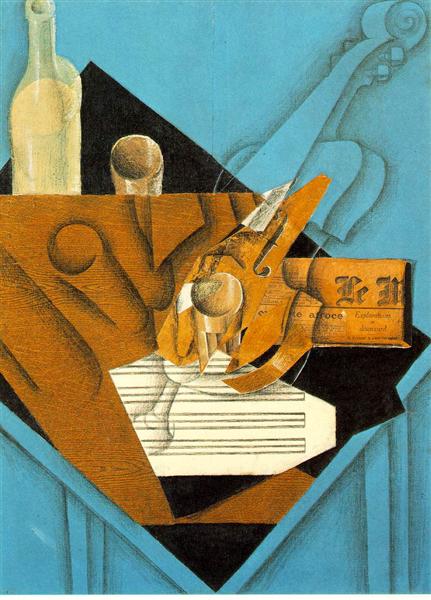
musician-s-table-1914.jpg!Large.jpg

      “Musician’s table (1914) 

            Juan Gris

                _____

Beethoven’s First String Quartet came 
out much around the same time as 
Haydn’s Opus 76, no 1among six of 
them in his set, Beethoven also had 
six in his, however junior still, first
collection, his Opus 18, Beethoven 
would’ve been going on thirty, Haydn
nearly seventy, though his spirit hadn’t
in any manner flagged, listen

but their differences are evident if you
lend a thoughtful ear 

the format is the same, four movements,
inarguably contrasting, with formal 
adherence to Classical norms, tonality,
tempo, and return, but the style is, in 
Beethoven, being overtaken by the 
substance, again inarguably

at dinner together, if I may continue my
earlier allegorical conceit, by the second
movement, Beethoven has already 
entered politics, essentially, religion, 
these four, the players, have a bone to 
pick, and their conversation gets heated, 
there’s a pause, a reconciliation, before 
the third movement, dessert, as it were, 
which is merrier initially, but later 
remains contentious, liqueurs later, in 
the final movement, are still not enough 
to allow for a comfortable exit, however 
might’ve been the serenity of the 
intoxicating sherries, cognacs

Haydn would never have done that, 
having grown up in the proprieties
of the Esterházys, his aristocratic
sponsors, courtesy would’ve been 
of their essence

Beethoven’s is a call to arms, a 
consequence of the French 
Revolution, the birth of the 
Romantic Period

you can hear it in the music


R ! chard

on string quartets – Opus 76, no 1 – Joseph Haydn

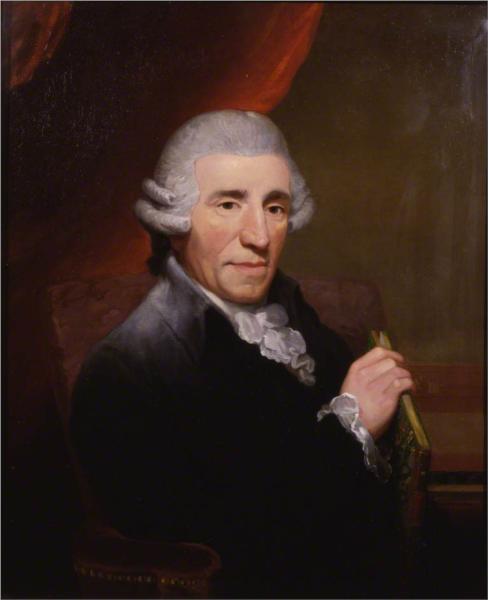
joseph-haydn-1791.jpg!Large.jpg

                                   “Joseph Haydn (1791) 

                                          Thomas Hardy

                                                 ______

to not consider other musical forms of
Shostakovich would be unfair, his
symphonies are mostly propaganda,
however often, though somewhat 
culturally specific, riveting

my favourite works of his, works I 
consider iconic, are mostly chamber 
pieces, piano solos, string quartets

a string quartet, after a symphony, is
like sitting down to dinner with four,
at the very least, acquaintances, 
rather than being a guest at a party,  
the conversation is more intimate,
every person plays hir part, everyone
is heeded, if even only with courtesy,
a social, a Classical, an aristocratic,
prerequisite 

movements can be compared to 
courses, distinct and identifiable for
their particular culinary, musical, 
propriety

later variations on this reflect the 
variations in social mores, where 
restaurants, the modern way of
socializing, allow for disparate 
choices, often superimposed, 
throughout the meal for any,
every, occasion

dim sum, tapas, celebrate this, not
unhappily 


but string quartets can be tricky, I 
thought I’d start from the beginning,
with some Haydn, their recognized 
Father, you’ll understand when you
hear this, his Opus 76, no 1, an 
outstanding string quartet to live 
up to

Haydn set the standard for string 
quartets when the norms of Western 
music were being established, Bach
had given us the alphabet, the
well-tempered clavier, Mozart, the 
grammar, the structure of music,
tempo, tonality, repetition, Beethoven 
gave us the literature, the poetry, the 
philosophical, the transcendent

Haydn is somewhere between these 
last two, but decidedly, still, the king  
of the string quartet, though Beethoven  
does a good job of trying to best him,  
and so does Shostakovich, you’ll have 
to pick

but first, let’s start with Haydn, that’ll
be already, you’ll see, or hear, enough

later, I’ll get into it


R ! chard

Symphony no. 15 in a major, opus 141 – Dmitri Shostakovich

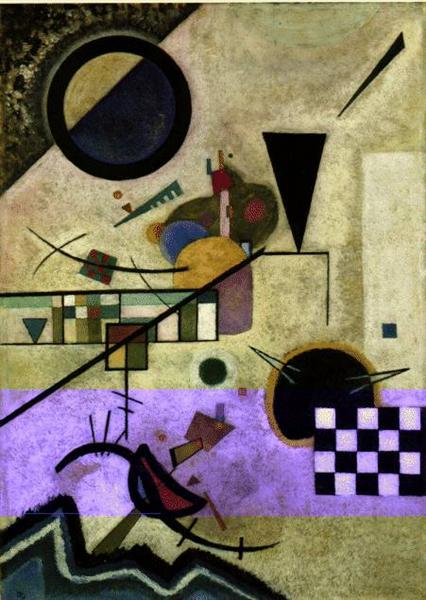
contrasting-sounds-1924.jpg!Large.jpg

        “Contrasting Sounds (1924) 

                Wassily Kandinsky

                       __________

Shostakovich can be difficult, he speaks a
foreign language, discordant notes leave 
you wondering where you’re going

the disruption of the three conditions of
Classical music, tonality, tempo and 
repetition, has given us here, the 
equivalent of derivatives of Latin, you 
don’t understand Italian if you speak 
only French, despite the profound
interconnections, roots

or think of trying even to read 
Shakespeare

also Shostakovich is more literal than 
other composers, his works are intimately
connected with the history and trials 
of his homeland, wrapped in folkloric 
references later cultures and generations 
would not be aware of

one can detect a composer of great 
consequence, like reading Homer in
translation, but never be able to feel 
their local, tribal, force

only a French Canadian could truly 
understand French Canadian, say,  
in hir very atoms, and that, everywhere


there are many references to personal
influences in Shostakovich’s 15th
Symphony, which he viewed, apparently,
as a kind of autobiography – the initial
revolutionary ardour, his profound 
disillusion, the day to day struggles to 
endure the murderous tribulations of his 
political masters, the moral ambiguities  
that would have gone with them, the  
existential crosses to bear – with   
appropriately pertinent quotations from   
other foundational composers

you’ll surely not miss Rossini’s Overture” 
to his opera, William Tell“, which Russians 
would’ve been entirely familiar with, though 
we’re more likely to have known it in North 
America as the theme from the TV show, 
The Lone Ranger

much as we got our Shostakovich, however 
circuitously, from Walt DisneyHanna-Barbera,
if you’ll remember them

and if you think you’ve heard in this symphony 
something you might’ve heard already
Shostakovich quotes himself from his earlier 
symphonies 

and if you’re good, you might even catch 
some WagnerMahler, some, however 
esoteric, Glinka, even

much of it, I’m afraid, now lost to us, in 
this new century, unless we’re total 
nerds

which is where, of course, I take a bow


the first movement was conceived as a 
toy box, it’s disorganized in the manner
of a child discovering

I heard, as well, a drunken degenerate
dancing, or trying to, a bull in a china 
shop 

but in the next movement, a dirge, an
“adagio – largo – adagio – largo”, if 
you’ve ever heard one, the drunken 
lout, in my mind, the next morning 
wakes up, broken but nevertheless
patient, and resilient

with one shoulder to the pillow, he 
props himself up, having understood 
that he must face the day, if only to do
his morning business, with a hand on 
the night table, he braces himself for 
the effort of heaving himself up from
the side of the bed, hears every bone
crack, every muscle stir as he lifts
himself up to a stable posture, tests 
his balance, then turns to move 
forward, crouched under the weight 
of all of his days, towards the basin 
and the mirror, where the picture 
could be better, but could also be 
worse

a blemish there takes up less than
a minute, a residual sense of duty, 
much more than of pride

his business done, the coffee, the 
grinder, the beans, the warmed cup
and then the hour or two to read 
poetry and find the inspiration, to 
undertake the day that’s been 
thrust upon him

he writes his Symphony no 15


the following movements are 
excessive to me, we drown in a sea 
of adagios and allegrettos, a not
unpleasant fate, but more confusing
than entertaining

though I’ll return

I think I might even get to really like
this symphonyit took me years to 
adjust to Kandinsky’s paintings


R ! chard

psst: thanks for listening

Symphony no 14, opus 135 – Dmitri Shostakovich

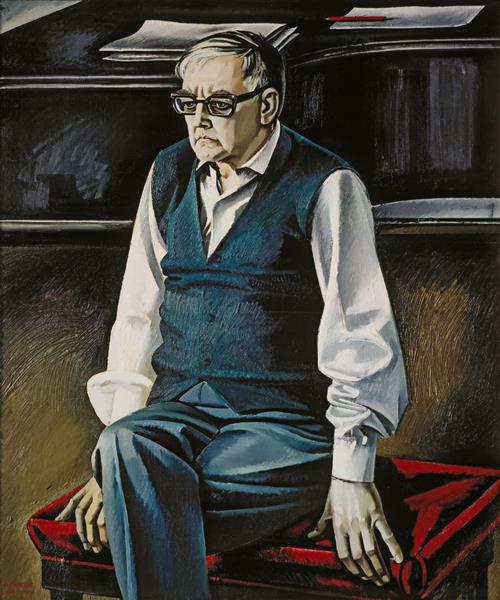
portrait-of-shostakovich-1976-2.jpg!Large

      “Portrait of Shostakovich (1976)

            Tahir Salahov

                   _______

though I’d feared undertaking Shostakovich’s
14th Symphony – it would be a set of eleven
movements, each setting its own poem to
music, poems by Federico García Lorca,
Guillaume Apollinaire, Rainer Maria Rilke,
and one Wilhelm Küchelbecher, translated 
from their respective languages into Russian,
compounded by once again the fact that this
wasn’t either a symphony, but strictly speaking
a song cycle – I found the 14th Symphony to be,
counterintuitively, a triumph, all the issues I’d
earlier listed as compositional misadventures 
– the play of voice and instruments, the dangers 
of using a single singer, one pitch, to anchor an 
orchestral work – had been dealt with expertly, 
all the obbligatos, even, were back, I couldn’t 
wait to hear it again

Schubert had done several song cycles, 
Die Schöne Müllerin“, “Schwanengesang“,
Winterreise“, for instance, sad stories, 
steeped in Romantic torment, not unlike, 
still in 1969, Shostakovich the 14th  

Schubert, though, accompanies with just a 
piano


but a music cycle, without voice this one, 
no poems, just musical ones, of Liszt, his 
Années de pèlerinage“, his Years as a 
Pilgrim, three years, one, two, three,  
1835 through to 1838, travelling through 
Switzerland and Italy, is consummate, 
ethereal, exquisite, and goes on for a  
few utterly enchanting hours 

one New Year’s Eve, I sat before a cozy fire,  
comfortable on my fluffy sofa, cuddled up 
in the several picturesque melodies along 
the musical way, like station stops on a 
train

did the entire trip with him, nearly three 
hours, the music like a sonic looking glass
a hearing glass, a hearing film, not only 
transparent, but transcendental, into  
very wonderland, beyond even its mere 
incidental geography

that’s what art does, and music, when 
you look, listen

enjoy


R ! chard

Symphony no 13 in B-flat minor, opus 113, “Babi Yar” – Dmitri Shostakovich

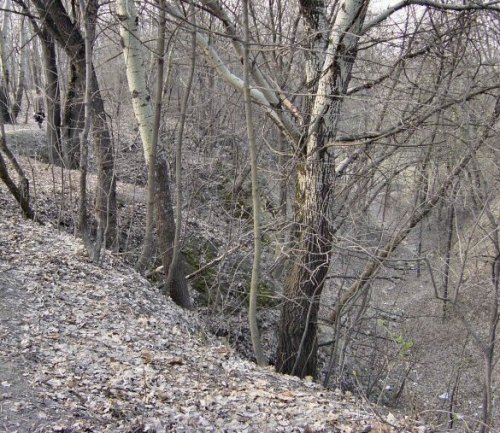
Babi_Jar_ravijn

             the ravine at Baby Yar 

                     ___________

Shostakovich’s Symphony no 13
“Babi Yar”, to me is not a symphony, 
it’s a cantata, a text with accompanying 
orchestra, which is what we have here

does it matter, perhaps not that much, 
but it’s like going to a restaurant where 
you’re looking to enjoy what they’ve 
posted on their website but when you 
get there they tell you they’re out, you 
can only have what they’re serving 

unless it’s sensational, you’re put out 

Shostakovich’s Symphony no 13
“Babi Yar”, is not sensational, not only 
too mired in local history, no matter
how horrid, how very horrid, but too, 
musically, not inspired 

note that with voice to concentrate the
composition, the orchestra becomes
just backdrop, no more of 
Shostakovich’s signature obbligatos, 
that gave distinction and significance 
to individual orchestral players’ lone,
often poignant, complaints

the choice of a bass to anchor the 
enterprise is especially, I think,
unfortunate, like putting all your eggs 
in one basket, that basket lugubrious
and forbidding – I thought of Taras 
Bulba, or Alberich, the gnome in
Wagner’s “Ring”, singing – the jokes in 
the second movement, “Humour”,  
go flat, people wouldn’t laugh, but 
tremble rather before the domineering 
patriarch, oligarch, the composition
needs the grace, the lightness, the 
breath, of a female figure, voice


Bach is famous for cantatas, but what
came up for me was Carl Orff‘s 
incomparable Carmina Burana“,
written in, coincidentally, 1937, from 
medieval texts the composer had 
found, in Latin, describing, in lurid 
lyrics, the spirit of cloistered monks
during the Medieval Era 

you’ll enjoy the translation of the 
Latin into English here, something I 
hadn’t experienced before, giving 
a whole new meaning to the word
“monastery”


R ! chard

Symphony no 12 in D minor, opus 112 (The Year of 1917) – Dmitri Shostakovich

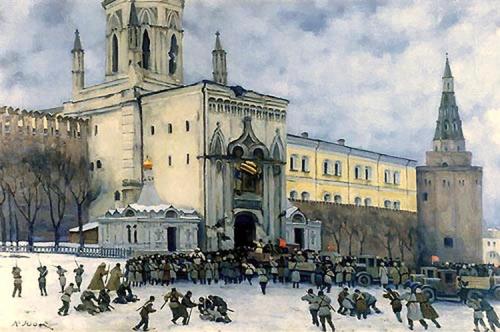
assault-on-the-kremlin-in-1917-1951.jpg!Large

 Assault on the Kremlin in 1917 (1951)

               Konstantin Yuon

                    __________

the Twelfth Symphony of Shostakovich, 
“The Year of 1917”, is a lot more of the 
Eleventh, “The Year 1905”, both 
commissioned, both celebrating 
significant events of the Russian 
Revolution, both therefore steeped in 
references that now elude many who 
aren’t Russian, and certainly those who
generations elsewhere later never lived 
through these particularly local events 

but the Twelfth is shorter by nearly 
half, thankfully, I also found it to be 
unconvincing, plastic, formulaic, 
neither original, nor enthusiastic, 
tedious and uninspired, musically 
speaking, of course

or maybe I’m just getting cranky

also a music honouring a system that 
is now defunct, debunked, discredited, 
couldn’t long survive but historically
among the works of an otherwise 
extraordinary composer, think of 
Confederate monuments still standing 
in the Southern United States, or of 
those of oppressors of First Nations, 
for instance, in our very own Canada, 
though these might’ve been  
sculpted by even Michelangelos,   
an irresolvable cultural confusion,
predicament


the works are programmatic, both 
have titles to indicate a particular
referent, and should be evocative 
of, therefore, those situations, 
music, in other words, for the 
movies, but in these instances, 
without the movie, I’ve talked 
about that before 

all the movements also have titles,
apart from the time signatures, 
adagio, presto, allegro, the like,
the Eleventh, “The Palace Square”, 
“The 9th of January”, “Eternal
Memory”, and “Tocsin”, a warning 
bell

the Twelfth, “Revolutionary Petrograd”,
“Razliv”, “Aurora”, and “The Dawn of 
Humanity”

I couldn’t help but refer to Beethoven’s
Sixth Symphony, the “Pastoral”, to
compare identical musical intentions,
his five movements are “Awakening of 
cheerful feelings upon arrival in the 
countryside“, “Scene by the brook“, 
Merry gathering of country folk“,
Thunder, Storm“, and “Shepherd’s 
song; cheerful and thankful feelings 
after the storm

compare the use of the flute, the 
oboe, the bassoon, Beethoven isn’t 
using any obbligatos yet, solos for 
particular instruments, but you still 
get the feeling of country folk 
dancing, spring taking hold


let me point out that you’ll have to be
patient with the link to the Sixth
Symphony, it’s Japanese, I think, and
will require you to push the arrow in 
the middle of the screen, then wait 
out a few movie ads, which’ll nearly
confound you, but then you’ll get the
best ever Sixth Symphony I’ve ever 
heard, Herbert von Karajan at the 
helm of the Berliner Philharmoniker,
proving why he is still Zeus among
conductors

and his thumbs, goodness, anyone 
with thumbs like that is bound to 
change history


R ! chard

psst: incidentally, Yevgeny Mravinsky 
          was the conductor, equally 
          illustrious, who premiered 
          Shostakovich’s Twelfth in 1961, 
          the same conductor as in the 
          presentation here

Symphony no 11 in G minor, opus 103 (The Year 1905) – Dmitri Shostakovich

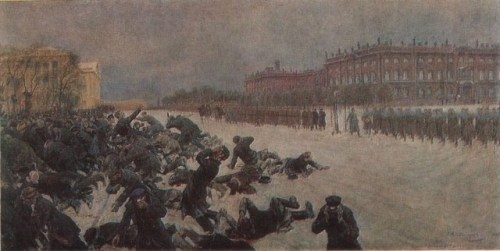
bloody-sunday-shooting-workers-near-the-winter-palace-january-9-1905-1  Bloody Sunday. Shooting workers near the Winter Palace January 9, 1905” 

       Ivan Vladimirov

            ________

if you don’t find a lot to hang on to in
Shostakovich’s 11th Symphony, as I
didn’t, apart from his everywhere
ravishing instrumentation, it’s that 
the piece is a commemoration of a 
particular event in Russian history, 
Bloody Sunday, when the Tsar’s 
Imperial Guard opened fire on a 
crowd of unarmed protestors who 
had come to petition Nicolas ll for 
better work conditions, akinindeed, 
to slavery then, there, January 22, 
1905, the first stirrings, thus, of the 
1917 Russian Revolution, which 
installed the Bolsheviks, Leninism, 
then Stalinism, and so forth

Bloody Sunday can be compared to 
China’s Tiananmen Square, June 4, 
1989it seems totalitarian states will 
blithely resort to such dire measures

Shostakovich had been commissioned 
to write a symphony for the 50th 
anniversary of the event, January 22, 
1955

he’d been reinstated by Khrushchev  
after the death of Stalin, who’d 
excused the tyrant’s condemnation 
of Shostakovich by saying the despot 
had been too subjective, and rescinded 
the law which that earlier ruler had 
imposed requiring all artists to  
conform to party ideology, see Hitler 
again on that one, his proscribed
entartete Kunsthis interdicted
degenerate art

but for personal reasons, Shostakovich 
was unable to compose this new work 
until 1957, the year after the Soviets had 
quashed the Hungarian uprising of 1956
with tanks and ammunition, an event 
too reminiscent of, to the composer, the
earlier tsarist massacre, and horrifying

furthermore, his father had been there,
and spoke of children having been shot 
out of the trees as they merely watched
the proceedings, felled too suddenly, 
apparently, to wipe the smiles off their 
innocent still faces 

the Symphony is called The Year 1905“,
it is mighty, but is too local to effect any
universal understanding, I think, the 
program is too specifically Russian to 
evoke more than historical attention to
an unacquainted observer, listener

I’d visited a church in Rome, Sant’Agnese
fuori le mura, St Agnes Outside the Walls,
once, a place I would not miss were I ever
to return to that illustrious city, before even 
the Vatican, the Coliseum, et cetera, the 
church was built in the 4th Century and 
has weathered the ages, the vicissitudes 
of time, with all their impositions 

the mass was in Italian, however, not the 
Latin that had once united all Catholics
in a common set of sounds that had been
internalized to represent the message of 
the service

but now I could only recognize the form,
no longer the content, something like the 
response a person without the history
of Russia would have here, I would 
contend

this is the dilemma of this, however 
significant, composition, I find

you might also imagine that a tribute to
Canadian soldiers who’d died at, say,
Vimy Ridge, or Passchendaele, might 
not be as moving to someone who    
wasn’t Canadian 


Shostakovich received the Lenin Prize
for his achievement, one of the Soviet 
Union’s most prestigious accolades


R ! chard

Symphony no 10 in E minor, op 93 – Dmitri Shostakovich

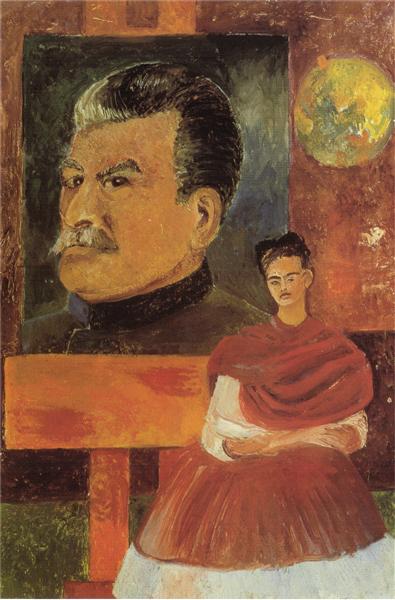
self-portrait-with-stalin-1954.jpg!Large.jpg

     “Self Portrait with Stalin (1954) 

             Frida Kahlo

                 ______

Shostakovich’s 10th Symphony was a
success from the moment I heard it, 
it resolved issues for me I found 
difficult in his earlier showpieces, for
that’s what symphonies are, indeed
blockbusters

from the very beginning, Shostakovich
gives a musical theme, a few notes 
played by a solo oboe, an obbligato
that is then repeated with variations by
other instruments, if not by the entire
orchestra, this is an old trick of 
Beethoven

later movements do the same thing 
with flute, piccolo, or bassoon
obbligati, a particular device of
Shostakovich to indicate a lone,
individual voice amidst the clamour 
of military brass and proletarian
violins

but the tactic of repeating a theme, 
like rhyming in poetry, gives one a 
sense of position, which is lost if 
there’s no reiteration, no reference 
point, it’s like wandering off into a 
forest instead of into a park you 
could safely be enjoying, that had 
trails at least to let you know you 
weren’t far from civilization, 
signposts pointing out directions, 
whereas a forest could be a tundra, 
vast for miles, one could walk for 
days without being found, that’s 
the role of repetition, rhyme, a 
refrain, in music, getting one’s 
bearings

and incidentally, one could be 
walking around in circles in that 
forest and atonality wouldn’t be 
any help at all 


the Tenth has, however, all the 
guideposts throughout, one can 
tell where the music ‘s going at 
each and every movement, it was 
like finding my way home, the, long  
even at nearly an hour, soundscape 
whipped by leaving me breathless, 
awestruck, Shostakovich has hit 
here, I thought, my big time, it took 
him long enough


it was first performed just after the 
death of Stalin, March, 1953, was 
thus probably composed somewhat 
earlier, belying the supposition that 
Stalin‘s demise had affected the 
spirit of his composition, which is 
uncharacteristically cheery for him, 
to my mind, seems to have unleashed 
in him the dogs not of war and 
disillusion, but of fun, something that 
was happening to the entire 20th 
Century, for that matter, especially 
after the Second World War, even, it 
appears, however grimly, in Russia, 
oops, in the U.S.S.R


an aside – Mrs Premise had said of 
Jean-Paul Sartre, the expositor of 
Existentialism in the Twentieth Century, 
implications of which he related to us,
of living in world without God, in his
magnum opusBeing and Nothingness“,
to her Monty Python counterpart, Mrs 
Conclusion, in a hilarious skit of theirs, 
that Sartre wasn’t receiving that day, he 
was, according to his housekeeper, 
especially moody

is he free, asks Mrs Premise, he’s been 
investigating that one for years, the 
woman at the door replies, the kind of 
joke – in musical terminology, a scherzo – 
utterly cherishwitty, pithy, trenchant, 
if you’ll pardon my giddy digression

but I sense Russian counterpart in the
dour Shostakovich

 
it should be noted here, that the 
orchestra in the link I provide, is
the Simon Bolivar Youth Orchestra
of Venezuela, a country with its 
own political history of oppression, 
under the direction of the deservedly 
celebrated conductor, Gustavo 
Dudamelhimself a Venezuelan 

the struggle doesn’t stop, the oracular 
hits must keep on coming, go, Gustavo
Dudamel, go, Simon Bolivar Youth
Orchestra, go, Shostakovich


 R ! chard