Richibi’s Weblog

Just another WordPress.com weblog

Category: mythology

“Europa’s Rape” – Ovid

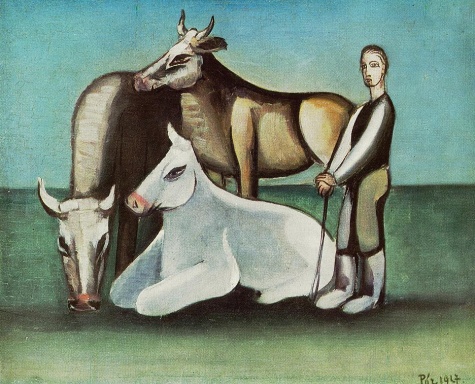
Bulls, 1948 - Bertalan Por

       Bulls” (1948)


               Bertalan Por


                           ____


though I’d heard, indeed, of the rape of

Europa, I wasn’t aware, I’d thought, of

the details, was loathe, therefore, to

read on, in the next segment of Ovid’s

Metamorphoseshaving been earlier

put off by such incidents in that text


as it turned out, Europa isn’t raped,

but, rather, abducted, more or less

willingly, however innocently, by

Jove / Jupiter / Zeus, and will even,

later, consensually, bear his children


who will then migrate, from their base

in Crete, to populate, to people, the

continent which we’ll come to know

as Europe, after their mum


but that’s a whole other story


meanwhile


           When now the God his fury had allay’d,

           And taken vengeance of the stubborn maid,

           From where the bright Athenian turrets rise

           He mounts aloft, and re-ascends the skies.


the God, Hermes / Mercury, if you’ll

remember, had just transformed

Aglauros, the stubborn maid, into a

statue for having been impudent

with him, and mounts aloft now,

re-ascends the skies over Athens,

where the damsel had lived


           Jove saw him enter the sublime abodes,


the sublime abodes, Olympus,

home of the gods


           And, as he mix’d among the crowd of Gods,

           Beckon’d him out, and drew him from the rest,

           And in soft whispers thus his will exprest.


Jove / Jupiter / Zeus wants something

from Hermes / Mercury


“My trusty Hermes, by whose ready aid

           Thy sire’s commands are through the world convey’d.


sire, Jove / Jupiter / Zeus is the father

of Hermes / Mercury, his sire


Hermes / Mercury, the messenger god,

patron of travellers, heralds, newscasters,

those who convey information

through[out] the world


           Resume thy wings, exert their utmost force,

           And to the walls of Sidon speed thy course;


Sidon, a city still in Lebanon


There find a herd of heifers wand’ring o’er

           The neighb’ring hill, and drive ’em to the shore.”

           Thus spoke the God, concealing his intent.


Jove / Jupiter / Zeus, the God, has

an ulterior motive, a conceal[ed] …

intent


           The trusty Hermes, on his message went,

           And found the herd of heifers wand’ring o’er

           A neighb’ring hill, and drove ’em to the shore;


mission accomplished


           Where the king’s daughter, with a lovely train
           Of fellow-nymphs, was sporting on the plain.


the conceal[ed] …intent is exposed,

Jove / Jupiter / Zeus, in character,

is on the prowl


           The dignity of empire laid aside,

           (For love but ill agrees with kingly pride)


power, empire, will not abide being

deprived, we’ve seen ample examples

of that in our, even most recent, past


           The ruler of the skies, the thund’ring God,

           Who shakes the world’s foundations with a nod,


Jove / Jupiter, Zeus, god, remember,

of Thunder


           Among a herd of lowing heifers ran,

           Frisk’d in a bull, and bellow’d o’er the plain.


Frisk’d, accoutered, dressed up as,

in the guise of, a bull


           Large rowles of fat about his shoulders clung,


rowles, rolls


           And from his neck the double dewlap hung.


dewlap, a looseflap of skin hanging

from the throat of some animals, or

birds, cattle, for instance, turkeys,

a wattle


           His skin was whiter than the snow


see above


                                                             that lies

           Unsully’d by the breath of southern skies;


breath of southern skies would

melt away white snow, revealing,

fatefully, ignominiously, patches

of [ ]sully’d earth


           Small shining horns on his curl’d forehead stand,

           As turn’d and polish’d by the work-man’s hand;

           His eye-balls rowl’d, not formidably bright,


rowl’d, rolled


           But gaz’d and languish’d with a gentle light.


as in doe eyes


           His ev’ry look was peaceful, and exprest

           The softness of the lover in the beast.


a wolf, if here a bull, in

sheep’s clothing


stay tuned


R ! chard

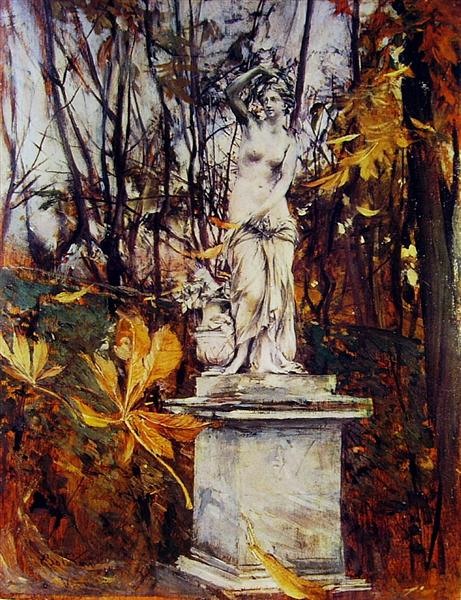
“The Story of Aglauros, transform’d into a Statue” (lV) – Ovid

statue-in-the-park-of-versailles.jpg!Large

       Statue in the Park of Versailles


                   Giovanni Boldini


                             ________


Envy, at the instigation of Minerva,

has flown towards the site of her

commissioned mischief, to hex

Aglauros, who’s miffed her


            When Athens she beheld, for arts renown’d,

            With peace made happy, and with plenty crown’d,


Athens, its glories, architectural,

literary, political, philosophical, would

have been impressive still, despite its

intervening decline, to the mind of a

Roman poet of the later First Century,

compare, say, a contemporary poet’s

evaluation of Great Britain’s grandeur

during its 19th Century supremacy, or

of the United States’ promise before

its late-20th-Century deterioration


            Scarce could the hideous fiend from tears forbear,

            To find out nothing that deserv’d a tear.


Envy, the hideous fiend, was upset

because she couldn’t find anything

to cry about, anything that deserv’d

a tear


            Th’ apartment now she enter’d, where at rest

            Aglauros lay, with gentle sleep opprest.


with gentle sleep opprest seems

to me oxymoronic, conflicting

definitions, how could a gentle

sleep oppress, but let’s continue


            To execute Minerva’s dire command,

            She stroak’d the virgin with her canker’d hand,

            Then prickly thorns into her breast convey’d,

            That stung to madness the devoted maid:

            Her subtle venom still improves the smart,


improves the smart, accentuates

the sudden pain


            Frets in the blood, and festers in the heart.


Frets in, unsettles, the blood, festers,

rots , becomes cankerous, in the heart.


            To make the work more sure, a scene she drew,

            And plac’d before the dreaming virgin’s view

            Her sister’s marriage, and her glorious fate:

            Th’ imaginary bride appears in state;

            The bride-groom with unwonted beauty glows:

            For envy magnifies what-e’er she shows.


Aglauros is not only struck with

subtle venom, but subjected to

psychological manipulation, if

you’ll excuse the reference to

modern analytical methods, is

made to see [h]er sister’s

marriage, Herse‘s, as well as 

her glorious fate


For envy magnifies what-e’er

she shows, an observation

worth remembering


            Full of the dream, Aglauros pin’d away

            In tears all night, in darkness all the day;


the dream, though Envy might’ve

envenomed Aglauros in her sleep,

the unwanted vision continues to

plague her throughout the following

days, and nights


            Consum’d like ice, that just begins to run,

            When feebly smitten by the distant sun;

            Or like unwholsome weeds, that set on fire

            Are slowly wasted, and in smoke expire.


the slow torture in the mind of

rancour there eating away at

the psyche


            Giv’n up to envy (for in ev’ry thought

            The thorns, the venom, and the vision wrought)


The thorns, the venom, and the vision,

all three, wrought, writhing, smouldering,

in ev’ry thought


            Oft did she call on death, as oft decreed,


decreed, resolved


            Rather than see her sister’s wish succeed,

            To tell her awfull father what had past:


her awfull father, Cecrops l, founder

and first king of Athens, according to

myth


awfull, as in inspiring awe, reverence


            At length before the door her self she cast;


the door, of her chamber, where the

God Hermes / Mercury had asked

Aglauros to speak in his favour to

her sister, Herse, whom he had

wanted, if you’ll remember, to woo


cast, set herself up awaiting the

God’s return


            And, sitting on the ground with sullen pride,

            A passage to the love-sick God deny’d.


Aglauros denies the God his wish,

she will not praise him to her sister


            The God caress’d, and for admission pray’d,

            And sooth’d in softest words th’ envenom’d maid.


caress’d, used endearing words


            In vain he sooth’d: “Begone!” the maid replies,

            “Or here I keep my seat, and never rise.”


I’ll stay here till you leave, Aglauros

tells Hermes / Mercury


            “Then keep thy seat for ever,” cries the God,


the impudence of vying with a god

has its consequences


            And touch’d the door, wide op’ning to his rod.


his rod, his caduceus, his winged

staff


            Fain would she rise, and stop him,


Fain,willingly


                                                             but she found

            Her trunk too heavy to forsake the ground;

            Her joynts are all benum’d, her hands are pale,

            And marble now appears in ev’ry nail.

            As when a cancer in the body feeds,

            And gradual death from limb to limb proceeds;

            So does the chilness to each vital parte

            Spread by degrees, and creeps into her heart;

            ‘Till hard’ning ev’ry where, and speechless grown,

            She sits unmov’d, and freezes to a stone.


Aglauros has become of stone,

a statue


            But still her envious hue and sullen mien

            Are in the sedentary figure seen.


still, though Aglauros might’ve been

rendered inanimate, it’s interesting

to note that she’s nevertheless

become immortal, immortalized


see, for instance, above


R ! chard

“The Story of Aglauros, transform’d into a Statue” (lll) – Ovid

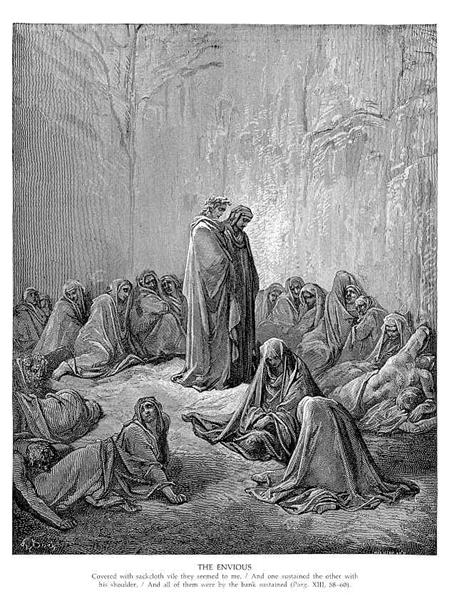
the-envious.jpg!Large

          The Envious


                  Gustave Doré


                             _______


all mythologies have their picture, their

rendition, their evocation of an afterlife,

states of either resignation, in earlier

traditions, perdition or bliss in the later

Christian view, manifest, these latter,

in Dante, his depictions of Hell,

Purgatory, and Heaven in his

Commediaare probably its most

explicit evocations


the Greek and Roman pictures of

their own representative Underworld,

available in Homer, Horace, Virgil,

notably, is less compartmentalized,

less extreme in its divisions, a gloom

pervades, but nowhere fire and

brimstone, nor the diametrically

opposed consolation of archangels

and trumpets, only an unending

sense of desolation, be one worthy

of it or not


limbo comes to mind


but Envy’s realm is actual, not

belated, in the Ancient Greek and

Roman traditions, it is of this world,

present, however horrid, a place

that lurks in the hearts of men, of

people, always, ever, accessible


Dante situates his nexus of Envy in

Purgatory, the afterlife, the nether

world, its Second Circle, of seven,

Wrath, Envy, Pride, Lust, Gluttony,

Greed, Sloth


for Ovid, you can reach Envy’s

dominion, in the nearby mountainous

areas, if only you’ll follow Minerva


the one course is transcendental,

the other, organic, note, physical,

carnate


            Directly to the cave her course she steer’d;

            Against the gates her martial lance she rear’d;

            The gates flew open, and the fiend appear’d.


the fiend, Envy herself


            A pois’nous morsel in her teeth she chew’d,

            And gorg’d the flesh of vipers for her food.


yech


             Minerva loathing turn’d away her eye;


as, incontrovertibly, would I


            The hideous monster, rising heavily,

            Came stalking forward with a sullen pace,

            And left her mangled offals on the place.

            Soon as she saw the goddess gay and bright,

            She fetch’d a groan at such a chearful sight.

            Livid and meagre were her looks, her eye

            In foul distorted glances turn’d awry;

            A hoard of gall her inward parts possess’d,

            And spread a greenness o’er her canker’d breast;

            Her teeth were brown with rust, and from her tongue,

            In dangling drops, the stringy poison hung.

            She never smiles but when the wretched weep,

            Nor lulls her malice with a moment’s sleep,

            Restless in spite: while watchful to destroy,

            She pines and sickens at another’s joy;

            Foe to her self, distressing and distrest,

            She bears her own tormentor in her breast.


the passage, without explication,

speaks for itself, I cede to its

manifest erudition


            The Goddess gave (for she abhorr’d her sight)


her sight, what she was looking

upon

 
            A short command: “To Athens speed thy flight;

            On curst Aglauros try thy utmost art,

            And fix thy rankest venoms in her heart.”


Minerva condemns, curs[es], 

Aglauros


            This said, her spear she push’d against the ground,

            And mounting from it with an active bound,

            Flew off to Heav’n:


Minerva reminds me of my own

generation’s Wonder Woman


meanwhile, the hag, Envy, with

eyes askew


            Look’d up, and mutter’d curses as she flew;

            For sore she fretted, and began to grieve

            At the success which she her self must give.


success, the humiliation of

Aglauros


            Then takes her staff, hung round with wreaths ofthorn,

            And sails along, in a black whirlwind born,


the picture of a witch on a

broomstick shouldn’t

here be unanticipated 


            O’er fields and flow’ry meadows: where she steers

            Her baneful course, a mighty blast appears,

            Mildews and blights; the meadows are defac’d,

            The fields, the flow’rs, and the whole years laidwaste:


the whole years, the yearly crops


            On mortals next, and peopled towns she falls,

            And breathes a burning plague among their walls.


the, not unfamiliar to us, season,

now, of the witch


R ! chard

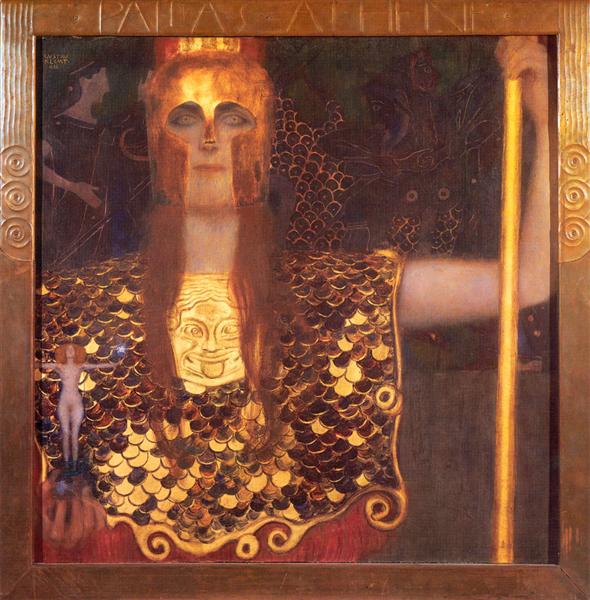
“The Story of Aglauros, transform’d into a Statue” (ll) – Ovid

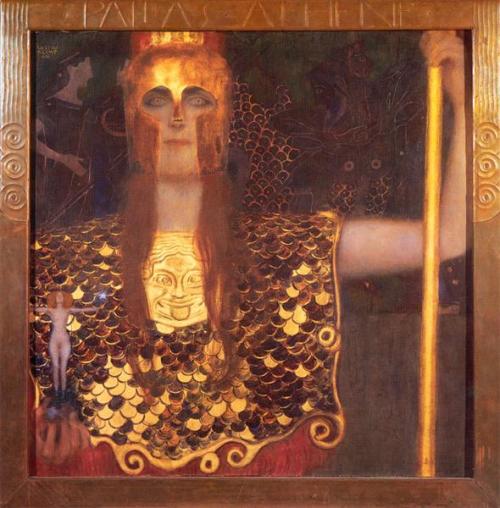
minerva-or-pallas-athena.jpg!Large


        Minerva or Pallas Athena” (1898)


               Gustav Klimt


                      _______


Hermes / Mercury, messenger god,

has spotted Herse, Greek princess,

from on high, the most beautiful

among a procession of shining

virgins and, fir’d, swoops down to

earth, to th’ apartment of the royal

maid, in order to seduce her


             The roof was all with polish’d iv’ry lin’d,

             That richly mix’d, in clouds of tortoise shin’d.


tortoise, tortoiseshell, either the

colour, or the substance itself,

are referenced here, or maybe

even both


             Three rooms, contiguous, in a range were plac’d,


contiguous, one beside the other


             The midmost by the beauteous Herse grac’d;

             Her virgin sisters lodg’d on either side.


Herse, you might remember, had

two sisters, Pandrosos and

Aglauros, daughters of King

Cecrops, they’d seen the child

Ericthonius, half man, half snake,

son of Minerva, who had been

given to them, into their care, 

cradled in a basket, a chest, of

twining osierswhich they were

categorically not to open, but did,

to their great, to their utter, indeed

mythic, chagrin


             Aglauros first th’ approaching God descry’d,


descry’d, witnessed, beheld


             And, as he cross’d her chamber, ask’d his name,

             And what his business was, and whence he came.

             “I come,” reply’d the God, “from Heav’n, to woo

             Your sister, and to make an aunt of you;


however unabashedly be he

forthright


             I am the son and messenger of Jove;

             My name is Mercury, my bus’ness love;

             Do you, kind damsel, take a lover’s part,

             And gain admittance to your sister’s heart.”


take a lover’s part, Mercury entreats,

be of help, he asks Aglauros, in this

amorous adventure, strategize a path,

gain admittance for me, to your sister’s

heart, to her serene acquiescence


             She star’d him in the face with looks amaz’d,
             As when she on Minerva’s secret gaz’d,


Minerva’s secret, her babe,

Ericthonius, half man, half snake,

whom Aglauros had earlier,

however treacherously, beheld


             And asks a mighty treasure for her hire;


sure, says Aglauros, I’ll help, but

what will you give me in return

for my service, my hire


             And, ’till he brings it, makes the God retire.


Aglauros will not assist till she

receives the mighty treasure she

requests for her hire


             Minerva griev’d to see the nymph succeed;


Minerva, is not happy to see Aglauros

get anything at all because of her

earlier indiscretion, disobediently

uncovering Ericthonius, the

goddess’ son


             And now remembring the late impious deed,

             When, disobedient to her strict command,

             She touch’d the chest with an unhallow’d hand;

             In big-swoln sighs her inward rage express’d,

             That heav’d the rising Aegis on her breast;


Aegis, the shield that Minerva wore,

fashioned by the Cyclopes, brothers,

one-eyed giants, in the workplace of

Hephaestus, god of Craftsmen, Fire,

Metallurgy, it bore the Gorgoneion,

the head of Medusa, which would

turn one to stone when looked upon


see above


             Then sought out Envy in her dark abode,

             Defil’d with ropy gore and clots of blood:

             Shut from the winds, and from the wholesome skies,

             In a deep vale the gloomy dungeon lies,

             Dismal and cold, where not a beam of light

             Invades the winter, or disturbs the night.


Envy, its personification, is a goddess

here, though the representative of

Envy is usually considered to be

Phthonus, a male deity


next stop, Envy’s dark abode


stay tuned


R ! chard


“The Story of Aglauros, transform’d into a Statue” – Ovid

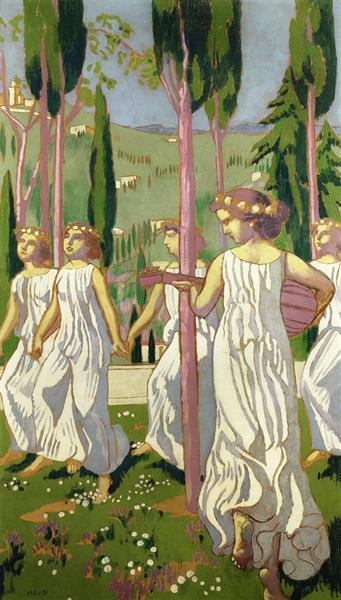
the-dancers-also-known-as-eternal-summer-wiesbaden.jpg!Large


      The Dancers” (c.1905)


               Maurice Denis


                          ________


            This done, the God flew up on high,


This done, Hermes, the God, had just

turned Battus to a Touch stone


                                                          and pass’d

            O’er lofty Athens, by Minerva grac’d,


Minerva, the Latin version of Athena,

was patroness of Athens, grac’d,

indeed, by the very Parthenon, then,

and still now, her temple


            And wide Munichia, whilst his eyes survey

            All the vast region that beneath him lay.


Munichia, the ancient name for a steep

hill, now called Kastella, in Piraeus, the

port of Athens


            ‘Twas now the feast, when each Athenian maid

            Her yearly homage to Minerva paid;


let me point out that during the period

when pantheism prevailed, which is to

say anything earlier than the Emperor

Constantine, 272 – 337 AD, who

established Christianity as the official

religion of the Roman Empire, and going

back to the very beginnings of recorded

history, but at the very least to the epics

of Homer, his Iliad, his Odysseythe 8th

Century BC, which tell of the Trojan War

and its aftermath, from the even more

distant 12th Century BC, homage was

paid, around the Mediterranean, to gods

and goddesses of Olympus, temples

were built, rituals performed in their

honour, much as in the Christian Era,

believers attend church, build cathedrals

to their preferred deity, feasts to Minerva

were as fervent then, in other words, as,

later, were those of devotees to their own

Christmas and Easter, say, celebrations


            In canisters, with garlands cover’d o’er,

            High on their heads, their mystick gifts they bore:

            And now, returning in a solemn train,

            The troop of shining virgins fill’d the plain.


see above


            The God well pleas’d beheld the pompous show,


The God, Hermes still


            And saw the bright procession pass below;

            Then veer’d about, and took a wheeling flight,

            And hover’d o’er them: as the spreading kite,


kitea bird of prey


            That smells the slaughter’d victim from on high,

            Flies at a distance, if the priests are nigh,

            And sails around, and keeps it in her eye:


her eye, the kite is given the feminine

gender here, perhaps following upon

the original Latin word’s grammar


            So kept the God the virgin quire in view,

            And in slow winding circles round them flew.


quire, archaic spelling of choir, a

group of instrumentalists or singers


            As Lucifer excells the meanest star,

            Or, as the full-orb’d Phoebe, Lucifer;


Lucifer, the Morning Star, the planet

Venus, as it appears in the East

before sunrise


Phoebe, pre-Olympian goddess

representative of the moon, thus

in the verse above the very moon


            So much did Herse all the rest outvy,

            And gave a grace to the solemnity.


Herse, a Greek princess


outvy, outvie, to surpass


            Hermes was fir’d, as in the clouds he hung:


fir’d, inflamed, aroused, thus

flung as would be a missile,

the word fir’d here shimmers

with both meanings


            So the cold bullet, that with fury slung

            From Balearick engines mounts on high,

            Glows in the whirl, and burns along the sky.


Balearick engines, slingshots,

the people of the Balearic Islands,

off the coast of Spain, were famous

in ancient times for their use of the

slingshot, or sling, especially as a

weapon


            At length he pitch’d upon the ground, and show’d

            The form divine, the features of a God.

            He knew their vertue o’er a female heart,


their vertue, the virtues of both [t]he

form divine and the features of a

God, however be these identical,

allow grammatically for the

possessive adjective their to be

used here


            And yet he strives to better them by art.


Hermes would rather seduce with

art, which is to say with charm 

and artistry, than by his august

credentials merely


            He hangs his mantle loose, and sets to show

            The golden edging on the seam below;

            Adjusts his flowing curls, and in his hand

            Waves, with an air, the sleep-procuring wand;

            The glitt’ring sandals to his feet applies,

            And to each heel the well-trim’d pinion ties.


pinion, the outer part of a bird’s wing,

including the flight feathers, which

Hermes applies to his sandals


            His ornaments with nicest art display’d,

            He seeks th’ apartment of the royal maid.


to be continued


R ! chard

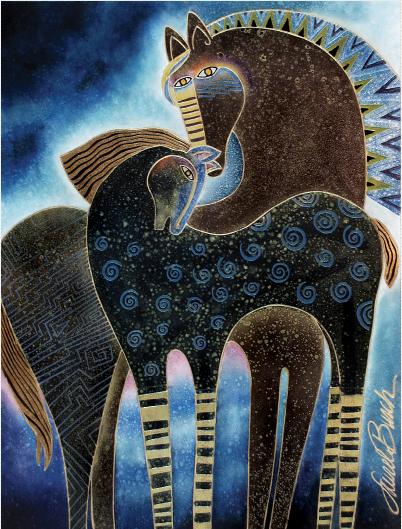
“Ocyrrhoe transform’d into a Mare” (II) – Ovid

indigo-sky-mares

      Indigo Sky Mares


             Laurel Burch


                     ______


         Thus entring into destiny, the maid

         The secrets of offended Jove betray’d:


the maid, Ocyrrhoe, daughter of Chiron

and [t]he nymph Charicle


Ocyrrhoe had offended Jove, but

especially Hades, Jove’s brother,

ruler of the Underworld, when she

had prophesied that Apollo‘s child

with Coronis would be an acclaimed

healer, thus defraud[ing] the tomb,

thereby saving people from the 

clutches of Hades, the especially 

aggrieved god


         More had she still to say; but now appears

         Oppress’d with sobs and sighs, and drown’d in tears.


Occhyroe would have had more

to prophesy, but was impeded by

involuntary physical spasms


         “My voice,” says she, “is gone, my language fails;

         Through ev’ry limb my kindred shape prevails:


kindred shape, the bodily

characteristics of her father,

her kin, the centaur Chiron 


         Why did the God this fatal gift impart,

         And with prophetick raptures swell my heart!


prophetick raptures, Occhyroe, who

knew her father’s arts, and could

rehearse The depths of prophecy,

had inherited through her father,

Chiron, who had himself received

it from Apollo, his own father, the 

gift of divination, for better, for 

either, we’ll learn, or for worse


         What new desires are these? I long to pace

         O’er flow’ry meadows, and to feed on grass;

         I hasten to a brute, a maid no more;


what’s happening, What new desires

are these?, Occhyroe cries, or nearly

neighs, rather, at this point, I’m

becoming a brute, she groans, an

animal, a maid, no more, she objects


         But why, alas! am I transform’d all o’er?

         My sire does half a human shape retain,

         And in his upper parts preserve the man.”


why, Occhyroe asks, since my

father, Chiron, is partially a man,

am I transform’d all o’er?, why

is there nothing left of me that

is human


         Her tongue no more distinct complaints affords,


distinct, clear, easy to decipher


affords, allows, permits


         But in shrill accents and mis-shapen words

         Pours forth such hideous wailings, as declare

         The human form confounded in the mare:


Occhyroe has become a horse,

the proof is in her braying


         ‘Till by degrees accomplish’d in the beast,

         She neigh’d outright, and all the steed exprest.


all the steed exprest, was

everywhere the very picture 

of a horse


         Her stooping body on her hands is born,


born, borne, carried


         Her hands are turn’d to hoofs, and shod in horn,

         Her yellow tresses ruffle in a mane,

         And in a flowing tail she frisks her train,

         The mare was finish’d in her voice and look,

         And a new name from the new figure took.


Occhyroe can no longer be called

Occhyroe, she is no longer she,

but a new figure, needing to be

identified as something else


R ! chard

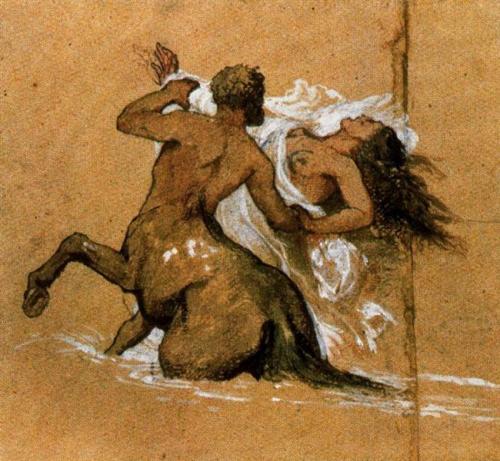
“Ocyrrhoe transform’d into a Mare” – Ovid

centaur-and-nymph.jpg!Large


       Centaur and Nymph


              Arnold Böcklin


                           ________


                  Old Chiron took the babe with secret joy,                 

                  Proud of the charge of the celestial boy.

                  His daughter too, whom on the sandy shore

                  The nymph Charicle to the centaur bore,

                  With hair dishevel’d on her shoulders, came

                  To see the child, Ocyrrhoe was her name;


Ocyrrhoe, daughter of Chiron and [t]he

nymph Chariclec[o]me …[t]see

the child


With hair dishevel’d on her shoulders,

there’s a suggestion here, regarding

Charicle, of madness, or possession


the child, the babethe celestial boy,

the infant, ript, by its very father,

Apollo, from his unfaithful lover,

Coronis’, womb, and [given] … to

the centaur Chiron”s charge, into

its, or his, care


                  She knew her father’s arts, and could rehearse

                  The depths of prophecy in sounding verse.


it appears that Ocyrrhoe, daughter of

Chiron and the nymph Charicle, was

a poetess, was possessed, on her

father’s side, of poetry, could reveal,  

decipher, or rehearse / The depths

of prophecy, in sounding verse, was

able, as wordmongers sometimes do,

to tell truth, deliver, in rhyme, incisive

evaluations


              Once, as the sacred infant she survey’d,


the sacred infant, the child born of

Apollo and Coronis 


              The God was kindled in the raving maid,


The God, the child, the sacred infant,

by virtue of being half, if only half,

divine, having been fathered by the

god, Apollo


kindled, inspired


the raving maid, Ocyrrhoe, beset by

neurotic, irrational, though prophetic,

it is proposed, powers


                   And thus she utter’d her prophetick tale:

                  “Hail, great physician of the world, all-hail;


great physician of the world, the fated

child of Apollo and Coronis would

become a healer of legend


                  Hail, mighty infant, who in years to come

                  Shalt heal the nations, and defraud the tomb;


defraud the tomb, recall from the

hereafter, resuscitate, revive,

return to life


                  Swift be thy growth! thy triumphs unconfin’d!

                  Make kingdoms thicker, and increase mankind.


thicker, more populated


                  Thy daring art shall animate the dead,


Thy daring art, medicine, the mighty

infant will eventually be recognized

as a celebrated man of healing 


                  And draw the thunder on thy guilty head:


guilty head, when Hades, king of the

Underworld, complained to Zeus, his

brother, that the mighty infant was

stealing his subjects, the departed,

Zeus shot the great physician down,

acknowledging the healer’s guilt, of

his defraud[ing] the tomb, condemning

the culprit with a punishing, an

annihilating, thunderbolt


                  Then shalt thou dye, but from the dark abode

                  Rise up victorious, and be twice a God.


Apollo, aggrieved, had had his son,

the child, the sacred infant, reinstated,

after tortuous ministrations, as an

immortal god, an entirely, however,

other story


                  And thou, my sire, not destin’d by thy birth

                  To turn to dust, and mix with common earth,

                  How wilt thou toss, and rave, and long to dye,

                  And quit thy claim to immortality;

                  When thou shalt feel, enrag’d with inward pains,

                  The Hydra’s venom rankling in thy veins?


the child, the sire, not destin’d by [its] birth

/ To turn to dust, which is to say, to be no

longer mortal but immortal, how will it, not

wanting particularly to survive, quit [its]

claim to immortality, deal with the

impossibility of dying, [w]hen [it] shal[l]

feel, enrag’d with inward pains, agonies,

that compel it to seek personal annihilation


Hydra, a snakelike monster with many

heads, whose venom and very breath

were poisonous, stationed at one of

the entrances to the Underworld


                  The Gods, in pity, shall contract thy date,

                  And give thee over to the pow’r of Fate.”


contract thy date, make mortal,

subject once again to Fate


R ! chard

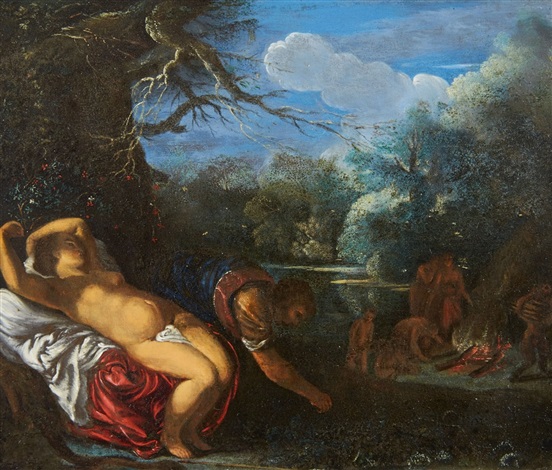
“The Story of Coronis, and Birth of Aesculapius” (IV) – Ovid

adam-elsheimer-apollo-and-coronis-2

   “Apollo and Coronis (1606 – 1608)


                Adam Elsheimer


                   __________


               On her incestuous life I need not dwell 
               (In Lesbos still the horrid tale they tell), 
               And of her dire amours you must have heard, 
               For which she now does penance in a bird, 
               That conscious of her shame, avoids the light, 
               And loves the gloomy cov’ring of the night; 
               The birds, where-e’er she flutters, scare away 
               The hooting wretch, and drive her from the day.” 


Nyctimene, daughter of Epopeus

king of Lesbos, a Greek Island in

the Aegean Sea, had been defiled 

by her father, Minerva, out of pity,

transformed her into an owl, the

above verses tell the story of

that owl, Nyctimene


               The raven, urg’d by such impertinence, 
               Grew passionate, it seems, and took offence, 
               And curst the harmless daw; the daw withdrew: 
               The raven to her injur’d patron flew, 
               And found him out, and told the fatal truth 
               Of false Coronis and the favour’d youth. 


the raven, Apollo’s own bird, having 

discovered Coronis to be unfaithful 

to their master, its and hers, remained

intentdespite the daw’s warnings,

earlier here reported, on informing

the god of the Sun 


               The God was wroth, the colour left his look, 


wroth, angry


               The wreath his head, the harp his hand forsook: 


[t]he wreath, … the harp, Apollo’s

usual attributes, symbols of his

harmony, concord


               His silver bow and feather’d shafts he took, 
               And lodg’d an arrow in the tender breast, 
               That had so often to his own been prest. 


though Apollo is not usually 

associated with bows and arrows,

his twin sister Diana, goddess of

the Hunt, always is, it would not 

be unusual to conflate the two 

deities for poetic, or indeed

mythological, purposes


               Down fell the wounded nymph, and sadly groan’d, 
               And pull’d his arrow reeking from the wound; 
               And weltring in her blood, thus faintly cry’d, 
               “Ah cruel God! tho’ I have justly dy’d, 
               What has, alas! my unborn infant done, 
               That he should fall, and two expire in one?” 
               This said, in agonies she fetch’d her breath. 


it is supposed here that the unborn

infant is indeed Apollo’s


               The God dissolves in pity at her death;

               He hates the bird that made her falshood known, 
               And hates himself for what himself had done; 
               The feather’d shaft, that sent her to the Fates, 
               And his own hand, that sent the shaft, he hates.


Apollo is suffused with regret, anger,

self-recrimination


               Fain would he heal the wound, and ease her pain, 


Fain, with pleasure, gladly


               And tries the compass of his art in vain. 


the compass of his art, the range 

of his ability, in this case vain, 

faulty, ineffective


               Soon as he saw the lovely nymph expire, 
               The pile made ready, and the kindling fire. 


pile, pyre


the sentence lacks a verb here, it 

should read The pile was made 

ready, just saying


               With sighs and groans her obsequies he kept, 


obsequies, funeral rites


               And, if a God could weep, the God had wept. 


I’ll have to watch out for gods

weeping, I suspect some have, 

some can


               Her corps he kiss’d, and heav’nly incense brought, 
               And solemniz’d the death himself had wrought. 


corps, body, corpse


wrought, brought about, made

happen


               But lest his offspring should her fate partake, 
               Spight of th’ immortal mixture in his make, 


Spight, in spite 


               He ript her womb, and set the child at large, 
               And gave him to the centaur Chiron’s charge: 


Chiron, first among the centaurs,  

half man, half horse, was highly 

revered as a teacher, having 

been raised by the twins, Apollo 

and Diana / Artemis, supremely

accomplished deities


               Then in his fury black’d the raven o’er, 
               And bid him prate in his white plumes no more. 


black’d, Apollo turned the snowy 

plume[d], [w]hite as the whitest 

dove’s unsully’d breast raven 

black


prate, babble, talk incoherently


R ! chard


“The Story of Coronis, and Birth of Aesculapius” (III) – Ovid

minerva-or-pallas-athena.jpg!Large

   “Minerva, or Pallas Athena (1898) 


             Gustav Klimt


                  ______


             But you, perhaps, may think I was remov’d, 

             As never by the heav’nly maid belov’d:


says the daw to the still snowy plume[d], 

[w]hite as the whitest dove’s unsully’d 

breast raven


remov’d, rejected, discarded and

disgrac’d 


the heav’nly maid, Minerva


             But I was lov’d; ask Pallas if I lye; 


Pallas, another name for Minerva


             Tho’ Pallas hate me now, she won’t deny: 


hate, note, is in the subjunctive here, 

the mood of conjecture, where the s 

is removed from the ending of the 

third person singular, that she, he, or 

one, for instance, read, no s on read, 

Ovid, would be a part of any Latin 

curriculum


             For I, whom in a feather’d shape you view, 
             Was once a maid (by Heav’n the story’s true) 
             A blooming maid, and a king’s daughter too. 
             A crowd of lovers own’d my beauty’s charms; 


own’d, admitted to, acknowledged


             My beauty was the cause of all my harms; 


to a vain friend once who complained 

to me of the rigours of being beautiful, 

I said, your beauty, girl, to upend the, 

otherwise tiresome, conversation, is 

your curse, get over it, which he did, 

it did, in at least that instance


             Neptune, as on his shores I wont to rove, 


Neptune, god of the Sea


wont, to be used to, predisposed to


             Observ’d me in my walks, and fell in love. 
             He made his courtship, he confess’d his pain, 
             And offer’d force, when all his arts were vain; 


all of the gods, it appears, are engines, 

ever, of irrepressible lust, perhaps 

allegorically alluding to the unquenchable 

generative powers of very Nature 


             Swift he pursu’d: I ran along the strand, 
             ‘Till, spent and weary’d on the sinking sand, 
             I shriek’d aloud, with cries I fill’d the air 
             To Gods and men; nor God nor man was there: 


who hasn’t been there, forlorn, 

abandoned, desolate, forsaken


             A virgin Goddess heard a virgin’s pray’r. 


virgin Goddess, Minerva / Pallas 

Athena


note that Minerva / Pallas / Athena,

the virgin Goddess, remains, however 

unconventionally, however irregularly,

the mother of Erichthonius 


             For, as my arms I lifted to the skies, 
             I saw black feathers from my fingers rise; 
             I strove to fling my garment on the ground; 
             My garment turn’d to plumes, and girt me round: 
             My hands to beat my naked bosom try; 
             Nor naked bosom now nor hands had I: 


the king’s daughter, still unnamed, note, 

attesting to the interchangeability of 

virgin’s in Greek and Roman mythology, 

is in the process of becoming a daw, a

black bird


             Lightly I tript, nor weary as before 
             Sunk in the sand, but skim’d along the shore; 


it appears there are advantages 

to becoming a bird


             ‘Till, rising on my wings, I was preferr’d 
             To be the chaste Minerva’s virgin bird: 


go, girl


             Preferr’d in vain! I am now in disgrace: 
             Nyctimene the owl enjoys my place. 


Nyctimene, Minerva’s owl


friendship, it appears, can turn 

on a dime, or an inadvertent,

but decisive, irritation


R ! chard


“The Story of Coronis, and Birth of Aesculapius” (II) – Ovid

the-daughters-of-cecrops-finding-the-child-erichthonius

     “The Daughters of Cecrops Finding the Child Erichthonius (1640) 


               Jacob Jordaens


                   _________


                                 Once upon a time, 


something interesting happens here,

where earlier in this particular myth

we had a fable, a story in which 

animals play major roles, Aesop is 

famous for his, for instance, as is

Jean de la Fontainewith the

opening catchphrase above, a line

as old at least as Dryden, we’re

suddenly in the land of fairy tales,

structurally, technically


              The two-shap’d Ericthonius had his birth 
              (Without a mother) from the teeming Earth; 


Ericthonius, son of Minervagoddess 

of Wisdom, and of several other traits 

and abilities, and Hephaestus, god of 

Craftsmen, Metallurgy, Fire, among

other, again, areas of malleability 

and possibility


Without a mother, not in the usual,

mammalian, manner


two-shap’d, half human, half serpent,

don’t ask


              Minerva nurs’d him, and the infant laid 
              Within a chest, of twining osiers made. 


Minerva hid her fearsome child in  

a box, a chest, closed the lid, and 

entrusted the secret contents to a 

trio of sisters


              The daughters of king Cecrops undertook 
              To guard the chest, commanded not to look 
              On what was hid within.


king Cecrops, mythical founder and

first king of Athens


                                                               I stood to see 
              The charge obey’d, perch’d on a neighb’ring tree. 


I, the daw, the storyteller


              The sisters Pandrosos and Herse keep 
              The strict command; Aglauros needs would peep, 


Pandrosos, not to be cofused with 

Pandora, Herseand Aglauros, the

three daughters of Cecrops


              And saw the monstrous infant, in a fright, 
              And call’d her sisters to the hideous sight: 
              A boy’s soft shape did to the waste prevail, 
              But the boy ended in a dragon’s tail. 


there’s the ring here, nevertheless,

of Pandora’s tale, though this story

is not at all as dire for humanity as 

Pandora‘s fateful introduction of 

very evil into the world


              I told the stern Minerva all that pass’d; 
              But for my pains, discarded and disgrac’d, 
              The frowning Goddess drove me from her sight, 
              And for her fav’rite chose the bird of night. 


the bird of night, the owl, with which

Minerva is often associated, often

portrayed


              Be then no tell-tale; for I think my wrong 
              Enough to teach a bird to hold her tongue. 


and aptly, we learn the lesson a

fable is meant, by definition, to 

expose


R ! chard