Richibi’s Weblog

Just another WordPress.com weblog

Category: music to ponder

Mozart piano sonata no 11, in A major, K 331

again my especially musically erudite friend,
Norm, has returned with a catchy morsel, a
popularized version this time of the third
movement, the Alla Turca“, of Mozart’s
piano sonata no 11, in A major, K 331
,
possessed by the glitzy spirit, in this
outing
, of Las Vegas

these whet my appetite always for the entire
meal, the source from which these playful
tidbits originate, like an ebullient tributary
returning to its more elementary, and
profound, as it were, spring, a lost child
needing to return to its place of origin
for direction and validation

Mozart, you’ll note, is not Beethoven, though
he might be a not inconsequential Mozart, I
think of his stuff as music for the nursery,
toy soldiers and rocking horses, dairy maids
and cuckoo clocks, not at all to inform but to
delight, the musical structure is foursquare,
lilting ever, and entirely comprehensible,
Mozart just wants to have fun, with here
and there a nod to melancholy, perfect, I
would think, for a powdered and pampered,
though pilloried eventually, indeed
guillotined then, court

the first movement, you’ll remark, is a set
of variations, a bit of a novelty still during
this period, 1778 to 1783 approximately,
the date of composition is not precisely
known, which allowed for, of course, a
variety of styles, voices, to be flaunted
in one only section of a work, instead
of the usual call and response of,
ordinarily, the traditional movement,
extending already, incidentally, the
possibilities of the sonata form, which
later composers would make much
use of

neither of the next movements are
slow, Mozart, as I said, just wanted
to essentially enjoy himself, or his
sponsors did, music did, that’s
what they payed him for

but the times they were a’ changing

as indeed they still are

Richard

psst: thanks Norm

“Requiem” – Andrew Lloyd Webber‏

 
a friend sent me a video of an unlikely
international trio wowing the judges
on “America’s Got Talent”, of all
places, with as unlikely a musical
choice, something called Pie Jesu“,
not at all, I thought, prime time
 
but I was also wowed
 
 
the Pie Jesu“, I learned, is one of the
chants in, of all people, Andrew Lloyd
Webber’s Requiem“, to my mind now
his undisputed masterpiece, despite
his other more notable but less
convincing, I thinksuccesses
 
it consists of a series of chants, much
as movements in music, incidentally,
which is probably where music itself
would originally have copied that
more formal, and decidedly potent, 
pattern
 
the Pie Jesuis the last chant in this
from its stunning, Oscar-ready,
conductrix to its other soaring
musical heights 
 
but it seems to me that the last part 
as written,the Libera me“, for some
reason or other was not included,
though you’ll find the rest here will
already, and quite triumphantly,
indeed indisputablyperfectly do  
 
wow, indeed


psst: note the white triangles of the
        hymnals, the music books, like
        origami angels, Miro abstracts,
        or artful representations of,
        indeed, the very Christian
        Trinity
 
        also, thanks Norm


Gounod’s “Ave Maria”, etc.


Gounod’s Ave Maria sung by John Paul ll, 

for pedigree you can’t get much better than

that, nearly as impressive as Rachmaninoff

playing his own Rachmaninoff, listen


Richard


Liszt – piano concerto no 2 in A major‏

since discovering Tamás Érdi, feral hands,
uncommonly hirsute, but uncovering the
soul of a poet, an angel in wolf’s clothing,
a satyr, without a flute but, at the piano,
I’ve been hooked, combined with Liszt he
is again irresistible, not to mention totally
transcendental

you’ll find Liszt quite a bit like Beethoven,
but more bombastic than philosophical,
style trumps substance, Liszt was a
show-off, a pianistic Paganini

stylistic flourishes abound in the hands
of a deft, however uninformed might he
or she be, technical wizard, it doesn’t
take an Einstein, in other words, to be
a Puccini

and Liszt is a Puccini, who delivers
likewise, and for the very ages

note the same intensity as Beethoven
in Liszt, much of the same musical
idiosyncrasies, but with more dramatic,
late Romantic, alterations of tempo, he’ll
milk a phrase before returning to a more
Classical, which is to say, less elastic
beat

his extemporisations are also less
ruminative, more serendipitously
motivated, like jazz, Liszt wants
primarily to dazzle, kick around,
not instruct

and he does, masterfully, just that

here’s Alfred Brendel doing an alternate,
wholly incandescent version
I couldn’t
at all leave out

here’s Julie Andrews giving her take on
the history of jazz

Richard

XXXVlll. First time he kissed me, he but only kissed – Elizabeth Barrett Browning‏

from Sonnets from the Portuguese

XXXVlll. First time he kissed me, he but only kissed

First time he kissed me, he but only kissed
The fingers of this hand wherewith I write;
And ever since, it grew more clean and white,
Slow to world-greetings, quick with its “Oh, list,”
When the angels speak. A ring of amethyst
I could not wear here, plainer to my sight,
Than that first kiss. The second passed in height
The first, and sought the forehead, and half missed,
Half falling on the hair. O beyond meed!
That was the chrism of love, which love’s own crown,
With sanctifying sweetness, did precede.
The third upon my lips was folded down
In perfect, purple state; since when, indeed,
I have been proud and said, “My love, my own.”

Elizabeth Barrett Browning

________________________

had the sonnet allowed for more lines,
instead of its strict fourteen, this poem
could not ‘ve not become indecent,
“purple”, she says, indeed

nor, for that matter, more clear, Elizabeth
has succumbed to his one, two, three
kisses, enough to now call him [m]y love,
my own”

meed is a reward, and archaic

chrism is holy anointing oil, nearly also
now, but sacramentally, lost

so intimate a declaration as this would’ve
been unprecedented in 1845-46, when
these poems were written, though we’re
used to much more flagrant stuff nowadays

that this had been written by a woman
must’ve been nearly scandalous, though
such was allowing the Romantic Age, and
this “most flagrant” expression would
become eventually its very symbol, the
exploration of the human heart, the highly
intimate revelations of an individual soul

Elizabeth Barrett Browning holds the top
spot here, nobody does it better

in intrinsically less overtly graphic music,
Chopin

Richard Strauss does a similar thing in his
opera “Salome” several years later, several,
indeed, decades later, 1905, but in reverse,
Salome wants to first of all touch John the
Baptist’s skin, he won’t allow it, undaunted
she asks to touch his black hair, nor will
he allow that, she insists further on a kiss,
which doesn’t either come, the scene is
lurid and shocking

“nothing in the world is as red as your
mouth”,
she begs, “let me kiss it, your
mouth”

my dear, I cautioned

later she will dance the Dance of the Seven
Veils
“,
lately performed even, after the veils
are, one by one, off, naked

for which she gets John the Baptist’s head,
and finally gets her kiss

honest

the version I saw was unforgettable,
though it had taken a free ticket to
get me there

Richard

psst: you’ll note, incidentally, that this poem
is not an avowal, but a confidence,
spoken to us, not to him, a not
insignificant factor

miracles‏

when I started looking for miracles,
I found out that there indeed were
some, as a matter of fact, many

here’s another, in case you missed
the last one

Richard

XXXVll. Pardon, oh, pardon, that my soul should make – Elizabeth Barrett Browning‏

from Sonnets from the Portuguese

XXXVll. Pardon, oh, pardon, that my soul should make

Pardon, oh, pardon, that my soul should make,
Of all that strong divineness which I know
For thine and thee, an image only so
Formed of the sand, and fit to shift and break.
It is that distant years which did not take
Thy sovranty, recoiling with a blow,
Have forced my swimming brain to undergo
Their doubt and dread, and blindly to forsake
The purity of likeness and distort
Thy worthiest love to a worthless counterfeit:
As if a shipwrecked Pagan, safe in port,
His guardian sea-god to commemorate,
Should set a sculptured porpoise, gills a-snort
And vibrant tail, within the temple-gate

Elizabeth Barrett Browning

_________________________

though Elizabeth Barrett Browning is ever
abstruse, dare I say, even Baroque – the
epoch of distorted perspectives and
dimensions which preceded the Classical
Era – in her not only grammatical but also
metaphorical constructions, to the point of,
as in the last, her XXXVlth sonnet, being
incomprehensible, too athwart for my taste,
or even my tolerance, here she returns to
form to shine again in her own Romantic
Age, a more literate time, as opposed to
our more visual one, where straight talk
would not ‘ve passed muster as worthy
of any art, that would happen only later
as a reaction to too elaborate artifice,
which you might already even decry,
for instance, in these sonnets

but to make distinctive the form – the sonnet
goes back to at least Shakespeare, who is
even an obvious inspiration for Elizabeth
she would’ve had to embroider her own
version of it, which she could only have
done with fresh artifice upon the ancient
structure, like decorative elaborations on
the traditional tablecloth

if they work it’s because the artifice meets
the substance equally, enough to give
meaning to the poem, verve to the
reinvigorated tabletop

but often, dear Elizabeth, for me, and I would
think for many others in our Twitter age, for
the most part your poems do only just, albeit
enough to make you nevertheless iconic

for Elizabeth Barrett Browning and Chopin
represent for us now more than any of the
other Romantics their distinctive Age, and
with great, let there be no doubt, and easily
demonstrated, authority

Pardon, oh, pardon is not a breeze but it
expands admirably, and distinctively, on her
other masterpieces, or should I say here,
mistresspieces

forgive my soul, she asks, for mistaking your
“strong divineness” for something as fleeting
as “sand”, something “fit to shift and break”

his “sovranty” – sovereignty, which finds its
etymological roots in the French word
“souveraineté”, should you be wondering –
had not been a part of her past, her “distant
years”
and therefore led to her confusion,
her “swimming brain”, imagining he might
be “a worthless counterfeit” – haven’t we all
been there – instead of the “worthiest love”

she compares herself to a “shipwrecked
Pagan”,
who, saved, “safe in port”, gives
thanks, pays homage, to “a sea-god”, “a
sculptured porpoise, gills a-snort”,
rather
than, of course, her One and True
Christian God, an interesting instance
of religious iconographical inflexibility,
as though her Christian God had more
authenticity than the sea deity

Elizabeth Barrett Browning, it should be
noted, remained ever to her Divinity devout
despite the intermittent fluctuations of her
less religiously committed husband

who nevertheless remained ever to her
true, and ever, both romantically and
Romantically, by her, stalwart

Richard

Beethoven Strinq Quartet no 14, opus 131‏

if Beethoven had written merely one transcendental
work we would still have been beholden, but that he
wrote neither two, nor three, but several immutable
pieces is extraordinary, super-, apparently, human,
though, of course, manifestly not, unless you want
to bring Jesus into the picture as such a dual being,
then we’ll talk, but Beethoven is a staunchly secular
voice, devoid of the spiritual considerations of a
Bach, for instance, Beethoven speaks for humanity,
its longings, consternations, aspirations, its essence,
no longer the discredited primacy of the Cross and
Its imperial derivatives, Human Rights have trumped
God

what Beethoven maintains however is the reverence,
his later pieces – you’ve heard the Hammerklavier“,
already, the 32nd piano sonata – are manifestly
spiritual experiences, as opposed to religious

the 14th String Quartet will do the same

if the Hammerklavier is akin to Moses delivering
his peremptory tablets, the 14th String Quartet is
the Sermon on the Mount, in the history of music
they have so great an impact

briefly, as briefly as I can, I’ll say a few introductory
words, then let your soul and the music do the rest,
see what happens to your karma

there are seven movements in the 14th, uninterrupted,
no pauses between the movements, though each is
easily identifiable, tempo therefore becomes incidental
instead of Classically ordered, the first movement, for
instance, is an adagio, a Classically improbable spot

the sections therefore play much as chapters in a
novel, advancing according to the logic and emotions
of the moment, always, as in all of Beethoven, moving
inexorably forward despite the intricacies of the, not at
all predictable, plot, as had been the case in the more
regimented Classical model, Beethoven takes you,
instead of around the corner, into the clouds, into a
spiritualized heaven, a place of profound existential
introspection

try listening to the 14th String Quartet attentively
without thinking about your soul, its existence,
its mission, in the very face of its ineradicable,
and fateful, actuality, the human conundrum,
Beethoven lets us know we’re not alone

some mountaintop Sermon indeed, watch what
happens to your sensibility, your very sacred
self, or maybe I should say, listen

may your path be decked meanwhile with laurels,
and your days be blessed with grace, be it ever
so merely, maybe, human

who knows

sincerely

Richard

psst: if you’ll allow me to pursue my series of
similarities you’ll imagine piano sonata
no 32
as Beethoven’s “Last Supper”,
this one in particular five luminous stars

Beethoven piano sonata no 28 in A major, opus 101

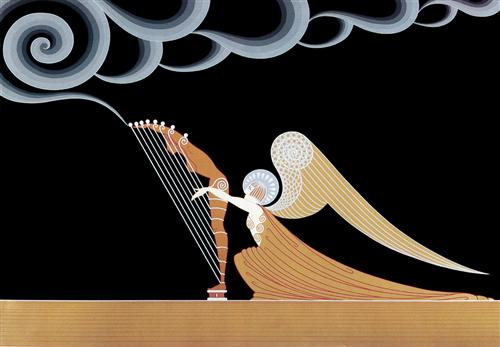
Erte - "The Angel"

The Angel

Erte

___

Beethoven’s piano sonata no 28, opus 101,
in A major
, is the first of what is considered
to be his late piano sonatas, as opposed to
early and middle, three entirely distinct
periods that are easily recognizable upon
closer listening, the early ones are bold,
even headstrong, with Beethoven’s ever
characteristic vigor and Promethean authority,
the length themselves of his early works are
a testament to his sense of his own great
personal validity, the first four, to my mind,
go on much longer than often enough they
should, a typically youthful presumption on
his part, and are musically at best trite, I find,
after their first expositions, the repeats come
as redundant, and tolerable merely, surprises,
even the famous 8th, the Pathétique“, opus 13,
is, I think, too brash and impudent, however in
this manner, nevertheless admittedly, entirely
effective, listen

the Pastorale“, of the middle period, opus 28,
no 15
, is where I deem the music to become
henceforward sublime, it has a settled
confidence that brims with not only technical
wizardry but with also positively enchanting
and entrancing musical ideas, bursting like
very flowers in springtime, with colour and
inspired, effervescent, imagination

the late period is where Beethoven becomes,
however, a sage, a prophet, and indeed a
hierarch in the new secular order of a
reconstituted Heaven, after all, someone
had to take the place of the now discredited
angels, Nietzsche called them Übermenschen,
Supermen

the 28th sonata starts out slowly, or rather,
more slowly than the earlier forthright ones,
already a sign of less physical, more
measured and considered reponses, my
impression here is of a grandfather visiting
his granchildren, jovial but not too disportive,
merely jaunty, always cheery but for a moment
of haunting melancholy, at the adagio, before
becoming congenial and avuncular again,
with then a big, boastful ending, snapping
staunchly his patriarchal suspenders,
getting the last, and traditional, word, with
a firm, which is to say, a foursquare-major-
chord, finish, the aural equivalent of turning
out the lights

musically, however, the progressions are
exploratory, incremental, more and more
layered with possible, and often apparently
rejected outcomes, in order to try out
something more fitting, maybe, more
accurate, a deconstruction, in other words,
of musical ideas, an investigation, in search
of a viable musically cohesive path

in the 28th sonata Beethoven, I think, is
doodling, however, coming up with the
methods of his great addresses, the
language here is not yet philosophically
precise, a smattering merely of pianistically
plausible ideas, musical sketches, the first
stirrings here, you’ll gather, of formal jazz

in the next sonata, the 29th, the still
unsurpassed “Hammerklavier”, he writes
the definitive book, speaking for music in
the forthcoming history of the world, and
determining its future path, we are still
moving along on his transcendent carpet,
no one ‘s come along still to give us a
more assured ride, kind of like Homer,
some would say Shakespeare, others
Albert Einstein, other, incidentally,
post-Christian, post Revolutionary
Supermen

who do you presently pray to, who are
your angels, who your Superwomen,
-men,
towards what do you aspire,
towards whom

Superwomen, -men, incidentally,
cultivate their own efflorescence,
manifest their own, I think, destinies,
or, if you like, their own Heaven

much as I believe angels also do

Mozart’s Fantasy in C minor on the
same program
shows him in a nearly
Beethovenian mode atavistically, much
more somber than he usually is, but he’s
nevertheless easily distinguished by
his much less intricate musical
accompaniment and his much more
rigorous melodic line, you’re more
likely to hum it

Mozart also composes from the nursery,
I find, the exhilaration of playful discovery,
you can see the toy soldiers, the golden
tresses on little milkmaids in dirndls with
red circles for cheeks

Mozart’s pieces are like nursery rhymes

Beethoven progresses to literature

before you judge me too harsh on Mozart,
by the way, consider that my favourite
piece of the two in this program is the
Mozart, it’s like comparing apples and
oranges, though, it depends on your
mood that day which you’ll favour

cheers

Richard

psst: just in case you missed it, this version
of the Pathétique is the best I’ve ever
heard, indeed, of all the pieces here
the most extraordinary, don’t miss it
XXXll. The first time that the sun rose on thine oath – Elizabeth Barrett Browning‏

from “Sonnets from the Portuguese

XXXll. The first time that the sun rose on thine oath

The first time that the sun rose on thine oath
To love me, I looked forward to the moon
To slacken all those bonds which seemed too soon
And quickly tied to make a lasting troth.
Quick-loving hearts, I thought, may quickly loathe;
And, looking on myself, I seemed not one
For such man’s love! – more like an out-of-tune
Worn viol, a good singer would be wroth
To spoil his song with, and which, snatched in haste,
Is laid down at the first ill-sounding note.
I did not wrong myself so, but I placed
A wrong on thee. For perfect strains may float
‘Neath master-hands, from instruments defaced, –
And great souls, at one stroke, may do and dote.

Elizabeth Barrett Browning

_____________________

“great souls” may transform those they touch,
to their great honour, and may stay to watch,
and nurture, in proud appreciation of that
transcendental transformation, look at our
children

but see here Elizabeth Barrett Browning
herself in this very poem, and also those
we’ve touched, been touched by, and
loved

if I’ve been connecting XlXth-Century
Elizabeth Barrett Browning with modern
torch songs, sublime often evocations
of consummate and unfettered love, it
is not without the influence of, indeed,
Elizabeth Barrett Browning, who opened
the floodgates to our cultural emotional
honesty, name any other otherwise

brave, brave Elizabeth Barrett Browning,
to whom we owe our unadulterated
present

here is Roberta Flack doing her own
sororal “first time”, an obvious heir
to Elizabeth Barrett Browning‘s
tacit permission and poem

here is another, and updated version
of the featured classic, that, however
improbably, in every moment, shines,
blazons, becoming just as, goodness,
unforgettable, just watch

Richard