Richibi’s Weblog

Just another WordPress.com weblog

Category: music to ponder

Rose “Osang” Fontanes‏

forget the Eiffel Tower, an antiquated
relic, you’ll want to know about Rose
“Osang” Fostanes, a Philippino woman
of 46 who now lives in Tel Aviv, she
works there as a caregiver cause she
likes to take care of old people, how
can you not give her a chance

she never had time, she says, for
romantic love, I say, who’d o’
thunk it

here she is auditioning

this is what happens next

be inspired

bring Kleenex

Richard

psst: it gets better every time
you put her on

a message, and an angel, of hope

there is so much more about music
than just music

thought I’d share

just click

Richard

psst: here’s some, equally inspirational,
background, just click

Beethoven, piano sonata no 15, opus 28‏


Beethoven’s piano sonata no 15, opus 28,
the Pastorale, is all about nature,
efflervescence and spring, one of my very
favourites, I call it his Johnny Appleseed
Sonata

in this instance, something I’ve never
experienced before, Tomoki Sakata made
me feel as though I were his instrument,
responding to his fingers, something
entirely transcendental, but with
rushes running up my spine

Classical music indeed

watch

if you dare

Richard

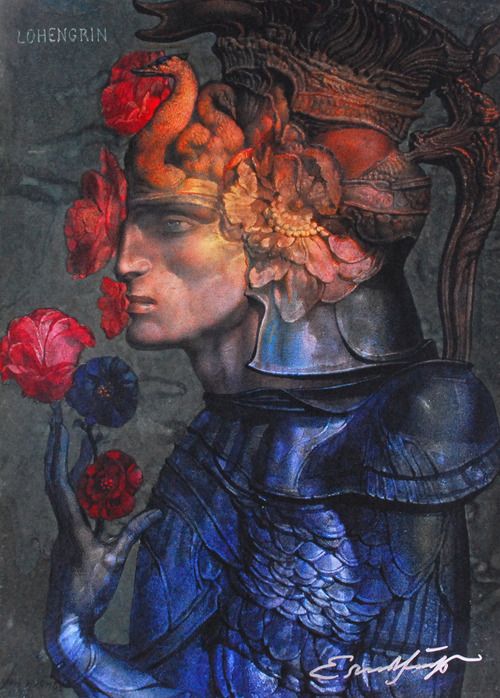
“Lohengrin”, Act 1‏

"Lohengrin" - Ernst Fuchs

Lohengrin (1977)

Ernst Fuchs

_______

this morning, requiring especially strong
medicine to get me through my day, I put
on Lohengrin, Wagner’s masterpiece,
directed by the thorny and unpredictable
Werner Herzog, from Bayreuth, the high
temple of that music, its very Acropolis,
1990, to lighten my load, to give me
mythic, maybe even Sisyphean,
perseverance, it didn’t disappoint

Elsa of Brabant is accused by Friedrich
of Telramund of having killed her brother,
who stood before both of them in line to
the throne, Ortrud, Friedrich’s wife, stands
silent throughout the first act looking
positively Machiavellian, Lady,
incontrovertibly, Macbeth

Elsa, summoned to plead her corner, tells
of a shining knight who appears to her in
her dreams, calls upon him to defend her
honour, he shows up at the very last
moment, on no less than a swan

he’ll only fight for her, he says, after she’s
offered him her anticipated kingdom, her
throne, her very honour and chastity, to
do with what he will, should he win for
her her cause, if she’ll pledge to never
ever ask about his origins, despite his
extraordinary entrance

she accedes, of course, though no other
knight, critically, has shown up to redeem
her

the shining knight conquers, of course,
but Ortrud, during the celebrations,
lurking ominously nearby, doesn’t give
the impression that anyone’s going to
live happily ever after, so long as
she can help it

it was the end of Act 1, I got up, made
a sandwich, I’d watch the following act
tomorrow, and so on, until the distant
end of that four-hour saga, to which
the epithet “Wagnerian”, for “epic”,
also, manifestly, belongs

wistfully I wondered about my own
knights in shining armour, who might
be my own guardian angels, entering
on fabled, maybe, even, swans,
concluded one of them had just been
Wagner, who’d turned, from heavy to
at the very least wistful, my day
around

wishing you Wagners

Richard

Beethoven – piano sonata no 7, in D major, opus 10, no 3‏

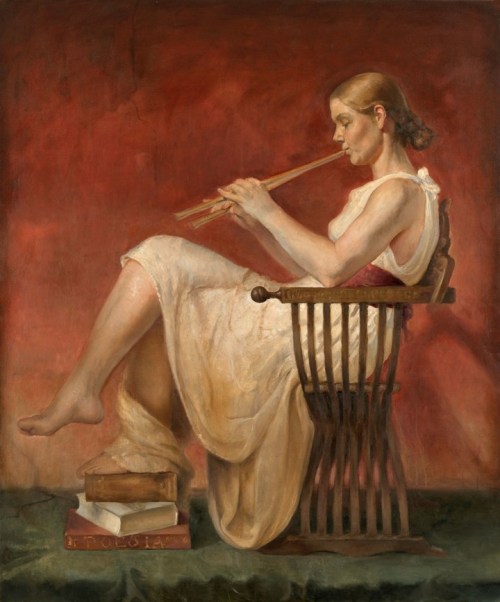
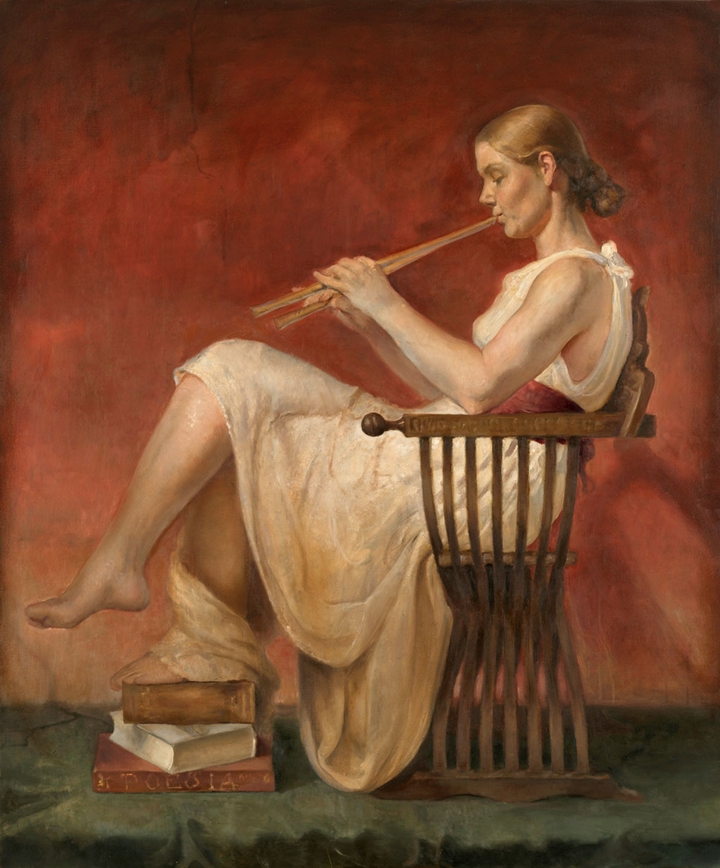
Euterpe - Apollo and the Muses - Helene Knoop 1979 - Norwegian Figurative painter - Tutt'Art@

EuterpeApollo and the Muses (2008 – 9)

Helene Knoop

________

if the piano sonata no 4 of Beethoven,
in E flat, opus 7, was academic, an
exercise, a display of technical
dexterity and some, admittedly,
even mighty, compositional verve,
it lacked, in my estimation, a centre,
a convincing motivating factor, a muse,
though ever ardent, ever entertaining,
it is ultimately arid, I think, trite, I’m
not, one is not, keen on returning to it

but in the piano sonata no 7, in D major,
opus 10, no 3
, Beethoven hits, I submit,
his stride, this sonata is enchanting

note the similarities of structure
between the two, the order of the
movements with identical, essentially,
tempo patterns, notably the middle
slow movement, in the first a largo,
con gran expressione,
slow with
great expression, in the latter, a
largo e mesta, slow with sadness,
where Beethoven plumbs, evidently,
the limits of pacing, the time lapse
between two notes, the capacity for
silence of this new instrument, the
pianoforte, of which he’ll look into
also, and even vigorously, its
capacity for volume, the crashing
introduction to his celebrated 8th,
for instance, to establish the
instrument’s new perimeters

you’ll note you can listen to the later
largo, the opus 10, no 3, forever, you
can get lost in its aural world, I can’t
think of anywhere else right now a
more profound largo

the other movements are dazzling
in their thrilling prestidigitation, all
organically sound, and, crucially,
motivationally centred, I think, this
is indeed music, magisterial music,
Beethoven’s not just kidding
anymore, he’s hitched onto his
proper inspirational deity, his own
private Euterpe, music’s muse, and
we’re in for something, from here
on, of a ride

note the cool riff closing off the last
movement, Beethoven in the guise
of Gene Kelly stepping in for a
breezy good-bye, prefiguring, of
course, XXth-Century music, and
the serendipitous extrapolations
of jazz

Richard

psst: incidentally, the headings, largo,
con gran expressione, largo e
mesta,
are entirely Romantic
musical notions, notations,
Classical composers would’ve
been too sedate, formal, courtly,
for such flagrant sentiment
Beethoven – piano sonata no 4, in E flat major, opus 7

though Beethoven’s piano sonata no 4,
in E flat major
, opus 7 has never been
one of my favourites, I’m finding this
particular renderin
g completely
enchanting

the opus 7 is, of course, early, when
you consider Beethoven reached into
the late 130s for his opuses, his opera,
not counting his, as bountiful, WoOs,
works without opus numbers

the sonata is steeped in Classical
conditions that are becoming ossified
at this point, about a decade after the
French Revolution, 1796 – 7, and that
have yet to be culturally overturned,
put to rest, you can hear it, you hear
the Classical form – formality, repetition,
congenial tonalities still – in the sonata,
brilliantly displayed by a composer
of ripe and rich imagination, but at
the service of structure rather than
the music itself, style over substance,
a student’s musical submission for a
composition exam

you’ll hear the repeat of the opening air
in the first movement more times than
you think is necessary, though the tune
be ever jaunty, never unpleasant, just
essentially trite, the second movement,
is a largo, a largo indeed, you’ll think,
about to fall asleep, even, at the wheel,
the later movements keep you
entertained in most interpretations,
not much, however, inspired, music to
pass the time, to check your watch by,
it needs what Beethoven will later
deliver in spades, miracles and
majesty, conviction

the opus 7 is long as well, nearly
interminable, I think, second only in
length to the sublime however
Hammerklavier, the 106, impudent
therefore, to my mind, if not outright
arrogant, in the mode of lesser artists,
Salieri, Clementi, for instance, who
never manage to transcend their,
however impressive, technical
expertise

but in this commanding account
maybe I’ve grown into the piece, or
maybe the performance itself is more
inspired – Joel Schoenhals finds
something that’s had me listen for
hours and hours, rapt, mesmerized

listen

Richard

psst: I needed this sonata for a course
I’m taking at Coursera, an Internet
learning site, on the Beethoven
piano sonatas
, the opus 7 is the
first one we’re looking at, this
performance
was the best one I
could find

join me

“Eugene Onegin”

years ago, when I first started paying
attention to opera, I listened to Joan
Sutherland and Luciano Pavarotti
singing “La Traviata” on my
headphones for six months solid,
Alfredo, Alfredo, I sang, di questa
core / Non puoi comprendere tutto
l’amore

now there’s “Eugene Onegin“,
Tchaikowsky’s homage to Pushkin,
the celebrated Russian poet who
wrote the national epic, turning it
into another prideful, musical this
time, monument

at first I’d been reluctant to take it on,
wary of other too ponderous Russian
productions, all heavy and lugubrious,
fraught with the trying tribulations of
too many harsh winters, I fathom

but after only a brief folkloric
interjection, too ecclesiastical a
reference for me, the story moved on
to less pompous things, an unfolding
love

Onegin is a rake, a rogue, a young
man not yet smitten, Tatyana, a
country lass but from a good manor,
hopelessly falls in love with him

he, of course, will break her heart

he will also break the heart of his
friend Lensky, when he dances an
écossaise, a grand waltz, and a
cotillion with Olga, Lensky’s
intended, and, parenthetically,
Tatyana’s sister

Olga had, injudiciously, allowed
Onegin to flirt

Lensky, offended, challenges
Onegin to a duel

in an aria that will haunt you forever,
Lensky commits himself to his fate,
be it Olga or the ineluctable hereafter,
knowing that she couldn’t either have
much loved him

you’ll cry

Kuda, kuda, you’ll also sing, kuda
vy udalilis,
like I will into surely at
least next month

I won’t tell you who wins, but it’s
tragic

and unforgettable

Richard

Pink Floyd‏

after Beethoven there was Pink Floyd,
just click

Richard

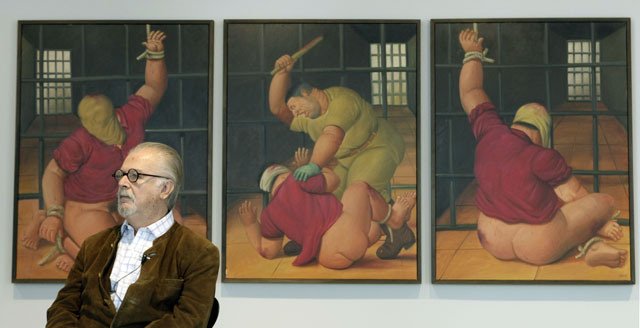
Botero’s Abu Ghraib

Botero's Abu Ghraib

Fernando Botero standing before three of over 80 of his stylized
depictions of atrocities committed at Abu Ghraib

____________

the role of art has always been to bring
attention to injustice, Goya, for instance,
famously, Picasso’s Guernica“, without
which Guernica would be forgotten, in
literature the servile position of women
and those marginalized by industrialization
in the works of Charles Dickens, Henrik
Ibsen, Émile Zola, in music the strident
strains of Shostakovich indelibly
imprinting the cruel depredations
of the Soviet system in his searing
compositions, just click

Botero, as the others, has given here
impermeability to what had been merely
news items, something tragic but lost
amongst so many other tragedies, by
giving it ideological breadth, depth and
substance, giving it the modern postion
of an altarpiece, a place of ardent
contemplation

we have after all no more churches,
only malls, we rely on potent images
for our moral guidance

therefore art

Richard

“A Little Touch of Schmilsson in the Night” – Harry Nilsson‏

 
when I was much younger, and still beset
by the unruly vagaries of love, finding my
way through its thorny thickets, this is
what I’d listen to as I’d fall asleep   


Richard
 
psst: all adagios, you’ll note, each and
        every one a lullaby
 
        Harry Nilsson (1941 – 1994)