Richibi’s Weblog

Just another WordPress.com weblog

Category: music to ponder

parsing art – John Caged‏

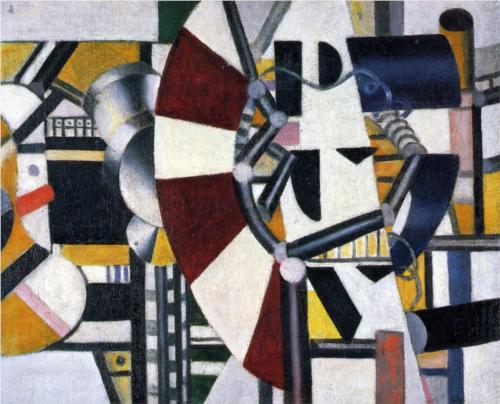
Fernand Léger - "Les éléments mécaniques"" (1920)

Les éléments mécaniques (1920)

Fernand Léger

_________

more John Cage, if you dare

just click

with, if you can believe it, Garry Moore,
I’ve Got a Secret“,
a trip down memory
lane

also ads for Winston, and Bufferin, very
Andy Warhol, thrown in, entirely the
1950s

Richard

parsing art – a response to my mother

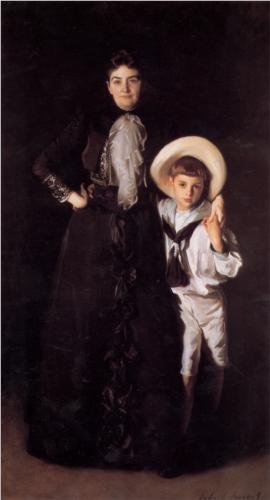
JohnSinger Sargent - "Mrs Edward L. Davis and Her Son Llivingston" (1890)

Mrs Edward L. Davis and Her Son Livingston (1890)

John Singer Sargent

______

about John Cage my mom writes,

“Hi Rick…..

When you called I had written the message but not sent it….I am trying again..

I cannot see people spending $100 or more and wasting almost 8 minutes of their time
to watch that crap…..

As for David Hockney…..well…..not my style….but for your sake I hope a lot of people like it…..

See you at 6 p.m……will give you enough time to digest what I said…..All my love….MOM….XXXX”,

most uncharacteristically, the last time
she used an epithet was when I landed
some Schönberg on her, which she
returned promptly and categorically,
that was some fifteen years ago, even
maybe twenty

bravo, Mom, for your robust opinion,
that’s what art’s about

but I’m reminded thereby that art is not
just for effetes, pretenders to arcane
insights, it’s for all of us, not getting it
is not necessarily our fault, sometimes
the artist is obtuse, even trite

what is true should be clear, I believe,
to everyone, which is why I ever adhere
to art, art cannot be anything other than
true, manifestly, else it falls apart

love you, mom

Rick

psst: if you’ve got quarters, please bring
some over tonight

Études, opus 10 and 25 – Frédéric Chopin

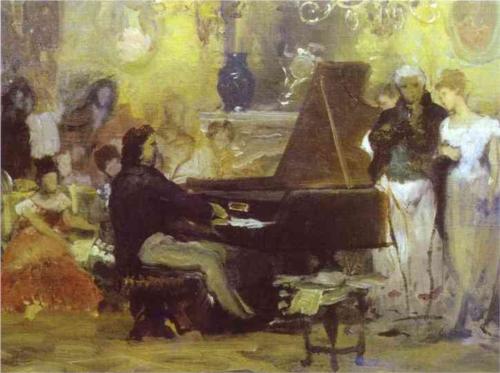
 Henryk Siemiradzki - "Chopin Performing in the Guest Hall- of Anton Radziville in Berlin In 1829" (1887)

Chopin Performing in the Guest Hall- of Anton Radziville in Berlin In 1829” (1887)

Henryk Siemiradzki

__________

no sooner does one inveigh against an
attitude than that attitude turns around
and slaps you in the face, my, however
brief, enrolments at art school, musical
conservatories, and creative writing
classes, were not, I think, without some
merit, some would even say much merit,
despite my short disparagement of them
in my last blog, there are tools for every
art, schools have the machinery to
channel inspiration

Hans Hofman must’ve believed he was
painting a Poème d’amour when he
painted it, why otherwise would he
have painted it, despite myriad
objections, and general
incomprehension, could he have
known that no one would get it, did
he care, who called it art

did Chopin know when he wrote his
first set of “Études”, opus 10, a
theoretical set if there ever was one,
a set of fiendishly challenging
technical exercises, that they would
define the Romantic Period, an era
given over to the very heart, he was
23, having fun

what is art, art is what works, art is a
consensus, sometimes you’ll get it,
sometimes you won’t, sometimes I
get it, sometimes I don’t, art is in the
eye of the beholder, just like beauty
and love

Chopin, the theoretician, produces a
resounding argument for the technical
side of composition, the cerebral, this
is perhaps why they are my favourites
of his compositions

but he hasn’t left out the very centre
of music, how it connects, how it can
carry you along, even to enchantment,
he hasn’t left out the enchantment,
these to me are poems of love

he calls them études, opus 10 and 25

who’d ‘a’ thunk it

enjoy

Richard
“Anything Goes”‏

Anything-Goes

Anything Goes

________

‘nough said

just click

Richard

“Six Pictures for Piano” – Arno Babajanian‏


Paul Gauguin "Poèmes barbares" (1896)

Poèmes barbares (1896)

Paul Gauguin

_______

if you thought that Arno Babajanian was
done with synesthetic investigations,
seeing sounds, hearing colours, here’s
his Six Pictures for Piano“, which he
plays, all of them, himself

can a piano paint, take pictures

you tell me

something else interesting is happening
here, the six are individual pieces despite
being part of a common whole, as the title
suggests

this is the opposite of trying to integrate
movements to a continuous and unfolding
conception, something Beethoven, for
instance, pursued, indeed ardently, in his
own sublime music

dissociation seems a context, a XXth-,
a XXlst-Century, context, in our presently
more polarized world, according to, of
course, Babajanian

what might hold us together then

maybe music

incidentally, the movements to the
Six Pictures here are

1 – Improvisation
2 – Folk Song
3 – Toccatine (a little toccata)
4 – Intermezzo
5 – Choral
6 – Sasoun Dance (don’t ask),

should you not be able to read Russian

note, none of these themes are
photographic

don’t either miss Babajanian‘s
Sonata for Violin and Piano
as played by, here again,
himself, it’s rapturous

Richard

psst: see Gauguin above paint poems

“Tonight You Belong to Me”

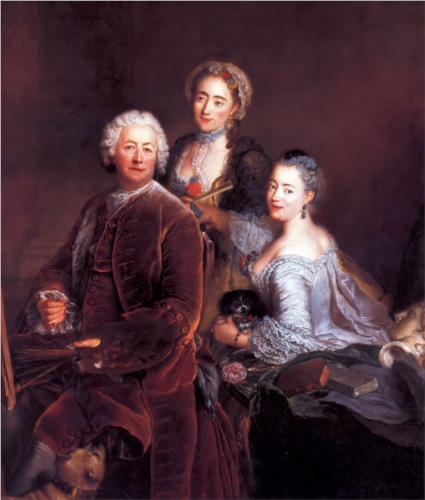
Antoine Pesne - "Self-portrait with Daughters" (1754

Self-portrait with Daughters (1754)

Antoine Pesne

______

for fathers, especially, and daughters

and all those who love them

just click

Richard

psst: in the spirit of Brain,
worthy contenders from

before my time

after

“Poem for Piano in C# minor” – Arno Babajanian‏

Corneille - "Music" (1949)

Music (1949)

Corneille

______

in the spirit of unusual juxtapositions,
the very stuff, let me suggest, of art,
here’s a Poem for Piano, in C# minor“,
by Arno Babajanian, an Armenian
composer, 1921 to 1983, played by a
countryman of his, Armen Babakhanian

a Poem for Piano begs the question,
what is a poem, can a poem be devoid
of stanzas and words, can music be a
poem

you tell me

Richard

psst: can music, incidentally, be a painting,
see here, or above

“Caprice d’après l’étude en forme de valse de Saint-Saëns” – Eugène Ysaÿe


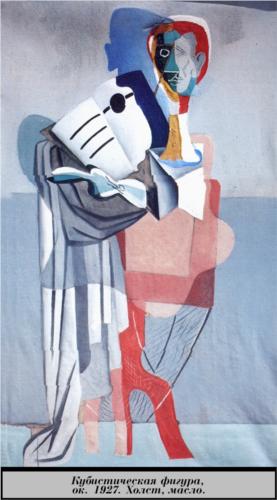
Salvador Dali "Homage to Erik Satie" (c. 1926)

Homage to Erik Satie (c. 1926)

Salvador Dali

________

the very variety, the infinite variety,
of possibilities in music, in any art,
in any craft, in any even venture,
has had me believe in a diversified
world rather than the monotheistic
one we’ve been trained to ascribe
to, I believe in Olympus rather than
in Purgatory, Hell, and Heaven, I
see many more variations on a
theme, always, than immutable
objects, we are even ourselves in
constant, ever evolving, flux, look
at me, I’m not the boy, not the even
young man I used to be, though I
was never, of course, as wise as
I am now, later in life, or so I feel
I can continue to tell myself, ha ha

on this multiplicity read the
accomplished and convincing
Martha Nussbaum, incidentally

as an example of this exuberant
fruition consider this wonderful
interplay of artists and forms,
Ysaÿe‘s Caprice d’après l’étude
en forme de valse de Saint-Saëns
“,

Caprice on the Study in Waltz
Form of Saint-Saëns

here’s the study, Étude en forme
de valse, op 52, no 6
“,
from which
it’s taken

don’t overlook either the “exuberant
fruition
” above, the Dali on Satie

or find it again right here, just click

Richard

Chopin piano concerto no 1, opus 11‏


this is for Brain, who, according
to its response to my last blog,
is about to explore Chopin, a
transformational experience,
which I’d like to encourage
and heartily abet

____________

watch, be transported

Evgeny Kissin at the piano, Zubin
Mehta conducts, Chopin’s First
Piano Concerto
, an indisputable
masterpiece, just click

before this performance I will remain,
uncharacteristically, mum, let Chopin
speak for himself, from the early
Nineteenth Century, letting us know
what they were up to then

it appears to have been utterly
astonishing

Richard

psst: thanks Brain

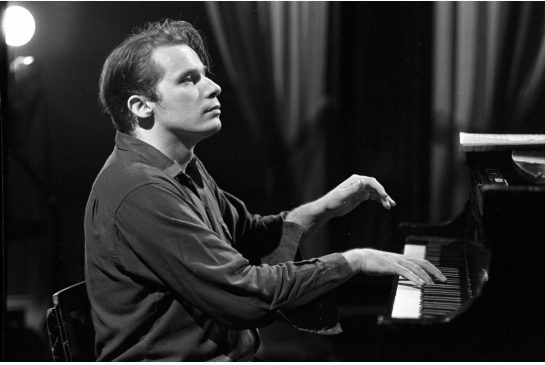
Glenn Gould‏

Glenn Gould

Glenn Gould

_______


if you think I can talk, listen to Glenn
Gould
tell in spades what I’ve only
ever been able to tell in clubs, or,
as we say in French, trèfles, clover,
a piece of music can say more than
just hello, great ones are oracular,
even transcendent

if ever they made a movie of my life
I want Glenn Gould to play me, even
the wonderful Colm Feore, I think,
couldn’t as effectively manage it

Richard

psst: here’s more, incandescent, Bach,
Glenn Gould playing his signature
piece
, just click