Richibi’s Weblog

Just another WordPress.com weblog

Category: music to ponder

“Octet in F major”, D803 – Franz Schubert
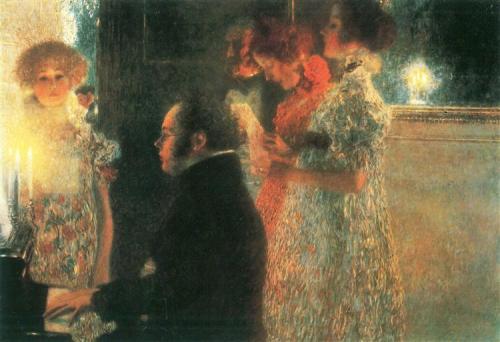
schubert-at-the-piano-ii-jpglarge

     “Schubert At The Piano II (1899) 

              Gustav Klimt

                  _______

there are reasons why an octet, a 
piece for eight performers, would 
be a rare occurrence in our modern
world, the most flagrant being the 
sheer number of players to 
assemble, all with international 
commitments, and all, more 
specifically, working individually, 
or in smaller composites

duos can play any choice of 
instruments, trios as well, but
quartets are usually, which is to 
say traditionally, comprised of 
only strings, first and second 
violins, a viola and a cello, 
these three groupings, duos, 
trios, quartets, are often already 
formed, play or meet together 
regularly

also musical compositions for such 
groupings abound, the canon is 
replete with music written for two, 
three or four instruments

but at five participants, a quintet, 
the combinations are less stable, 
there isn’t enough in the 
repertoire for four strings and 
clarinet, say, to play, so that a
clarinettist must be invited in
for such an occasion, any 
other alternative accompanying 
instrument would be fit in as
incidentally 

with six, of course, and upwards, 
you get egg rolls, anything can 
happen

but at eight, an octet, you need 
friends, people who’ll gather from 
their individual busy schedules to 
perform specifically together out 
of sympathy, much as friends 
would’ve back in the Nineteenth 
Century, before television, when 
the form took shape, to socially 
cut up the rug
 
if indeed it did take shape, cause I 
can think of no other octet, off hand
after Schubert’s glorious one 

Schubert’s Octet, the composition, 
with this particular octet, the group, 
is probably the best you’ll ever hear 
of either ever, Schubert’s D803 in F
major is everything you want 
Schubert to be, and in a generous 
indeed six movements, while
Janine Jansen and her friends, the 
octet performing here, with the 
requisite four strings, plus a horn,  
a bassoon and a clarinet, are 
magisterial, dare I say definitive, 
the standard now to exceed 

octets, incidentally, don’t do 
encores, for obvious reasons

enjoy

Richard

psst: for a comparable congregation 
         of friends, see Roy Orbison’s 
         Black & White Night“, equally
         as improbable, epic
Puccini on poets

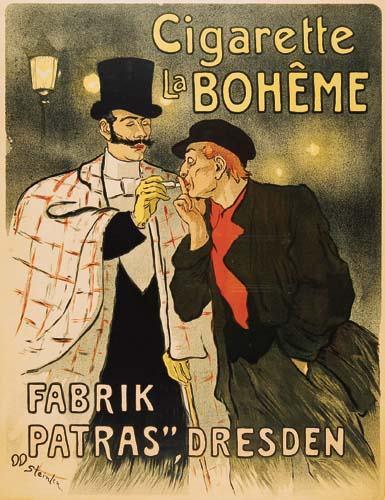
cigarette-la-boheme-1879

                   “Cigarette La Bohême (1879) 

                             Théophile Steinlen

                                        ______

with a friend today over lunch I told 
her that we’d watched, my mom and 
I and a mutual friend, La Bohème“,  
an Australian production of it, Baz 
Luhrmann directing, a man we both 
knew, at my place last Sunday, we 
were all wowed by it, I extrapolated 

the only opera I’ve ever seen, she 
said, was La Bohème

where did you see it, I asked, and 
when  

with my first husband, she replied,
in Vienna 

was it wonderful, I inquired  

it was, she answered, I had on a 
long dress, my husband was in 
coat and, essentially, tails, we 
walked up a very long staircase, 
I  remember

coincidentally, the first time I’d 
seen “La Bohème was also in 
Vienna, I can’t remember the 
staircase, couldn’t remember what  
I wore, can’t even remember where 
I was sitting, what I remember, as
though through a telescope, darkly,  
was Mimi and Rodolphe looking for   
the key she’d lost, on their knees   
on the floor, in the dark cause her  
candle ‘d gone out, he’d put his out
surreptitiously too to  join her 

your little hand is so cold, he sings,
when he, unforgettably, finds it 

in this production, Rodolphe has  
found the key but conceals it 
from Mimi until she sees it in his 
eyes, he pretends to return it but 
instead manages to hold her 
hand 

your little hand is so cold, he 
sings, again unforgettably

there’s nothing to fear, he 
continues, the moon is out, let’s
get to know each other

who am I, he asks, to start the 
conversation, I am a poet, he 
declares, and proceeds to tell 
us what it is to be a poet 

you’ll be utterly enchanted

tell me about a world, I ask,  
without poets, tell me about  
a world without poetry 

where would we be without 
dreamers, I wonder, where would 
we be without dreams

watch here, and wonder

Richard

the wall

colors-for-a-large-wall-1951.jpg

   “Colors For A Large Wall (1951)

       Ellsworth Kelly

          __________

talking about walls, isn’t it only a few
years ago we were tearing one down

here is Roger Waters and several
other outstanding guest artists, in 
very Berlin, July 21, 1990, celebrating 
its demise

a little earlier, C***mas, 1989, only
moments after East Germans had 
been allowed to visit West Germany,
essentially giving way to the 
dissolution of the barrier, Leonard
Bernstein conducted Beethoven’s
Ninth Symphony, changing the 
word “joy” from the title of Schiller’s 
poem, appropriated by Beethoven 
for his great fourth choral movement, 
to “freedom”, giving new meaning, 
and new life, and new inspiration,  
to Beethoven’s always resounding 
nevertheless masterpiece

how soon we’ve forgotten

Richard

psst: let’s paint the wall

“Dido and Aeneas” – Henry Purcell

1024px-sir_nathaniel_dance-holland_-_the_meeting_of_dido_and_aeneas_-_google_art_project

         “The Meeting of Dido and Aeneas (1766)

                       Nathaniel Dance-Holland

                            _________________

despite difficulties with the presentation – 
a French production of an English opera 
supplying Spanish, I think, subtitles – this
Dido and  Aeneas is not only the best
version of it I’ve found, but one of the 
very best opera productions I’ve come
across, period

Dido is the queen of Carthage who, having 
fallen in love with Aeneas, a prince of Troy
bent on creating a new commemorative city, 
forsakes her very husband for this heroic 
suitor

Aeneas in turn will leave her, to follow his 
mission of founding Rome, Dido will not 
survive his departure 

ah, Belinda, I am pressed with torment not
to be confessed,  she cries, when she fears
her entanglement with so mighty a hero
will come to an unfortunate end, peace 
and I are strangers grown, she determines

figures in dark clothes in the production
are obviously up to no good, one most
evidently a sorceress, they cast a spell
on the fraught conjunction that the 
lovers cannot at all resist

away, away, Dido exclaims, enraged by
Aeneas’ mere hesitation, no, faithless
man, thy course pursue, she cries, for
’tis enough, no matter whate’er you 
now decree, that you had once the  
thought of leaving me, though Jove,
god of gods, had himself ordained that 
Aeneas pursue his original intention, 
to found the Eternal City, the Rome  
he would choose over her  

for Dido, there is no turning back

thy hand, Belinda, she of her trusted
confidante in those final moments 
requests, darkness shades me, on 
thy bosom let me rest, more I would 
but Death invades me, Death is now 
a welcome guest 

the asp has, in a metaphorical word, 
been cast

remember me, she thereupon moans 
and that for the very ages, remember, 
me, but, ah, forget my fate

last night I was Dido, watch, so can 
you

angels then appear, in the form of, 
granted, extras here, to accompany
her to a peaceful and immortal end,  
much as they did our own Princess 
Diana when she suffered a similar
misfortune

may they both inform our progress

Richard

psst: a spoken preamble is not part of the 
         original text, nor did I find it especially 
         pertinent, however splendidly it might
         have been executed

on art, its purpose

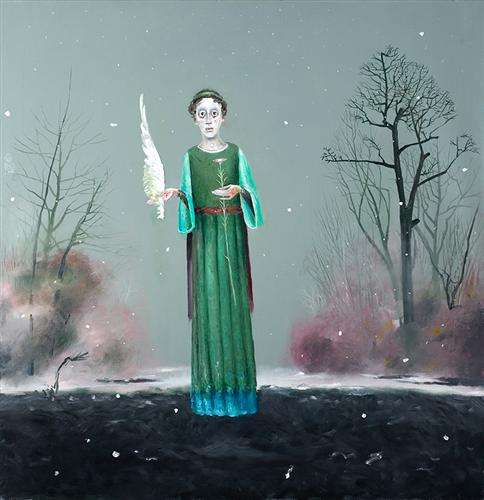
poet-with-flower-2008-jpgblog

                                Poet With Flower (2008)

                                          Stefan Caltia

                                                 _____

wherefore art, I’ve long and often wondered,
with only a wink to Juliet’s Romeo, for my
question dug deeper, why, indeed, itself art

we build our souls on the stories we’ve 
heard, the impressions we’ve received
from voices that spoke directly to our 
senses, painters with paint, musicians
with music, writers with words, poets 
with poems

it started with fairy tales, which told of
right and wrong, good and bad, courage,
kindness, responsibility, and dire 
consequences for discord

Biblical stories also took up a lot of my own
childhood, Jesus, Adam and Eve, Moses
and the Ten Commandments, this last 
reinforced by Cecil B. DeMille’s epic

but soon enough it was Oliver TwistLittle
Nell, and by an inescapable authorial leap, 
since these were all by an irresistible 
Charles Dickens for a guy my age, Sydney
Carton, who valiantly stands in for his
friend, Charles Darnay, at the guillotine, a 
quantum, even existential, leap from 
Peter Pan and Mary Poppins 

though I had the good fortune to learn to 
read and write music as a boy, play music, 
learn about Bach, Brahms and Beethoven, 
it didn’t take anyone else much more than
their enthusiasm to see what the Beatles
were similarly doing, the Rolling Stones, 
the Supremes, they were not only singing, 
but making history, shaping it, and us, we 
followed the questions they rose, their 
responses, the effects upon ourselves
for nothing is considered until it’s 
mentioned, spoken, made clear, and they
were those prophets

the same goes for art, we see as we see
cause Monet, Picasso, Warhol showed 
us how to see, what to look at

and of course poets, Shakespeare, 
RostandDanteGoethe, to inform, each,
their individual language, and culture

I have been Philip CareyScarlett O’Hara, 
Blanche DuboisGary Cooper in High
Noon“, both Martha and George in 
Who’s Afraid of Virginia Woolf“, lately 
I’ve been even Hank Williams

as Babette would say, a French doll who 
gets abducted in Raggedy Ann and Andy:
A Musical Misadventure“, an animated 
movie from the Seventies, – oo aahrr yoo 

Richard

psst: all of them have been me too,
      incidentally

“The Man I Love” – George and Ira Gershwin

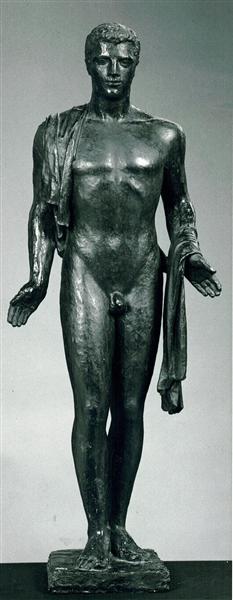
apollon-1937-jpglarge

             Apollon” (1937) 

             Charles Despiau

                    _______

when my heart is broken, I learn the 
words to torch songs, and wallow in 
my misery until the poignancy of the
poetry seduces me and I revel in its 
caress

for a while now I’ve been yodelling 
along with Hank Williams, who, 
incidentally, sings in my key, though 
the accurate reach of his far-flung 
notes can be tricky

but today, I inadvertently slipped into 
this Sophie Tucker classic enough to 
change my tune

watch this wonderful rendition of 
The Man I Love in a version you’ll 
never forget for both its originality
and its great humanity

Richard

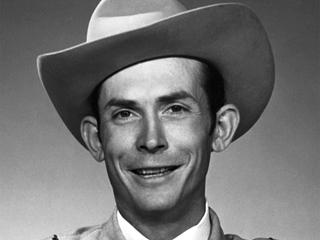
“Hank Williams: The Show He Never Gave”

hank-williams-1

                        Hank Williams

                              _______

halfway through The Last Picture Show
recently, a celebrated movie from the early 
Seventies I was watching, about the early
Fifties, I was sidetracked by the Hank  
Williams soundtrack till I was out and out 
stopped by its fervent Cold, Cold Heart 

I put the film on pause 

another love before my time, I warbled,
made your heart sad and blue, and so 
my heart is paying now, I wallowed, for 
things didn’t do, in anger unkind words
were said, I rued, that made the teardrops 
start, why can’t I free, your doubtful mind, 
I fretted, and melt your cold, cold heart 

but I wanted to hear Hank Williams do
it too, live if I could, and lo and behold 
got it

but listed as an option among other 
options nearby was also a longer  
feature purporting to be a 
representation of a concert he 
never  gave the night, December 31, 
1952, he died, the movie is called,
not inappropriately, Hank Williams:
The Show He Never Gave

the actor who plays Williams steps
right into his shoes, he’ll break your 
heart, you’ll need a lot of Kleenex

one of he best film biographies I’ve 
ever seen 

watch it

Hank Williams died of a heart attack
on the night of December 31, 1952

he was 29

may he rest in everlasting peace

Richard

in recognition of Prince

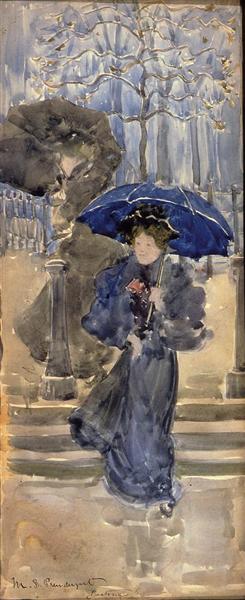
ladies-in-the-rain.jpg!Large

Ladies In The Rain (1893-1894) 
 
         Maurice Prendergast
 
                _____________
 
 
trying to find a musical representation

of me for a love recently lost, but with
whom the interaction is nevertheless
cordial, for a letter I was writing him,

cordially, and which I would sign me,

I hit upon Prince’s Purple Rain“, I never  
meant to cause you any trouble, never 
meant to cause you any pain, perfect, I 
thought, I only want to see you laughing 
in the purple rain
 
how else can one love
 
I remembered that Prince was a hero, 
an angel, a prophet, an epiphany of the 
late Twentieth Century, some voices are
indelible, incandescent, illuminating,
avatars of love
 
 
note the pace of Pink Floyd, the 
hypnotic, messianic even, tempo,  
note the elements of the prophet


Richard


up my idiosyncrasies – Albertine‏

wing-seller-2006.jpg!Large

            Wing Seller (2006)

               Stefan Caltia


                        _______ 

 
what are you doing, a friend of mine
asked when he called 
 
I’m reading my Proust, I answered,
comfy enough with my textafter 
years waking up side by side, to 
use the possessive adjective 
 
what’s going on, he inquired
 
Albertine is lying on his bed, 
recounted, asleep, she’s been there 
for the past ten pages, and she’s 
just now turned onto her stomach
 
 
there is not so much story as 
paintings, in Proustdetailed 
descriptions applied like strokes of 
colour to a canvas, that of recovered 
time, colours that are specific to a 
place and a period, like photographs 
showing in their very fabric their 
ancestry, their lineage
 
but in the elucidation of what he 
sees, or, more accurately, of what
he remembers, Proust delivers 
a work of the very highest art, a 
mixture of poetry and philosophy,
Beethoven did as much, see his
 
 
Proust’s French is essentially 
immaculate, his tone, however 
intimate, always erudite, aristocratic, 
perspicacious, wise, penetrating,
embracing, which is to say, French,
though German can be also
incidentally, pretty cerebral, English 
is narrative, just the facts, please, 
though often, I think, hilarious
 
 
Albertine had been one of the “young
girls in bloom” he’d met at Balbec, a 
seaside resort, with whom he’d 
undertaken an illicit affair, but 
whose faithfulness he doubted
 
as she lay on his bed at his Paris
apartmenthe replays all the 
speculations his imagination could 
provide, an endless set of variations
on his anguish, which is to say, his
jealousy, worthy of a very Othello
 
for ten pages he paints a picture of 
infidelities completely of his making,
which, of course, becomes the world 
he will respond to
 
it is all in our little heads, I surmise, 
however informed, intelligent, that 
we create our little realities, they 
have never been nearly enough, 
though, indeed, our lives depend 
on themhowever dutifully
considered, however unconsciously,
and ever convincingly, contrived   
 
make them, I submit, good ones
  
I imagine myself a poet, for instance,
how’s that for a shot in the improbable 
dark
 
 
Richard

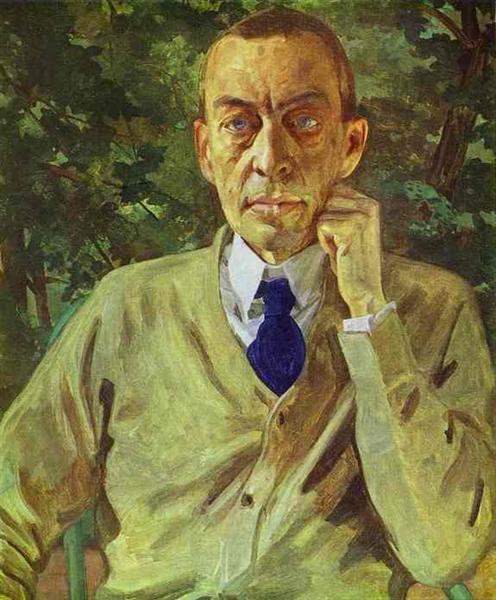
“Rhapsody on a Theme of Paganini” – Rachmaninov‏

portrait-of-the-composer-sergei-rachmaninov-1925.jpg!Large

 
                                      Konstantin Somov
 
                                              _________
 
 
no one plays Rachmaninov better than
Rachmaninov, of which we’ve got aural
representations though no visual live
performances
 
but here’s a Rhapsody on a Theme of 
Paganini to knock your socks off, in 
all its kinetic, electrifying energy
 
you might remember Daniil Trifonov
from my coverage of the XVth 
who has gone on to achieve a 
stunning international reputation, 
entirely, I submit, deservedly
 
watch him set the piece on fire, at 
pace I find faster than most, with 
nevertheless all the requisite 
dexterity, indeed prestidigitation,  
necessary to weave the intricacies 
of Rachmaninovian sound into 
apposite magic, that magic 
Rachmaninov would surely ‘ve 
looked for
 
check them both out
 
 
Richard