Richibi’s Weblog

Just another WordPress.com weblog

Category: music to ponder

on “Elegy for the Victims of the Tsunami of March 11, 2011 in Japan” – Nobuyuki Tsujii
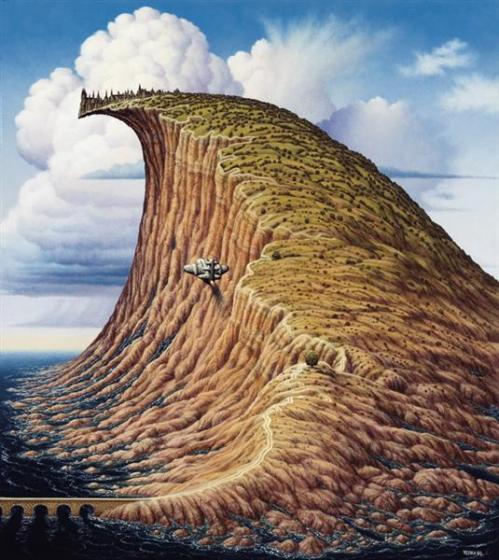
tsunami-1998.jpg!Large

    Tsunami (1998) 

         Jacek Yerka

          __________

while watching Nobuyuki Tsujii play the
extraordinarily demanding Tchaikovsky 
First Piano Concerto on television the 
other night, with no less than Valery
Gergiev, conducting the resident 
orchestra at the Mariinsky Theatre in 
Moscow, for its White NightsI was 
wonderstruck by the challenges a 
visually handicapable pianist would 
have to conquer in order to reach 
such an apogee 

everything must be learned by ear, all
items must be discovered tactually, 
from the piano itself to the very 
individual keys, not to mention 
the player’s very own fingers

there can be no visual contact with a 
conductor, either, for cues, for 
instance, nor for any other 
accompaniment, for neither even an 
audience, it would all take place in 
the dark recesses of the head, the 
amorphous and, I suppose, 
confounding, cerebellum

later he played for an encore his own 
composition, Elegy for the Victims of
the Tsunami of March 11, 2011 in Japan“,
a fine addition to my budding collection 
of threnodies

and a very, very moving piece

an elegy, incidentally, is usually written,
while a threnody is composed, but these 
terms are often used interchangeably, as, 
indeed, they are here

you’ll note the utterly Classical mode of
composition of the Elegy“, it adheres to  
a uniform tonality, a consistent tempo, 
and the grounding and comfort of 
repetition, returning always to the main, 
endearing air, rather than more modern 
tripwires and stridencies, traditionalism 
being not an inappropriate, nor ineffective,
mode of address for honoured forebears 

long live Classicism


R ! chard
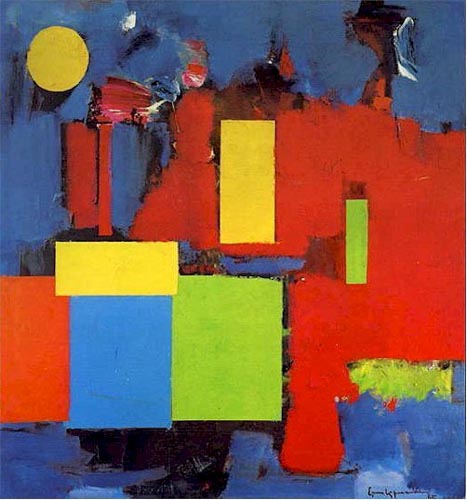
on “Song to the Moon” – Antonin Dvořák

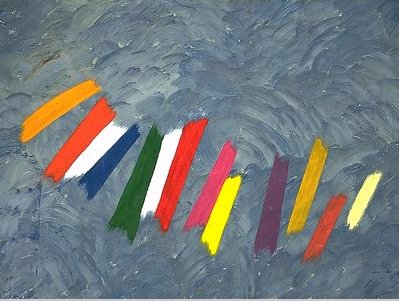
rising-moon-1964

   “Rising Moon (1964)

          Hans Hofmann

              __________

the moon was out last night, grand
upon the starlit evening, either 
waxing or waning, I’m not sure, but
not full, a gibbous moon, above the 
buildings that scrape, in my big city 
neighbourhood, in the very Cubist 
manner, the night sky, see above

I’d been listening to Renée Fleming
singing Dvořák‘s Song to the Moon
in my head since I’d seen her do it, 
on television, in a summer evening 
concert at Schönbrunn, Vienna, some
few days ago, sheit, had been utterly, 
sublimely, enchanting, I’m a Cancer, a
moon child, I speak to the moon

to the moon, I said, moon in the dark
heavens, who steal into every home
and hearth at night, find my beloved
and tell him what is in my heart, rapt 
as I was in the spell of my special
planet, my personal orb, and the 
enveloping Dvořákian magic, though 
there’s been no beloved lately, just 
trailings of the latest one who broke, 
of course, my heart, which gives more 
pathos, however, incidentally, to my 
singing, I’ve giddily gathered

at home, I found Renée Fleming doing 
the piece on the Internet, entirely as 
splendidly, earlier, at London’s Royal
Albert Hall, September, 2010

listen

R ! chard

an homage to the victims of the Titanic

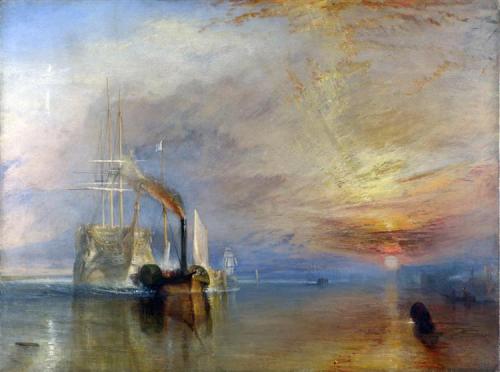
the-fighting-temeraire-tugged-to-her-last-berth-to-be-broken-up-1839.jpg!Large

  The Fighting Temeraire tugged to her last berth to be broken up (1839) 

          William Turner

                _______

while I’m on the subject of threnodies
which is to say “song[s] of lamentation
for the dead”, as I earlier statedlet me 
bring your attention to this extraordinary 
piece, an homage to the victims of the
Titanic
 
it doesn’t even have a title, much as 
Mozart and Haydn didn’t before music 
went mainstream, into public forums 
rather than merely aristocratic salons, 
and when an identifying moniker 
instead of a number became manifestly 
more practical, especially when the 
emerging Middle Classes were 
becoming the ones who were paying 
the composer’s bills, at the opera 
houses and the other sprouting 
concert venues, when some composers 
had even up to 32 sets of piano sonatas 
to remember, three and four often to 
a single set, opus number, as many as 
there are movements in a very sonata

and that’s not counting the numbered 

symphonies and string quartets of 
theirs, left to similarly calculate, 
decipher, extricate

it doesn’t have a title, I think, because
to my knowledge, it is the first of its
kind, a composition created by 
computer, for computer, an entirely 
self-contained digital work of, 
manifestly, art – I’d been waiting, 
diligently, for one – and like Beethoven, 
after the work was done, the artist(s)
just felt the title best left to the 
wordsmiths, thus – you’re welcome –  
Threnody for the Victims of the 
Titanic

sure, computers have done practical
things before, admirably, but never 
told a story, and certainly never one 
as profound as this one

these are the last moments of the 
Titanic, digitally reproduced, in real 
time, 2 hours and 40 minutes, they
are mesmerizing, you don’t want 
to miss a thing

there are no voices, apart from a 
few radio transmissions at the 
start, spotting the iceberg, calling 
out commands to beware, stop 
the engines

afterwards only silence, and the 
sound of the waves, the churning
of the engines, which have been 
restarted, sounding as rhythmic, 
incidentally, and numbing, as the 
wheels on the railroad tracks of
Steve Reich‘s Different Trains“,
another powerful threnody 

later the flash and crack of flares,
the crunch of the ship sinking  

the pervasive, however disrupted, 
silence and the inexorable passage 
of ever ticking time combine to be, 
thereafter, transfixing, meditative, 
ultimately transcendent, a fitting 
setting for a threnody 

I know of only another work to take
you to that venerable place,
Beethoven’s opus 111

and often enough Pink Floyd, for 
that matter, and the visionary 
Alan Parsons Project, of course, 
discoursing on inexorable Time 

and, now that I think of it, Elgar‘s
The Dream of Gerontius, whose 
character goes from his deathbed 
in the first act, to his afterlife in 
the second, effecting transcendence
for us by, yes, ingenious 
metaphorical proxy

but I digress

what I call Threnody for the Victims 
of the Titanic is a narrative with 
sound, not a movie, not a television
program, it has more commonality 
with a musical production than 
anything else but painting in art 
history, though its means are 
intuitively literary, ship stories go
back to The Odyssey through
Gulliver’s TravelsTreasure 
Island and to one of my very 
favourites, Ship of Fools“,
relatively recently

I could add Mutiny on the Bounty“,
Moby Dick“, “The Caine Mutiny 

in art, a precedent would’ve been set
in our collective consciousness by 
William Turner‘s celebratedThe 
Fighting Temeraire …, but I would 
mention as well Caspar David 
Friedrich‘s The Wanderer above 
the Sea of Fog for its existential
pertinence

a few literary points I’d like to stress
to back up my overt adulation, I find  
it impressive that the Classical rules
of tragedy have been maintained, 
unity of action, time, and place, 
prescriptions going back to 
Aristotle‘s Poetics in our cultural 
history, to profoundly express 
tragedy, iconic, epic, misfortune

not to mention the Classical musical
imperatives of tempo, tonality and 
repetition, none of which can be 
faulted here in this consummate 
composition

there is a no greater leveller of tempo 
than time, larghissimo here*, in the 
largest sense of that word, the 
cosmic, the inexorable pace of 
temporality in our brief heavens

a greater leveller of tonality neither  
is there than the rigorously impartial 
hum of the imperturbable Cosmos 

nor is there greater repetition than 
uniformity, however disrupted by  
however fervent ever human 
intervention, see Sisyphus, or 
Martha in “Who’s Afraid of Virginia
Woolf for iconic disrupters

R ! chard

*   Shostakovich had asked the 
     Beethoven Quartet to play the first 
     movement of his 15th String Quartet,
     “Elegy: Adagio“, so that flies 
     drop dead in mid-air, and the 
     audience start leaving the hall from 
     sheer boredom  

     well this inspired elucidation is even  
     slower than that

threnodies: to the victims of Hiroshima, of the Holocaust, and to the Canadian North

The Scream, 1893 - Edvard Munch

       The Scream (1893) 

             Edvard Munch

                    ____________

before we leave too far behind the 
anniversary of the annihilation of
Hiroshima, August 6, 1945, let me 
introduce you to a piece that 
purports to pay it homage

if I didn’t bring it up before, it’s 
because the date was wrong, but
especially because the work 
offends me, the only thing I like
about it is the title, a thing of 
beauty, poetry – Threnody to the
Victims of Hiroshima – a threnody
is a song of lamentation for the 
dead, which worked for me, this 
one, no further than its title

there is nothing remotely 
reminiscent of the tragedy
throughout the piece, it is a 
collection of academic exercises,
pretensions, I think, without a 
heartbeat 

let me compare Steve Reich’s 
threnody to the victims of the 
Holocaust, the other signature 
Twentieth Century atrocity, his 
Different Trains“, a work in three 
movements, America – Before the 
War”, “Europe – During the War”, 
and After the War”, for string 
quartet and tape, upon which 
Reich has recorded interviews 
with people relating impressions 
from before the warduring, and 
after, according to the movements

the quartet, you’ll note, must keep 
time with the tape, and in this 
production visuals have been 
effectively added 

Glenn Gould had done something 
like this several years earlier,
incidentally, in his The Idea of 
North“, a threnody itself to that 
very idea, a masterpiece, a
groundbreaking transcendental
work of the imagination, with 
overlapping voices, which is to 
say human counterpointthough 
without string quartet

you’ll note that distressing tonalities
affect throughout this other, much 
more successful however, tribute
but the different rhythms of the 
recurrent, which is to say minimalist, 
rails keep you emotionally, as it were, 
on track

Different Trains is appropriately,
and profoundly, commemorative, 
not to mention unforgettable 

Richard

“My Romance” – Carly Simon

hot-jazz-1940.jpg!Large

       Hot Jazz (1940) 

               Franz Kline

                        _____

in this video of one of her concerts, 
Carly Simon tells the story of how
when she told her special guest on
the program, Harry Connick Jr., that
he was born the same year as 
Sgt. Pepper, he answered, Sgt. Who

   “Harry, you were born the same year that 
                     Sgt. Pepper came out”, she said
   “Sgt. Who”, he answered

the same had happened to me when  
I’d told someone, a sprite, ten years 
younger, don’t ask, about my 
admiration for Susan Hayward
Richard, he asked, who’s Susan 
Hayward, to my utter consternation

I mean, Susan Hayward

you might not know who Carly Simon
is, nor even Sgt. Pepper, but the story 
is that those who once had been our 
very idols fade and become question 
marks in the eyes of the following 
generations

you might not either know who Harry 
Connick Jr. is, but listen to both of 
them here, Carly and Harry, put 
together an entertainment enough 
to turn an otherwise lazy hour into 
an unmitigated enchantment

Richard

“Daffodils” – William Wordsworth (an epitaph)

wild-poppies-near-argenteuil-1873.jpg!Blog

     “Wild Poppies, Near Argenteuil” (1873) 

             Claude Monet

                  ________

                                                  for Pat

a dear friend passed away recently, 
Pat, the mother of my partner, who
passed away himself nearly 30 years 
ago, was already of a certain age at
which death follows closely tripping 
us up with itches and cramps and 
dire debilities as we walk along the 
winding road that isn’t that long any 
longer 

she’d already acquired Alzheimer’s 
though she read stillunderstood, 
even poetry, though she could not 
remember what had happened 
yesterday even, however traumatic, 
that she’d fallen the day before, for 
instance, and bore still corroborative 
angry scratches escaped her, left 
her puzzled, though never rattled,
ever compliant

you can forget all you want, Pat, I’d
said to her earlier in her prognosis,
but don’t ever forget I love you

since, during our regular Internet
encounters, along with her husband
on her end, she’s left the conversation
to him, but wraps her arms around 
herself and tells me she wants to hug
me, we always end our visit with I love 
you’s

when I went to visit her in hospital, 
where she’d ended up following more 
falls, which indicated eventually dire
complications, I brought her a teddy 
bear

here, Pat, I said, I can’t be here always 
to hug you, but you can think of me 
when you hug this bear

she died a few days later, the last 
words we said were, I love you, I
love you, before I flew back home 
to Vancouver from Victoria

I was sad, I lit candles, then a day 
later I thought, how do I get out from
under this somber cloud, I should  
listen for her, I remembered

talk to me, Pat, I’ll hear, I entreated

when my dad died, I’d said, talk to 
me, Dad, I’m your son, I’ll hear, and 
I did

when his sister died, a beloved aunt, 
I’d lit a scented candle inadvertently
in commemoration, when the air 
suddenly filled with the aroma of 
rosemary, which had wafted in on the 
exhalations of the candle to fuse with 
my own reveries in epiphanic, verily 
transcendental, conversation 

adagios, also, always remind me of 
John, Pat’s son

talk to me, Pat, say something, I 
said to the ether, and listened

last Thursday, at the service, turning
to the last page of the programme
which had been provided, I began to
read her favourite poem

I wandered lonely as a cloud, I read
but couldn’t make it through the next
line, tears welling up in my eyes, my 
mom, who was with me, holding my 
hand

thank you, Pat, I said, overcome with 
emotion, this poem would be her 
teddy bear to me

Richard

         ________________

Daffodils

I wander’d lonely as a cloud
That floats on high o’er vales and hills,
When all at once I saw a crowd,
A host of golden daffodils,
Beside the lake, beneath the trees
Fluttering and dancing in the breeze.

Continuous as the stars that shine
And twinkle on the milky way,
They stretch’d in never-ending line
Along the margin of a bay:
Ten thousand saw I at a glance
Tossing their heads in sprightly dance.

The waves beside them danced, but they
Out-did the sparkling waves in glee: –
A poet could not but be gay
In such a jocund company!
I gazed – and gazed – but little thought
What wealth the show to me had brought.

For oft, when on my couch I lie
In vacant or in pensive mood,
They flash upon that inward eye
Which is the bliss of solitude;
And then my heart with pleasure fills
And dances with the daffodils.

                         William Wordsworth

“First Piano Concerto” – Pyotr Ilyich Tchaikovsky

concerto-1975

      “Concerto (1975) 

               Jack Bush

                         _____

if there’s a piece that defines Classical music
for most people, encapsulates it, even for 
those who aren’t especially interested in 
Classical music, that piece would be, I think,
Tchaikovsky‘s First Piano Concerto

strictly speaking Tchaikovsky isn’t a Classical
composer, but a Romantic one, the Classical 
period in music having been transformed 
some years earlier into the Romantic period
by none other than Beethoven1770 – 1827, 
perhaps the most transformative composer 
of all time – Tchaikovsky‘s First Piano Concerto
was written in the winter of 1874 – 1875, pretty
well at the end of the Romantic Period, which 
then ceded to the Impressionists, just to get 
our periods right

what the Romantic Period added to the 
Classical Era was emotion, sentiment – note 
the use of tenuto, for instance, beats being 
drawn out, languidly, longingly, for pathos – 
what it maintained was the structure, the 
trinity of Classical conditions, rhythm, tonality, 
and repetition, which is why even the most 
uninformed listener will usually be able to 
sing along throughout the entire performance
the blueprint is in our collective blood, in the 
DNA of our culture

to remain present a piece must remain 
relevant to the promoter, an interpreter must
have reason to play it, substance surely plays 
a big part, but technical considerations play 
perhaps an even greater role towards a great
work’s longevityChopsticks“, for instance, 
is good but it won’t fill a concert hall  

unless, of course, it’s with Liberace

the “First Piano Concerto” of Tchaikovsky is 
the Everest of compositions, emotionally
complex and technically forbidding, nearly 
impossible, it would seem, were it not for 
those few who’ve mastered its treacherous 
challenges, conquered its nearly indomitable  
spirit

Van Cliburn put it on the map for my 
generation, with a ticker tape parade in 
New York to confirm it

Martha Argerich later on kept the ball rolling

and now Behzod Abduraimov, a mere youth, 
born in 1990 in UzbekistanTashkent, delivers 
by far the best performance I’ve seen since,
giving it new life for the new millenium
 
behold, be moved, be dazzled, be bewitched  

Behzod Abduraimov, watch

Richard

“Is Art Truth?”

paradise-jpglarge

  “Paradise” 

        Hieronymus Bosch

                   __________

Is Art Truth?“, a friend asks after speaking of 
its benefits, “Art accepts and tells the truth-Is
that it ?“, she inquires, wonders

art, like truth itself and beauty, is in the eye 
of the beholder, I submit, and therefore my 
definition is, once again, entirely personal, 
though I’ve rigorously plumbed it

it requires background

art died for a thousand years, it was 
essentially unrecorded, dormant from 
the fall of Rome to the Renaissance, nor 
promoted but for Catholic purposes, 
hence the majestic cathedrals and the 
magisterial altarpieces, works produced 
by, however, communities until eventually 
certain artisans were recognized as more 
inspired than others, and given autonomy

enter Duccio, for instance

in time these new, necessarily idiosyncratic
perspectives – see Hieronymus BoschDante
Alighieri – dominated, veering in their search 
for truth in their art and beauty – selling points,
incidentally – towards less strictly orthodox 
utterances

see above

art, and its contemporary science, were 
chipping away at ecclesiastical dogma

till God died, and artists continued their 
prescient march forward, shaping our 
zeitgeist, our spirit of the times, with 
their pronouncements for lack of any 
other guides

but the voices grew personal, see Mozart
often profound and prophetic, see 
Beethoven, till the confluence of disparate 
realities gave us secularism, each soul for 
itself as a tenet, a credo, a belief, a truth

what did they have in common

I believe it was their quest for beauty 
through truth, their quest for truth 
through beauty, with a nod here to 
the salient Keats 

art is prayer, a search for, as well as a 
manifestation of, one’s personal 
identification with the sacred

it is not truth, it is not beauty, it is the 
fervent intention itself, linked with a 
correspondent workmanship, craft, 
which inspires 

see for instance van Gogh for this, who, 
remember, nevertheless shot himself, 
artists are mortal, merely, messengers, 
ever, therefore, fallible, unsure, fearful 
even, often, of their, perhaps 
Promethean, fire

for consolation, or even maybe 
transcendence, see again,
pertinently here, Beethoven  

listen

Richard

psst: thanks, Joan

“Symphonie espagnole” – Édouard Lalo

the-treachery-of-images-this-is-not-a-pipe-19482-jpglarge

          La Trahison des images (Ceci n’est pas une pipe)
           / “The Treachery Of Images (This Is Not A Pipe) – (1948) 

                    René Magritte

                     ___________

                                                     paintings don’t lie,
                                                          music doesn’t either,
                                                              only words do 

                                                                                me

in this age of fake news, maybe the 
following piece of musicological 
misinformation shouldn’t be so 
surprising, yet there it is, flagrant,
disturbing and disorienting, and 
apparently irreversible

Édouard Lalo‘s Symphonie espagnole“, 
however acclaimed as such, is still to my
mind, and to several others concerned, a
misnomer, the Symphonie is actually a 
concerto, and can’t think for moment 
why Lalo would’ve called it otherwise

a symphony is an aggregation of sounds
to produce melodies and harmonies, a 
concerto spotlights a soloist, who 
generally determines the direction the 
music will follow

or soloists

once you have a concerto, you can no 
longer call it a symphony, it would be 
to disregard a defining element, like 
calling someone a girl once she’s 
become princessfor instance, 
complete with glass slippers and a 
tiara, it would be at the very least 
disrespectful, if not out and out 
dishonest

Lalo here is, however, magisterial, all 
five movements glitter with, for the 
violin, utterly magical moments, the 
violinist weaving wizardry minute by 
electrifying minute

after such a turn, one must allow 
Lalo to call his opus what he will,
I guess, forgive him his linguistic
trespasses

listen

Richard

psst: I have not accorded Bartók the same leniency
        for his Concerto for Orchestra, 
        however – the Lalo dilemma but in reverse,  
       an orchestra is by definition not a soloist 
         – for I’ve always found Bartók inscrutable, 
         sound and fury, here specifically, though 
         uncharacteristically scrutable in this 
         particular instance, signifying nevertheless,  
         I’m afraid, still nothing, no underlying animus, 
         philosophical, or existential, underpinning 
         but to kill time, a tragic and disqualifying, 
         flaw, unfortunately, in my, however humble  
         everopinion 

         but you be the judge

Rutebeuf’s Lament – Rutebeuf/Ferré

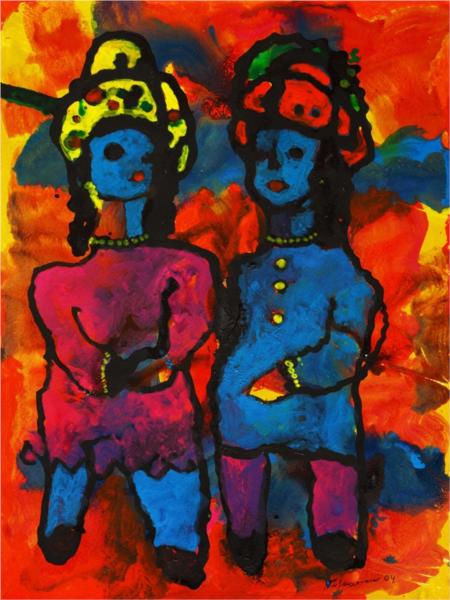
friends-since-childhood-2004-jpglarge

                      Friends Since Childhood” (2004) 

                                  George Stefanescu

                                         __________

having disparaged the only translation
I could find on the Internet of a poem
that is in French as famous as in 
English Elizabeth Barrett Browning‘s
How do I love thee? Let me count the 
ways.“, her 43rd “Sonnet[ ] from the
Portuguese”, I decided to translate 
myself the excerpt from “La Complainte
Rutebeuf“, of Rutebeuf himself, 1245 – 
1285, which became its indelible, and 
apparently timeless, virtual
manifestation

Rutebeuf’s entire poem is written in 
Old French, and excerpts of it were 
adapted into an updated French in 
1956 by Léo Ferré, a French
troubadour of the time, who then 
made it into a song that everyone
French remembers, despite, or 
maybe because of, its archaisms

though Ferré familiarized the French
for his listeners, it was still in an older
French, like rendering Chaucer‘s 
14th-Century English into Shakespeare‘s 
17th-Century counterpart tongue, “But 
look, the morn, in russet mantle clad, / 
Walks o’er the dew of yon high eastern 
hill”, “Hamlet”, act l, scene l, lines 166 
and 167, for instance

in my translation below, I eschew –
Gesundheit – such a daunting
challenge, but have chosen rather
to highlight the humanity that I find
especially compelling in the original
composition

Rutebeuf today would sound 
something of a cross between Harry
Nilsson and Bob Dylan, I think, of my
generationthe one for his 
straightforward simplicity, his crushing 
intimacy, the other for his social 
consciousness and probable greater, 
therefore, longevity

but will even Bob Dylan endure 800 
years

some will, some have, some do 

but who

we will never know

Richard 

           ______________

Rutebeuf’s Lament

What has become of my friends
that I had held to be so close 
and loved so dearly,
they were too carelessly tended
I think the wind has blown them away,
friendship has been forsaken.
And as the wind passed by my door,
took all of them away.

As time strips the trees of their leaves,
when not a leaf on a branch remains 
that will not hasten to the ground,
and poverty befalling me, 
from every corner appalling me,
as winter edges on.
These do not lend themselves well to my telling
of how I courted disgrace,
nor of the manner. 

What has become of my friends
that I had held to be so close 
and loved so dearly,
they were too carelessly tended
I think the wind has blown them away,
friendship has been forsaken.
And as the wind passed by my door,
took all of them away.
Sorrows do not show up on their own,
everything that was ever to happen  
has happened.

Not much of common sense, a poor memory
has God granted me, that God of Glory,
not much in sustenance either,
and it’s straight up my butt when the North wind blows, 
sweeping right through me, 
friendship has been forsaken.
And as the wind passed by my door,
took all of them away.

                                 Rutebeuf

listen

Richard