Richibi’s Weblog

Just another WordPress.com weblog

Category: Mozart

at the XVth International Tchaikovsky Competition – Bach‏

"J.S. Bach, Wohltemp. Klav. Bd. I, No. IV. (Extrait) / (Duo de Tristesse)" -  Robert Strûbin

“J.S. Bach, Wohltemp. Klav. Bd. I, No. IV. (Extrait) / (Duo de Tristesse)” (1957)

Robert Strûbin

________

if I’ve been getting on their backs
about their Bachs at the Tchaikovsky
Competition
, it’s that they’re playing
Bach as though he were mediocre
Beethoven, it’s like asking Duke
Ellington to be Pink Floyd, it’s just
a completely different generation,
era

Bach wrote for the harpsichord, a
precursor to the piano, it could not
control the volume, nor the length
of a note, the pianoforte came
along to resolve both issues

therefore before Beethoven, who
made full use of the new invention
and worked hard the pianissimos
and the fortissimos, to degrees that
often became either inappropriate
or too authoritative, indelicate or
obnoxious if you’re not in the mood
– I remember wanting to play his so
solemn 111 at my father’s funeral,
but realized late that the first
movement was not especially in
that situation warranted, nor even
parts of the transcendental, but not
always not obstreperous, adagio –
and thumbed thus his nose at the
aristocracy, who earlier, before
the citoyens had demanded their
rights and when the world had
been considered to be of a
rational, logical order, a clock,
and as regular, would never have
tolerated such impudence

Bach and Mozart do not sway
much from strict rhythm, neither
do they alter volume much at all

so that the constant display of
heartfelt Bach and passionate
Mozart becomes cloying, and
not at all what these Classical
and Baroque masters would
have approved of

nor Beethoven, nor Chopin, for
that matter, whose strict tempo
markings didn’t include much
rubato, ritardandos, which you
could think of as milking a note,
putting velvet on your canvas,
it doesn’t work, the composition
itself unaided by bathos, pathos,
delivers, check out, of course,
Glenn Gould

Andrei Korobeinikov sat me right
down the other night with his
arresting BWV868, thrilling,
followed by more dazzling
pyrotechnics, though he fizzled,
and fractured his Beethoven, the
very 111 I care so much for, I
couldn’t even finish, you don’t
need a velvet canvas behind the
111, neither cloying ritardandos,
just skill, nor tangles of notes,
for that matter

Richard
at the XVth International Tchaikovsky Competition – the program‏‏

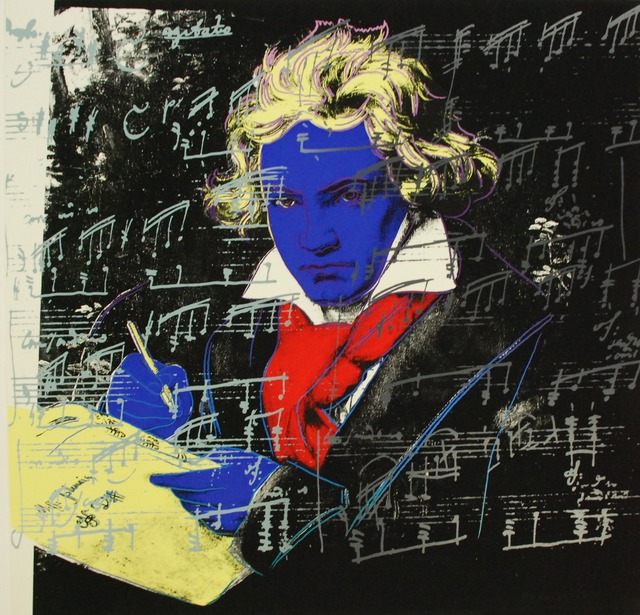
"Beethoven, 1987" -  Andy Warhol

Beethoven, 1987 (1987)

Andy Warhol

______

you’ll probably have noted, if you’ve
been following the Tchaikovsky
Competition
, that, unlike the
Rubinstein, the selection of works
is much more constrained, though
the mighties nevertheless
predominate

after the third day and into the
fourth, only one contestant has
started with anything other than
Bach, a Tchaikovsky

but unfortunately none of them but
one had given us a Bach worthy of
his name, then followed through
with, not surprisingly, a quite
competent Mozart, the cultural
conditions being not yet all that
different, aristocrats were looking
for their own music instead of the
church’s, secular instead of
ecclesiastical, therefore a tune
rather than an oratorio, Beethoven
and the Revolution would change
all that

afterwards a sonata of Mozart,
Haydn or Beethoven, the Classical
triumvirate, after which Tchaikovsky,
appropriately at this competition,
then études, either “-tableaux”,
“transcendentales”, or plain and
simple, by Rachmaninov, Liszt, or
Chopin, that’s it, you get to hear
the “Appassionata” or the “Grandes
études de Paganini”
several times
that way, sharpening discernibly
your musical ear

one was riveting, Andrey Dubov‘s

another, Lukas Geniušas transfixed
me with his opus 2, no 3, of
Beethoven, a work I usually only
ever tolerate, sending it soaring
into the bard’s later mature, and
revelatory, period

others have been competent, even
admirable, several, however, not
ready for this trial, they’ve come
without adequate preparation for
the ball

though I’ve been watching it in
my pajamas, I should talk

Richard

at the XVth International Tchaikovsky Competition‏ – June 16, 2015

Emmanuel Rimoldi

Emmanuel Rimoldi

__________

perhaps was I precipitous in my prompt
appraisal of a promising participant on
the first day of the XVth International
Tchaikovsky Competition, for every
other pianist, but two, was not
unequal to the plaudits I’d earlier
pronounced for this powerful
preliminary performer

it appears there are, indeed,
several

after an egregious error in her
Beethoven, a rhythmic miscalculation
that erupts like breaking wind at a
formal function, and needs to be
recovered by something, someone,
who will, which will, overwhelm the
unwelcome air, Maria Mazo quickly
rallies and delivers a Beethoven
you’re not likely to forget, followed
by a bouquet of other marvellous
concoctions

but Emanuel Rimoldi eventually
wins the day, June 16th, to my mind,
with a resplendent, and revelatory
Mozart, followed by other equally
dazzling interpretations

check them out

Richard

Alban Berg Violin Concerto‏

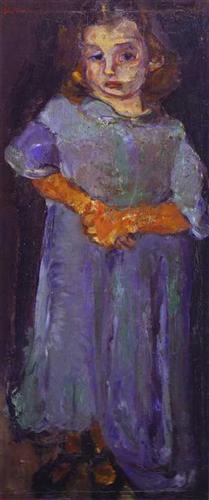
"Little Girl in Blue," - Chaim Soutine

Little Girl in Blue (c.1934-c.1935)

Chaim Soutine

________

though Apollo had offered the two
complimentary symphony tickets
he’d scored to my sister and my
mom, my mom bowed out and
suggested I, an adept, should
instead go along, though I needed
to know more about the content,
who and what would be on, no
one knew

meanwhile my sister, preferring not
to leave her husband alone, opted
to cede her ticket to Apollo so he
could accompany me

after some research, when I gushed
that Akiko Suwanai would be playing
Beethoven’s Violin Concerto in D
minor – his only one, I cried – Apollo
reconsidered, would, he said, come
along, my enthusiasm having struck
apparently a reverberant chord, a key,
maybe his D minor

once at the concert, to our surprise
and delight, my sister and her
husband, under the spell also of that
maybe bewitching key, had got rush
tickets for essentially, as it were,
a song, so that serendipitously we
all attended the superb performance
together

Dad does concert tickets too, my
sister exulted

Suwanai was transcendent, lifted me
from my seat at the very first touch of
her exquisite bow, I floated, though it
might’ve been also the magic chocolate
I’d bought at the corner, this is Vancouver
after all, known also, not inappropriately,
as Vansterdam

you’ve heard rapturous versions of
Beethoven’s Violin Concerto on at
least one of my earlier blogs,
Anne-Sophie Mutter’s there, Joshua
Bell’s
, but I couldn’t get any of Akiko
Suwanai’s renditions on the Internet

found instead for you this wonderful
Berg
, also his only violin concerto

Berg is of the Second Viennese
School, along with Schoenberg and
Webern, this is no longer Beethoven,
the advent of the First World War in
the Western world had fundamentally
altered everything, the arts were
reflecting this transformation, idioms
were abandoned in every creative field,
as well as in borders and forms of
government, rudiments were being
questioned, tested, see what Soutine
does, for instance, to traditional
representation above, to perspective,
colour, proportions

you’ll note that Berg’s Concerto
doesn’t stipulate a key, part of the
disintegration musical theory was
undergoing, twelve-tone music,
rather than the traditional eight,
was eliminating the subordination
of sharps and flats within scales,
atonality became dominant,
sounding a lot like the cacophony,
I think, of Twentieth-Century traffic

you won’t mistake however the
utterly Romantic sensibility beating
through Berg’s composition, midst
all the discord and the dissonance
you can’t miss his pulsing and
ardent heart, his wistful, dare I say,
heartstrings

there are two movements to the
concerto, the first representing life,
the second death and transfiguration,
Berg had written this, his last work,
for Alma Mahler’s daughter, Manon,
after she died of polio at the age of
18, Alma Mahler had been Gustav
Mahler’s wife, a musical giant, Berg
dedicated the piece, he wrote,
“to the memory of an angel”

Berg died later that same year,
Christmas Eve, 1935, he was 50

Richard

psst: the first part of the programme
had been a bust except for a
lovely piece for violin and koto

what’s a koto, I asked Apollo

it’s what you wear when you’re
coldo, he replied

a koto is a bit like a xylophone,
but with strings instead of
wooden bars, the performer
had dressed in traditional
Japanese garb for the special
Japanese occasion

“Le Jazz Hot” – Henry Mancini‏

  John Cage - "Mozart Mix" (1991)

Mozart Mix (1991)

John Cage

_______

in a movie,“Victor Victoria”, that should’ve
gotten more Oscars than it finally did,
Le Jazz Hot sizzles, Henry Mancini
received one for the music, Lesley Anne
Warren should’ve too for her incandescent
moll

lock the door, she says to Julie Andrews,
in an otherwise compromising moment,
a line one should never forget

in Julie Andrews’ category, who could’ve
taken it away from Meryl Streep for
“Sophie’s Choice”

but jazz here is a misnomer, jazz merely
dolls up in this number an otherwise
entirely Classical structure, the melody
is right out of Mozart, rigid rhythm,
unflinching tonality, and repetition after
repetition, you can sing along just as you
can for Mozart, try doing that with anyone
after him, try to hum along with real jazz

but I’ll entirely agree that this
whatever-it-is is hot, steaming

catch the astounding vocal glissando
at the very end, just before the final
whispered recitative, riveting

Richard

my reply to BookInhabiter, a.k.a. Brain

a reader writes

“Hello Richard,
Recently I’ve been watching up on many dance competitions. I knew of the existence of piano competitions but never thought that they would be filmed. I must listen to the top contenders. How did you hear about this competition?”

here is my, admittedly extended, answer, with pertinent links

Richard

_____________


I haven’t missed So You Think You
Can Dance
“,
Brain, for 11 years, so
we’ve probably been watching the
same “many dance competitions”

“piano competitions” aren’t much
different, just another art, judged
here by professionals throughout,
rather than entire publics

the competitions are fierce, to a
person the competitors are world
class

the music is often sublime, utterly
transcendent, though more rigorously
intellectual than popcorn – pace
Mozart – this puts some people off

much as you probably find covers of
songs you like, I go out looking for
sonatas, string quartets, concerti I
already know of and admire, I check
out the big names, Chopin, Beethoven,
Rachmaninov, see what might be up

the Internet abounds with nearly
anything you might want to find, the
only obstacle is the quality

the Van Cliburn competition, from
Houston, was dreadful, enough to
put me off it, but looking for musical
counterparts to pieces of interest, I
found the Rubinstein one in Tel
Aviv
offering sterling performances

I quickly flew across the globe,
virtually, of course, speaking

the experience has been well worth
it, I heard miracles of music, haven’t
had so much fun since reading Proust,
in French of course, but you must
understand I’m an inveterate egghead,
totally chronic

this week I started Edward Gibbon’s
The Decline and Fall of the Roman
Empire”
, text and, to my delight,
audiotape, its reader is extraordinary

check out the Chopin Competition
for, up to this point anyway in my
investigation, only Chopin, but he’ll
do for a significant while, his music
is consistently breathtaking

I’ll also check out the Russian
Tchaikovsky Competition, which Van
Cliburn made famous for us in the late
50’s
, by winning it, despite the rancours
of the Cold War, with a still paramount
rendition of Tchaikovsky’s own
monumental First Concerto

wow, I’ve been hooked ever since

thanks for stopping by my blog, Brain,
you’ll find, incidentally, a lot of excellent
performances highlighted there, several
of the best, in fact, from the most recent
Rubinstein Competition
, none of which,
to my utter consternation, managed to
win

other recommendations follow, check
it out

I think your blog is wonderful, keep
it up

Richard

Maria Mazo‏


if Mozart had written nothing other
than his piano concerto no 21 in C
major
, he would have still been
famous, its adagio is resplendent,
written even in our DNA, time stops,
one enters an epiphany

Maria Mazo could win the Rubinstein
Competition
for her interpretation of
this iconic piece

wow

watch, just click

Richard

from Beethoven to Pink Floyd


in juxtaposing inadvertently recently
Pink Floyd’s “Dark Side of the Moon”
with Beethoven’s String Quartet no 14
in C# minor, opus 131
, I was once again
struck by how one resembled implicitly
the other, both had achieved structurally
an operatic concert, an original musical
form for each their epoch, a piece of
instrumental music – with, even with
Beethoven eventually, voice – see his
9th Symphony for that – in the form of
opera

stay with me

songs started off as ditties, see, for
instance, in our time, She Loves You“,
the Beatles, in Classical music that’s
the equivalent of a Mozart sonata,
quick, easy to hum along with, and
spirited

then MacArthur Park came along, in
1968, with a song twice the length,
seven minutes and some, of anything
heard before, check out Jimmy Webb,
Richard Harris, and the process

that sounds a lot like Beethoven, I
thought, throw in extrapolations of
symphonic proportions and that
sounds a lot like Beethoven too,
saying, this is not just pretty, people,
it’s potentially momentous, listen

Sgt. Pepper’s Lonely Hearts Club
Band
then put several compositions
together, without breaks, to give us
the first concept album, an
uninterrupted flow of various musical
ideas held together by an, however
inexplicit, theme

or MacArthur Park“, in other words,
amplified

in 1826, it had been Beethoven’s 14th,
where all this started out, no one had
ever done this sort of thing before,
confounded so intimately contrasting
musical forms, but he’d got it from
the Christian Mass

thus Beethoven, a secular prophet

and thus, in his eminent footsteps,
Pink Floyd, solely, among
contemporary artists, addressing
God

it all seems nearly inevitable today,
but it was 1968 then, a time of, if
you’ll recall, revolution

and all of these had been, for better
or worse, once again, our rallying
cries, anthems, towards a better
world

Richard

Mozart piano sonata no 11, in A major, K 331

again my especially musically erudite friend,
Norm, has returned with a catchy morsel, a
popularized version this time of the third
movement, the Alla Turca“, of Mozart’s
piano sonata no 11, in A major, K 331
,
possessed by the glitzy spirit, in this
outing
, of Las Vegas

these whet my appetite always for the entire
meal, the source from which these playful
tidbits originate, like an ebullient tributary
returning to its more elementary, and
profound, as it were, spring, a lost child
needing to return to its place of origin
for direction and validation

Mozart, you’ll note, is not Beethoven, though
he might be a not inconsequential Mozart, I
think of his stuff as music for the nursery,
toy soldiers and rocking horses, dairy maids
and cuckoo clocks, not at all to inform but to
delight, the musical structure is foursquare,
lilting ever, and entirely comprehensible,
Mozart just wants to have fun, with here
and there a nod to melancholy, perfect, I
would think, for a powdered and pampered,
though pilloried eventually, indeed
guillotined then, court

the first movement, you’ll remark, is a set
of variations, a bit of a novelty still during
this period, 1778 to 1783 approximately,
the date of composition is not precisely
known, which allowed for, of course, a
variety of styles, voices, to be flaunted
in one only section of a work, instead
of the usual call and response of,
ordinarily, the traditional movement,
extending already, incidentally, the
possibilities of the sonata form, which
later composers would make much
use of

neither of the next movements are
slow, Mozart, as I said, just wanted
to essentially enjoy himself, or his
sponsors did, music did, that’s
what they payed him for

but the times they were a’ changing

as indeed they still are

Richard

psst: thanks Norm

Schubert – Piano Sonata D959‏

to my utter surprise when I checked I’d never
but only once in the many months I haven’t
been able to shut up since I started spouting
my bristling endorsements, like a very rushing
river gushing with the overflowing bounty of
an inveterate spring, mentioned Schubert, an
incandescent voice from surely heaven

it was about his String Quartet in C major, the
D956, not surprisingly, it is utterly enchanting,
D for Otto Erich Deutsch still, incidentally

here’s an alternate version of it, an utterly
inspired one

but if I’ve reintroduced Schubert it’s specifically
this time to compare him with Beethoven, they’re
easily confounded, I even did it once myself, to
my crushing embarrassment, in erudite and
unflinching company, oof, I cringe to even
remember it

the D959, moments only after the 956 of course,
has all the idioms of a Beethoven, and exercises
them as expertly, the beat, however, is always
on, unlike Beethoven, whose beat is always off,
contrary, rebellious, against the prevailing
order

though this variance might seem slight, one
senses already in the younger and later
Schubert a return to form, elegance, and civility,
the First Empire had indeed taken hold during
the transformation of Napoleon from hero of
the Revolution to a different incarnation of
Emperor, Chopin as well would be beholden
to later similarly reinstated French courts

so seemingly trivial an alteration speaks
volumes when one attentively listens, one
must do this with one’s heart

such a return to aristocratic principles is not
uncommon, incidentally, we seem, indeed, to
thirst for dynasties, if you’ll note the return of
late, of the Bushes, the Clintons, and most
recently the Canadian Trudeaux

Putin is another, though arguably somewhat
less democratic, version of that principle

Beethoven is off the beat then, Schubert on, you
won’t find much else that’s different upon first
listening, you’ll note only that their music is very
much the same, rigorous beat, tonal, essentially,
harmonics, and the return eventually of the
melodies, Classical imperatives, but with the
distinction of the new Romantic,
transformational however, sensibilities

Schubert might’ve even outpaced Beethoven
had he survived, I think, but he didn’t, he died
much too young, at the most tender age of
only 31, younger even than the more
celebrated Mozart, famous for succumbing
prematurely at the still early age of 36

may they rest, may they all rest, Schubert,
Mozart, and the somewhat longer-lived
Beethoven, still early deceased at 56, in
eternal peace, for they have brought us
but wonders

Richard

psst: here’s a movie to go with the earlier
Schubert
, The Company of Strangers“,
the very best film Canada has ever had
to offer, bar none, a gaggle of old women
are stranded in the Laurentians after their
tour bus breaks down, Schubert would’ve
loved it

and been honoured