Just another WordPress.com weblog
Category: Mozart
________
though there are other, and quite significant,
composers who fit into this category,
Beethoven, Schubert, and Chopin pretty
much define, all by themselves, the
Romantic Period
Chopin composed only two sonatas of note,
plus one more that is overlooked for being
an early, student effort, not up to the
standard of his later ones, Chopin, rather,
wrote mostly shorter pieces, nocturnes,
études, preludes, polonaises, and more,
that later became the very stuff of his
reputation
Schubert wrote enough sonatas that he
could be compared to Beethoven, indeed
it can be difficult to tell one from the other,
much as it can be difficult to tell Haydn
from Mozart, products in either case of
being both of their respective eras
when I was much younger, a guest among
a group of academics, where I’d been invited
by the host’s wife, a co-worker, what I knew
of Classical music, in the large sense, which
is to say comprising all of the musical periods,
Classicism, Romanticism, Impressionism,
and beyond, was all self-taught
is that Beethoven, I asked the host, about
a piece of music he’d put on
that’s Schubert, he replied, aghast, as
though I’d just farted
I blushed, deep red, confounded
Schubert, having great admiration for
Beethoven, took on many of the older
composer’s lessons, four movements
instead of the Classical three, for
instance, and many of the technical
tricks of his forebear
but there’s an essential component of
their styles that marks one from the
other, an easy way to tell them apart,
Beethoven always composes against
the beat, Schubert following it
listen to the first few notes of Beethoven’s
“Pathétique”, for instance, the beats are
erratic, confrontational, the mark of a
revolutionary, Beethoven was brashly
proclaiming his worth, he had something
to prove
Schubert, who was essentially playing
for friends, just wanted to entertain
them, which he did in spades, without
bombast or bluster
D959, for example, no swagger, no
ostentation, delivering nevertheless
something quite, and utterly,
enchanting, everything following,
unobtrusively, the beat
enjoy
R ! chard
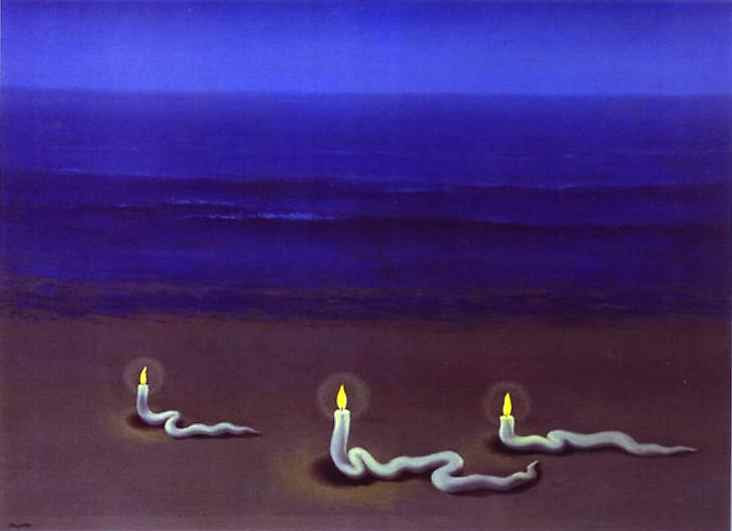.jpg "Meditation, 1936 - Rene Magritte")
_______
a story
while I volunteered at the palliative care
unit of our downtown hospital, a family
asked if I could monitor their mother
while they took time off for lunch
of course, I agreed
their mother lay unsettled on her hospital
bed, jittery, shaking, distressed, incoherent,
out of touch, in her own nether, dissociated
world, while the family, about ten of them,
had been chatting, seemingly oblivious to,
or unconcerned with, their mother’s flailing
they left
I sat by her side, placed a palm tenderly on
her quivering arm, to impart what calm I
could, to bring her warmth, care, attention,
and began to sing a mantra I’d learned at
an ashram I had been attending, weekly,
for months, after the death of my beloved,
in order to find solace, consolation, Om
Namah Shivaya, I chanted, gently, quietly,
over and over again
little by little, she settled, was becoming
calm
then, in a whisper, she began to join in,
Row, row, row your boat, she sang,
over and over again, along with my
own mantra, a duet of communication,
despite even the incongruity of the
tunes, we were meeting at an even
deeper, primordial level
something stirred behind me, I turned,
the family was standing in the doorway,
all held their breath, watching, as though
they were witnessing grace
I think they were
a mantra is a distillation of the three
pillars of Western music, tempo,
tonality, and repetition, what we sing
to children to lull them to sleep, that’s
what a mantra is
Row, row, row your boat indeed
the history of music in the West is
the disintegration of those norms,
for better or for worse
Bach, no accompaniment, no piano,
tail end of the Renaissance, when art
was directed by the Christian Church,
Bach was in fact cantor, music director,
of several churches in Leipzig
it took Mozart to kickstart the Classical
Era in the West, the purview, now, of
the aristocracy, a process that started
that he commissioned for Versailles,
leaving the Church behind in a
secularizing world
with Bach, tempo, tonality and repetition,
set the uncorrupted standard for the
ensuing ages, Bach is the next best
thing, to my mind, to meditation
R ! chard
_____________
meanwhile, back at sonatas for one
instrument, it’s about time I brought
up Chopin, the one composer that
everyone associates before anyone
else with Romanticism, 1800, say,
till about 1880, he incorporates it,
not without reason, Chopin
personifies the Romantic Era, like
Mozart represents the Classical
others who count would be Elizabeth
Barrett Browning, her “Sonnets from
“Les Misérables”, and Charles Dickens
preaching, in all his works, humanity
Chopin sounds a lot like Beethoven,
indeed, the first notes of his Second
are a reference to Beethoven’s
you’ll hear the same peremptory,
commanding, chord, demanding
attention, the rest is consummate,
however, Chopin
in the last movement, you’ll specifically
hear what Chopin brought to the table,
texture, soundscape, rather than a
narrative line, music as background,
atmosphere, context
enjoy
R ! chard
_________
here’s a violin sonata from Beethoven,
nicknamed “Spring“, it is ebullient
Beethoven is more forthright than
Mozart, he’s passionate, wears his
heart on his sleeve, is tender, then
rambunctious, you’ll hear it in the
extremes of volume, loud, soft,
often with spontaneous outbursts,
it’s like talking to a friend, the
appeal is emotional, personal,
where Mozart was earlier decorative,
it’s the Romantic Era taking over
from the Classical
you’ll notice also that Beethoven is
chipping away at the conventions,
there are four movements here
instead of just three, he’s saying
that his stuff is not just decorative
but important, Beethoven has
something to say, he’s got a story
to tell, there’s even a narrative feel
to his composition, like there’s a
conclusion to his story, a point
we’ve moved from a variety of
artefacts, disparate pieces, to a
cohesive and meaningful entity
the sonata is a trinity, three
essences in one
R ! chard
____
it must be pointed out that sonatas could be
written for other instruments than keyboard,
but since any other instrument could play
just one note at a time, it became the custom
to make a keyboard instrument, which is to
say, essentially, the piano, its accompaniment
therefore, you’ll find that sonatas can be
comprised of more than just one instrument,
more about which later
don’t be confused, the history of music
is one of contradictions, as it is with, for
that matter, any representation of reality
including, incidentally, religion, art’s
historical ancestor, before the modern
world took over, before the advent of
democracy, the French and American
Revolutions, before our secular
21st Century, when artists took over
from preachers, where we started
getting our gospel from literature,
rather, movies, television, concerts,
instead of the Bible, for better or
for worse
here’s, meanwhile, Mozart’s Violin Sonata
telling it like it was, back then, starting
the process
R ! chard
“Mona Lisa“ ( c.1503 – c.1519)
__________
the next sonata, Beethoven’s “Piano Sonata
is one that everyone’s heard, if only ever in
fragments, right up there with “Jingle Bells”
in our musical repertory, in our cultural DNA,
or, for that matter, Beethoven’s, also, other
the initial chords are peremptory, have
resonated, echoed, reverberated,
throughout the ages
this is not, however, the way one should
be addressing the aristocracy, Beethoven
was speaking for the growing Middle
Classes, who, hungering for the status
and refinement of the elite, the French
Revolution having just happened, were
crowding the burgeoning concert and
recital halls cashing in on that interest
the artist was now the main attraction,
where earlier the performer had been
merely decorative, the sponsored
employee of an, however benevolent,
aristocrat, see Mozart, see Haydn
ages, his revolutionary stuff, thumbing
his nose at convention, demanding
attention
R ! chard
________
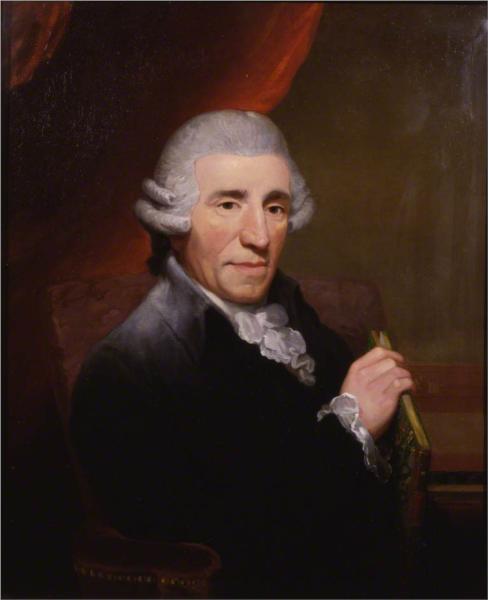
Haydn, profoundly underrated, was the
other pillar of Classical music during that
period, Beethoven, with half a foot only
in that era, uses its elements to yank us,
yelling and screaming, into the next, the
Romantic Era, 1800 to 1870 more or less,
more about which later
if Haydn sounds a lot like Mozart, it’s that
this piece was also written in 1789, both
were catering to the aristocracy, courts,
salons, music was therefore frivolous,
meant to be entertaining, not inspirational,
trills, a lot of decoration, technical agility,
prestidigitation over profundity
Beethoven will change all that, stay tuned
meanwhile, listen to, enjoy, Haydn’s Piano
today’s prescribed apple
R ! chard
_____
is to an apple pie, its essential component,
after which the rest is decoration, however
inspired
sonatas existed before Mozart, but he’s
the one, along with Haydn, as well as
early Beethoven, who put them on the
musical map, 1750 to 1800, more or
less
it seems to me appropriate, therefore,
to start my Sonata Month then
here’s something by Mozart, 1789, his
three movements, fast, slow, fast – allegro,
adagio, allegretto – a perfect example of
the sonata as it was establishing itself
then, a piece of music consisting of
several distinct sections, movements,
meant to highlight contrasts, musical
agility in the artist, compositional
imagination
R ! chard
_______
though I’ve focused especially, during
on Mozart, a second great pillar of
that era is Haydn, 1732 – 1809
here is one of his 62 piano sonatas,
which expresses more than anything
you’ve heard here yet the definition
of what music was at the time, or
should be, tonality, as I’ve earlier
said, tempo and repetition were
tantamount
listen for or the rigidity of the tempo,
the consistent melliflousness of
the melody, and therefore tonality,
and the repetition of all the
component tunes
I remember going to a drum recital
once, here in Vancouver, a guy was
expressing his artistry in a formal
venue, I was sitting in a forward
row, saw him set up his music on
his music stand, and I thought,
he’s going to have to turn the
pages, which he did, a drummer
that’s all I remember of the
presentation, but that was enough,
an entire revelation
turns the pages of his score, back
and forth, an interesting visual
expression of the imperative of
repetition in that era’s music,
having to return to what had
been written on the previous
page
also note that trills abound
note too in the second movement,
the adagio cantabile, the sudden
introduction of arpeggios,
transcendent, as though angels
had just appeared
which prefigures the metaphysical
aspirations of the Romantic Period
which ensued, see, for instance,
note also that we’re on fortepiano
here, a period instrument, a cross
between the harpsichord and the
modern instrument
R ! chard
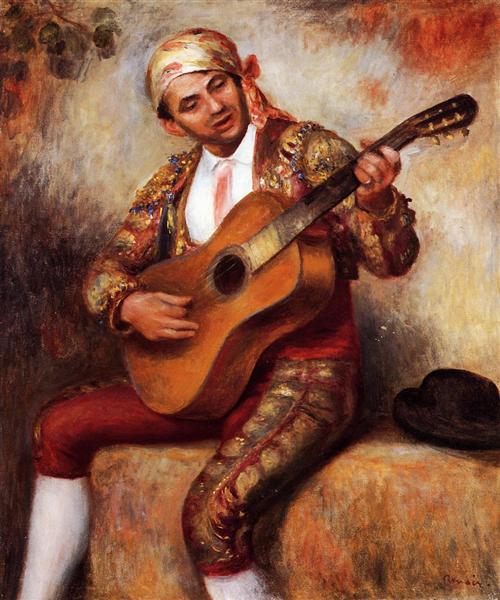
____________
just as I was about to relegate the trill
to Mozart and the Classical Period, I
inadvertently came upon something
Spanish composer, 1901 – 1999, a
the trill had been decorative, meant to
appeal to aristocrats frequenting
salons
then the French Revolution happened,
and the growth of the Middle Class,
and consequently popular avenues
of entertainment for the liberated,
concert halls, for instance, looked
for a more emotionally powerful
experience, arpeggios took care of
that
the trill died
but in 1939, nearly two centuries
homage to an elder, trills abound
it should be stated that a guitar can
play only one note at a time, it might
be that trills lend themselves better
to such an instrument than an
arpeggio would
then again, I’ve found that Spanish
music, the tango, the tarantella, for
instance, see above, has held more
rigidly to the imperatives of Western
music I’ve spoken of here before,
tempo, tonality, repetition, it is not
Debussy, Ravel, it is not even
Chopin, it is peripheral, maybe, to
the cultural establishment, but
potent, steeped in blood and
tradition
R ! chard

 Richibi's Weblog