Richibi’s Weblog

Just another WordPress.com weblog

Category: literature to ponder

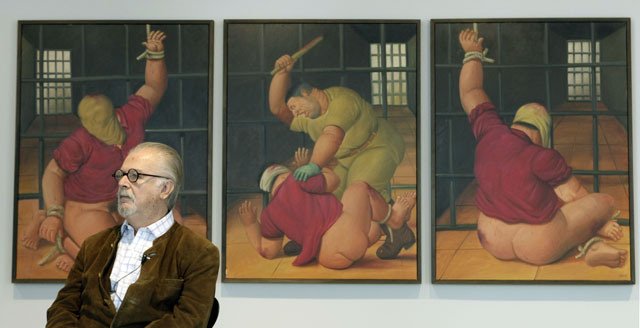
Botero’s Abu Ghraib

Botero's Abu Ghraib

Fernando Botero standing before three of over 80 of his stylized
depictions of atrocities committed at Abu Ghraib

____________

the role of art has always been to bring
attention to injustice, Goya, for instance,
famously, Picasso’s Guernica“, without
which Guernica would be forgotten, in
literature the servile position of women
and those marginalized by industrialization
in the works of Charles Dickens, Henrik
Ibsen, Émile Zola, in music the strident
strains of Shostakovich indelibly
imprinting the cruel depredations
of the Soviet system in his searing
compositions, just click

Botero, as the others, has given here
impermeability to what had been merely
news items, something tragic but lost
amongst so many other tragedies, by
giving it ideological breadth, depth and
substance, giving it the modern postion
of an altarpiece, a place of ardent
contemplation

we have after all no more churches,
only malls, we rely on potent images
for our moral guidance

therefore art

Richard

“Ghosts” – Henrik Ibsen

of Ibsen‘s plays, Ghostsis the only
one that I can ever really tolerate, his
others being entirely always for me 
too didactic, preachy 
 
in this brilliant production, riveting and
unforgettable, one I feared I’d never see
again, Judi Dench is again consummate,
as Mrs Alving surely definitive, and
Kenneth Branagh, as her son, nearly as
good, from way back when he still could
act
  
enjoy, marvel, be verily enlightened
 
  
Richard 
 
psst: Henrik Ibsen (1828 – 1906)


“A Dog Was Crying in Wicklow Also” – Seamus Heaney‏

the death of a poet is not a happy occasion,
and yet their voices become clearer, it seems,
after their demise, as though the connection
had been stripped of any temporal, or even
corporal, merely, considerations, I talk to my
father, for instance, more directly, and indeed
intimately, than ever I did when he was alive
 
Seamus Heaney, 1939 – 2013, a poet, even
laureate, died August 30th, but left us with
this beautiful poem he’d written, on the
death of a friend
 
 
Richard
 
                     _______________
 
 
A Dog Was Crying in Wicklow Also
 
When human beings found out about death
They sent the dog to Chukwu with a message:
They wanted to be let back to the house of life.
They didn’t want to end up lost forever
Like burnt wood disappearing into smoke
Or ashes that get blown away to nothing.
Instead, they saw their souls in a flock at twilight
Cawing and headed back for the same old roosts
And the same bright airs and wing-stretchings each morning.
Death would be like a night spent in the wood:
At first light they’d be back in the house of life.
(The dog was meant to tell all this to Chukwu).
But death and human beings took second place
When he trotted off the path and started barking
At another dog in broad daylight just barking
Back at him from the far bank of a river.
And that is how the toad reached Chukwu first,
The toad who’d overheard in the beginning
What the dog was meant to tell. “Human beings,” he said
(And here the toad was trusted absolutely),
“Human beings want death to last forever.”
Then Chukwu saw the people’s souls in birds
Coming towards him like black spots off the sunset
To a place where there would be neither roosts nor trees
Nor any way back to the house of life.
And his mind reddened and darkened all at once
And nothing that the dog would tell him later
Could change that vision. Great chiefs and great loves
In obliterated light, the toad in mud,
The dog crying out all night behind the corpse house.
 

                                       Seamus Heaney, 1995


XLlll. How do I love thee? Let me count the ways – Elizabeth Barrett Browning‏

from Sonnets from the Portuguese

XLlll. How do I love thee? Let me count the ways

How do I love thee? Let me count the ways.
I love thee to the depth and breadth and height
My soul can reach, when feeling out of sight
For the ends of Being and ideal Grace.
I love thee to the level of everyday’s
Most quiet need, by sun and candle-light.
I love thee freely, as men strive for Right;
I love thee purely, as they turn from Praise.
I love thee with the passion put to use
In my old griefs, and with my childhood’s faith.
I love thee with a love I seemed to lose
With my lost saints, – I love thee with the breath,
Smiles, tears, of all my life! – and, if God choose,
I shall but love thee better after death.

Elizabeth Barrett Browning

__________________________

there are two lines of verse in English
poetry which are early trumpeted by even
those who would have no truck in general
with poems, one about life, one about love,
paraded by already youths with all the
passion of their unbridled years, if not
oratorically advocating, at least sardonically
making fun of perhaps too mannered, even
irrelevant, in their opinion, I would think,
matter, namely Shakespeare‘s To be, or
not to be
and Elizabeth Barrett Browning‘s
How do I love thee? Let me count the ways

nothing much of the rest of these two
poems generally is known, though their
introductions be, even at the level of the
succeeeding ages, panoramic, neither,
either, incidentally, has ever, in its
substance, been equalled

To be, or not to be upon first exploring
it surprises for being, not, as supposed,
a paean to glory, for its declamatory, I
suspect, and engaging, cadences, but a
treatise on the very value of life, Hamlet,
despairing of the state of Denmark, where,
“something”, if you’ll remember, “is rotten”,
where his mother and murderous stepfather
have evilly, he imagines, conspired to steal
his real father’s throne, who hovers now
as a disturbing, and exhortative, presence,
keeping the action, or inaction in this case,
going, can never reach an answer, come to
a decision, To be, or not to be“, “that is the
[inexorable] question”

more specifically, “Whether ’tis nobler
in the mind to suffer”,
he asks, “The slings
and arrows of outrageous fortune, / Or to
take arms against a sea of troubles, /
And by opposing end them:”,
is life
worth living if the cost is so dire

Hamlet will not do the deed himself,
ultimately, of securing his own demise,
but will actively eventually allow it

one will wonder then, is life worthwhile,
Shakespeare never gives us a direct
answer

Elizabeth, however, talks about love, its,
essentially, apotheosis, an expression,
yet unrivalled of how we would like to
love, be loved

her declamation becomes somewhat
elaborate, even morbid, at the end,
macabre, but the force of the initial
statement has weathered already
several unforgiving ages, fresh and
true and captivating, fundamentally,
as ever

Richard

XLll. “My future will not copy fair my past” – Elizabeth Barrett Browning

from Sonnets from the Portuguese

XLll. My future will not copy fair my past

“My future will not copy fair my past”
I wrote that once; and thinking at my side
My ministering life-angel justified
The word by his appealing look upcast
To the white throne of God, I turned at last,
And there, instead, saw thee, not unallied
To angels in thy soul! Then I, long tried
By natural ills, received the comfort fast,
While budding, at thy sight, my pilgrim’s staff
Gave out green leaves with morning dews impearled.
I seek no copy now of life’s first half:
Leave here the pages with long musing curled,
And write me new my future’s epigraph,
New angel mine, unhoped for in the world!

Elizabeth Barrett Browning

_________________________

“You really make it seem so easy with your presentation but I find this
matter to be actually something which I think I would never understand.
It seems too complicated and extremely broad for me.
I am looking forward for your next post, I will try
to get the hang of it!“

because there was no return address
on this comment, and because its
uncorroborated website, a gaming site,
seemed to me suspect, I’ve chosen to
reply within the safer body of my
discussion, rather than within the
thickets and brambles of the more
treacherous Internet

but I profoundly respect the, not at all
uncommon, opinion

therefore this

Elizabeth Barrett Browning is not
immediately accesible to us in the
early 21st Century, this comment is
such an example, unsolicited but
honest, and it is the cry of the
uninitiated through no fault of their
own before time’s obfuscating,
even linguistic, even literary, but
ever ineffable, shroud, I had the
same sense of its, often, preciosity
when I first started reading poetry,
not only even but especially the
greats who’d been recommended,
it took a poet who spoke my
language before I could take
verse seriously

but since then it has become for
me a garden of existential, of
transcendental, delights,
revelations I can’t help but want
to share, not only substantial
stuff, but, I think, sacred

no one has said it better to date
than Pamela Spiro Wagner in
How to Read a Poem: Beginner’s
Manual

“Read just one poem a day.
Someday a book of poems may open in your hands
like a daffodil offering its cup
to the sun“

even a daffodil like Elizabeth
Barrett Browning

Elizabeth is a siren here, I asked of heaven,
she says, “My future will not copy fair my
past”,
and along comes, goodness, a
miracle in the form of, more or less, an
angel – “not unallied / To angels in thy
soul”,
she describes him in her particular
Victorian dialect, not always immediately
penetrable

she was so happy then, she grew ”green
leaves”,
she asserts, evidently exaggerating,
“with”, even, “morning dews impearled”,
she further enthusiastically confides, but
of which we won’t out of discretion, of
course, inquire

let’s just say she will hitch her wagon
therefore to his, [n]ew angel mine”, star,
for the foreseeable, however “unhoped
for”
, future

which man could resist being called “not
unallied / To angels“,
Elizabeth, seductress,
enchantress, I call my man Apollo, my
golden god of light

Richard

XXXVlll. First time he kissed me, he but only kissed – Elizabeth Barrett Browning‏

from Sonnets from the Portuguese

XXXVlll. First time he kissed me, he but only kissed

First time he kissed me, he but only kissed
The fingers of this hand wherewith I write;
And ever since, it grew more clean and white,
Slow to world-greetings, quick with its “Oh, list,”
When the angels speak. A ring of amethyst
I could not wear here, plainer to my sight,
Than that first kiss. The second passed in height
The first, and sought the forehead, and half missed,
Half falling on the hair. O beyond meed!
That was the chrism of love, which love’s own crown,
With sanctifying sweetness, did precede.
The third upon my lips was folded down
In perfect, purple state; since when, indeed,
I have been proud and said, “My love, my own.”

Elizabeth Barrett Browning

________________________

had the sonnet allowed for more lines,
instead of its strict fourteen, this poem
could not ‘ve not become indecent,
“purple”, she says, indeed

nor, for that matter, more clear, Elizabeth
has succumbed to his one, two, three
kisses, enough to now call him [m]y love,
my own”

meed is a reward, and archaic

chrism is holy anointing oil, nearly also
now, but sacramentally, lost

so intimate a declaration as this would’ve
been unprecedented in 1845-46, when
these poems were written, though we’re
used to much more flagrant stuff nowadays

that this had been written by a woman
must’ve been nearly scandalous, though
such was allowing the Romantic Age, and
this “most flagrant” expression would
become eventually its very symbol, the
exploration of the human heart, the highly
intimate revelations of an individual soul

Elizabeth Barrett Browning holds the top
spot here, nobody does it better

in intrinsically less overtly graphic music,
Chopin

Richard Strauss does a similar thing in his
opera “Salome” several years later, several,
indeed, decades later, 1905, but in reverse,
Salome wants to first of all touch John the
Baptist’s skin, he won’t allow it, undaunted
she asks to touch his black hair, nor will
he allow that, she insists further on a kiss,
which doesn’t either come, the scene is
lurid and shocking

“nothing in the world is as red as your
mouth”,
she begs, “let me kiss it, your
mouth”

my dear, I cautioned

later she will dance the Dance of the Seven
Veils
“,
lately performed even, after the veils
are, one by one, off, naked

for which she gets John the Baptist’s head,
and finally gets her kiss

honest

the version I saw was unforgettable,
though it had taken a free ticket to
get me there

Richard

psst: you’ll note, incidentally, that this poem
is not an avowal, but a confidence,
spoken to us, not to him, a not
insignificant factor

XXXVll. Pardon, oh, pardon, that my soul should make – Elizabeth Barrett Browning‏

from Sonnets from the Portuguese

XXXVll. Pardon, oh, pardon, that my soul should make

Pardon, oh, pardon, that my soul should make,
Of all that strong divineness which I know
For thine and thee, an image only so
Formed of the sand, and fit to shift and break.
It is that distant years which did not take
Thy sovranty, recoiling with a blow,
Have forced my swimming brain to undergo
Their doubt and dread, and blindly to forsake
The purity of likeness and distort
Thy worthiest love to a worthless counterfeit:
As if a shipwrecked Pagan, safe in port,
His guardian sea-god to commemorate,
Should set a sculptured porpoise, gills a-snort
And vibrant tail, within the temple-gate

Elizabeth Barrett Browning

_________________________

though Elizabeth Barrett Browning is ever
abstruse, dare I say, even Baroque – the
epoch of distorted perspectives and
dimensions which preceded the Classical
Era – in her not only grammatical but also
metaphorical constructions, to the point of,
as in the last, her XXXVlth sonnet, being
incomprehensible, too athwart for my taste,
or even my tolerance, here she returns to
form to shine again in her own Romantic
Age, a more literate time, as opposed to
our more visual one, where straight talk
would not ‘ve passed muster as worthy
of any art, that would happen only later
as a reaction to too elaborate artifice,
which you might already even decry,
for instance, in these sonnets

but to make distinctive the form – the sonnet
goes back to at least Shakespeare, who is
even an obvious inspiration for Elizabeth
she would’ve had to embroider her own
version of it, which she could only have
done with fresh artifice upon the ancient
structure, like decorative elaborations on
the traditional tablecloth

if they work it’s because the artifice meets
the substance equally, enough to give
meaning to the poem, verve to the
reinvigorated tabletop

but often, dear Elizabeth, for me, and I would
think for many others in our Twitter age, for
the most part your poems do only just, albeit
enough to make you nevertheless iconic

for Elizabeth Barrett Browning and Chopin
represent for us now more than any of the
other Romantics their distinctive Age, and
with great, let there be no doubt, and easily
demonstrated, authority

Pardon, oh, pardon is not a breeze but it
expands admirably, and distinctively, on her
other masterpieces, or should I say here,
mistresspieces

forgive my soul, she asks, for mistaking your
“strong divineness” for something as fleeting
as “sand”, something “fit to shift and break”

his “sovranty” – sovereignty, which finds its
etymological roots in the French word
“souveraineté”, should you be wondering –
had not been a part of her past, her “distant
years”
and therefore led to her confusion,
her “swimming brain”, imagining he might
be “a worthless counterfeit” – haven’t we all
been there – instead of the “worthiest love”

she compares herself to a “shipwrecked
Pagan”,
who, saved, “safe in port”, gives
thanks, pays homage, to “a sea-god”, “a
sculptured porpoise, gills a-snort”,
rather
than, of course, her One and True
Christian God, an interesting instance
of religious iconographical inflexibility,
as though her Christian God had more
authenticity than the sea deity

Elizabeth Barrett Browning, it should be
noted, remained ever to her Divinity devout
despite the intermittent fluctuations of her
less religiously committed husband

who nevertheless remained ever to her
true, and ever, both romantically and
Romantically, by her, stalwart

Richard

XXXVl. When we met first and loved, I did not build – Elizabeth Barrett Browning‏

from Sonnets from the Portuguese

XXXVl. When we met first and loved, I did not build

When we met first and loved, I did not build
Upon the event with marble. Could it mean
To last, a love set pendulous between
Sorrow and sorrow? Nay, I rather thrilled,
Distrusting every light that seemed to gild
The onward path, and feared to overlean
A finger even. And, though I have grown serene
And strong since then, I think that God has willed
A still renewable fear . . .O love, O troth
Lest these enclaspèd hands should never hold,
This mutual kiss drop down between us both
As an unowned thing, once the lips being cold.
And Love, be false! if he, to keep one oath,
Must lose one joy, by his life’s star foretold

Elizabeth Barrett Browning

_________________________

some poems cross the line of scrutability,
the line of even credibility sometimes,
being too cute for their own artful ever
nevertheless intentions, too abstruse,
clever, for their own too weighted words,
having let artifice overwhelm whatever
substance

the beginning here is straightforward,
Elizabeth hasn’t cast her dreams in
“marble”, she hasn’t engraved her
illusions in stone, she dutifully allows
for disappointment in the promise of
fulfilment that lies between what has
lain before for her and what lies ahead
be this promise not fulfilled, or
eventually, in any case, forthwith
thwarted, as inexorably it must, for
she is, they are, we all are, inescapably
mortal, we come to the end, ineluctably,
of all our projected dreams

but the danger of breaking, however
inadvertently, so magical a spell,
prevents her from moving even a
finger, as though a breath, a bristle,
a brush, could threaten its tenuous,
as she would have it, enchantment

and haven’t we all been there, I
remember the death of a possible love
in the momentary merely, and utterly
arbitrary, obstruction of our charged
line of sight, a sure sign of discordance,
a clear and irrevocable omen

but should their own conjunction not
hold, “This mutual kiss drop down
between us both”,
she enjoins, allow
it to take hold as an independent, an
“unowned”, thing, a tribute ever to the
ineradicability of the moment, she urges,
even beyond their “lips being cold”, which
is to say, each beyond their, indomitably
separated, extraterrestrial existences

but why “drop down” instead of “raise”,
[t]his mutual kiss …. between us”, one
incidentally wonders, shouldn’t a kiss
move up

“Love”, she then continues, “be false”,
out of, it seems, nowhere, do not hold
your promise of forever, she says, should
her suitor’s “oath” in any way betray his
happiness

hn, I asked, where did that come from

what are you talking about here, Elizabeth,
I pondered, which “oath” is to be kept, and
what “joy” is being threatened, you’ll have
to be more specific, dear

and how, furthermore, does this statement
follow from your otherwise reasonably
consecutive text

your love, I’m afraid, is a literary muddle in
this sorry construction, you’re generally,
though always metaphorically intricate,
more penetrable than this, you’ve let your
literary impulse trump your logic on this
one, Elizabeth, we’re not getting it

a poem must be, by definition, coherent, I
think, otherwise it’s nothing but hogwash,
doing damage to the very idea of poetry,
an affront, in the instance, indeed a
blasphemy

for poetry, to my mind, is sacred

then again maybe I’m being too ardent,
too harsh, too inflexible

and, for that matter, what, indeed, is
poetry

you define it

you be, for you are, the judge

Richard
Beethoven’s piano sonata no 29, “Hammerklavier”, revisited, as promised

upon listening to Beethoven’s 29th sonata
one doesn’t imagine its originality, having
been showered for centuries now with its
miracles and majesties, nothing would’ve
been heard like it before, so great a project,
a work of not only temporal magnitude, an
astonishing fifty minutes, but evidently of
more than just mere entertainment, a work
of philosophical, even, amplitude

Beethoven is not just trying to delight, he’s
trying to engage here, bring together, stir,
more profound human responses, evoke
thought, responsibility, compassion, a
spiritual complicity in the new
post-Revolutionary secular order, he is
establishing new metaphysical ground

the subject is existential, the audience
no longer merely aristocratic, masses
now were talking, an affluent bourgeoisie,
artists were responding to a new Romantic
Age, about rights, and what it means to be
human, both men and women, incidentally
– and I stress that newly pertinent at the time
conjunction – above and beyond those of
God, for each couldn’t both hold the
supreme, the earlier Classical, pinnacle,
the rights of Gods and, by extension,
Kings, Queens if you lived in England,
Russia

secularism was needing new oracles

see Elizabeth Barrett Browning, for
instance, for the emergence of
women

see also, of course, otherwise,
Beethoven

the difference with Beethoven is that
he achieved, ultimately, profound
wisdom, I can think of no other
comparable poet, save, of course,
Marcel Proust, both of whom proved
to be, in the same breath, philosophers,
able to stake that exalted claim, certainly
no painter, a difficult medium through
which to philosophize admittedly, to
bring logical and existential constructions
together to enunciate a transcendental
vision

then again, before Proust and Beethoven,
who’d ‘a’ thunk one could’ve transformed
words or music into very grace, mystically
transubstantiated gold, notwithstanding
the misguided alchemists

Pink Floyd did some of that in the Seventies
but retreated into historic and more personal,
less oracular, reminiscences, philosophizing
isn’t easy, see the punishment of Prometheus,
or, for that matter, John Lennon

Beethoven was completely deaf by the time
he composed the Hammerklavier“, lost in
his own isolation, like Homer, blind to,
though obviously not unaware of, his art

not lost, not unaware either, more like
having been given extrasensory, outright
extraordinary, manifestly, perception

to our utter and everlasting, both of them,
benefit

Richard

“Mrs Dalloway”‏

if you’re not afraid of Virginia Woolf
you might enjoy Mrs Dalloway“, the 
film version of one of her novels,
introspective, discreet ever, and 
only carefully and politely ever ardent,
existentially awash in civilities, with
feeble only attempts at philosophically
sounder, maybe, positions, all ultimately,
of course, inconclusive, an aristocratic
inversion of Van Gogh, but with statelier,
which is to say, more opulent, 
surroundings and, of course, corollary
attendant pretensions, all of it, incidentally, 
marvelously filmed  
 
the performances are all first rate, with
Vanessa Redgrave being, as usual,
resplendent
 
but Rupert Graves, as the shell-shocked
First-World-War veteran, turns in a
wrenching performance, one you’re not
likely to soon forget, one pointedly at
odds with the gentried airs of the rest of
the story, a terse, and damning, Woolfian
comment, who’s afraid of Virginia Woolf 
indeed, the institutionalization of
murderous insensitivities, and the
consequent blight of the blunting
of love  
 
nor did Virginia Woolf survive her own
condemnation, of course, famously
taking her own life in 1941   
 
 
all the other performances here are 
impeccable, up, admirably, each, to
the illustrious task  
 
I could’ve done without the two
time periods, however, Virginia Woolf,
the wordsmith, had it all going in her,
which is to say, Mrs Dalloway’s, 
sedentary head, leading up to her,
their, climactic party
 
 
may Septimus Warren Smith meanwhile,
and all others like him, rest ever in
ascendant, and proliferating, peace       
 
  
Richard