Richibi’s Weblog

Just another WordPress.com weblog

Category: literature to ponder

“Reciprocity” – Wislawa Szymborska

Wislawa Szymborska won the Nobel prize
in Literature in 1996, here is one of her
poems, translated from the Polish by
Clare Cavanagh

Richard

_______________

from the New Yorker, February 3, 2014

Reciprocity

There are catalogues of catalogues.
There are poems about poems.
There are plays about actors played by actors.
Letters due to letters.
Words used to clarify words.
Brains occupied with studying brains.
There are griefs as infectious as laughter.
Papers emerging from waste papers.
Seen glances.
Conditions conditioned by the conditional.
Large rivers with major contributions from small ones.
Forests grown over and above by forests.
Machines designed to make machines.
Dreams that wake us suddenly from dreams.
Health needed for regaining health.
Stairs leading as much up as down.
Glasses for finding glasses.
Inspiration born of expiration.
And even if only from time to time
hatred of hatred.
All in all,
ignorance of ignorance
and hands employed to wash hands.

Wislawa Szymborska

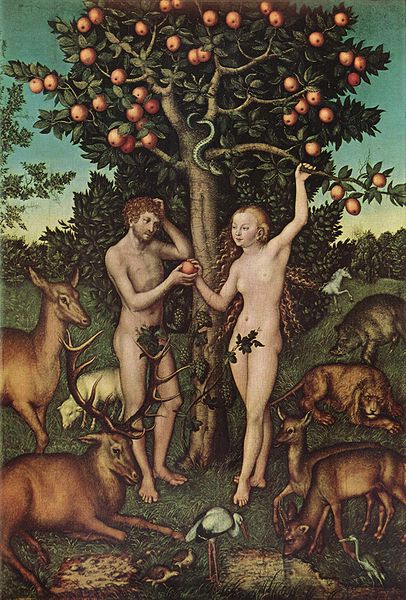
“Adam and Eve” – Lucas Cranach the Elder

Cranach Adam Eve

Adam and Eve (1596)

Lucas Cranach the Elder

____________

from The New Yorker, January 27, 2014

Adam and Eve” by Lucas Cranach the Elder, 1526

She seems a mere girl really,
small-breasted and slim,
her body luminescent
next to Adam, who scratches
his head in mild perplexity,
So many baubles hang
from the tree
it didn’t hurt to pick one.
The snake is a quicksilver curve
on a branch she is almost
young enough to swing from.

The garden bores her anyway:
no weedy chaos among
the flowers and vegetables;
the animals so tame
you can hardly tell the lamb
from the lion, the doe from the stag
whose antlers outline Adam’s modesty.
She is like that teen-age girl
who wandered from the mall last week
not to be seen again, the world before her
glittering and perilous.

Linda Pastan

______________

yesterday on a mission to buy socks,
finally – I had only a pair left and one
of those with a hole in it – I wondered
about clothes, why hadn’t we evolved
fur or feathers or, heaven forbid,
scales, like all other creatures,
without exception

cherry trees were in blossom, birds
sang along my path, despite an
inoffensive drizzle as I went along

perhaps, I thought, by standing erect
our private parts were too much in
evidence for even indiscriminate
Nature to bear, though apes in all
their varieties walk on two legs and
seem to cavort happily, indeed
lasciviously, though ever
unsheathed, I objected, everywhere

the only difference I could muster
between us and them was that we’d
eaten from the Tree of Knowledge,
the fruit, apparently, of our
apocalyptic decadence, while they’d
never had ever an Eve, nor, for that
matter, an, equally complicit, note,
Adam, no matter what the, mostly
male, elders might say

therefore apes gambol in their
Garden of Eden still, as you can
see in the Cranach above, serenely
uncontrite, while we buy socks in
the jungle next door, and berate,
burdened, our bedevilled lubricities,
what’s under those strategically
positioned, and obliterating, leaves

Tree of Knowledge indeed

Richard

psst: from the Courtauld Gallery in
London, more on Cranach’s
painting
, just click

on rhyme‏


commenting on his choice of idiom
in Paradise Lost, John Milton writes
the following

“The measure is English heroic verse without rime, as that of Homer in
Greek, and of Virgil in Latin—rime being no necessary adjunct or true
ornament of poem or good verse, in longer works especially, but the
invention of a barbarous age, to set off wretched matter and lame metre;
graced indeed since by the use of some famous modern poets, carried away
by custom, but much to their own vexation, hindrance, and constraint to
express many things otherwise, and for the most part worse, than else they
would have expressed them. Not without cause therefore some both Italian
and Spanish poets of prime note have rejected rime both in longer and
shorter works, as have also long since our best English tragedies, as a thing
of itself, to all judicious ears, trivial and of no true musical delight; which
consists only in apt numbers, fit quantity of syllables, and the sense variously
drawn out from one verse into another, not in the jingling sound of like
endings—a fault avoided by the learned ancients both in poetry and all good
oratory. This neglect then of rime so little is to be taken for a defect, though
it may seem so perhaps to vulgar readers, that it rather is to be esteemed an
example set, the first in English, of ancient liberty recovered to heroic poem
from the troublesome and modern bondage of riming.”

“Paradise Lost”: The Verse

John Milton

_______________

that’s of course his opinion, what do
you think

and what, thus, do you think poetry is,
not an especially easy question

Richard

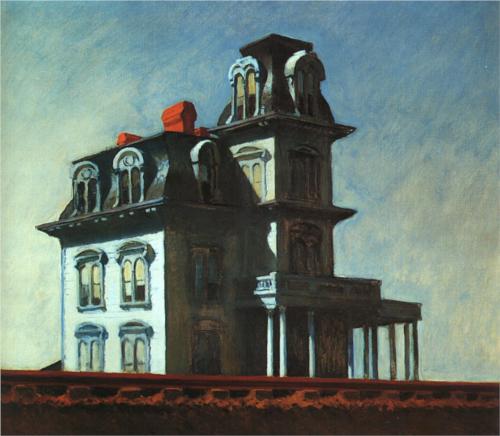
“Edward Hopper and the House by the Railroad” (1925) – Edward Hirsch‏

"House by the Railroad" (1925) - Edward Hopper

House by the Railroad (1925)

Edward Hopper

______

Edward Hopper and the House by the Railroad (1925)

Out here in the exact middle of the day,
This strange, gawky house has the expression
Of someone being stared at, someone holding
His breath underwater, hushed and expectant;

This house is ashamed of itself, ashamed
Of its fantastic mansard rooftop
And its pseudo-Gothic porch, ashamed
of its shoulders and large, awkward hands.

But the man behind the easel is relentless.
He is as brutal as sunlight, and believes
The house must have done something horrible
To the people who once lived here

Because now it is so desperately empty,
It must have done something to the sky
Because the sky, too, is utterly vacant
And devoid of meaning. There are no

Trees or shrubs anywhere–the house
Must have done something against the earth.
All that is present is a single pair of tracks
Straightening into the distance. No trains pass.

Now the stranger returns to this place daily
Until the house begins to suspect
That the man, too, is desolate, desolate
And even ashamed. Soon the house starts

To stare frankly at the man. And somehow
The empty white canvas slowly takes on
The expression of someone who is unnerved,
Someone holding his breath underwater.

And then one day the man simply disappears.
He is a last afternoon shadow moving
Across the tracks, making its way
Through the vast, darkening fields.

This man will paint other abandoned mansions,
And faded cafeteria windows, and poorly lettered
Storefronts on the edges of small towns.
Always they will have this same expression,

The utterly naked look of someone
Being stared at, someone American and gawky.
Someone who is about to be left alone
Again, and can no longer stand it.

Edward Hirsch

___________

Edward Hopper seems to have had
a profound influence on American
poets, this is the third poem around
one of his paintings I’ve encountered,
one by Joyce Carol Oates, a great lady
of not only poetry but of letters, having
been prolific in all literary forms, in each
nothing short of exemplary, another by
Brice Maiurro
, a budding poet of the
greatest, to my mind, merit, of whom
we will surely hear more if there is any
poetic justice

you can read about both of them right
here
in my blog, or just click their
individual names above

Edward Hirsch, by the way, stands
no less tall here, I submit, than the
other two in this coveted company

Richard

“Meditations”, Book 5 – Marcus Aurelius

“In the morning when thou risest unwillingly, let this thought be present – I am rising to the work of a human being. Why then am I dissatisfied if I am going to do the things for which I exist and for which I was brought into the world? Or have I been made for this, to lie in the bed-clothes and keep myself warm? – But this is more pleasant. – Dost thou exist then to take thy pleasure, and not at all for action or exertion? Dost thou not see the little plants, the little birds, the ants, the spiders, the bees working together to put in order their several parts of the universe? And art thou unwilling to do the work of a human being, and dost thou not make haste to do that which is according to thy nature? – But it is necessary to take rest also. – It is necessary: however nature has fixed bounds to this too: she has fixed bounds both to eating and drinking, and yet thou goest beyond these bounds, beyond what is sufficient; yet in thy acts it is not so, but thou stoppest short of what thou canst do. So thou lovest not thyself, for if thou didst, thou wouldst love thy nature and her will. But those who love their several arts exhaust themselves in working at them unwashed and without food; but thou valuest thy own own nature less than the turner values the turning art, or the dancer the dancing art, or the lover of money values his money, or the vainglorious man his little glory. And such men, when they have a violent affection to a thing, choose neither to eat nor to sleep rather than to perfect the things which they care for. But are the acts which concern society more vile in thy eyes and less worthy of thy labour?”

Meditations“, Book 5, 1

Marcus Aurelius

___________

though Marcus Aurelius produces
a seemingly logical argument in the
first paragraph of his fifth book of
meditations, his premises are not
air-tight

are we meant to “work”, a notion
already roundly infiltrating Christian
ideology, by the “sweat of its brow”,
as it were, at the time of Marcus
Aurelius, with those roots already in
early Stoicism, with Zeno of Citium,
a good 350 years before Christ

this notion is alive and well, indeed
thriving still, in the Protestant Ethic,
where very salvation is achieved
through labour, a consequence of
the Fall, which is to say, the expulsion
from the Garden of Eden

and Utilitarianism, where effort, which
is to say, work, is required to maximize
happiness, minimize suffering

these are profound pathways based
on faith, not necessarily ineluctable,
Epicureanism, an opposite philosophy,
of savouring the moment, though less
purported, less proclaimed, appears
ever flourishing nevertheless in our
voluptuous 21st Century

Marcus Aurelius brings up another
issue tangentially here, though he
expounds on it in later passages,
that of the primacy of either the
person or the community, a central
question of our times, socialism
versus democracy

he favours community, after Plato,
so, incidentally, does Jesus

these are not easy questions to
answer, what, essentially, are the
conditions required before one
starts to smell the flowers, is
smelling the flowers an abomination
when people are cruelly suffering,
dying

how can I help, should I, and when
do I say no to myself

therefore philosophy

your life, indeed your very next step,
depend on it

cheers

Richard

“Eugene Onegin”

years ago, when I first started paying
attention to opera, I listened to Joan
Sutherland and Luciano Pavarotti
singing “La Traviata” on my
headphones for six months solid,
Alfredo, Alfredo, I sang, di questa
core / Non puoi comprendere tutto
l’amore

now there’s “Eugene Onegin“,
Tchaikowsky’s homage to Pushkin,
the celebrated Russian poet who
wrote the national epic, turning it
into another prideful, musical this
time, monument

at first I’d been reluctant to take it on,
wary of other too ponderous Russian
productions, all heavy and lugubrious,
fraught with the trying tribulations of
too many harsh winters, I fathom

but after only a brief folkloric
interjection, too ecclesiastical a
reference for me, the story moved on
to less pompous things, an unfolding
love

Onegin is a rake, a rogue, a young
man not yet smitten, Tatyana, a
country lass but from a good manor,
hopelessly falls in love with him

he, of course, will break her heart

he will also break the heart of his
friend Lensky, when he dances an
écossaise, a grand waltz, and a
cotillion with Olga, Lensky’s
intended, and, parenthetically,
Tatyana’s sister

Olga had, injudiciously, allowed
Onegin to flirt

Lensky, offended, challenges
Onegin to a duel

in an aria that will haunt you forever,
Lensky commits himself to his fate,
be it Olga or the ineluctable hereafter,
knowing that she couldn’t either have
much loved him

you’ll cry

Kuda, kuda, you’ll also sing, kuda
vy udalilis,
like I will into surely at
least next month

I won’t tell you who wins, but it’s
tragic

and unforgettable

Richard

“Meditations“, Book 4 – Marcus Aurelius

“How much trouble he avoids who does not look to see what his
neighbour says or does or thinks, but only to what he does himself,
that it may be just and pure; or as Agathon says, look not round at
the depraved morals of others, but run straight along the line
without deviating from it.”

Meditations“, Book 4, 18

Marcus Aurelius

___________

having given the sciences their theoretical
foundations, philosophy, overtaken by facts,
theorems and numbers, impermeable verities
based on rigorous calculations and verifiable
experimentations, feared ceding its austere
position at the head of progressive thought
and ground its studies in more rationally
impregnable pursuits, empiricism overtook
speculation, morality became merely a
subtext instead of the existential quest
it had earlier informed

it has never recovered, though the
importance of the question of good
and evil has never subsided

towards what do we aspire, how do we
accord that with our environment, be it
social, political, natural

it is not a bad thing to consider our
priorities, otherwise we are merely
wisps, I would think, of undifferentiated
dust in the wind, dust having returned
inexorably to untransubstantiated
dust

therefore Marcus Aurelius

Richard

“Meditations”, Book 3 – Marcus Aurelius‏

“If thou workest at that which is before thee, following right reason seriously, vigorously, calmly, without allowing anything else to distract thee, but keeping thy divine part pure, as if thou shouldst be bound to give it back immediately; if thou holdest to this, expecting nothing, fearing nothing, but satisfied with thy present activity according to nature, and with heroic truth in every word and sound which thou utterest, thou wilt live happy. And there is no man who is able to prevent this.”

Meditations“, Book 3, 12

Marcus Aurelius

_________

the idea of the virtuous man, or the
interpretation of Marcus Aurelius of
such a person, goes back of course to
Socrates by way of Plato, 427 – 347
B.C., who’s ideal was primarily
political, what to achieve within a
political order, rather than a private
meditation, an advice rather than
a contemplation as in Marcus
Aurelius, 121 – 180 A.D., 550,
not inconsequential, years later

other moral perspectives meanwhile
applied, Epicureanism, for instance,
notably, after which the stranglehold
of Christianity produced not philosophy
but dogma, for a subservient and,
biblically labeled, fallen people,
nearly fifteen hundred years spent
trying to figure out how many angels
fit through the eye of a needle,
essentially, how many irrationalities
could prove the existence, and
authority, of a mandated God

René Descartes inadvertently in this
very quest, but not before 1637, put
an end to that, introduced a new, and
revolutionary, perspective, I think,
therefore I am
“,
which put the individual
instead of the Church in the driver’s seat,
this, if it didn’t bring on the Renaissance,
at least gave it a significant push

but because of his famous scientific
method
, studies afterwards in what
we now know as the humanities
became more empirical than
specifically moral, how do we
perceive rather than how do we live
according to what is right or wrong,
Nietzsche‘s Beyond Good and Evil“,
1886, reoriented that investigation,
as it happened, ominously, in an age
where any kind of god had become
irrelevant, Beethoven would be
transformed into a Hitler, an
uncomfortably fateful Übermensch,
Superman

now philosophy is concerned with
language, what do we mean when
we say what do we mean, and can
anybody understand that

our closest moralist, our modern day
Marcus Aurelius, is at present Miss
Manners
, whom I wholeheartedly
recommend

as well as, of course, Marcus Aurelius

Richard

psst: Miss Manners‘ question and answer
format, incidentally, is not at all unlike
what Plato does in his Socratic dialogues
,
she just has a larger, more flip audience
Meditations, Book 2 – Marcus Aurelius‏

“Begin the morning by saying to thyself, I shall meet with the busy-body, the ungrateful, arrogant, deceitful, envious, unsocial. All these things happen to them by reason of their ignorance of what is good and evil. But I who have seen the nature of the good that it is beautiful, and of the bad that it is ugly, and the nature of him who does wrong, that it is akin to me, not only of the same blood or seed, but that it participates in the same intelligence and the same portion of the divinity, I can neither be injured by any of them, for no one can fix on me what is ugly, nor can I be angry with my kinsman, nor hate him, For we are made for co-operation, like feet, like hands, like eyelids, like the rows of the upper and lower teeth. To act against one another then is contrary to nature; and it is acting against one another to be vexed and to turn away.”

Meditations“, Book 2, 1

Marcus Aurelius

____________

Marcus Aurelius was an emperor, he ruled
Rome for just under 20 years, from 161 to
180 A.D., a highly unlikely fount of
philosophical inspiration, do potentates
think this way, for instance, nowadays

meanwhile the advice above is not a
bad way to start any day, I think, even
for impotentates

respectfully

Richard

psst: “Remember that all is opinion.”,
Book 2, paragraph 15, also one of my
favourite ruminations

for all I‘m apparently therefore worth

Meditations, Book l – Marcus Aurelius‏

“From Rusticus I received the impression that my character required improvement and discipline; and from him I learned not to be led astray to sophistic emulation, nor to writing on speculative matters, nor to delivering little hortatory orations, nor to showing myself off as a man who practises much discipline, or does benevolent acts in order to make a display; and to abstain from rhetoric, and poetry, and fine writing; and not to walk about in the house in my outdoor dress, nor to do other things of the kind; and to write my letters with simplicity, like the letter which Rusticus wrote from Sinuessa to my mother; and with respect to those who have offended me by words, or done me wrong, to be easily disposed to be pacified and reconciled, as soon as they have shown a readiness to be reconciled; and to read carefully, and not to be satisfied with a superficial understanding of a book; nor hastily to give my assent to those who talk overmuch; and I am indebted to him for being acquainted with the discourses of Epictetus, which he communicated to me out of his own collection.”

Meditations, Book l, 7

Marcus Aurelius

______________

recently a website caught my attention
with news of a shared interest in things
of, to my mind, significance, a guide to
a moral life

Marcus Aurelius, an emperor, 121 – 180
A.D., along with Epictetus, 55 -135 A.D.,
a slave, are probably the only two
philosophers we know today specifically
devoted to that profoundly noble
intention

the juxtaposition of states here, from
the imperial to the abject, is instructive,
if not even inspiring

both from their divergent positions
proposed a considered life, of probity
and tolerance, what more do we
need of philosophy, fundamentally,
than that

above is an excerpt from Book l, others
will follow

Richard

psst: I found it hard not to imagine here
Laertes responding to Polonius in
“Hamlet”, Act l, scene l, lines 55 – 80,
nor Rudyard Kipling’s son responding
to his father’s poem, “If“, with its
famous, indeed timeless, exhortation,
“… you’ll be a Man, my son!”

daughters should also participate