Richibi’s Weblog

Just another WordPress.com weblog

Category: literature to ponder

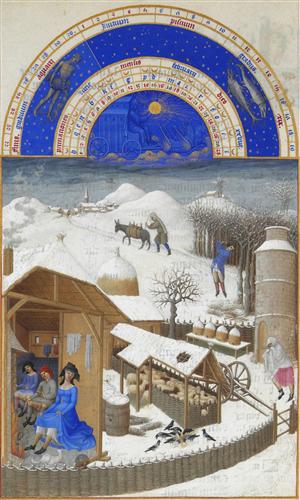
“The Poet’s Calendar” (February) – Henry Wadsworth Longfellow‏

 "Facsimile of February: Farmyard Scene with Peasants" -  Limbourg brothers

Facsimile of February:
Farmyard Scene with Peasants

the Limbourg brothers

___________

if there are paintings about February,
there must be poems about February,
I thought, hence the following entry,
though preceded by a belated January,
or Janus, as it turns out, held back by
nothing other, surely, than the “fields
with snow”, the “frosts”, and the
fowl-filled “frozen fen”

both are from a very calendar of
poems by Henry Wadsworth
Longfellow
, whom I’ve always
imagined tall, however
inappropriate, kind of like thinking
that because my name is Richard
I’m rich

it’s called, appropriately enough,
The Poet’s Calendar, just click

January

Janus am I; oldest of potentates;
Forward I look, and backward, and below
I count, as god of avenues and gates,
The years that through my portals come and go.
I block the roads, and drift the fields with snow;
I chase the wild-fowl from the frozen fen;
My frosts congeal the rivers in their flow,
My fires light up the hearths and hearts of men.

February

I am lustration, and the sea is mine!
I wash the sands and headlands with my tide;
My brow is crowned with branches of the pine;
Before my chariot-wheels the fishes glide.
By me all things unclean are purified,
By me the souls of men washed white again;
E’en the unlovely tombs of those who died
Without a dirge, I cleanse from every stain.

Henry Wadsworth Longfellow

March will have to wait

Richard

psst: lustration is a purification, Janus, the
god with two faces, who can see
backwards and forwards, fen,
marshland
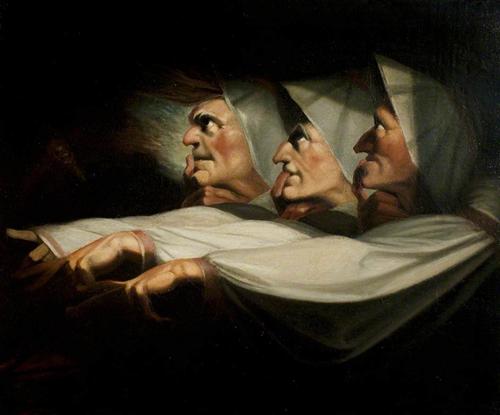
“Macbeth” – William Shakespeare‏

Henry Fuseli - "'Macbeth', Act I, Scene 3, the Weird Sisters"

‘Macbeth’, Act I, Scene 3, the Weird Sisters (1783)

Henry Fuseli

_______

Judy Dench is Lady Macbeth, Ian McKellen
her consort, in this superb production by
Trevor Nunn

also great witches

watch

Richard

“Riposte to Ode” – Michael Homolka‏

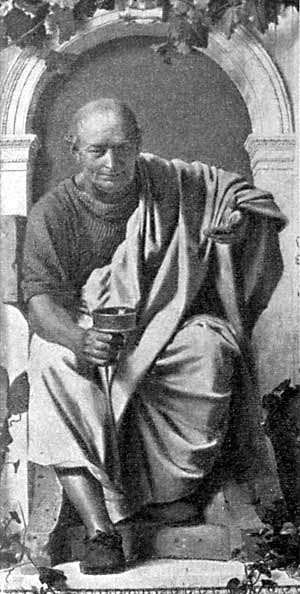
Anton von Werner - "Horace"

Horace

Anton von Werner

______

Riposte to Ode

It isn’t like that Horace Life stresses us out
However many hundreds of decades later we’re told
to welcome anxiety is beneficial
and to quote honor our imperfections

You’ve got the Adriatic Sea We’ve got what
the Finger Lakes? Not quite as conducive
to worrying the infinite question so we worry
about other things equities statistics

I’m not really a wine man either
not in the unmixed sense where Alcibiades
might barge in any moment and out-naked us all
I’m an American so I prefer pig iron

Wildflowers abound somewhere I’m sure
I don’t know anything about flowers though
Few of us in the cities follow them
the way you seem to as if tracking currencies

But to speak to your point about an actual
battlefront approaching Main Street who knows?
Maybe we would resort to hookers and crack
per your suggestion I can’t say Horace I wish I could

Michael Homolka

______________

which “Ode” remains a mystery, so
one should suppose Michael Homolka
is “ripost[ing]” to Horace’s entire body
of odes, he wrote four books of them,
23 – 11 B.C.E., during the time of
Augustus

I found the Odes too steeped in
Roman and mythological arcana to
follow their uneasy referents, too
esoteric, I thought, to even look
them up, seems Michael Homolka
thought the same

but his Ars Poetica“, if you’ll pardon
the expression, spoke directly to my
heart, On style“, “On metre“, on
How to be a good poet“, for
instance, topics I find irresistible

you’ll note that whereas I’ve used
commas ever to indicate pauses
in what I write, Homolka uses
spaces, if you’ll allow me that,
perhaps immodest, conjunction,
you’ll find these in his original
copy
, WordPress won’t allow me
that, click here for that original
copy

he also allows himself question
marks, something I never do

go figure

you’ll also note his dramatic
monologue, my favourite, if
you haven’t already done so

Richard

psst: “None knows the reason why this curse
Was sent on him, this love of making verse.” – Ars Poetica“, line 470

“How I Didn’t Get Myself to a Nunnery” – Suzanne Lummis‏

"Ophelia" - Arthur Hughes

Ophelia (1852)

Arthur Hughes

_________

according to Suzanne Lummis Ophelia
“g[o]t outta town”

Suzanne Lummis is Ophelia here, this
is a dramatic monologue, I can’t tell you
how much I find that exciting

you’ll want to run to the source, of course,
to find pertinent references, so I’ve linked
a few for you from the text below to their
counterparts in Hamlet“, if it’s coloured,
just click, otherwise a couple of asterisks
explain two probably too obvious items,
in which case you’ll forgive me my
infelicitous impertinence, my unintended
and hapless presumption

thanks

How I Didn’t Get Myself to a Nunnery

That girl they found ensconced in mud and loam,
she wasn’t me. Small wonder, though, they jumped.
To a conclusion. Water puffs you up,
and we pale Slavic girls looked much alike—
back then. Deprivation smooths you out.
Yes, that was the season of self-drowned maids,
heart-to-hearts with skulls, great minds overthrown.
And minds that could be great if they could just
come up for air. Not in that town. Something stank. *

But me, I drifted on. I like rivers.
And I’m all right with flowers. I floated
on a bed of roses—well, O.K., rue
and columbine
. It bore me up not down.
That night I made a circle with my thumb
and finger, like a lens, and peered through it
at the moon—mine, all mine. My kissed-white moon.
“Moon River wider than a . . .” Mancini/
Mercer wrote that, sure, but I wrote it first.

You wonder where I’m going with all this?
Where water goes. It empties into sea.
Sold! I’d take it—the sea or a fresh life.
Some other life. A good man—good enough,
fair—fished me out. He’d come to quench his thirst.
No sun-god prince,* of course, like him I’d loved,
still loved. (Some loves don’t die; not even murder
kills them.) I married his thatched hut, hatched chicks—
kids running underfoot. Don’t cry for me,

Denmark. I’d learned the art of compromise
back there, in the black castle—then came blood,
ghosts. Something in me burst. If not lover,
father, king, ** then whom can you trust? Alone,
I took up some playing cards. I played them
into skinny air. A voice said, Swim or drown.
It said: Your house caught fire, flood, caught fear—
it’s coming down. No one loves you now, here.
By land or water, girl, get outta town.

Suzanne Lummis

* i.e. Hamlet, of course, prince of Denmark
** Hamlet, Polonius, Claudius

our debt to Shakespeare in literature
is enormous, after even 400 years –
“Hamlet” was written in 1602 – his
literary form, his countless neologisms,
his stories, his blueprints, transformed
into ballets, paintings as above, operas,
have become our myths, our moral and
philosophical standard, our modern
Olympus, the measure of our time,
our epoch, Shakespeare is our Iliad

only Beethoven in music has ever
matched this, in the visual arts, no
one

you’ll notice that the poem itself is a
monologue, in answer, in homage, to
Shakespeare, it’s in iambic pentameter,
also his wont

mine too, incidentally

Richard


“The Belle of Amherst”‏

Emily Dickinson

Emily Dickinson

_______

a couple of my Internet interests intersected
recently to bring me this theatrical gem, this
outright treasure

there’d been a few poems of Emily Dickinson
I’d read in my poetry class, none particularly
affecting, while at the Tonys on another site
Julie Harris was winning the ’77 award for
best actress for her role as that very poet, in
a superb evocation, The Belle of Amherst“,
of Dickinson’s life, available, I, to my delight,
indeed erudition, discovered, elsewhere still
on the Internet, straight from the original
Broadway stage

Julie Harris was the very stuff of Tonys, so
was the production

watch, don’t not watch

you’ll want to run back to your Emily
Dickinsons afterwards, even

here’s one

If I can stop one heart from breaking,
I shall not live in vain;
If I can ease one life the aching,
Or cool one pain,
Or help one fainting robin
Unto his nest again,
I shall not live in vain.

Emily Dickinson

Richard

what is a philosopher‏

Henri Martin - "Philosopher"

Philosopher

Henri Martin

________

considering the response below too
forthright for a discussion we were
having on a university course website,
interactively dealing with the question
of free will, I nevertheless found worthy
my opinion of what a philosopher is,
which I deign to mount here on my,
less discreet, canvas

if you’ll allow

it is evidently a dramatic monologue

Richard

__________

what is a philosopher

you are not a philosopher, sir, to take
offence so quickly, a philosopher is
objective, and wouldn’t allow for
emotion to get in the way of even an
offensive argument

but with irrefutable logic simply
expose his, her sound position

indeterminacy would be encountered
with humility first, then grace, only
ever consummate deference

if you’ll allow

cheers

Richard

psst: see, for more on indeterminacy,
Socrates, ever catering to objections

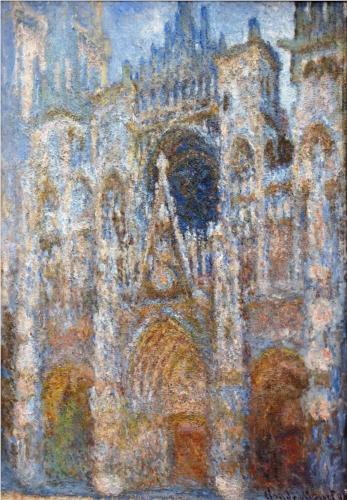
“Monet Refuses the Operation” – Lisel Mueller‏

Claude Monet - "Rouen Cathedral, Magic in Blue"

Rouen Cathedral, Magic in Blue (1894)

Claude Monet

______

up until now I’ve presented dramatic
monologues
, but only to music, on my
blog
, referring to Robert Browning as
their originator, but not ever producing
any representative spoken work, never
mind any of, themselves, the poet’s
seminal masterpieces, My Last
Duchess
“, “Fra Lippo Lippi“, “How
They Brought the Good News from
Ghent to Aix
“,
for instance, which,
granted, can be daunting now in their
breadth and erudition, the Romantics
didn’t have television, they had to
entertain themselves

here’s a poem for our time, written
in 1996, only two decades ago, gasp,
Lisel Mueller imagines herself Claude
Monet
, an easier concept, after all,
who’s been to Ghent or Aix, why
would anyone want to run there,
whereas Monet‘s another story, who
doesn’t today know Monet

Monet was blind at the end of his life,
one learns from the website where I
got this
, a blog with plenty of breadth
and already considerable erudition, he
received corrective surgery to be able
to continue with his work

there was, however, a limit

Monet Refuses the Operation

Doctor, you say there are no haloes
around the streetlights in Paris
and what I see is an aberration
caused by old age, an affliction.
I tell you it has taken me all my life
to arrive at the vision of gas lamps as angels,
to soften and blur and finally banish
the edges you regret I don’t see,
to learn that the line I called the horizon
does not exist and sky and water,
so long apart, are the same state of being.
Fifty-four years before I could see
Rouen cathedral is built
of parallel shafts of sun,
and now you want to restore
my youthful errors: fixed
notions of top and bottom,
the illusion of three-dimensional space,
wisteria separate
from the bridge it covers.
What can I say to convince you
the Houses of Parliament dissolve
night after night to become
the fluid dream of the Thames?
I will not return to a universe
of objects that don’t know each other,
as if islands were not the lost children
of one great continent. The world
is flux, and light becomes what it touches,
becomes water, lilies on water,
above and below water,
becomes lilac and mauve and yellow
and white and cerulean lamps,
small fists passing sunlight
so quickly to one another
that it would take long, streaming hair
inside my brush to catch it.
To paint the speed of light!
Our weighted shapes, these verticals,
burn to mix with air
and change our bones, skin, clothes
to gases. Doctor,
if only you could see
how heaven pulls earth into its arms
and how infinitely the heart expands
to claim this world, blue vapor without end.

Lisel Mueller

Richard

psst: thanks Brain for this beautiful poem

“Why Do I Love You?” – from “Behind the Candelabra”

just when you thought you’d never see
Elizabeth Barrett Browning again, here
she pops up in, of all places, a movie
about Liberace, Behind the Candelabra“,
a not undistinguished representation of
the high life, the over the top life, of an
aging and flamboyant superstar with his
much younger companion, feathers fly,
Ferraris too, and so do tempers

but at one point Liberace recites this
poem, “Why do I love you?”

where have I heard that line before, I
said to myself, and needed no one, of
course, to answer, here was Elizabeth
handing over her mantle to someone
in the XXlst Century, maybe

you decide

Richard

psst: Liberace also said, “too much of a good
thing is wonderful”,
I’ll drink to that

__________________

Why do I love you?

Why do I love you?
I love you not only for what you are,
but for what I am when I’m with you.
I love you not only for
what you have made of yourself
but for what you are making of me
I love you for not ignoring
the possibilities of the fool in me,
and for accepting
the possibilities of the good in me.

Why do I love you?
I love you for
closing your eyes to the discords in me,
and for adding to the music in me
by worshipful listening.
I love you
for helping me to construct my life,
not a tavern, but a temple.
I love you because
you have done so much to make me happy.
You have done it without a word,
without a touch, without a sign.
You have done it by just being yourself.
Perhaps, after all,
that is what love means,
and that is why
I love you.

“Bohemian Rhapsody” – Freddy Mercury‏


the poetic dramatic monologue, which finds
its popular source in Shakespeare, though
they are essentially introspective there,
philosophical rather than strictly narrative,
making them nevertheless, in a play, by
definition, dramatic, rightful claimants
still to that name, and which was
institutionalized as a poetic form by
Robert Browning later in the XlXth Century,
by upending the Shakespearean mode,
turning poems into plays instead of plays
into poems, makes its way into the XXth
Century, probably mostly unobtrusively,
no one really particularly notices, but
powerfully culturally nonetheless when
applied to, for instance, music, which is
to say poetry, of course, with notes

here’s “Bohemian Rhapsody”*, an abridged
version, as sung by Rose Osang Fostanes,
delivering a classic dramatic monologue

here’s Freddy Mercury’s complete version,
with a Greek chorus supplying oracular
even feedback

Richard

* Bohemian Rhapsody

Is this the real life?
Is this just fantasy?
Caught in a landslide,
No escape from reality.

Open your eyes,
Look up to the skies and see,
I’m just a poor boy, I need no sympathy,
Because I’m easy come, easy go,
Little high, little low,
Anyway the wind blows doesn’t really matter to me, to me.

Mama, just killed a man,
Put a gun against his head,
Pulled my trigger, now he’s dead.
Mama, life had just begun,
But now I’ve gone and thrown it all away.

Mama, ooh,
Didn’t mean to make you cry,
If I’m not back again this time tomorrow,
Carry on, carry on as if nothing really matters.

Too late, my time has come,
Sends shivers down my spine,
Body’s aching all the time.
Goodbye, everybody, I’ve got to go,
Gotta leave you all behind and face the truth.

Mama, ooh (anyway the wind blows),
I don’t wanna die,
I sometimes wish I’d never been born at all.

I see a little silhouetto of a man,
Scaramouche, Scaramouche, will you do the Fandango?
Thunderbolt and lightning,
Very, very frightening me.
(Galileo) Galileo.
(Galileo) Galileo,
Galileo Figaro
Magnifico.

I’m just a poor boy and nobody loves me.
He’s just a poor boy from a poor family,
Spare him his life from this monstrosity.

Easy come, easy go, will you let me go?
Bismillah! No, we will not let you go. (Let him go!)
Bismillah! We will not let you go. (Let him go!)
Bismillah! We will not let you go. (Let me go!)
Will not let you go. (Let me go!)
Never, never let you go
Never let me go, oh.
No, no, no, no, no, no, no.
Oh, mama mia, mama mia (Mama mia, let me go.)
Beelzebub has a devil put aside for me, for me, for me.

So you think you can stone me and spit in my eye?
So you think you can love me and leave me to die?
Oh, baby, can’t do this to me, baby,
Just gotta get out, just gotta get right outta here.

(Oh, yeah, oh yeah)

Nothing really matters,
Anyone can see,
Nothing really matters,
Nothing really matters to me.

Anyway the wind blows.

Freddy Mercury

“Ambush at Five O’clock” – Stephen Dunn‏


from the New Yorker, February 3, 2014

Ambush at Five O’clock

We were by the hedge that separates our properties
when I asked our neighbors about their souls.
I said it with a smile, the way one asks such a thing.
They were somewhat like us, I thought, more
than middle-aged, less dull than most.
Yet they seemed to have no interest
in disputation, our favorite game,
or any of the great national pastimes
like gossip and stories of misfortunes
about people they disliked.

In spite of these differences, kindred
was a word we often felt and used.
The man was shy, though came to life
when he spotted an uncommon bird,
and the woman lively, sometimes even funny
about barometer readings and sudden dips
in pressure, the general state of things.
We liked their affection for each other
and for dogs. We went to their house;
they came to ours.

After I asked about their souls
they laughed and stumbled towards an answer,
then gave up, turned the question back
to me. And because I felt mine always was
in jeopardy I said it went to the movies
and hasn’t been seen since. I said gobbledy
and I said gook. I found myself needing
to fool around, avoid, stay away from myself.

But my wife said her soul suffered from neglect,
that she herself was often neglectful
of important things, but so was I.
Then she started to cry. What’s the matter? I asked.
What brought this on? She didn’t answer.
I felt ambushed, publicly insensitive
about something, whatever it was.

It was a dusky five o’clock, that time
in between one thing and another.
Our neighbors retreated to their home,
but the women returned
and without a word put her arms
around my wife as if a woman weeping
indicated something already understood
among women, that needn’t be voiced.
They held each other, rocked back and forth,

and I thought Jesus Christ, am I guilty again
of one of those small errors
I’ve repeated until it became large?
what about me? I thought. What about
the sadness of being stupid?
Why doesn’t her husband return
with maybe a beer and a knowing nod?

Stephen Dunn

____________

poetry is a conversation, of course, a poet
has with all the other poets who’ve come
before him, her, here Dunn is evidently
channelling Robert Browning, “This is
my last Duchess”,
Browning writes,
“painted on the wall / Looking as though
she were alive.”,
from his My Last
Duchess
“,
a poem I’ve never forgotten,
wherein the speaker discusses the
portrait of his earlier wife, one he’d
summarily purportedly got rid of

Robert Browning had learned his craft,
the dramatic monologue, from, of course,
Shakespeare, down to even its dramatic
content

Elizabeth meanwhile had been inspired
rather by Shakespeare’s sonnets, by his
thee, thy, thine, and thou’s

in Dunn the Browningian drama is
significantly less dour, nobody out and
out dies, though the dilemma is never
not existential, however less morally
compromised, less psychologically
and tragically fraught

neither does Dunn rhyme

but that just sends us back to Homer
of course, less epic, more, maybe,
middle class, very, and distinctively,
XXlst Century

but that’s how you read between the
lines, the verses, in this case, and
thus across the centuries

poetry is a conversation

Richard