Richibi’s Weblog

Just another WordPress.com weblog

Category: literature to ponder

Meditation 1 – John Donne

John_Donne

                              John Donne
 
                                 _______
 

to my utter embarrassment, my
profound dismay, I attributed in
my last title John Donne‘s No
inadvertently, a somewhat later 
though nearly contemporary 
poet of Donne‘s, equally as 
noteworthy, thereby accounting, 
maybe, for my confusion, my 
lapse, my infelicity, however still 
unforgivable
 
once I mistook Schubert for 
Beethoven, and, however similar
these might become in their 
euphoric musical explorations
despite their obvious rhythmic 
differences, never a sufficient 
excuse, though, for that flagrant 
flaw – still blush at the memory 
of that faux pas, among French 
intellectuals no less, the worst, 
the least forgiving   
 
John Donne, I’ve found since, is
not only noteworthy for his ribald 
poems, the ones we studied mostly 
at school, but his “Devotions upon
Emergent Occasions, from which 
No man is an island” is but one
inspirational bit, is replete with 
other gems 
 
he’d composed them after having
survived a brush with death, they 
are wise, and worth individually
considering for their spiritual 
illumination, their metaphysical 
light, their sage and sober 
guidance
 
here’s Meditation 1, or
 
                                   The first grudging of, the sicknesse.
 
“Variable, and therfore miserable condition of Man; this minute I was well, and am ill, this minute. I am surpriz’d with a sodaine change, and alteration to worse, and can impute it to no cause, nor call it by any name. We study Health, and we deliberate upon our meats, and drink, and ayre, and exercises, and we hew, and wee polish every stone, that goes to that building; and so our Health is a long and regular work; But in a minute a Canon batters all, overthrowes all, demolishes all; a Sicknes unprevented for all our diligence, unsuspected for all our curiositie; nay, undeserved, if we consider only disorder, summons us, seizes us, possesses us, destroyes us in an instant. O miserable condition of Man, which was not imprinted by God, who as hee is immortall himselfe, had put a coale, a beame of Immortalitie into us, which we might have blowen into a flame, but blew it out, by our first sinne; wee beggard our selves by hearkning after false riches, and infatuated our selves by hearkning after false knowledge. So that now, we doe not onely die, but die upon the Rack, die by the torment of sicknesse; nor that onely, but are preafflicted, super-afflicted with these jelousies and suspitions, and apprehensions of Sicknes, before we can cal it a sicknes; we are not sure we are ill; one hand askes the other by the pulse, and our eye asks our urine, how we do. O multiplied misery! we die, and cannot enjoy death, because wee die in this torment of sicknes; we art tormented with sicknes, and cannot stay till the torment come, but preapprehensions and presages, prophecy those torments, which induce that death before either come; and our dissolution is conceived in these first changes, quickned in the sicknes it selfe, and borne in death, which beares date from these first changes. Is this the honour which Man hath by being a litle world, That he hath these earthquakes in him selfe, sodaine shakings; these lightnings, sodaine flashes; these thunders, sodaine noises; these Eclypses, sodain offuscations, and darknings of his senses; these Blazing stars, sodaine fiery exhalations; these Rivers of blood, sodaine red waters? Is he a world to himselfe onely therefore, that he hath inough in himself, not only to destroy, and execute himselfe, but to presage that execution upon himselfe; to assist the sicknes, to antidate the sicknes, to make the sicknes the more irremediable, by sad apprehensions, and as if he would make a fire the more vehement, by sprinkling water upon the coales, so to wrap a hote fever in cold Melancholy, least the fever alone should not destroy fast enough, without this contribution nor perfit the work (which is destruction) except we joynd an artificiall sicknes, of our owne melancholy, to our natural, our unnaturall fever. O perplex’d discomposition, O ridling distemper, O miserable condition of Man!”
  
                                                                                      John Donne
 
 
in other words, carpe diem, seize 
the day, don’t worry, be happy,
something too many of us learn 
too late 
 
Richard
 
psst: thanks, Guy, for the heads up,
         Guy is a librarian friend of mine 
         with the goods on the Tudors


“No man is an island” – John Donne

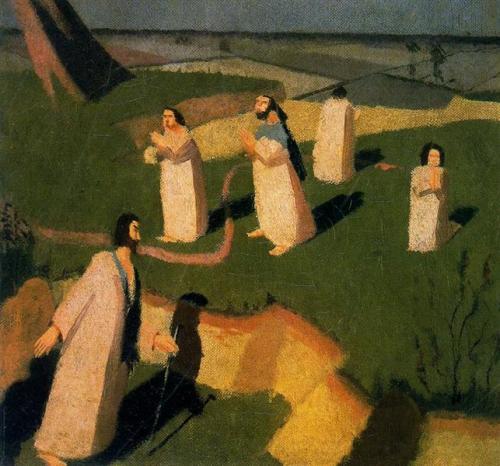
john-donne-arriving-in-heaven-1911.jpg!Large                                     

                              John Donne Arriving in Heaven (1911)
 
                                                   Stanley Spencer
 
                                                        _________
 
 
the Munk Debates have been going  
on for some time now, a community 
service program of the very highest 
order, personalities of considerable 
note come together to champion their
positions on questions of supreme
importance in our global environment
 
Hitchens, the notorious, and highly 
influential, atheist contrarian, on 
religion, and suffered to him an 
ignominious defeat   
 
the crude but highly influential military 
advocate and, for a time, Canada’s Chief 
of Defence Staff, as well as the irascible 
Robert BoltonAmerican Ambassador to 
the U.N during the George W. Bush 
administration, and mightily held her 
own
 
Glenn Greenwald, the man who
published Edward Snowden’s trove
of leaked documents, discusses state
surveillance, others, all, have 
contributed to eloquent, and often 
riveting, exchanges 
 
last week the Canadian program went
continent-wide, including, this time, 
in other words, the United States, 
Louise Arbour, the highly respected 
Canadian jurist, and other mostly 
 
Simon Schama, a political pundit, 
offered little to that arenacounting on 
polished credentials, it appeared to me, 
instead of solid information, but stopped 
the show nevertheless with a recitation 
a literary document of the highest 
consequence we’ve all heard but never 
quite properly placed, during otherwise
more conventional closing arguments
 
despite strong opposition to my 
perspective from the site’s comment 
section, I thought No man is an island 
is on this issue not a bad at all place to 
start
 
 
Richard 
 
 
              ________________


No man is an island, entire of itself; every man is a piece of the continent, a part of the main; if a clod be washed away by the sea, Europe is the less, as well as if a promontory were, as well as if a manor of thy friend’s or of thine own were; any man’s death diminishes me, because I am involved in mankind, and therefore never send to know for whom the bell tolls; it tolls for thee.

              
                                                                                       John Donne

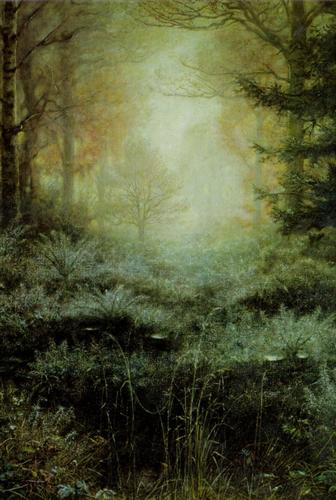
“Diet Mountain Dew” – Timothy Donnelly

dew-drenched-furze.jpg!Blog

                  Dew Drenched Furze (1890)
 
                            John Everett Millais
 
                                 _____________
 
 
I have been, perhaps still am, 
grasshopper, which is why I 
react so strongly to this poem
 
at twelve already, after having
read Somerset Maugham’s 
Of Human Bondage“, I knew 
such would be my own fate, 
love wouldn’t be kind to me 
 
it hasn’t, it ain’t easy being 
green
 
 
Richard
 
                  ____________


I have built my ship of death
and when a wind kicks up
I’ll cut it loose to do its thing
across an unnamed lake of you,
a firefly sent pulsing through
the non-stop estivation of
the verses of our South, who in
its larval phase would feast
on bitter worms and snails, who
emerges from its mud chamber
our planet’s most efficient
luminescence, who turns
chemical energy into radiant
energy shedding very little heat,
so will I sail the compass of
you pleased with my cold light.
 
I have built my ship of death
aglow in sturdy chemicals
and powered up at night like
American Express, I’m all
customer service only minus
the customer, no service to speak
of other than death, you will
know my logo by its absence
and slogan from the past
ad for the sugared style of you
on TV in my youth, it goes
like this: “When my thirst
is at its worst . . .” and then I
let it trail off into the unsayable
or is it just unsaid because
my mouth is full of you again.
 
A green like no other green
in the dale, indelicate green or
green indecent, surpassing
the fern and sprout and April’s
optimistic leaflet some stop
to admire in nature, they take
photographs noncognizant
of other vehicles, you are too
green for pasture, you are
my green oncoming vehicle,
usurper of green, assassin
to the grasshopper and its plan,
I put me in your path which is
the path a planet takes when it
means to destroy another I think
you know I’m O.K. with that.
 
A green like no other green
resplending in production since
1940 when brothers Barney
and Ally Hartman cooked it up
in Tennessee qua private
mixer named after moonshine,
its formula then revised by
Bill Bridgforth of the Tri-City
Beverage Corp. in 1958, year
Linwood Burton, chemically
inclined entrepreneur and ship
cleaning service owner, sold
his formula for a relatively safe
maritime solvent to Procter
& Gamble of Ohio, who went on
to market it under the name
 
of Mr. Clean, whose green
approaches yours then at the
last second swerves into
a joke yellow plays on green
to make blue jealous till it
blows up in its face but I can’t
not love the smell of it, citrus
reimagined by an extra-
terrestrial lizard which is to say
inhuman in the way you say
inhuman to me, a compliment
unravelled in the drawl: “Hey
you, over there, you look
so unaccustomed to temporality
I would’ve sworn you were
inhuman,” and time for it after
 
time I fall, further evidence
of my humanity: I am at heart
no less susceptible to rot
than the felt hat on the head
of the rifle-toting barefoot
hillbilly, your mascot until he
disappeared in 1969. Instinct
says he must have shot his
self in the woods in the mouth
one sunrise when a frost
was at hand and the apples
fell thick and he was way
too awake when he did so not to
think there would be another
waiting like a can of you in
the 12-pack in my refrigerator.
 
I have built my ship of death
and enough already, every
toxic sip of you preparing for
the journey to bloviation:
I leave to return and return
to depart again the stronger
for a satisfaction being bound
to no port has afforded me:
I have built my ship of death
so that even when I crawl
back down into the hold of it
alive as what unnaturalness
in you can keep me, it’s only
to emerge from the other
end of it intact, and perfectly
prepared to be your grasshopper.
 
                       Timothy Donnelly


a rumination on rain‏

spring-rain.jpg!Blog

                                                 Spring Rain 
 
                                        Erte (Romain de Tirtoff)
 
                                                    _________
 
 
since last November the days have 
been short, and have not hastened 
since winter to be longer, not 
helped either by the most recent 
time change, more than anything 
a biannual irritant  
 
nor has the rain stopped, apart from 
a few clement days, its persistent,
often pounding, onslaught
 
that’s me, above, expressing my 
displeasure
 
 
as usual, in distress, I turned to art 
to see, or hear, what others might 
have to say about my current 
dilemma, my chagrin du jour, if you 
like, in this instance, the Erte on rain 
took the sting out of the raindrops
 
others had inspired, a Gauguin,
unexpectedly grey, but haunting,
a Monet, of course, equally sombre, 
who painted in all weathers
 
Constable, uncharacteristically 
angry, was looking a lot like 
Turner, but more direct, accessible,
less oracular, more matter-of-fact, 
sensible, reading only the weather 
in the weather
 
Winston Churchill, of all people, 
gives us, incidentally, something 
in between
 
 
especially to my sense of poetry 
among the artworks I perused, 
someone I’ll have to further, for his 
tender homage to perhaps other 
colours than orange, explore
 
to me unknown, does a similar thing
in, essentially, a monochrome, with 
a fine mist standing in for ethereality
 
Miró is ever up to his old tricks, 
find it  
 
but Erte catches best of all my desire
for irony, sardonicism, self-criticism
 
in music I couldn’t think of anything 
other than Beethoven’s Der Sturm
to temper the weather, despite the 
fact that rain hadn’t been ever his 
inspiration, the title came from his 
publisher to increase sales, 
Beethoven wrote pure music, 
abstract, never specifically literally 
to describe, what is called program
music, his descriptions, his 
evocations, came unadulterated,
untransliterated, from the heart 
 
 
in literature nothing beats Somerset 
Maugham’s short story, Rain“, 
masterpiece of intrigue as well as 
literary prowess, searing substance 
married to superb style
 
the book was duly made into film,
and several times, with Gloria 
Swanson in 1928, Joan Crawford 
in 1932, and Rita Hayworth in 1953
none of these slouches
 
 
the clouds have now coincidentally
dispersed, the metaphorical ones, 
not so surprisingly, have been 
meanwhile displaced by my retreat 
into art, a recourse I’ve found to be 
always dependable, and, yet again, 
in this otherwise grim environment,
diverting and trustworthily inspiring
 
 
I wish you consequently, also, for 
similar reasons, art, a salve along 
life’s often obstreperous journey 
 
 
Richard
 

“The Afternoon of a Faun” – Vaslav Nijinsky‏

800px-Bakst_Nizhinsky

                           Program for L’après-midi d’un faune”  (1912)

                                                       Léon Bakst
 
                                                          _______
 
 
though the reference to Pan is not direct
in the title of Nijinsky‘s choreographic 
rendition of Debussy‘s 1894 symphonic
classic, itself a musical transposition
of Stéphane Mallarmé‘s 1876 poem, 
L’après-midi d’un faune“, or, in English, 
connections are unmistakably implicit, 
not only in the story which is told, but 
also in the elements of the dance, which 
borrows heavily from Grecian urns, their 
static, angular poses
 
also Mallarmé makes specific allusions to
Syrinx herself, among other nymphs, in his 
seminal work, not to mention to the deity’s
eponymous flute
 
the only change to the original production 
dancers, here, Rudolf Nureyev performs 
with the Joffrey Ballet, where Vaslav
Nijinskythe choreographer himself, 
danced with Sergei Diaghilev‘s Ballets
Russes in the show that made history, 
the sets and costumes by Léon Bakst 
remain also unchanged, this is what the 
audience saw May 12, 1912, at the very  
 
the piece shocked even irreverent Paris,
of course, for its overt and unapologetic
eroticism, it‘ll probably even shock you, 
still
 
I thought, this is what happened to Berlin 
after the First World War, a reconstructed
chthonic* resurgence at the death of an 
old order, the Age of Aquarius after the 
nuclear scare, “Hair
 
famously, Auguste Rodin loved it
 
 
Richard
 
chthonic: of what makes you snort, grunt,
   instinctive forces, the ones which make  
   a young man’s fancy turn to, well, love 
 
   or worse

“Syrinx” – Claude Debussy‏

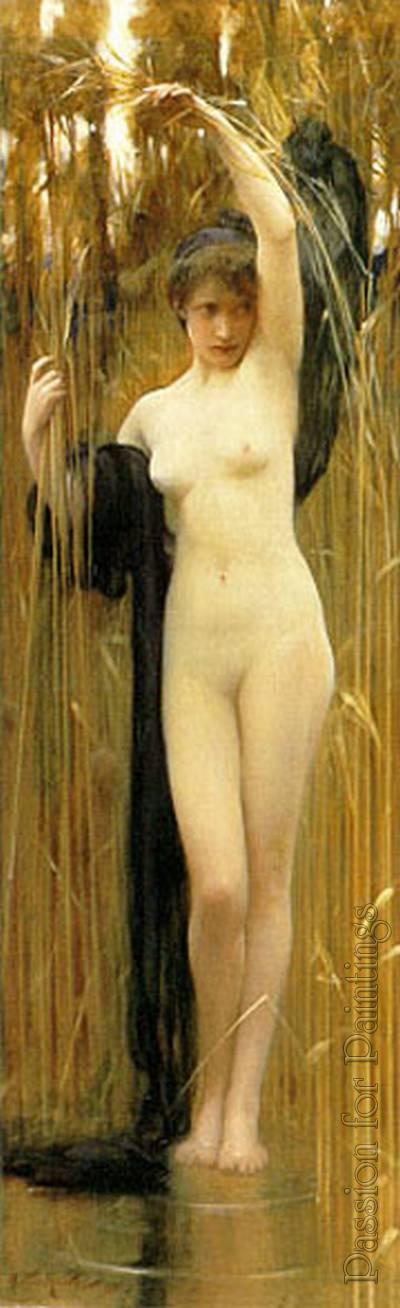
big

         Syrinx (1892)
 
          Arthur Hacker
 
            __________
 
 
though Debussy would’ve called his
Syrinx “Flûte de Pan”, “Pan Flute”,
alas, the name had already been 
taken, he therefore came up with the 
much more inspired Syrinx
 
Syrinx, with the help of other nymphs, 
who’d come at her cry for help as she 
fled the god Pan, a pursuer, had been 
turned into a bush of reeds, its canes 
producing a song so sweet as to 
confound and disarm him, impelling
him to create of them that sublime 
instrument  
 
Hermes had been telling Argus, Argus 
Panoptes, the giant with the hundred 
eyes, the story about the pipes he  
was playing, an implement received 
from Jove, apparently, god of all the 
gods, who wanted him to kill Argus, 
for confining Io, who’d been turned 
into a heifer by Juno, Jove’s wife, 
who’d caught him chasing her, Io’s 
plaintive lows had been getting to 
Juno as Io fretted unfettered through 
the fields too close to Olympus 
 
when Hermes’ music finally closed the
giant’s last two eyes, he beheaded him,
but Juno, in merciful recognition of his
service, however ultimately ineffectual, 
set them into the variegated tail of the 
peacock
 
are you kidding me, I always think when
I read Ovid’s “Metamorphoses”, and am
ever nevertheless entirely enchanted
 
a flute solo had not been composed in
over 150 years when Debussy composed
his Syrinx“, 1913, after C.P.E. Bach’s not  
at all unimpressive Sonata in A Minor 
of 1747, it duly set off a new life for the 
long overlooked flute, a reed which 
Mozart famously didn’t like
 
note the tonal, rhythmic, and repetition 
shifts from the rigid Classical model, 
where these are much more strict, 
Impressionism was not only breaking 
down pictures, the pictorial arts, but its
sound world as well, it was an utterly
new era, new sensibility, new zeitgeist, 
and you can feel it, though you might
not be quite able to immediately 
verbalize it, the arts were again, as
they ever ‘ve been, the canary in the 
gold mine
 
 
Richard
 
psst:
 
   The Transformation of Syrinx into Reeds 
 
Then Hermes thus: A nymph of late there was 
Whose heav’nly form her fellows did surpass. 
The pride and joy of fair Arcadia’s plains, 
Belov’d by deities, ador’d by swains: 
Syrinx her name, by Sylvans oft pursu’d, 
As oft she did the lustful Gods delude: 
The rural, and the woodland Pow’rs disdain’d; 
With Cynthia hunted, and her rites maintain’d: 
Like Phoebe clad, even Phoebe’s self she seems, 
So tall, so streight, such well-proportion’d limbs: 
The nicest eye did no distinction know, 
But that the goddess bore a golden bow: 
Distinguish’d thus, the sight she cheated too. 
Descending from Lycaeus, Pan admires 
The matchless nymph, and burns with new desires. 
A crown of pine upon his head he wore; 
And thus began her pity to implore. 
 
Now while the lustful God, with speedy pace, 
Just thought to strain her in a strict embrace, 
He fill’d his arms with reeds, new rising on the place. 
And while he sighs, his ill success to find, 
The tender canes were shaken by the wind; 
And breath’d a mournful air, unheard before; 
That much surprizing Pan, yet pleas’d him more. 
Admiring this new musick, Thou, he said, 
Who canst not be the partner of my bed, 
At least shall be the confort of my mind: 
And often, often to my lips be joyn’d. 
He form’d the reeds, proportion’d as they are, 
Unequal in their length, and wax’d with care, 
They still retain the name of his ungrateful fair.
 
                                                  Ovid

“Tissue Gallery” – Loretta Collins Klobah‏

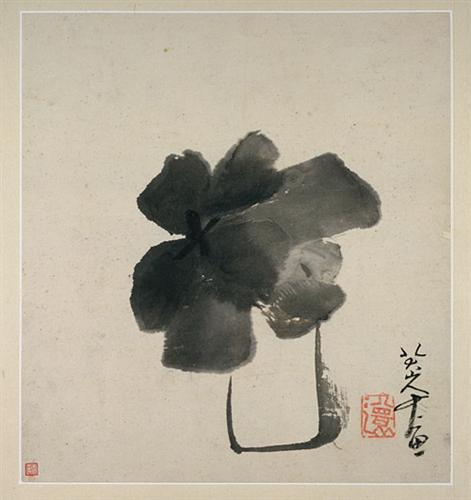
"Flower in a Jar" - Bada Shanren

Flower in a Jar (1689)

Bada Shanren

________

the only thing I’ll say about this poem
is that it’s about human tissue, also
that you’ll never forget it

though difficult perhaps, it is entirely
worth the journey – not only through
the stylistic thickets it might present
technically, but amongst the assorted
homuncul[i]” it more substantially,
even clinically, describes – for the
spotlight it presses onto our world,
not to mention its own manifest
artistry

alliteration, for instance, the limpid
lilting of its language, hand in hand
with its kindred, and complicit,
onomatopoeia, enumeration, prismatic
facets of an idea like aspects of an
iridescent gem, vivid, vital metaphors,
apt allegories, the very literary lot, to
relay a big picture, then an even bigger
picture, then a transcendence, an
expression of very grace, poetry
of the very highest order, of which
even a Homer, I warrant, would sing

Tissue Gallery“, my poem of,
at least, the year, and likely in my
memory forever

that’s, as I said, “the only thing I’ll
say about this poem”

Richard

_____________

Tissue Gallery

On the fifth floor
of the medical school,
sequestered from public view,
a black slab lab table
lined with old apothecary jars and twist-top jars
sealed with paraffin wax,
a shoal of not-fish treading bronzy water,
each homunculus labelled
in terms of in-utero days and weeks.

In this jarscape, a palm-size one
sitting with legs crossed,
arms raised protectively,
clasping the top of his head
like a child expecting blows in a parental brawl,
and this golem, a perfect mini-person,
holds fingers curved lightly in front of him,
as if playing a piano chord,
and this quelque chose has blackened soles –
in the womb,
a douen meant to range the barefoot forest,
those faceless stillborn and early-dead children with backward feet,
who lure human playmates to the woods
and fill their always hungry mouths with little crabs.

All casualties are clipped
with yellowed plastic navel clamps
that look like bones.
Here are twins, one larger than the other,
one malformed
with hydrocephalitic-fissured face
and this one’s wrinkly forehead,
the face of a worried eighty-year-old concentrating
on his death, an extra epaulette flap on his shoulder,
as if he is sprouting wings;
triplets like three piglets,
one with lots of hair,
one with cauliflower, puckered ear,
one with a purple-black hand reaching out of the water,
as if in hope to be rescued from drowning.

The thirty-six-weekers are not stored in glassware.
A perfect pair, girl and boy, are on separate cookie baking sheets,
wrapped in sterile pads, their swaddling blankets.
They are not desiccated, withered, mummified,
quick-frozen, frost-nipped, or sealed in wax.
They look like leatherette dolls in mid-kick stop-motion animation,
as if they’d only now stopped breathing.

Girl was a low birth weight,
vagina snapped as tightly shut as the seam of a walnut.
Boy is not the color of life, a rich-colored brown boy
bleached-out to plasticine-pale, dun-white.
Still, on his cheek-ear-hair, the almost feel of life.
The abdomen is caved in,
and the testicles are paper-thin, black, crumpled leaves.

Some in the grey jars were named and tagged on the wrist.
I was told that I cannot tell you the names.
It is a secret between the women
and these medical anomalies.
One is named for a hurricane.

The resto muertos have closed eyes and African features.
They were not colorfast,
so the chemicals have bleached them to albino.
The women, who came with gravid uterus to Puerto Rico
from the Virgin Islands, seeking to save or end pregnancies,
do not know that the small ones are still here
curled in their womb poses,
each blanched
in its lit-glass aquarium,
lolling in solvent tinted the color of beer, brandy, honey, oil, or perfume.

These small floating gods in primer paint, never to be besprinkled
with blessed water to help them cross over,
never to evaporate, dust-scatter, or waste — they are here and not here!
What is the shelf-life of the unborn?

In the Caribbean, women must travel
from island to island
to get needed health care,
and so these doodads
were not carried home but donated,
no one knows how long ago.

I have been invited here by a doctor who loves the arts,
and whom I like.
I was told beforehand only that I would be seeing human tissue.
He proposes collaboration, an artistic public exhibition
of these impossible children,
who will never utter “peacock,”
“butterfly,”
“confetti,” “crazy quilt,” “cashmere,” or “soap.”

Skullduggery.
Monster Midway. Gaff joints. Shell games. Sideshow piebald children.
Human oddities and the science of teratology.

At home, I whisper to the midnight page,
Women of the Virgin Islands, Sistren,
I saw them, and they are okay.
Your small ones are still on Earth!

Loretta Collins Klobah


December, 2015‏

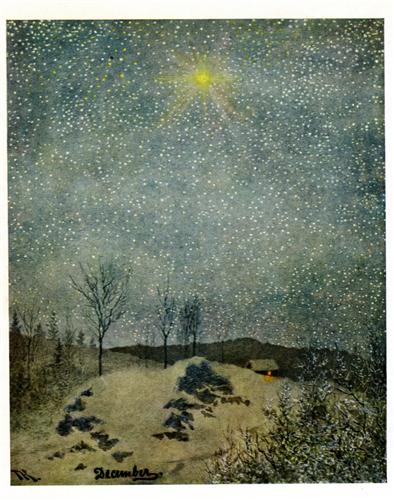
"December" - Theodor Severin Kittelsen

December (1890)

Theodor Severin Kittelsen

__________

for Susan

several years ago, a friend of mine
invited me to a concert, Sir Edward
Elgar
‘s The Dream of Gerontius“,
to my mind, a double mountain to
cross, both English and ceremonial,
this is not music you can dance to,
nor even dream on, but music that
demands your allegiance, as well
as your attention

to my mind English music, nearly
an oxymoron, remained stagnant
from Purcell, 1659 to 1695, to the
Beatles
, 1960 to 1970, with very
few exceptions, never managing,
mostly, to hold, even, a tune

ceremonial music suffered much
from its rigid partisan bent,
whether political or religious, try
singing La Marseillaise or
The Stars and Stripes if you’re
not of those nations, you are
instantly sidelined, a mere
spectator, try How Great Thou
Art
at a party, however
inspirational

but the ticket was free, my friend
couldn’t think of anyone else she
could invite who’d enjoy the show,
she’d received the tickets in a
bundle

Gerontius, an old man – you’ll note
the Greek root, geron, as in
gerontology” – is dying, fears the
other side, friends comfort him and,
in particular, a priest sends him on
his way, that’s act one

act two, he’s on the other side,
wherein the dream of being on the
other side, should he still be alive,
or the actuality of being on the
other side, confront him, have I
died, he wonders

I could tell you something about
that

an angel appears to lead him to,
the programme boasted, no less
than God eventually, in a burst,
for the occasion, of musical
pyrotechnics

well, I wondered, let’s see what
they’re going to do with that

it was unforgettable, though my
friend was somewhat more
equivocal, perhaps not as intent,
quite yet, as I was, about meeting
her divine

in search of something lately to
commemorate the several recent
worldwide atrocities, I quickly
settled on the only work I could
think of, apart from anything,
of course, by Bruckner, to mourn
appropriately

I found this extraordinary production
from no less than London’s St Paul’s

though not an oratorio, according
to the composer’s strict intentions,
Elgar‘s The Dream of Gerontius“, a
concert piece, is played here in a
church, an Anglican, indeed,
cathedral, despite the flagrantly
Catholic story being told, Elgar had
converted to Catholicism, the piece
transcends, however, religions

an oratorio, incidentally – not to be
confused with Ontario, the Canadian
province – is an opera conceived
without sets or costumes, usually
associated with significant religious
occasions

the text of “Gerontius” is taken
from a poem of Cardinal John
Henry Newman
, 1801 to 1890,
a Catholic convert himself, only
recently beatified, as a matter
of fact, not yet, however, for
insufficiency of miracles, it
would appear, canonized

The Dream of Gerontius is
Cardinal Newman‘s retelling of
Dante‘s Divine Comedy“, our
original tour guide through
Purgatory, Heaven and Hell,
Newman‘s take on it is
particularly poignant, Elgar‘s
musical accompaniment not
any less

the conjunction of divine,
composer, sacred venue and
superior performers is an
extraordinary occasion,
despite, not least, a
scratchy recording, the
experience here is
profound

bring your solemnity

Richard

by the way: December is the end of
the year, 2016 is already act two, are
you ready to meet your own God/dess

“Suite Française” (2014)

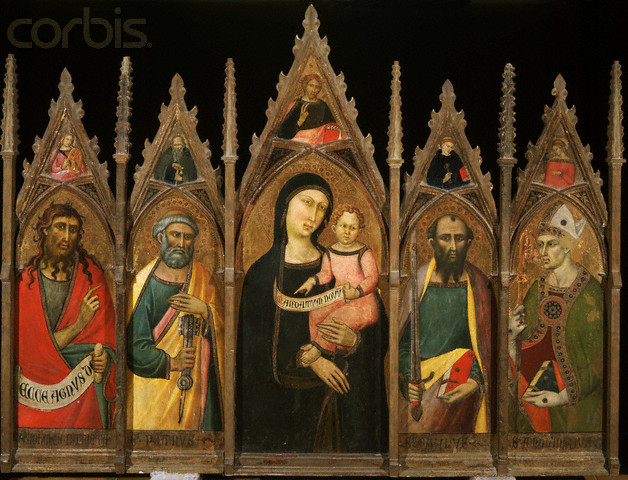
 "Madonna and Child Pentaptych" - Luca di Tommè Madonna and Child Pentaptych

Luca di Tommè

__________

Suite française“, had it not been for
its musical associations, would’ve
been called a “quintette”

a suite is, of course, a series of five
dance movements, a sarabande, a
minuet, a gigue, for instance, most
commonly with reference to Bach’s
Baroque masterpieces

which is to say that without its dance
implications, a suite would’ve been
called simply a sonata with five
movements, or a duet, trio, quartet,
and so forth, depending on the
participating instruments

in fiction, a sequence of five books
equals a quintet, see Durrell’s
Avignon Quintet“, for instance

in art, five panels are called a
pentaptych, see above

five books had been intended for her
Suite française“, but in 1942 their
author, Irène Némirovsky, was arrested
for being Jewish, and died later at
Auschwitz, she’d completed only two
of her intended manuscripts, a tragic
account of day-to-day life during the
Second World War

these texts were only discovered by her
daughters in 1998, who then had them
published in 2002, in just one volume
called Suite française

the superb movie came out last year

it’s a whiff of another era, a
recollection of things past

also a timely consideration of the
flawed foundations of any occupation,
I thought

Richard

psst: incidentally, in French, capital
letters are eschewed – gesundheit –
after the first initial, therefore
the French title, Suite française“,
sports a lower case f

the film, Suite Française uses
the English construction


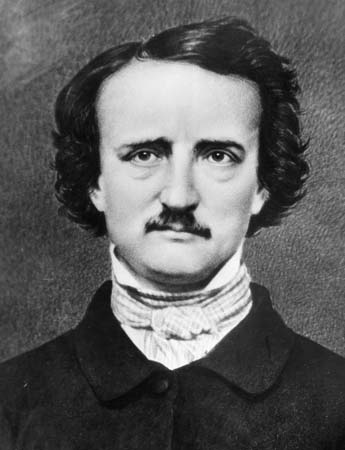
“The Raven” – Edgar Allan Poe

Edgar Allan Poe

Edgar Allan Poe

_________

only a few days ago, of an otherwise
uneventful afternoon, “there came a
tapping, as if someone gently rapping,
rapping at my”
[laptop] door”

“Tis some visitor”, I muttered, “tapping
at my [laptop] door – Only this and
nothing more.”

but to my surprise, to my delight, to my,
lo, roused and rustled up excitement,
for I hadn’t read this poem in countless
years, “in there stepped”, serendipitously,
uninvited, [the] stately Raven of the
saintly days of yore”

thanks, David

Edgar Allan Poe’s The Raven“, after
several perhaps of Shakespeare’s, is the
most famous of dramatic monologues,
certainly the most haunting

though it is set in “bleak December”,
there is no more apt poem to herald,
I think, the feast of Hallowe’en

here Vincent Price channels the epochal
work
, magisterially, unforgettably

watch

Richard

psst:

The Raven

Once upon a midnight dreary, while I pondered, weak and weary,
Over many a quaint and curious volume of forgotten lore—
While I nodded, nearly napping, suddenly there came a tapping,
As of some one gently rapping, rapping at my chamber door.
“’Tis some visitor,” I muttered, “tapping at my chamber door—
Only this and nothing more.”

Ah, distinctly I remember it was in the bleak December;
And each separate dying ember wrought its ghost upon the floor.
Eagerly I wished the morrow;—vainly I had sought to borrow
From my books surcease of sorrow—sorrow for the lost Lenore—
For the rare and radiant maiden whom the angels name Lenore—
Nameless here for evermore.

And the silken, sad, uncertain rustling of each purple curtain
Thrilled me—filled me with fantastic terrors never felt before;
So that now, to still the beating of my heart, I stood repeating
“’Tis some visitor entreating entrance at my chamber door—
Some late visitor entreating entrance at my chamber door;—
This it is and nothing more.”

Presently my soul grew stronger; hesitating then no longer,
“Sir,” said I, “or Madam, truly your forgiveness I implore;
But the fact is I was napping, and so gently you came rapping,
And so faintly you came tapping, tapping at my chamber door,
That I scarce was sure I heard you”—here I opened wide the door;—
Darkness there and nothing more.

Deep into that darkness peering, long I stood there wondering, fearing,
Doubting, dreaming dreams no mortal ever dared to dream before;
But the silence was unbroken, and the stillness gave no token,
And the only word there spoken was the whispered word, “Lenore?”
This I whispered, and an echo murmured back the word, “Lenore!”—
Merely this and nothing more.

Back into the chamber turning, all my soul within me burning,
Soon again I heard a tapping somewhat louder than before.
“Surely,” said I, “surely that is something at my window lattice;
Let me see, then, what thereat is, and this mystery explore—
Let my heart be still a moment and this mystery explore;—
’Tis the wind and nothing more!”

Open here I flung the shutter, when, with many a flirt and flutter,
In there stepped a stately Raven of the saintly days of yore;
Not the least obeisance made he; not a minute stopped or stayed he;
But, with mien of lord or lady, perched above my chamber door—
Perched upon a bust of Pallas * just above my chamber door—
Perched, and sat, and nothing more.

Then this ebony bird beguiling my sad fancy into smiling,
By the grave and stern decorum of the countenance it wore,
“Though thy crest be shorn and shaven, thou,” I said, “art sure no craven,
Ghastly grim and ancient Raven wandering from the Nightly shore—
Tell me what thy lordly name is on the Night’s Plutonian ** shore!”
Quoth the Raven “Nevermore.”

Much I marvelled this ungainly fowl to hear discourse so plainly,
Though its answer little meaning—little relevancy bore;
For we cannot help agreeing that no living human being
Ever yet was blessed with seeing bird above his chamber door—
Bird or beast upon the sculptured bust above his chamber door,
With such name as “Nevermore.”

But the Raven, sitting lonely on the placid bust, spoke only
That one word, as if his soul in that one word he did outpour.
Nothing farther then he uttered—not a feather then he fluttered—
Till I scarcely more than muttered “Other friends have flown before—
On the morrow he will leave me, as my Hopes have flown before.”
Then the bird said “Nevermore.”

Startled at the stillness broken by reply so aptly spoken,
“Doubtless,” said I, “what it utters is its only stock and store
Caught from some unhappy master whom unmerciful Disaster
Followed fast and followed faster till his songs one burden bore—
Till the dirges of his Hope that melancholy burden bore
Of ‘Never—nevermore’.”

But the Raven still beguiling all my fancy into smiling,
Straight I wheeled a cushioned seat in front of bird, and bust and door;
Then, upon the velvet sinking, I betook myself to linking
Fancy unto fancy, thinking what this ominous bird of yore—
What this grim, ungainly, ghastly, gaunt, and ominous bird of yore
Meant in croaking “Nevermore.”

This I sat engaged in guessing, but no syllable expressing
To the fowl whose fiery eyes now burned into my bosom’s core;
This and more I sat divining, with my head at ease reclining
On the cushion’s velvet lining that the lamp-light gloated o’er,
But whose velvet-violet lining with the lamp-light gloating o’er,
She shall press, ah, nevermore!

Then, methought, the air grew denser, perfumed from an unseen censer ***
Swung by Seraphim whose foot-falls tinkled on the tufted floor.
“Wretch,” I cried, “thy God hath lent thee—by these angels he hath sent thee
Respite—respite and nepenthe **** from thy memories of Lenore;
Quaff, oh quaff this kind nepenthe **** and forget this lost Lenore!”
Quoth the Raven “Nevermore.”

“Prophet!” said I, “thing of evil!—prophet still, if bird or devil!—
Whether Tempter sent, or whether tempest tossed thee here ashore,
Desolate yet all undaunted, on this desert land enchanted—
On this home by Horror haunted—tell me truly, I implore—
Is there—is there balm in Gilead? ***** —tell me—tell me, I implore!”
Quoth the Raven “Nevermore.”

“Prophet!” said I, “thing of evil!—prophet still, if bird or devil!
By that Heaven that bends above us—by that God we both adore—
Tell this soul with sorrow laden if, within the distant Aidenn, ******
It shall clasp a sainted maiden whom the angels name Lenore—
Clasp a rare and radiant maiden whom the angels name Lenore.”
Quoth the Raven “Nevermore.”

“Be that word our sign of parting, bird or fiend!” I shrieked, upstarting—
“Get thee back into the tempest and the Night’s Plutonian ** shore!
Leave no black plume as a token of that lie thy soul hath spoken!
Leave my loneliness unbroken!—quit the bust above my door!
Take thy beak from out my heart, and take thy form from off my door!”
Quoth the Raven “Nevermore.”

And the Raven, never flitting, still is sitting, still is sitting
On the pallid bust of Pallas * just above my chamber door;
And his eyes have all the seeming of a demon’s that is dreaming,
And the lamp-light o’er him streaming throws his shadow on the floor;
And my soul from out that shadow that lies floating on the floor
Shall be lifted—nevermore!

Edgar Allan Poe

* Pallas Athene, Greek goddess of wisdom,
courage, justice, the arts, patroness of
Athens

** Pluto, Greek god of the Underworld

*** censer, a vessel for burning incense

**** nepenthe, a drug which induces
forgetfulness

***** balm of Gilead, a rare perfume of Gilead,
a region east of the River Jordan, reputed to
have been a universal cure

****** Aidenn, paradise