Richibi’s Weblog

Just another WordPress.com weblog

Category: literature to ponder

Aristotle on poetry

aristotle-jpglarge

      Aristotle” (1653)

        Luca Giordano

          ___________

so what’s a poem

in an attempt to get a clearer picture 
of what a poem should be, rather 
than trust only my own, however 
informed perhaps, opinion – though 
it must be added that we all bring 
something to that word’s definition, 
mine no less worthy than yours, 
yours no less worthy than mine – 
thought I’d go back to authoritative 
sources to see what they might 
have said

and it doesn’t get any earlier and 
authoritative than Aristotlewriting 
in 350 B.C.E., at the height of 
Ancient Greek preeminence, 
dissecting the term in his 
penetrating and perspicacious, 
ahem, Poetics” 

I propose to treat of Poetry in itself and of its various kinds,
noting the essential quality of each, to inquire into the
structure of the plot as requisite to a good poem; into the
number and nature of the parts of which a poem is
composed; and similarly into whatever else falls within
the same inquiry.“, he says in Part 1 of his 
magisterial treatise

and proceeds to declare the parameters 
of “Poetry” for the ages  

Poetry in general seems to have sprung from two causes“, 
he proceeds, imitation and rhythm 

by imitation I think it best to think of 
representation, which is another way, 
anyway, of saying imitation, but 
much more evocative in this instance,
more attuned to our sense of his word 

a poem is a representation then, a 
reproduction of something other than 
itself 

while its rhythm is what George
Gershwin‘s got, and by extension, as  
you can see from this videoGene Kelly

and yes, that means that “Epic poetry and Tragedy, Comedy also
and Dithyrambic poetry, and the music of the flute and of the lyre in
most of their forms, are all in their general conception modes of
imitation.” 

so, according to Aristotle, is dance 

all, therefore, poems

an interesting elaboration about “Tragedy” 
states that it should have the three unities 
that I grew up with during my French 
Canadian upbringing, the unity of time, of
space, and of action the famous French 
Classical dramatists, Racine and Corneille,
applied under the aegis of Louis XlV

not to mention Tragedy’s use of iambic 
pentameter, Shakespeare’s ubiquitous 
beat, a beat that persevered into the very 
Nineteenth Century, in France with 
Rostand‘s Cyrano de Bergerac“, for 
instance, and into the Twentieth Century 
with Eliot‘s Murder in the Cathedral“, 
about the assassination of Archbishop
Thomas Becket at Canterbury in 1170 
under Henry the Second‘s own aegis,
all written as poetry 

the most famous play to follow the 
three unities in the modern era is 
Who’s Afraid of Virginia Woolf?“,
the play which I think defines the 
Twentieth Century, which takes 
place overnight somewhere in 
New England college town, mid-
century, at George and Martha’s 

though followed closely by O’Neill‘s 
Long Day’s Journey int Night“, 
which transpires from morning, one 
day in August, 1912, till midnight, at 
the home ofunity of space, note, 
the dysfunctional Tyrones

so it appears not much has changed
about poetry, Aristotle got a lot of 
mileage out of his early definition, 
nearly 2500 years 

makes you wonder  why so much 
attention was paid instead to 
Platohis contemporary, the 
mystic, who would’ve banned
poetry, he thought it was 
subversive
 
Richard

psst: for a modern day application
          of the three unities, watch 
          In Treatment“, a television
          series, which takes place 
          in a psychotherapist’s office,
          each episode a session,  
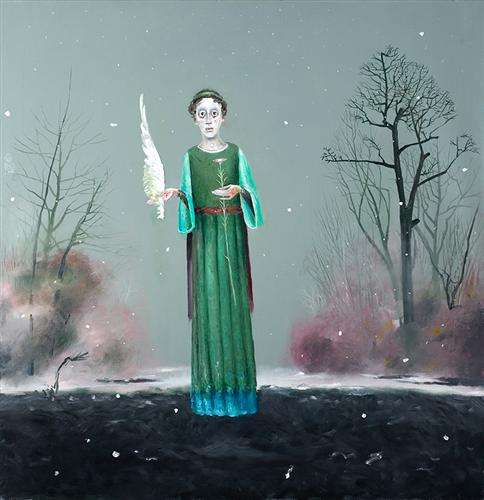
   

on art, its purpose

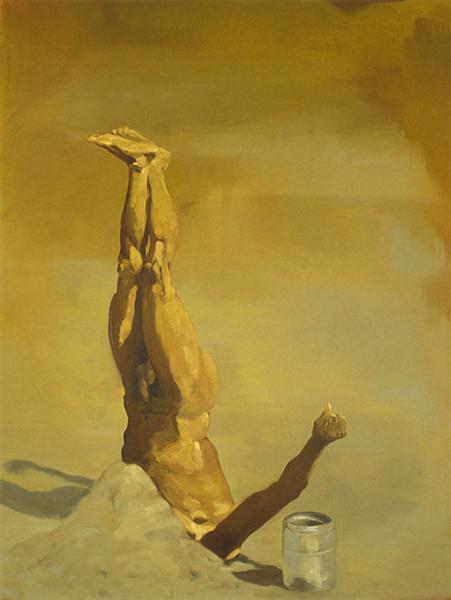
poet-with-flower-2008-jpgblog

                                Poet With Flower (2008)

                                          Stefan Caltia

                                                 _____

wherefore art, I’ve long and often wondered,
with only a wink to Juliet’s Romeo, for my
question dug deeper, why, indeed, itself art

we build our souls on the stories we’ve 
heard, the impressions we’ve received
from voices that spoke directly to our 
senses, painters with paint, musicians
with music, writers with words, poets 
with poems

it started with fairy tales, which told of
right and wrong, good and bad, courage,
kindness, responsibility, and dire 
consequences for discord

Biblical stories also took up a lot of my own
childhood, Jesus, Adam and Eve, Moses
and the Ten Commandments, this last 
reinforced by Cecil B. DeMille’s epic

but soon enough it was Oliver TwistLittle
Nell, and by an inescapable authorial leap, 
since these were all by an irresistible 
Charles Dickens for a guy my age, Sydney
Carton, who valiantly stands in for his
friend, Charles Darnay, at the guillotine, a 
quantum, even existential, leap from 
Peter Pan and Mary Poppins 

though I had the good fortune to learn to 
read and write music as a boy, play music, 
learn about Bach, Brahms and Beethoven, 
it didn’t take anyone else much more than
their enthusiasm to see what the Beatles
were similarly doing, the Rolling Stones, 
the Supremes, they were not only singing, 
but making history, shaping it, and us, we 
followed the questions they rose, their 
responses, the effects upon ourselves
for nothing is considered until it’s 
mentioned, spoken, made clear, and they
were those prophets

the same goes for art, we see as we see
cause Monet, Picasso, Warhol showed 
us how to see, what to look at

and of course poets, Shakespeare, 
RostandDanteGoethe, to inform, each,
their individual language, and culture

I have been Philip CareyScarlett O’Hara, 
Blanche DuboisGary Cooper in High
Noon“, both Martha and George in 
Who’s Afraid of Virginia Woolf“, lately 
I’ve been even Hank Williams

as Babette would say, a French doll who 
gets abducted in Raggedy Ann and Andy:
A Musical Misadventure“, an animated 
movie from the Seventies, – oo aahrr yoo 

Richard

psst: all of them have been me too,
      incidentally

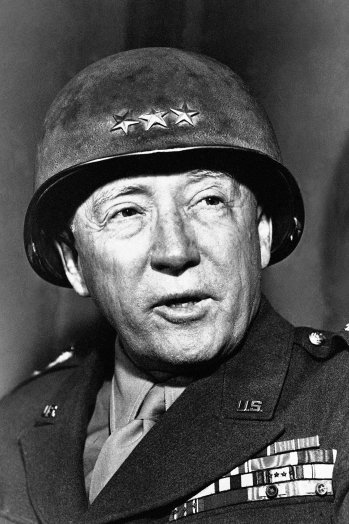
“Through a Glass, Darkly” – General George S. Patton, Jr.

general_george_patton_a_p

                 General George S. Patton, Jr.

                           ______________

Through a Glass, Darkly

Through the travail of the ages,
Midst the pomp and toil of war,
I have fought and strove and perished
Countless times upon this star.

In the form of many people
In all panoplies of time
Have I seen the luring vision
Of the Victory Maid, sublime.

I have battled for fresh mammoth,
I have warred for pastures new,
I have listed to the whispers
When the race trek instinct grew.

I have known the call to battle
In each changeless changing shape
From the high souled voice of conscience
To the beastly lust for rape.

I have sinned and I have suffered,
Played the hero and the knave;
Fought for belly, shame, or country,
And for each have found a grave.

I cannot name my battles
For the visions are not clear,
Yet, I see the twisted faces
And I feel the rending spear.

Perhaps I stabbed our Savior
In His sacred helpless side.
Yet, I’ve called His name in blessing
When after times I died.

In the dimness of the shadows
Where we hairy heathens warred,
I can taste in thought the lifeblood;
We used teeth before the sword.

While in later clearer vision
I can sense the coppery sweat,
Feel the pikes grow wet and slippery
When our Phalanx, Cyrus met.

Hear the rattle of the harness
Where the Persian darts bounced clear,
See their chariots wheel in panic
From the Hoplite’s leveled spear.

See the goal grow monthly longer,
Reaching for the walls of Tyre.
Hear the crash of tons of granite,
Smell the quenchless eastern fire.

Still more clearly as a Roman,
Can I see the Legion close,
As our third rank moved in forward
And the short sword found our foes.

Once again I feel the anguish
Of that blistering treeless plain
When the Parthian showered death bolts,
And our discipline was in vain.

I remember all the suffering
Of those arrows in my neck.
Yet, I stabbed a grinning savage
As I died upon my back.

Once again I smell the heat sparks
When my Flemish plate gave way
And the lance ripped through my entrails
As on Crecy’s field I lay.

In the windless, blinding stillness
Of the glittering tropic sea
I can see the bubbles rising
Where we set the captives free.

Midst the spume of half a tempest
I have heard the bulwarks go
When the crashing, point blank round shot
Sent destruction to our foe.

I have fought with gun and cutlass
On the red and slippery deck
With all Hell aflame within me
And a rope around my neck.

And still later as a General
Have I galloped with Murat
When we laughed at death and numbers
Trusting in the Emperor’s Star.

Till at last our star faded,
And we shouted to our doom
Where the sunken road of Ohein
Closed us in it’s quivering gloom.

So but now with Tanks a’clatter
Have I waddled on the foe
Belching death at twenty paces,
By the star shell’s ghastly glow.

So as through a glass, and darkly
The age long strife I see
Where I fought in many guises,
Many names, but always me.

And I see not in my blindness
What the objects were I wrought,
But as God rules o’er our bickerings
It was through His will I fought.

So forever in the future,
Shall I battle as of yore,
Dying to be born a fighter,
But to die again, once more.

                 General George S. Patton, Jr.

                        ____________

General George S. Patton, Jr., a 
celebrated American general who 
fought bravely during the Second  
World War, is known to my  
generation especially through the 
much acclaimed film, Patton“, 
which lionized him then, 1970 

George C. Scott portrayed him 
impeccably, indelibly searing him 
into our collective consciousness

he appears to have been the very
paradigm of American heroism, 
rough, coarse even, wilful, 
inflexible, unforgiving, righteous 
to a fault, but instilled with a 
sense of divine mission 

he believed in reincarnation, notably,
the poem above recounts throughout 
history his many lives as a warrior

to me he seems the very incarnation 
of the Greek god Ares, rather, come 
down from high Olympus, again 
throughout history and time, to  
 effect his defining role as the
immortal God of War

George S. Patton was also, it would 
appear, a poet, if the example above 
is to count, maybe he was, indeed, 
inspired

Richard

“La traviata” – Guiseppe Verdi

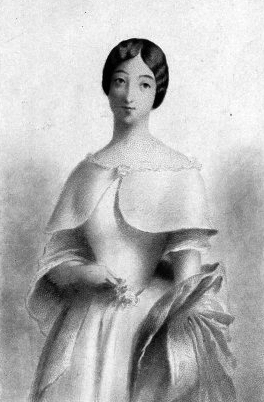
La_Dame_aux_camélias_d'après_Charles_Chaplin

             La Dame aux camélias

       Charles Chaplin (1825 – 1891)

                       _________

this version of La traviata has no
subtitles, but it should be remembered
that only a few years ago none of them
had, 
not even in opera houses

I learned to love La traviata on CD,
couldn’t 
either see the performance
then, 
now the internet supplies us,
gratis, with complete operas, from
very 
Gluck‘s to very Philip Glass
with the text 
translated throughout


a synopsis 

Violetta is a courtesan, a traviata, a
f
allen woman, who’s fallen all the way
to the top of Parisian 
society, she has
just recovered from malaise and is 
hosting a celebration, her salon 
entertains many who’ve been 
instrumental in securing her not 
unsullied reputation, it is the world 
of Marcel Proust

a new suitor arrives, Alfredo Germont, 
who pledges his love undying, she is 
eventually seduced, by his, no doubt,
impressive arias, croce e delizia, he
sings, she counters, agony and 
ecstasy, indeed

the ups and downs of love ensue,
Germont’s father objects to the match,
claiming Alfredo’s sister’s chances
at marriage would falter should her 
name, their name, be defiled, he 
convinces Violetta to leave Alfredo
for the sake of his family, whereupon 
everyone feels betrayed

Alfredo, Alfredo, she cries, di questo 
core non puoi comprendere tutto 
l’amore, Alfredo, Alfredo, you cannot 
understand fully the love I have in 
my heart, she moans, begrudges
 
but love conquers all in the end, 
though not life, as it turns out, Violetta 
succumbs to her malaise, which had 
all along been consumption, 
tuberculosis nowadays

you’ll see Spanish dancers, gypsies,
they are part of Violetta’s entertainment,
have nothing to do with the story,
otherwise the music itself tells all

the camellia, note, which you’ll see 
highlighted here and there, is a 
reference to Violetta’s inspiration,  
the novel by Alexandre Dumas, fils, 
or junior,  his La Dame aux camélias“, 
which the same author shortly 
thereafter made into an equally 
successful play, Camille” in English, 
the lady of the camellias, incidentally, 

Renée Fleming has taken over the role,
from Maria Callas in the Fifties, then 
from Joan Sutherland in the Eighties, 
she is the traviata for this generation

she is perfect, her arpeggios will 
shoot up your spine 

listen


Richard

to Socrates – on monotheism‏

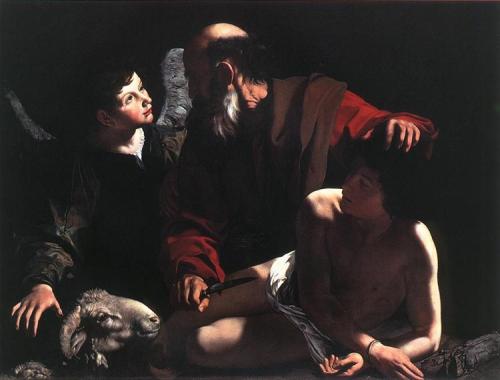
sacrifice-of-isaac(1).jpg!Large

      “The Sacrifice of Isaac (1598)

                        Caravaggio

                               ________

by very definition, the inevitable
result of monotheism, Socrates,  
is war, if there is one authority it  
will eventually be opposed by a 
contrary, however picayune, 
however trivial, opinion, see the 
Protestant Reformationsee Islam, 
for instance, now
 
after which there is disintegration
 
before Christianity, there were gods, 
a pantheon of them symbolically
alive among the rivers, the trees, 
the mountains, read Ovid for an
exhilarating description, wars were 
waged for territory, not conscience  
 
Judaism, the religion of the Jews,
evolved for their own existence a
deity, Yahweh, who was their one 
god, disdainful of foreign others,
an uncharacteristic attitude among 
other religions then, becoming one 
of the very first monotheistic, and
consequently existentially 
compromised faiths, if not the 
first
 
the intent was to rally ideological 
support among its adherents so 
that they could protect the lands 
of Israel and Judahtheir ancestral 
homesas they would have it, a 
sanctification of the territorial 
principle
 
their Bible, the Torah, a vengeful 
work, and the basis for the 
Christian Old Testament, 
demanded of its followers 
unblinking and cruel allegiance,
the sacrifice of Isaacfor instance,
a father required to sacrifice his 
own son, however might it ‘ve
been at the last minute averted by 
the intercession of an angel sent 
by that very Lord
 
Christ came along to turn the other
cheek
 
which didn’t last long 
 
indeed Montesquieu, an early 
philosopher of the French
Enlightenment, tells of the 
King’s librarian of Chinese 
texts, who had been converted 
to Catholicism in China, but 
who was nonplussed upon his 
arrival in Christian France to find 
that the French did not do onto 
others as they would have them 
do unto themselves, nor did they, 
more catastrophically, turn the  
other cheek
 
for that matter see what Christian 
Europe did to the Americans
 
Christ’s own followers, once they’d 
achieved political prominence, after, 
admittedly, 300 years of persecution 
by the prevailing Roman authorities, 
set their own deity, God, on high, 
indeed beyond the rivers, the 
mountains, the trees into the very 
ineffable, the inscrutable abstract, 
and squelched any opposition for  
the next thousand and some years,
the philosophical underpinnings of 
which was the work of your 
contemporary, Plato, Socrates, his 
ideal of the Ideal
 
Augustine signed those recalibrated 
papers with his City of God“, it took 
the Renaissance to make a dent in its 
armour, and another several centuries 
to declare the Christian God dead, 
Time magazine in the ’60s, on the 
heels of Nietzsche‘s nihilistic  
pronouncement some 70 years earlier, 
that God had exited history
 
what we are left with, Socrates, is every 
wo/man for hirself, therefore the Age of 
Human Rights, for better or for worse
otherwise many of us would’ve been 
guillotined, burnt at the stake, stoned 
to death, by now
 
what do you think
 
I’ll bet I can tell, you think that every 
wo/man owes allegiance to what s/he 
believes in, even to inexorable death, 
however impractical, unfortunate, or 
fateful, if your exemplary life has  
anything to say about it 
 
 
cheers
 
Richard

up my idiosyncrasies – Plato‏

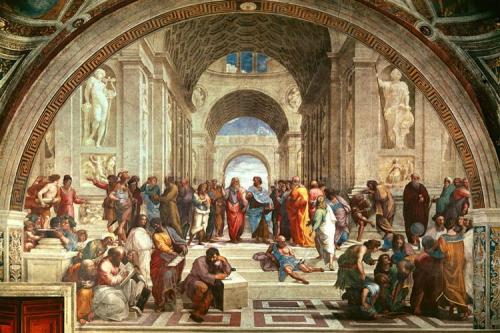
school-of-athens-detail-from-right-hand-side-showing-diogenes-on-the-steps-and-euclid-1511.jpg!Large

      “The School Of Athens (1510-1511)
 
                   Raphael
 
                       _____
 
 
he sounds just like you, my friend said,
who’d bought me the works of Plato
for C***mas maybe, or my birthday, or 
maybe just because he knew I’d very
much appreciate them
 
we were reading him together, as is 
always my inclination, his Meno 
according to my calculations, 
Socrates was doing most of the 
talking, with Meno, a Sophist 
acolyte, a school of philosophy then, 
the Sophists, which claimed it could 
prove anything by using the right 
arguments 
 
lawyers, of course, ensued, politicians
 
and rhetoric, the art of proving anything 
by using the right arguments 
 
philosophy had reached a structural,
indeed an existential, impasse, why, 
they therefore wondered, philosophy
 
wherein it entered a phase of moral 
speculation, StoicismEpicureanism,
ScepticismCynicism, and can you 
blame them, theories about the 
stars, the moon, the world, even 
matter itself, had become so 
questionable, was it fire, air, water, 
atoms, at its source, who knew
 
 
I thought so too, I said, and told 
him that Plato’s were the first   
texts studied in philosophy when 
entered university, that’s where I 
learned to talk like that, philosophy 
from the scratch, as my German 
teacher would’ve said, which is to 
say, from its very beginnings, 
whence I could view, I figured, the 
evolution of received wisdom in 
Western culture
 
I was young then, the young have 
such dreams 
 
 
my father had been agnostic, ever
asking questions, though we were 
being raised Catholic, my sister 
and I, on account of our mother 
tongue, our entire community, 
having been historically linked 
with that religion, and cause my 
parents wanted us to be educated 
in French
 
an existentialist crisis would
eventually follow, I intuited, as
indeed it did, so I majored in 
philosophy
 
 
Socrates taught me to ask 
questions, that no one had  
all the answers
 
Plato, usurping his master’s voice, 
created the paradigm for our present 
version of a Divinity, and Its Paradise
 
there is an ideal version of any 
item we might consider, he spouted,
an ideal table, for instance, exists
of which every material table is an
imperfect example
 
to virtue, love, beauty, truth, he 
applied the same principle, which
early erudite Catholics, Augustine
Thomas Aquinas, for instance, and
others, despite rejecting all of the 
other Greek cultural achievements
appropriated in order to bolster their 
impression of God, the ideal of the 
Ideal
 
this lasted uncontested for just
over a thousand years
 
for a thousand years our salvation
had been extraterrestrial, 
supranatural, this, our very, 
perhaps only, existence, an 
imperfect reflection of somewhere
else an ideal, a mere simulacrum,  
we were, a metaphor
 
Socrates had only asked questions,
what is virtue, what is justice, what
is beauty, truth
 
Plato presumed to have known the 
answers
 
 
Aristotle is making a comeback,
whose method, in opposition to 
his contemporaneous forebear,  
was much more like Charles 
Darwin‘s, working from the facts, 
which proved then, and are 
proving still now, to be multifarious, 
diverse, astonishing, and nearly 
enough to make you believe in 
God/dess again, this time, however, 
through the back door 
 
or in a multiplicity, a panoply, a 
very pavilion, even, of natural 
deities, otherwise known as 
angels, for better or for worse
 
God/dess bless, or angels
 
 
Richard

up my idiosyncrasies – Albertine‏

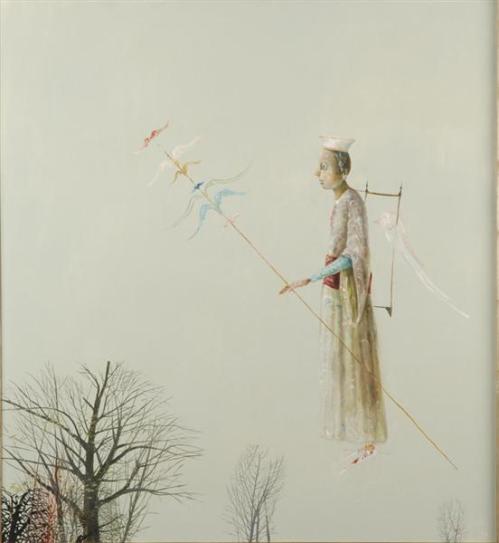
wing-seller-2006.jpg!Large

            Wing Seller (2006)

               Stefan Caltia


                        _______ 

 
what are you doing, a friend of mine
asked when he called 
 
I’m reading my Proust, I answered,
comfy enough with my textafter 
years waking up side by side, to 
use the possessive adjective 
 
what’s going on, he inquired
 
Albertine is lying on his bed, 
recounted, asleep, she’s been there 
for the past ten pages, and she’s 
just now turned onto her stomach
 
 
there is not so much story as 
paintings, in Proustdetailed 
descriptions applied like strokes of 
colour to a canvas, that of recovered 
time, colours that are specific to a 
place and a period, like photographs 
showing in their very fabric their 
ancestry, their lineage
 
but in the elucidation of what he 
sees, or, more accurately, of what
he remembers, Proust delivers 
a work of the very highest art, a 
mixture of poetry and philosophy,
Beethoven did as much, see his
 
 
Proust’s French is essentially 
immaculate, his tone, however 
intimate, always erudite, aristocratic, 
perspicacious, wise, penetrating,
embracing, which is to say, French,
though German can be also
incidentally, pretty cerebral, English 
is narrative, just the facts, please, 
though often, I think, hilarious
 
 
Albertine had been one of the “young
girls in bloom” he’d met at Balbec, a 
seaside resort, with whom he’d 
undertaken an illicit affair, but 
whose faithfulness he doubted
 
as she lay on his bed at his Paris
apartmenthe replays all the 
speculations his imagination could 
provide, an endless set of variations
on his anguish, which is to say, his
jealousy, worthy of a very Othello
 
for ten pages he paints a picture of 
infidelities completely of his making,
which, of course, becomes the world 
he will respond to
 
it is all in our little heads, I surmise, 
however informed, intelligent, that 
we create our little realities, they 
have never been nearly enough, 
though, indeed, our lives depend 
on themhowever dutifully
considered, however unconsciously,
and ever convincingly, contrived   
 
make them, I submit, good ones
  
I imagine myself a poet, for instance,
how’s that for a shot in the improbable 
dark
 
 
Richard

up my idiosyncrasies – Marcel Proust‏

holy-man.jpg!Large

    “Holy Man (1989)
 
       Eric Fischl
 
          ______
 
 
Marcel Proust is not an easy read, 
of literature it is surely its Everest,
not an easy climb, but from its peak
the world takes on an entirely other
order
 
an English-speaking friend has 
suggested he might try to read it 
again, but not in French this time,
I countered that that way he’d miss
the many crevices and crags, the
slippery slopes and lethal ledges, 
that give shape to the mountain, 
which the French grammar would
apply in all its intricate 
manifestations
 
part of the pleasure in reading 
Proust is the poetry, where style 
and substance coexist to create 
magic, and inspiration  
 
the sentences are long, they wind 
on for often pages, you need to be 
able to tell the subject from the verb
despite sometimes extended
intervening distances
 
but the grammar is sound throughout, 
except for in a couple of isolated
instances, grammar that would test
even a Frenchman
 
indeed Proust is where, I profess, I 
truly learned to speak French
 
there’s another mountain
 
 
the conceit is that someone rings 
the bell at their Combray cottage,
and after 3300 pages someone 
rings at the same door again
 
in between the years have passed,
they are the fruit of Proust’s 
“recherche”, search, investigation,
quest, a term that can’t be fully 
expressed as such in English, 
which doesn’t express the 
confluence of cold science and 
candle-lit spirituality expressed 
in the French word
 
in dissecting the very entrails of a 
flower, a tea cup, a crumpet, an eye, 
a brow, a lip, a gesture, a frown, a 
smile, a gait, Proust describes his 
own world, concocts it, minutely, 
meticulously, until you realize this 
can be only his perception, that 
therefore all of our interpretations 
are but our individual perceptions, 
our myriad unique worlds
 
from which one can begin to 
shape one’s own
 
later with Wittgenstein, the 
philosopher, this became known 
as phenomenology, the idea that 
we are confined for knowledge to 
our private views of the world,
wherein language plays, manifestly, 
a crucial part
 
in the beginning, if you’ll remember, 
was the word
 
curiously, in French, it is the verb, in
the beginning, implicitly suggesting 
a word of action 
 
 
Proust had been prescient as Freud
uncovering an inner world we’d always 
believed was outside us
 
at the top of his priorities Proust
chose art, personal expression,
it’s all that we can return to the 
world
 
and what else could be our purpose
 
 
Richard
 
psst: bonne lecture, Kurt

up my idiosyncrasies – a bio

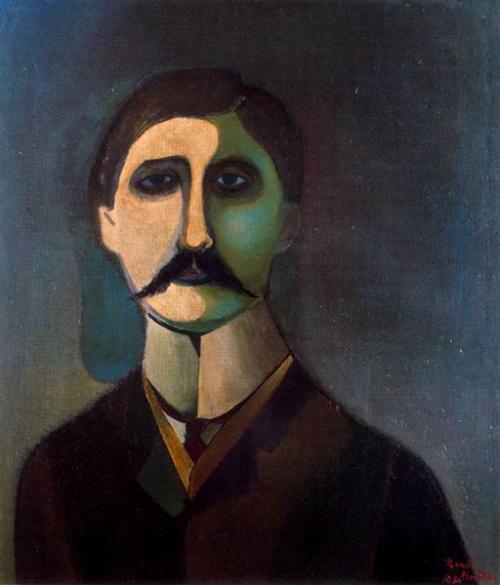
marcel-proust.jpg!Large

      “Marcel Proust” 
 
       Richard Lindner
 
          ___________
 
 
for a bio with which I’ve been asked 
to provide an online poetry magazine 
I’ve been encouraged to apply to, I’m 
submitting the following text
 
I thought you might enjoy it
 
 
Richard
 
           ______________
 
 
my name is Richard Bisson, from
which you’ll intuit my French 
Canadian background, though I 
write mostly in English, with no 
trouble however in French, my 
mother tongue is le français  
 
I am thus imbued, undoubtedly,
with that sensibility, my peers 
have been HugoFlaubert, and
most of all Marcel Proust, whom 
I imbibed for 33 years, in French,
page by page, reading each out 
loud as though it were my own, I 
cannot but be replicating now his 
rhythms, his aesthetic, his view 
of the world
 
it didn’t take me as long to read 
Homer, in the thunderous Robert  
Fitzgerald translation, – a mighty
roar resounding still from the 
ninth century before the Christian 
Era – from him I learned to speak 
from the heart, it’s not one’s style  
one has to master, but one’s 
humanity
 
Robert Browning gave me the 
dramatic monologue as a poetic
device, a gift he’d received from
 
Shakespeare himself, of course,
the unbridled freedom of his own 
literary imagination
 
Carl Sandburg‘s Chicago taught 
me to talk about every wo/man, 
about things even my own folks 
were doing
 
Collapsed showed me that even 
apparently inconsequential acts
can be poetry, poetry in the 
apparently humdrum 
 
Mary Oliver is a strong present 
influence
 
the cadence is entirely Beethoven,
with some help, I must admit, from 
the atonalists, SchoenbergBerg,
and Weberncommas are my bar 
lines
 
 
I call what I do prosetry, a word so 
new my computer won’t even let 
me write it, I’m a prosetrist, this 
word either
 
I want to link everyday experience 
with poetry, make poetry in the eye 
of the beholder, where truth and 
beauty lie
 
if people can see what I see, they 
can see that way themselves, it’s 
something one learns, and it’s all 
in the way one entrenches words 
and ideas
 
I eliminated the word “if” from my 
vocabulary once, for being then
too speculative, it changed my life, 
I’ve replaced it since with the word 
“miracle”, that has also changed 
my life
 
I am 67 years old
 
I live in Vancouver, Canada
 
I consider myself to be, at this 
point in my life, bibliosexual, I
sleep with my books, and we’re
all still getting along just fine 
 
may you be so blessed
 
 
Richard
 
psst: also Anaïs Nin, for the 
          intimacy of her diaries
 
          o, and Woody Allen, for
          giving up before his  
          nihilism and just 
          laughing

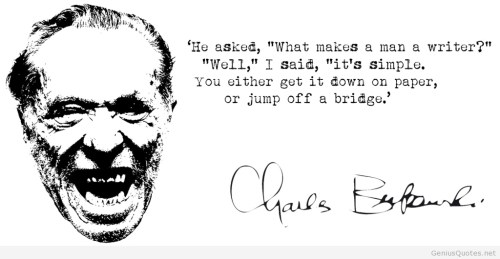
“So You Want To Be A Writer” – Charles Bukowski‏

Charles-Bukowski-quotes

                                                                      ___________
 
 
reading this poem for me was like 
looking into a mirror


if it doesn’t come bursting out of you

in spite of everything,
don’t do it.
unless it comes unasked out of your
heart and your mind and your mouth
and your gut,
don’t do it.
if you have to sit for hours
staring at your computer screen
or hunched over your
typewriter
searching for words,
don’t do it.
if you’re doing it for money or
fame,
don’t do it.
if you’re doing it because you want
women in your bed,
don’t do it.
if you have to sit there and
rewrite it again and again,
don’t do it.
if it’s hard work just thinking about doing it,
don’t do it.
if you’re trying to write like somebody
else,
forget about it.
if you have to wait for it to roar out of
you,
then wait patiently.
if it never does roar out of you,
do something else.

if you first have to read it to your wife
or your girlfriend or your boyfriend
or your parents or to anybody at all,
you’re not ready.

don’t be like so many writers,
don’t be like so many thousands of
people who call themselves writers,
don’t be dull and boring and
pretentious, don’t be consumed with self-
love.
the libraries of the world have
yawned themselves to
sleep
over your kind.
don’t add to that.
don’t do it.
unless it comes out of
your soul like a rocket,
unless being still would
drive you to madness or
suicide or murder,
don’t do it.
unless the sun inside you is
burning your gut,
don’t do it.

when it is truly time,
and if you have been chosen,
it will do it by
itself and it will keep on doing it
until you die or it dies in you.

there is no other way.

and there never was.

                   Charles Bukowski