Richibi’s Weblog

Just another WordPress.com weblog

Category: in search of truth

Beethoven piano concertos, complete‏

so that you may enjoy these masterpieces at your leisure, I’ve
compiled, for an online musical library you might easily store
among your “Folders”, the best I could find of Beethoven’s five
piano concertos on the Internet, all of them of course complete,
which is to say with all of their unabridged individual sections,
for what is a concerto by definition without its integral
movements, its parts, in Beethoven these fast, slow, fast, in
that order, fast first to draw in your attention, slow then to
signal the composer’s, the interpreters’ varied musical abilities,
versatility, then last fast again to send you off on your merry
way a happy, even exhilarated, camper, these are the
traditional, Classical, structural arrangements, this will change

there are better performances than the clutch of five here first
presented, a collaboration several years ago between a somewhat
celebrated, though inpressively able, performer, Krystian
Zimmerman – an especially European fame, which is of course not
surprising it being their very own music, which resounds for
them more than for us culturally, who only sporadically retained
some vestiges of it generally in our psyches across the pond,
we were busy building countries – and the illustrious, legendary
Leonard Bernstein, who died before finishing this august project
so that Zimerman had to continue on his own, he conducts from the
bench the 1, and the 2, having, I think, channeled his eminent
master for his conducting work sounds magnificently similar

there are better performances, I say, but there are also much,
much worse, and both Bernstein and Zimerman are entirely
worth the price of admission, only your time

the 1, in C major, opus 15 (1796/7)

the 2, in B flat major, opus 19 (1787/9)

the 3, in C minor, opus 37 (1800)

the 4, in G major, opus 58 (1805/6)

and the 5, in E flat major, the mighty, the “Emperor”, opus 73 (1809/11)

I couldn’t help adding to this compendium an alternate 2 of
great energy and enthusiasm, with younger and less austere
celebrants, Paul Lewis plays the piano with Andris Nelsons
conducting the City of Birmingham Symphony Orchestra
at
the Royal Albert Hall, London, July 29, 2010

what the old lack in dexterity, agility, they make up for in
tenderness, Alfred Brendel, another titan, sent shivers up my
spine early with the very first quiet notes he spun, delicately,
exquisitely, then intermittently again thrillingly throughout
so that I often swooned, flushed, he is led by Claudio Abbado,
whose silken sounds are never in the shadow of the great
pianist, the other equal part of that bilateral heaven

Claudio Abbado replaced Herbert von Karajan, that illustrious
luminary, at the head of the Berlin Philharmonic, with the Vienna
Philharmonic perhaps the two best orchestras then in the world,
when von Karajan died, 1989, this incidentally just after women
were being allowed in those orchestras, 1982 in Berlin, Karajan
was not amused, 1997 in Vienna, a contentious development still
over there, Vienna has only one yet, the harpist

they do a sublime, ravishing, utterly captivating Third, they are
at the Lucerne Festival with the Lucerne Festival Orchestra,
August 10, 2005

George Li is 15, Mark Churchill conducts the Symphony ProMusica,
somewhere, January 30, 2011, an intriguing curiosity, they do the
4, the enchanting unexpected encore is a piano transcription from
a flute obbligato, a required flute solo, from Glück’s wonderful
opera, “Orphée et Eurydice“, stick around

Beethoven transcends age incidentally, as well as cultures, races,
one might note, in that last production, the work, the sine qua
no
n indeed, the otherwise-there-is-none, of art

do not try to do all this at once, this is entirely for your delectation,
and further reference

Richard

psst: for the Beethoven, take out your metronome, or just
tap the beat, or nod to it, note again the rigidity of
the beat in Beethoven, you can even get up and
marvel, dance
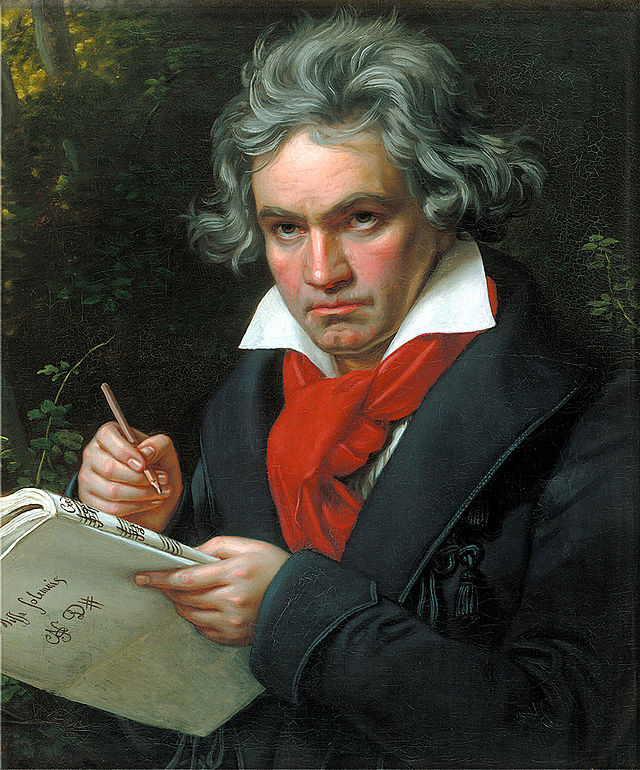
Beethoven: piano concerto no 5, in E flat major, opus 73‏

"Beethoven" - Joseph Karl Stieler

A portrait of Ludwig van Beethoven (1820)

Joseph Karl Stieler

_____________

you might say a triumvirate of piano concertos dominate
our Western musical culture, a veritable trinity of pianistic
masterworks that tower over, and have ruled, our musical
consciousness throughout the modern epoch, the
Rachmaninoff 3 has been one of them, but the 5th of
Beethove
n is surely the granddaddy, the “Guppa” as a
favourite grandchild I know would say, the Olympian
Zeus, the Christian God the Father, of them all, in majesty
and authority, others quake in its overwhelming aura, it is
the sun to all the other stars

Glenn Gould is the standard still by which it should be
played, none yet, to my mind, has surpassed him

Karel Ancerl conducts the Toronto Symphony Orchestra,
a competent orchestration, overshadowed inevitably by
this prodigy, who nevertheless doesn’t ever flaunt his
finger play but remains faithful throughout to the
dictates, the tonal balances, of the music, it is 1972

I had mentioned “variations in volume, tempo, tonality,
the play of harmonization and discords” in Rachmaninoff
,
note the strict adherence to tempo here, even the fastest
runs of notes are grounded in beat, more solid, less elusive
than the iridescent Rachmaninoffian allusions to Debussy,
you could set a metronome to the appropriate tempo of
each individual movement in Beethoven, it would remain
constant, apart from a few restrained ritardandos near
the end of some musical elaborations, until its very final
apotheosis, beat was ever an anchor for the fulgurating
Beethoven, an article of faith from which he strayed only
with great circumspection

note the language is not emotional, passionate and ardent,
but philosophical, metaphysical, Beethoven is confronting
cosmological considerations, existential realities, not the
more emotional concerns that confound us every day, it’s
God he’s talking to, eternity, not the incarnate tendrils
of the moment, not the poignant stuff even of soon
through Schubert a Chopin, Beethoven was at the start
of that Romantic Movement, indeed its very first
proponent, but not quite ready to wear his heart itself
on his sleeve, but a more spiritual, probing reason, whose
ardent metaphysical ratiocinations would set all the others
on fire, setting the stage for all the other stars

later, if you haven’t guessed what it’ll be already, I’ll
supply you with the third concerto, the Holy Ghost, of
the trinity, the Apollo, god of music and the sun, among
our concert greats

Richard

Rachmaninoff: Piano Concerto no 3, in D minor, opus 30

fully 150 years after Mozart the concerto was still a thriving
musical form though it had undergone some modifications,
you’ll hear a more passionate account in Rachmaninoff than
the more lyrical, less emotionally overt compositions of
Mozart, the variations in volume, tempo, tonality, the play
of harmonization and discords, all incidentally within a single
movement, show the passage of time, of Beethoven, of Chopin,
of Debussy between Mozart and the more Romantic, Impressionistic
Rachmaninoff, note the sweeping ritardandos, where the beat is
drawn out, stretched for pathos, a Chopinesque insinuation into
music not found in earlier stuff, one imagines torrid expressions
of fervent sentiment, note the evanescent flurry of notes passing
by like the fleeting glitter of stars, the ephemerality of an
incorporeal idea that Debussy originated and brought to music,
and of course note the irrepressibility, the authority, the masculinity
of a volcanic Beethoven underpinning the lot, you can hear them all

the Vladimir Horowitz Piano Concerto no 3 of Rachmaninoff at
Carnegie Hall, January 8, 1978, with Eugene Ormandy leading the
New York Philharmonic Orchestra is, after Van Cliburn’s historic
1950s account, May 19, 1958, again at Carnegie Hall but under Kiril
Kondrashin this time, and the now defunct Symphony of the Air,
don’t ask, the one I then grew up with, it was riveting even without
the pictures

with pictures here he is again a few months later at Avery Fisher
Hall in New York, September 24, 1978, under Zubin Mehta with
again the New York Philharmonic, so good you’ll even forgive
Mehta his usual sentimental excesses

incidentally Horowitz was 74 at this concert, he is astounding

Vladimir Horowitz, colossus and legend, 1903 -1989

enjoy, be transported, be transfixed, you have been warned

Richard

piano concerto no 25, K.503, Wolfgang Amadeus Mozart

 
Mozart in our Western musical tradition is arguably the first
composer to write piano concertos, for two reasons, first
cause earlier there were no pianos, there were only
harpsichords, Bach wrote five wonderful concertos but for
the harpsichord 
 
secondly cause music was coming out of the shadow of the
Church in order to also cater to a more secular audience,
the monied aristocracy, who were looking for status through
art, personal portraits, music to make more illustrious their
already storied houses
 
Mozart is sprightly, unaffiliated, unopinionated, and
supremely talented, it was going to take a Beethoven to
make music more profound
 
meanwhile we have Mozart’s effervescent baubles, his
glistening, incandescent gems  
 
three movements
 
     1. allegro maestoso     
 
     2. andante    
 
     3. allegretto    
 
 
K is for KöchelLudwig von Köchel, the man who catalogued
Mozart’s works chronologically, of which there have been
accumulated after several revisions 626, none of which had
originally been given titles, though later sometimes
posthumously, for instance the “Jupiter” Symphony, his last,
no 41, K551  
 
no one plays Mozart like Mitsuko Uchida  
 
 
Richard


Beethoven, Triple Concerto in C major, op. 56

recently trying to familiarize a friend of mine with the idea
of the concerto, something I’d been working at with him for
quite some time, along with the related concepts of the
sonata, the trio, the quartet, quintet, sextet, and, following
those numerical indices, the symphony, when to count the
multiplicity of instruments involved would be asinine, I
asked, what do you think you’d hear if I said a triple concerto

after some polite leeway I answered for him, you’d need
a symphony of course, another word for an orchestra but
perhaps with some pedantry, showcasing in this case not
one, not two, but three soloists in conversation with
the band, another word again for orchestra, this time
connoting perhaps less pedantry, calibrating prestige
as it moves from the bar to the nightclub, to the more
rarefied air of the concert hall

most often a concerto will spotlight one only performer, one
must consider temperaments, finances, compositional ability,
three musical variables instead of the usual, and less demanding
but still impressive, hypothetically virtuosic, one

and indeed I knew of only one triple concerto then, Beethoven’s,
though I’ve since learned of another by Mozart, but that’s another
story

not only was this a triple concerto, I exhilarated, but one by
Beethoven, Nietzsche’s very superman, an entity of supreme
musical authority

and in my collection I had it performed by Yo-Yo Ma, the superstar
cellist, who needs no other introduction, Emanuel Ax at the piano,
whom I’ve admired for many years, dominating some of the most
difficult piano pieces in the catalogue with elegance and majesty,
often accompanying Ma, and Gil Shaham, an internationally famous
violin virtuoso of the very highest order

I trembled at the very thought, and hoped my friend would also thrill
at the opportunity

we watched

Ma, Ax, and Shaham did their usual unforgettable stuff

Alan Gilbert conducts the New York Philharmonic, another word for
symphony, that one, with perhaps a nod to a congruence of many
harmonies instead of merely an assemblage of sounds, both here
striving equally however for the undifferentiated sublime

my friend later found me the corresponding online video

watch

Richard

On Being Eighty

if being eighty is a condition for writing so beautiful a poem,
how can that age be anything but precious, being eighty
must be a blessing only someone not eighty then can know,
never a “shadow”, never ever a “cobweb” 
 
a friend responded to my own poem with something of hers,
to which I could not but cede before its greater, its more
poignant, its more probing, its more pressing, beauty 
 
 
with applause
 
Richard  
 
                  _____________________
 
 
On Being Eighty
 

There’s been a subtle change, a feeling of absence,
I am an echo in the empty space 
Where once I stood among the crowd.
I am a shadow of the past
That haunts the edges of the world

I am the shadow that haunts my children
I am the shadow that clings like cobweb 
Entangling them with guilt. 
 
 
                                   a friend


          _______________________


love and hope

a poem by me  
 
                                                                                                                                                                                                                                          richibi 

                           __________________
 

love and hope

                                                                                                                                                                                                                                             why do we ever only hear of people falling hopelessly in love
and never hopefully

 
why do we fall in love instead of rising to it 
 
why don’t we have verbs of elevation,
like lift, fly, transcend

 
when love is often like very wings 
 
shouldn’t adverbs be more encouraging,
shouldn’t they inspire rather than drop like lead,
shouldn’t they water love like the garden of infinite possibilities 
one in love imagines and irrepressibly invents  
rather than succumb to fear of despair, 
and the dark side 

 
I’ve wondered
 
since without love there can after all be no heaven
 
and yet we fall   
 
 
                                                   richibi   


              ______________________________

the sixth and seventh circles of Purgatory

after having managed with Dante first the seven circles of lurid Hell,
then five in the much more tolerable Purgatory, I’ve reached the sixth
and seventh circles there of Lust and Gluttony, sins I have been more
particularly prone to
  
the egregious crimes of murder, fraud, treason, blasphemy, the stuff 
of very Hell, were never a concern for me, while the venial imperfections 
of pride, envy, wrath, sloth, Purgatory’s more tempered lot, would never,
surely, transcendentally confound me, I thought, should there be indeed
a Hell, a Heaven, or a Purgatory, notions incidentally that were first made
explicit by Dante himself in his “Divine Comedy“, no earlier topographical
description of the place had ever been written, later Bosch would paint his
Garden of Earthly Delights”  
 
we owe our notions of the Christian afterlife even still to Dante 
  
  
but where of course does all this fit in a universe we know to be infinite,
an idea itself, that last, that is no less awesome
 
somewhere above Olympus, the home of the Greek Gods, is where it sits,
I think, but beneath the canopy of the stars, which enclosed the earth then, 
but which dispersed, it would seem, of its own incorporeality when we’d
reached beyond  
 
  
at the terrace of Gluttony, a level that winds around the mountain,
Dante meets among emaciated shades – “shades”, he says, “that
seemed things dead twice over”, who hunger for instead of victuals
eternal life – Forese Donati, an old flame 
  
“how did you come so far so fast?”, he asks his bosom friend who’d died
only a short four years earlier  
  
“It is my Nella”, he replies, his wife
  
        “whose flooding tears so quickly brought me 
         to drink sweet wormwood in the torments. 
  
         With her devoted prayers and with her sighs,
         she plucked me from the slope where one must wait  
         and freed me from the other circles.”
   
but I think it was Dante himself who could never have consigned such a
privy buddy to anything short of Purgatory   
 
                                                                                                                                                                                                                                                    and that was the terrace of Gluttony
 
tomorrow I do Lust   
 
 
upon moving towards that terrace, the last before reaching the
circles of Paradise, an angel blinds Dante with its radiance so that
he must turn away his eyes  
 
        “And as, announcing dawn, the breeze of May
          stirs and exudes a fragrance
          filled with the scent of grass and flowers,
 
          just such a wind I felt stroking my brow  
          and I could feel the moving of his feathers,
          my senses steeped in odor of ambrosia.” **


I wish you angels, and Heaven 
 
Richard 
 
 
*    “Purgatorio“, XXIII, 85-90 
**  “Purgatorio“, XXIV, 145-150 
 
                           translations by Robert and Jean Hollander


about poems

a while ago, around a piece I’d sent purporting to be a poem,
a friend asked, can a poem have only two lines 
 
what do you think, I answered, can it, was it 
 
which is to say a poem is in the eye of the beholder 
 
 
what would you call the following strophe, it is worth considering, the more you define what you mean by a poem, the more, like angels, like miracles, you find them, the more, soon, you find your own, the more suddenly they’re everywhere 
 
 
Richard 
 
                         ___________________
 
                                                                                                                                                                                                                                                    A Hand

                                                                                                                                                                                                                                                     A hand is not four fingers and a thumb. Nor is it palm and knuckles, not ligaments or the fat’s yellow pillow, not tendons, star of the wristbone, meander of veins. A hand is not the thick thatch of its lines with their infinite dramas, nor what it has written, not on the page, not on the ecstatic body. Nor is the hand its meadows of holding, of shaping— not sponge of rising yeast-bread, not rotor pin’s smoothness, not ink. The maple’s green hands do not cup the proliferant rain. What empties itself falls into the place that is open. A hand turned upward holds only a single, transparent question. Unanswerable, humming like bees, it rises, swarms, departs.  
 
 
                                    Jane Hirshfield


“Once and Upon” – Madeline Gleason

having got up on the wrong side of my Monday morning, I wasn’t to be moved by even poetry, but like a morning prayer I began to read this one, as I do one, even two, even many, every morning
 
I was enchanted, I hope you are too 
 
 
Richard 
 
psst: compare e.e. cummings for childlike innocence and fancy, “anyone lived in a pretty how town” for instance
           
  
                          ___________________


Once and Upon

                                                                                                                                                                             Cross at the morning
and at waking,
with a mourning for summer,
she crossed the bridge Now
over the river Gone
toward the place called New
to begin her Once Upon.

Once and Upon
my daddy long legs
walked in a web of work
for my sisters and me,
as Mother spun round
with silver knives and forks
in a shining of pans,
a wash of Mondays
and plans
for our lives ten thousand weeks.

To cross the bridge Now
over the river Gone
toward the place called New
to begin her Once Upon,
in a mourning for summer, she moved
to write her right becoming
and find her true beloved.

Snippets and tags of Gone,
criss-crossed as retold,
beggared the strumming
of fresh rhythms
that should have stirred her becoming.

Once and Upon
she ate the plum
and from a full mouth
disgorged the pit
into her hand
while Mother spun as she canned
peach and plum in season –
the land, holy Mother to
the plentiful fruit.

To cross.
But where should her steps lead
away from the river?

Through a desert she hurried,
thirsting she ran
to reach becoming,
passed three water holes
but never saw them,
so eager was she to reach
outward evidence
of her inward drawing.

Sisters of grace,
comely, sea-washed,
with blond shell hair and skin,
whirling with intermittent passion
amidst daddy long legs
and Mother awash
among the underthings,
boys shouting and running,
swaggering and dying
for the sisters’ charms.
AMEN!

Tops a-spin in a dying dance.
Yoo Hoo, Fatty! Buck!
Hi, Pete! Hello, old Gene!

Cross at the morning,
summer crossed with the beginning
of gold,
a sea of brown leaves swirling.

And no trees bent down
to whisper their wisdom
for her becoming.
Ah! Now! Ah! Gone! Ah! New
Ah! Once Upon!  


                         Madeline Gleason 


             ___________________________