Just another WordPress.com weblog
Category: in search of God/dess
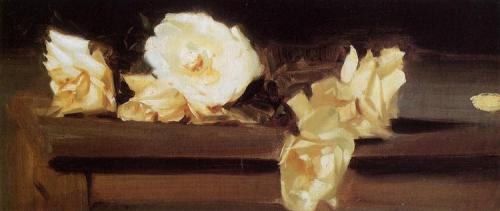
“Roses“ (c.1886)
____________
on a personal note, since I prefer longer
pieces, something I can sink my teeth
into – I like them when they’re long, I
always say – which led me into spending
33 years with Proust, for instance, page
by page, so that I could breathe it in, him,
I tend to veer towards music with several
movements, be they serial, as in sonatas,
symphonies, concertos, Classically
speaking, of course, or haphazard, as
in the more loosely associated suites
rather than smelling merely the rose,
as in a simple waltz, nocturne, étude,
I want to revel in the aroma of an
entire garden
therefore the three hours of Liszt‘s
even Wagner‘s daunting five hour
operas, individual portions of his
towering, indeed epic, four-part
these are high masses, and if you
subscribe to the faith, the experience
they allow can be transformational,
however such may still be,
nevertheless, a mere rose, a mere,
but epiphanic, rose, as is, for
inveterately, for me
a rose, a creation as unique as we
are, in our shared, however unevenly
apportioned, mortality, proud, sturdy,
protected by thorns, even, meanwhile,
as we are, in our own manner, against
our own existential vicissitudes
but vibrant, also, ever, drenched in
any of its several arresting colours,
fragrant, poised, full of perfect grace,
as we should be ourselves, I’ve told
myself, not only with regard to their
beauty, but to their inspiration,
whether a deity exists that we
might be beholden to, incidentally,
or not
Shostakovich has something poignant
to say about that, also Beethoven, but
that’s another story, for later, maybe,
however, either, powerfully
consequential
until then, l’important, as we sing in
or heed, it says, in other, but
nevertheless ever instructive words,
the wisdom of very nature
I live by it
R ! chard

___________
for John, who would’ve
been 60 today
though the suite might’ve started with
Bach’s string of dance pieces in the
early 18th Century, it becomes evident
during the 19th Century, after a lapse
of nearly 100 years, while it fell into
disfavour, that its resurrection as a
valid musical form might’ve kept the
original structure, which is to say its
several separate parts to make up a
whole, its movements, but that it
now was serving a different purpose
where music had, through to the early
Romantic Period, followed dance
rhythms, or variations of tempo,
adagio, andante, allegro, and the like,
it now presented itself as a background
for settings, be it ballets, as in
Tchaikovsky’s, plays, as in Edvard
after Ibsen‘s eponymous play,
specific locations, as in Debussy’s
expansively, both geographically
and in its compositional length,
these very “Années de pèlerinage”
of Liszt
this is in keeping with the exploration
of consciousness of that era, which
would lead to not only Impressionism,
but to Freud, and the others, and the
development of psychoanalysis
you’ll note that music seems much
more improvisational in Liszt than in
already even jazz, more evocative,
less emotional, more personal, not
generalized, idiosyncratic, a direct
development of the newly acquired
concept of democracy, one man, at
the time, one vote, one, indeed,
voice, however individual, however
even controversial
listen, for instance, to Liszt’s “Années
1. Sposalizio
2. Il penseroso
7. Après une lecture de Dante: Fantasia Quasi Sonata
today you can listen to suites
from famous films, for instance
other words, goes on
but note the renovations, find them,
I dare you, you’ll be surprised at
your unsuspected perspicacity
R ! chard
__________
a suite by any other name is still
a suite, a piece of music with
several related parts, a collage,
in painterly parlance
one New Year’s Eve, rather than
going out to celebrate, I took a
hot bath, rose at midnight like
Venus from the cleansing waters,
sat with my teddy bear before a
bristling fireplace, and listened,
serene, to Liszt’s “Années de
Pèlerinage”, all three of his
magical compositions around
his time in Switzerland and Italy,
rendered as musical photographs,
they are of Liszt, I think, his
summit, his acme, the rest of his
stuff is mostly show business
Suisse“, to my mind, a marvel
l – Chapelle de Guillaume Tell
ll – Au lac de Wallenstadt
lll – Pastorale
lV – Au bord d’une source, or, By a Spring
V – Orage – Storm
Vl – Vallée d’Obermann
Vlll – Le mal du pays (Heimweh) – Homesickness
lX – Les cloches de Genève (Nocturne) – The Bells of Geneva
R ! chard

______________
ferreting through old papers the other
night, I found, in a forgotten corner of
my closet, this poem, I thought it had
some merit
_________
a simple story,
mine.
Like yours,
it has its moments
— passion,
pain,
to each in similar proportions
(I’ve also had a broken heart,
and you are happy too, sometimes) —
moments telling tales, a lot, for me
of this
or that
— and every tale is true, in time,
of everyone —
moments that pass,
one,
and then the next,
just gone,
like that,
and apart from what is here,
right here — this black and white —
this thirtieth day in May,
nineteen seventy-nine,
its 13:48,
then 49,
are gone,
just gone,
like that !
R ! chard

from a 2008 production of “Swan Lake“ at the Royal Swedish Opera
_________________________
did you know that the girl in “Swan Lake“
is called Odette, my mom asked when I
told her I’d been looking it up, my mom’s
name is Odette
I’m the one who told you, I said, and
incidentally, I continued, she’s not a
girl, she’s a swan, which left my mom,
of course, flummoxed, indeed mum
a day later, we watched it
there she is, I pointed out, when Odette
made her appearance, fluttering in on
tiptoes from the wings, every single
inch a swan
as was equally the prince, in this
every single inch a prince
how is it different
R ! chard
psst: if you said the Suite is a collection
of miscellaneous excerpts from
the ballet strung together but with
instruments only, no sets, no
costumes, no dancers, you’re right,
the Suite can give you a taste of
stands magnificently enough,
thank you very much, on its own

__________
it didn’t take me long, after wondering
with a similar theme, childhood
fantasies
but the Nutcracker Suite
l. Miniature Overture
ll. Danses caractéristiques
a. Marche
b. Dance of the Sugar Plum Fairies
c. Russian Dance
d. Arabian Dance
e. Chinese Dance
f. Reed Flutes
lll. Waltz of the Flowers
is not to be confused with the complete
ballet, from which it had been excerpted
to great acclaim before the ballet itself
was presented, but to much less
enthusiasm, until George Balanchine
revived it in the 1960s
note that Tchaikovsky’s Suite, in 1892,
contains still the traditional elements
of the suite – see above – a prelude, or
overture, followed by a series of
dances, only a few years before
redefined the form, made the
movements indiscriminate, not
confined to dance rhythms
note also that Tchaikovsky sounds
a lot more like the Strausses, father
and son, Romantics both, than he
does like Debussy, an Impressionist,
a generation later only
a suite, in other words, is not limited
to one instrument
pianos, not to be missed
R ! chard
__________
two suites
how are they similar
how are they different
you tell me
a couple o’ clues
Prélude
Menuet
Clair de lune
Passepied
Doctor Gradus ad Parnassum
Jimbo’s Lullaby
Serenade for the Doll
The Snow is Dancing
The Little Shepherd
Golliwog’s Cakewalk
R ! chard
psst: if you said, there are no dance
and only three of the four
movements in “Suite
you’d be right, the others all
have evocative titles, nothing
to do with the cadence, the
step
but that begs the question,
what happened to the traditional
well, time, and the vagaries of
language, intentions, essentially,
Debussy did to the suite what
changed its meaning, took away
its original purpose, for better or
for worse, a suite is now, in a
similar transformation, a piece
of music, merely, any kind of music,
with several segments, without
even, necessarily, gasp, a
prelude
you can never step into the same
river twice, in other words, the
current just keeps on inexorably
moving, even immutable,
apparently, concepts fall by the
wayside, see democracy, at
present, for instance

_________
two pieces
a second, by Ravel, his “Le tombeau
how are they similar
how are they different
you tell me
a couple o’ clues
Prélude
Sarabande
Toccata
Prélude
Fugue
Forlane
Rigaudon
Menuet
Toccata
R ! chard
psst: both these works are suites, in
the manner of Bach, compositions
with more than one segment, the
first a prelude, followed by, at
least, two dance pieces
the form had remained fallow for
nearly two hundred years until it
was revived, atavistically, during
the Impressionist Period
if you can’t tell your sarabande
from your rigaudon, your forlane
from your toccata, don’t fret, they
are now defunct dances, not to
mention that they’ve always been
stylized, these suites, in other
words, weren’t made for dancing,
as the saying goes, but for
performance, listening

______
for a total of 24, as many as in Chopin’s
undivided set, his Opus 28, but with
different motivations, different musical
imperatives, which I won’t get into here
for being, for the present, too abstruse
Gershwin, just for kicks, his only three
what are the differences
you tell me
R ! chard
psst: Gershwin, to my mind, adds,
indeed stresses, rhythm,
fascinatin’, as it were, rhythm,
he’s no longer as unrelentingly
meditative, serious, as was
Debussy, a distinguishing
characteristic of the
increasingly American 20th
Century
_________
what’s a prelude
something that, by definition,
precedes something else
which it had been, formally,
before Chopin made it stand
alone as a musical form,
much, incidentally, as he
a prelude, earlier, had preceded
several other dance pieces in
example, all start with a
or fronted fugues, in, again,
notably, Bach’s celebrated
Preludes and Fugues sets,
more of which, for their
complexity, later
here’s Chopin, however, with
his array of 24, his Opus 28,
one for each key, incidentally,
much in the manner of Bach’s
template pieces, the Preludes
and Fugues
picking it up for the 20th
Century, with his tonally
indiscriminate 12
what’s the difference
you tell me
R ! chard
psst: apples and oranges, I think,
depends on my mood that
particular night, whether
meditative or melancholy

 Richibi's Weblog