Richibi’s Weblog

Just another WordPress.com weblog

Category: in search of God

the “Ode to Joy”‏

the Ode to Joyfrom Beethoven’s 9th Symphonythe
last part of the fourth movement, not to mention the
entire 9th Symphony itself, is without question the most
celebrated piece of music in the service of humanity in 
the very history of music, it brings together everyone in
an appeal for universal concord, community and hope
through the example of the music itself, a splendid array
of people and purposes in one common inspirational
aspiration, that aspiration not in any way dominion
but universal joy 
 
can we do it 
 
they do it here, in spades  
 
a Japanese orchestra and chorus of ten thousand, yes, 
ten thousand, perform superbly this German composer, 
interesting considering our not so distant bellicose past, 
it is a Japanese tradition apparently at the end of
December, in commemoration in this instance, Osaka,
1911, of the victims of the recent tsunami, they play in 
complete and utterly admirable harmony, each doing 
splendid honour to each as indeed the music suggests 
we all should
 
maybe we can, maybe we are, doing it  
 
 
incidentally no one had included voices ever in a
symphony before Beethoven, the premiere must
have been extraordinary 
 
this performance sure is  
 
 
Richard   
 
psst: Leonard Bernstein conducts the Vienna Philharmonic in
         the full symphony, Placido Domingo sings with the chorus,
         it’s 1970 


Olivier Messiaen – “Et exspecto resurrectionem mortuorum”

just in time for Easter here is something from
Olivier Messiaen, whom I consider to be, after
Shostakovich, the most important composer of
the Twentieth Century, and may one day, with
more distance, prove to be, of the two,
preeminent 
  
Messiaen, a devout Catholic, wrote specifically
to the glory of the Catholic God, an interesting
return to the music of the Baroque period, and
earlier, when the Church sponsored essentially
all the arts  
 
perhaps Messiaen is also a precursor – the Et
exspecto resurrectionem mortuorum“, which
I’m presenting, or, in my humble Latin,”In 
is from 1964 – of the resurgent fundamentalism
we’ve been witnessing in all churches,
synagogues, mosques, in our own times
 
Et exspecto resurrectionem mortuorum“, is
not at all Romantic, not even Impressionistic,
two world wars have been fought since, man  
has stepped on the unglorious moon, God even
died in the early sixties leaving us to reinvent
our own future, a time of youth and flowers,
and great indeed expectations, as it turned out  
 
the even profound assumptions of the earlier
order however, in the language of music
represented fundamentally by beat and tonality, 
hadn’t worked, couldn’t work anymore, having
been manifestly discredited, women had received 
the vote, financial and sexual independence,
traditional authority had been categorically
overthrown, there was no going back
 
 
Richard Strauss had already suggested this new
broader horizon, in 1896, with his “Also Sprach 
Zarathustra, a mighty work, made famous, even
unforgettable, by the movie  “2001: A Space   
Odyssey“, when the very sun bursts upon the
intergalactic universe to its interstellar strains
 
but Messiaen takes you even further into the
reaches of the infinite 
 
I couldn’t help thinking of a more adult Miró –
the individualized elements – but more profoundly 
metaphysical, I have rarely seen, heard, something
so transfixing, powerful, even the silences between
movements, there are five, are riveting
 
 
happy Easter

 
Richard 


art and God

a friend asks 
 
       “Hi Richard,
        Just in case you don’t think I’m listening.
        Here’s a [YOUTUBE rendering] that I think illustrates what you so aptly  explained
        in [your reply to a friend] regarding the term ‘adagio’.
        On listening to the adagio
        pieces that you referred us to, they seem to suggest a leaving or going to “God”. At least ,
        that’s the sensation they provoke in me.
        What would you say to this?
        Hugs,E.”
 
 
all art, I believe, is a conversation with God, in undertaking to
create a painting, a piece of music, a work of literature, a poem,
all entirely abstract inventions, verily defined by their lack of
any utilitarian function, but imbued with merely intellect and
heart, which is to say, soul, the artist, anyone, has only two
impulses ever as instinctual guides, beauty and truth, beauty
and truth, concepts which when given essence and flight I
associate with a living God, any at least relevant God 
 
and I believe truth and beauty, therefore art, are the closest
we’ll ever come to knowing IT
 
so yes, “the adagio pieces that [I] referred [my friend] to, [do
indeed] suggest a leaving or going to “God”.” 


what do you think
 
 
Richard 
 
psst: thanks E. 


Franz Lizst – Hungarian Rhapsody no 2‏

any one of the following outstanding interpretations
of Lizst’s Hungarian Rhapsody no 2, even individually,
will make your day, I promise, together, they’ll have
you rocking for surely a week 
 
Hanna and Barbera’s The Cat Concerto, with Tom
and Jerry, won the Oscar in 1947, Best Short Subject,
Cartoons 
 
the Rhapsody itself is of course not a concerto, it 
was written for piano only, it’s been proven to be 
incontrovertibly enough, but was given an orchestral
backdrop by the studio for the film, henceThe Cat
Concerto, I’ll leave the portion about the cat in the
title undiscussed  
 
Liszt also rearranged himself, incidentally, his
immensely successful work for solo piano, adding
a superfluous, in my opinion, orchestra, any virtuoso
who could play this would leave his backup surely,
inexorably, in the dust
 
but I might be wrong
 
 
Victor Borge is an absolute comic genius in a
performance you’re not likely to soon forget 
 
 
Marc-André Hamelin, a French Canadian, is in my
estimation unmatched in the world today, he’ll
blow your socks off, you will be dazzled 
 
the unfamiliar part near the end of his interpretation, 
the part you’ve never heard before, is of Hamelin‘s 
own invention, a cadenza, an option fully granted in
bravura compositons by composers, allowing any
pianist to strut his, her, individual stuff, foreshadowing,
by the way, improvisation, jazz 
 
you’ll find Marc-André Hamelin in his extrapolation
to be nothing short of extraordinary 
 
 
Richard  


Franz Schubert – String Quintet in C major, D 956‏

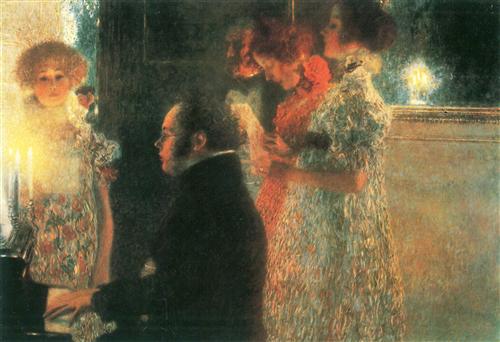
"Schubert at the Piano" II (1899) - Gustav Klimt

Schubert at the Piano (1899)

Gustav Klimt

________

the Filarmonica Quartet, which I’d earlier described
as “not at all unimpressive”, show themselves here,
performing Schubert‘s otherworldly String Quintet
in C major, D 956
, to be the very sound of those
angels Schubert calls upon to perform his
miraculous music

their hometown Novosibirsk audience will continue
however to stubbornly, shamelessly, cough, in
scattered places, though the angels themselves,
the players, seem not especially distraught, they
play with great conviction, patience and tolerance
throughout superbly, caught up surely in their own
Schubertian Nirvana, a not uninstructive response

the Filarmonica Quartet of course will need a fifth
to play with them a quintet, who is, I think, the
extra cello at the front on the right, uncredited,
the piece calls for two violins, a viola and two
cellos, instead of the standard, at the time, extra
viola, surely for their greater and more resonant
chthonic character, which is to say, triggered by
the very earth

Franz Schubert, 1797-1828, died much too young,
only 31, this piece was completed not two months
before he passed away

it is also therefore a very haunting last testament

Richard

psst: D is for Otto Erich Deutsch

smelling the roses‏

why did the ducklings cross the road     

to remind us of our profound connection                                                                 with nature

                                                                                                                                                     Richard


Shostakovich’s String Quartet no 15, opus 144 (revisited)

on a day of commemoration, or at a moment even of
merely contemplation, perhaps it’s not a bad idea to
revisit Shostakovich’s String Quartet no 15, in E flat
minor, opus 144
, his flurry of mournful adagios, his
string of stately dirges, his penetrating meditation
on mortality

complete this time around, on one only site, though
just a short while ago indeed I said it wasn’t to be
found, March 28, 2012, again I was wrong

today it stood, perhaps not coincidentally, directly
before me as I clicked onto my list of music,
unadulterated, intact, complete, apart from an
irrtating audience member coughing at one point,
unforgivably, for marring so sincere an expression
of fervent string sounds, though only momentarily

by the “Filarmonica” Quartet, of Novosibirsk, Russia,
a city just north of Mongolia and Kazakhstan, the
players are not at all unimpressive

accompanying images are apparently of Russian
inspirational countryside nearby, and of
neighbouring Mongolia

Richard

“Le sacre du printemps”, then, and later

 Russisches Ballett (I) - August Macke

                            Russisches Ballett (I)  (1912)

                                          August Macke

                                                        ____________  
 
 
Le sacre du printemps”, Stravinsky’s original, French,
title for “The Rite of Spring”, was choreographed by
Vaslav Nijinsky, a legendary ballet superstar of the
time, to sets, costumes and story by Nicholas Roerich,
a name essentially now forgotten 
 
Sergei Diaghilev, the equally legendary impresario,
produced the show for his hot then Ballets Russes,
which opened at the Théâtre des Champs-Élysées
in Paris, May 29th, 1913, a hundred years but one
since, nearly to the hour
 
minus of course the Ballets Russes
 
here a celebrated alternate version, 1970, from
highly regarded choreographer mid Twentieth Century,
with dancers to prove it – this effort now considered
 
 
may springtime bring you also meanwhile myriad
other roses
 
Richard  

“The Rite of Spring” – Igor Stravinsky (1913)‏

just in time for the season here is a deconstruction of
“The Rite of Spring”, Stravinsky, that will blow your
socks off, a clarification of a seminal moment in the
history of music and art that sheds light on history,
the history of music, the history of art, but the
history of our very own place in the pageant 
 
better than I could do Micheal Tilson Thomas,
conductor of note, explores our instincts, and
relation to music, aesthetically and anthropologically
through this most visceral music
 
stick around    


appropriate, I think, conductor, Pierre Boulez, of all
the most notably avant-gardist


Richard


Dmitri Shostakovich – String Quartet no 15, opus 144

several years ago when an angel I knew passed away
I read at his commemoration something I had written
for him, adagios, I said, always remind me of John

only a few days later, after I’d spoken, an adagio in
the distance was weaving its magic spell as I
abstractedly washed perennial dishes, a pivotal
spot, it would appear, for me, in my mystic
wanderings, my spiritual peregrinations

gradually I recognized the presence I’d apparently
inadvertently evoked with my unsuspecting but
thoughtful and caring script, opening a key, like
Ali Baba, it would transpire, to the very undiluted
infinite, something I’d wished for from my dad,
who’d died just a few months earlier, promising
me he’d speak to me if he could, though by then
I hadn’t yet heard from him

later when I was browsing for music to get into
to while away my pensive hours I happened upon
some Shostakovich in a nearby record store, I’d
recently been exploring his stuff, having reached
forward from the Romantics and even the
Impressionists, and looked to a relatively more
recent touch, the early Twentieth Century

which is to say the atonalists, Schoenberg, Berg,
Stravinsky and so forth, of which Shostakovich,
I would argue, has proven to be the most
significant voice, his music being that of a
desperate, nearly broken people enduring
the atrocities under Stalin

he is the most important composer of the
Twentieth Century, I think, along with Olivier
Messiaen, who survived a German prisoner of
war camp, two tough, even heroic, spirits

and here were not one, not two, not even three,
but six adagios in his 15th String Quartet, when
anything faster was too much for me to bear,
otherwise it would have to have been silence,
I was elated

I was not let down, Shostakovich’s 15th String
Quartet, opus 144, is a masterpiece, and helped
me through my rigorous Calvary with compassion,
grace, and ultimately golden hope, to health and
resignation

it is not an easy piece, you might find it
overwhelming, but it is the last word in adagios,
and for me it means the world, I couldn’t leave
it out

I found the distribution awkward however, I
haven’t found the quartet complete anywhere
on the Internet, you’ll have to access the movements
separately, pee breaks are therefore allowed, there
are six movements, not usual but we’ve seen
Beethoven do five already for his Sixth Symphony,
so not entirely unexpected

the first movement, Elegy (Adagio), is played by the
Rubio Quartet, but with only an image of war torn
Leningrad to inspire visually

the second, Serenade (Adagio), by the Borodin String
Quartet, perhaps Shostakovich’s best interpreters, are
also presented visuals inert

the third, fourth, and fifth – Intermezzo (Adagio),
Nocturne (Adagio), and Funeral March (Adagio molto)

in that order, are played live by the Shostakovich
Quartet, named of course in the composer’s honour

and the sixth, Epilogue (Adagio), again by the Borodin

may you be granted the poise and profound grace
of the adagio

Richard