Richibi’s Weblog

Just another WordPress.com weblog

Category: in search of God

“Paths of Glory”‏

hot on the heels of Sergeant Yorkhere’s
another war story, of war movies the one
that has left of all of them with me the most
indelible impression, Stanley Kubrick‘s 
searing Paths of Glory
 
incongruities exist, Kirk Douglas plays the
French Corporal Dax, not sounding at all like
a Frenchman but like the American voice of
reason back when such a position held, nor
do most of the other players, apart from,
among especially the military leads, more
formal, aristocratic, which is to say, viable
accents
 
but these inefficiencies soon cede to the
power of a compelling story, all consistently
thickening drama, to the very inexorable end
 
some situations are heightened of course
for the sake of tension, but this is a completely
valid metaphorical device of fiction, I argue, for
the sake of a more profound truth, reality would
be too fraught with its own not as readily 
scrutable inconsistencies and conundrums 
 
the tale is as involving, incidentally, as a
Beethoven sonata, with even its own
incandescent coda, a short musical epilogue,
that will leave you blubbering, a scene of such
subtlety and vision, poetry and powerit has 
remained personally etched forever on my
however maybe too impressionable heart 
 
you’ll need, I think, some Kleenex
 
Kubrick even married his leading lady,
remaining together with her till ’99, the
year of his surely greatly grieved demise
 
 
interiors incidentally by Fragonard,
exteriors by the ravages of war 
 
 
Richard
 
psst: where have we heard about
           courts-martial lately


“Snow White And The Seven Dwarfs”‏

enchanted movie for children of all ages, that
means especially you, Manolito, that means
especially you, Aidan
 
you might however notice, in a more analytical
vein, the introduction of German Expressionism
already in more popular culture, Nolde, Kirchner,
even some Edvard Munch, the Norwegian, in the
bold, garish colours that expressed horror and
perversion for them following the First World War,
and did the same for Walt Disney later if you’ll
consider the evil queen’s mirror and mask, or
van Gogh branches in the threatening forest, flat
surfaces, notably on faces for instance, touched
with only daubs of colour for only perfunctory
shading and character, prefiguring incidentally,
Andy Warhol‘s Pop Art
 
artists talk to each other
 
  
musical atonalities, also, show up, to attest to
modernity, in the music tooted out by the pipe
organ, delivering ornery pipes and a climactic
cuckoo who can only emit a shrill, discordant 
screech, we can thank especially Prokofiev,
the popinjay among the atonalists, for that,
with necessary nods to, for their more
theoretical groundwork, the more exacting
Stravinsky and the too dour, not to mention
for many too dire, Schoenberg  
 
Walt Disney was introducing modern art not so
surreptitiously at all to the larger popular culture,
acclimatizing children especially to the new
upended and revolutionizing art, crayons at
the behest of individuality 
 
 
you’ll also find interesting that Snow White 
succumbs to an apple, much like Mother Eve, 
both of whom are absolved, it’s worth pointing 
out, by nothing other than transcendental,
transformational, regenerative and ever
inspirational, Love
 
think about it  
 
 
Richard


“Sergeant York”

to my dismay when I turned to Sergeant York
thinking it’d be a short and hopefully sweet 
movie, clocking in at only one hour fourteen,
I’d read, according to the bottom time bar, I’d
only got the first part of the movie I found out, 
where he grows up in the Ozarks, or somewhere
like it, or is it like them, a stretch of film I found
essentially corny, but for Gary Cooper, who is 
consistently impeccable as a principled hillbilly,
and entirely worth watching 
 
but I only turned to the second part cause
change of setting, I thought, might hold more
promise, and indeed it did
 
it is however a lesson in how America developed 
its devotion to guns, it seems an early actual
textbook declaration of it, shot through with the
sounds of celestial strings, you’ll note, when the
commander expounds on its philosophical basis,
with instead of a Bible in hand a book called “The
History of the United States”, for maximum moral
suasion  
 
Sergeant York needs to accommodate his pacifist
stance, as delivered by the Bible and his Lord,
to the new paradigm of patriotism, national
defence, which calls of course for killing, in a
rousing call to arms his superior speaks of the
new ideal of freedom, which is worth, in his
impassioned dialectical exposition, dying for, 
in contrast to the traditional, more fraternal,
less annihilating, Word of God 
 
he is given 10 days leave to sort out his objections,
which may as well have been forty days and forty
nights, with next to no food and water on even a
very mountain, much like Moses on Mount Sinai,
to receive his spiritual enlightenment, trumpets
blow, lightning crashes, Biblical parallels rebound 
like echoing thunder
 
 
the movie came out in ’41, I suspect it was made
in view of marching America into the Second World
War, they didn’t commit to Europe until ’42
 
 
the battle scenes are worthy of Saving Private Ryan” 
 
Sergeant York bumps up against New York, like
the Beverly Hillbillies later hit Los Angeles 
 
Gary Cooper doesn’t miss a single beat on his
way to his fully earned Oscar
 
 
Alvin C. York, the actual war hero, had insisted,
incidentally, that no one but Gary Cooper should
play his part, had had it written specifically and 
incontrovertibly in his contract, Alvin must’ve
known something
 
since Gary Cooper is no longer around to play
my part I’d now let no one other than Joseph  
 
 
         “Sergeant York”, part 1


enjoy
 
 
Richard


“A TOAST” – Brice Maiurro‏

though I’ve tried to restrain myself from too
effusive appreciation of this inspired poet,
again tonight, a not especially eventful
though completely pleasant New Year’s
Eve night, watchIng the effervescent
movie, Charade“, with the ebullient
Audrey Hepburn and the equally suave
and captivating Cary Grant, at my mom’s,
inadvertently, a lesson in new, incidentally,
media savvy, foregoing antiquated television
for entertainment from her computer, I got
back home to the following Internet alert 
from evidently my presently favourite poet 
 
how could I wish anyone upon reading it, I
thought, a better New Year
 
I cede therefore to this supremely articulate
poet, who’s taken the time and his gift to
fashion a wish that I couldn’t’ve, nor had I,
articulated any better, had I found, I’m
sure, so instigating and grand a spirit
 
I had to pass it along
 
 
Richard  
 
                 _________________                     


lift up your spirits!
to this cataclysmic evening!
this parade!
of howling wolves! and monkeys!
to the altered perspectives!
of angels!
and their subjective
paradise!

 
let our warped worlds come together!
like pangea in reverse!
  
let all religions reside within us all!
and all around us!
 
this is my wish for you.
and all of you.
 
let us toast!
to the fact our irises
are all different colors!
and our pupils are
all
the
same!
 
let’s get lost!
in the rambunctious sound
of
actual
reality!
 
and remind our souls
that love
is not just romance:
it is
every breath
the flowers give us
and each one
we return to them!
 
parks
that are dead
in winter
and alive
with lush green grass
and wide-
eyed people
in summers!
 
let’s toast!
 
to the smell of rain!
to the taste of laughter!
forever! tonight!
and ever after!
 
 
           Brice Maiurro


Barbara Stanwyck/Gary Cooper‏ – “Ball of Fire”

Barbara Stanwyck has never been for me
a favourite, more testosterone mostly than
her leading men, but when a cousin asked
about a New Year’s Eve gift recommendation
for his wife, for whom she is a favourite, how
could I resist 
 
this perfect little treasure, Ball of Fire“, is
what I found, with Gary Cooper no less, who’s
always had testerone enough indeed for
everybody, even as an academic and
milquetoast grammarian
 
 she is a gangster’s moll  
 
the script is scintillating, he corrects someone’s
split infintives, not once but several times, how
could I not love it 
 
she was nominated for an Oscar in what appears
to have been, for its display of female icons, a tight
year, but for this movie Gary Cooper wasn’t even
mentioned  
 
he won the Oscar that year instead for Sergeant
York“, indisputably probably deserving it 
 
 
incidentally, Ball of Fire is a riff on Snow White 
and the Seven Dwarfs“, these reorganizations in
art are not uncommon nor unusual, fairy tales and
Biblical references for instance resound always
especially profoundly in reinvented updates
 
here Prince Charming is already living with the
dwarves, Snow White is at the very least scarlet,
but it all ends up the same, of course, utterly ever
charming 
 
 
have a happy, and prosperous, new year 
 
Richard


“EDWARD HOPPER*” – Brice Maiurro‏

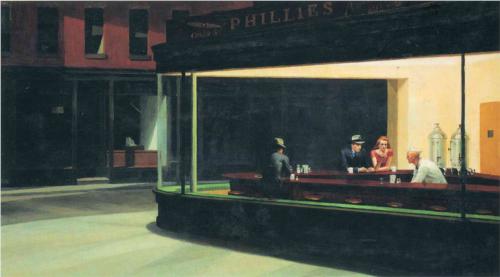
nighthawks.jpg!Blog

Nighthawks (1942)

Edward Hopper

___________

here‘s another gem from Brice Maiurro, of which
there are many, too many to daily share, I’d
sound like too much of an addled fan, or worse,
an unbridled sycophant, though soon that might
be already too late

I’ll commend you rather to his rich and growing
website, FLASHLIGHT CITY BLUES, ardently

the following poem ‘s to do with Edward Hopper,
remember Edward Hopper, for the sake of, nudge,
nudge, always revelatory comparison

EDWARD HOPPER*” is an ekphrastic poem

ekphrasis is poetry about art,
that’s where I got my formal start,
my poetry is still trying to sprout
wings under my perhaps too literal prose

Richard

______________

EDWARD HOPPER*

*based on the notes of American artist Edward Hopper and his wife Jo

Night
+ brilliant interior of
cheap restaurant.

Bright items:

cherry wood counter
+ tops of surrounding
stools; light on metal tanks
at rear right;

brilliant streak
of jade green tiles
3/4 across canvas-
at base of glass
window
curving around the
corner.

Light walls,

dull
yellow
ocre
door
into kitchen right.

Very good looking
blond boy
in white (coat, cap)
inside counter.

Girl in red blouse,

brown hair

eating sandwich.

Man night hawk
(beak)
in dark suit,
steel grey hat,
black band,
blue shirt (clean)
holding cigarette.

Other figure
dark
sinister
back-
at left.

Light side walk
outside
pale greenish.

Darkish red brick
house opposite.

Sign across
top of restaurant,
dark-
Phillies 5c cigar.

Picture of cigar.

Outside of shop dark,
green.

Note:
bit of bright
ceiling
inside shop

against dark of
outside street

-at edge
of stretch
of top
of window.

Brice Maiurro

Eva Cassidy‏

Eva Cassidy seems to have been an angel who
flew too close to the ground, maybe you have
even yourself known one or two of these, I
certainly have, and ever of course have been
for the inordinate grace so profoundly grateful,
despite the hardship, the anguish, of having
lost them
 
here she sings Somewhere Over The Rainbow“,
an inspirational perennial, and makes it fresh and
improbably again wonderful
 
here also however is her sad but instructive story
quality apparently reaches ever its intended level
 
 
may your new year be such that you may also
fly over the very rainbow that you dream of 
 
 
Richard


Beethoven piano sonata no 7, revisited‏

let me say a few words more about Beethoven’s
piano sonata no 7, opus 10, no 3, which I left in a
blur of other sonatas in my last set of opinions, it
is a wonder, and entirely worth a second visit, it
can neatly expose the new Romantic expression
midst the still Classical impositions
 
simply stated the elements of beat, tonality, and
repetition lay out the grid of Classical musical
composition, the blue print, like a house would
have a kitchen, bedroom, bathroom, and
variations on a communal social space 
 
Beethoven adheres to all of these elements but
does so eccentrically, beat itself is moderately
altered here and there, relaxed somewhat, mostly
at the end of musical phrases, an outcome
incidentally of the piano’s hold pedal, which
allows the reverberation of any note played
beyond its being played 
 
but you can nearly identify Beethoven by the
fact that he is always off the stated beat, which
is to say that his accent is always on the wrong
syllable, off what the time signature requires, the 
template along with key notations indicated
at
the front of each set of bars of a musical text
 
this is already a significant peculiarity, and
consistent, endemic, he is fundamentally out of
synch, innately rebellious, which makes for nervy,
edgy music, bristling and electric, electrifying  
 
none of it you can sing, though the tonalities are
still entirely melodic
 
 
as far as repetition is concerned, Beethoven is still
repeating religiously, albeit with extended, and
ever so complex, elaborations, leaving you awed
ever, might as well say soulfully levitated, and 
mesmerized
  
 
the first movement, the presto, for “very fast”, takes
place on hot coals, brisk and electric
 
the second movement, the enchanted largo e mesto,
“very slowly with sadness”, is not only in marked
contrast with the first, a required condition for any
new movement, though here rendered flagrantly
extreme, it also tests the limits of effective pace,
again an innovation of the new piano, this time
coming out, despite the absolutely funereal
constraints undertaken here, instead of stultifying  
unquestionably and incontrovertibly transcendental
 
in the last movement, the menuetto (allegro), a
(jaunty) minuet, his parentheses, after an equally
exuberant third, the rondo (allegro), a (jaunty), his
parentheses again, rondo, a musical form akin to
what a sonnet would be to a poem, you can already
hear intimations even of jazz in the free and easy
tickle of the ivories, casual, debonair and apparently
improvisational, like Gene Kelly himself in dance,
toes twinkling with fresh and candid effervescence
and exhilaration  
 
now how unClassical is that    
 
 
Richard 


Beethoven – piano sonata no 7 in D major, opus 10, no 3‏

when I first decided to explore Classical music
the field of course being so large it seemed
advisable to narrow my search, approach it 
methodically, I hadn’t had, nor since have had,
formal training, neither in the history nor in the
evaluation of music, apart from lessons in
flute and piano however extensive and
undistinguished those might’ve been it’s
been just me and my headphones ever and
my Walkman®, remember Walkman®s
 
but a world nevertheless opened up, and
bountifully, not this one, but the one I was
exploring
 
putting two things together and comparing
is at the root of any kind of knowledge, your
plant will grow profusely if you choose well
your soil, your soil is your avidity
 
I stirred in some Beethoven, already for me
question for being so highly revered by
succeeding generations, Nietzsche had
even made him out to be the template for
his superman, and I hadn’t got it yet
 
it seemed to me that a chronological
investigation, opus 1, then 2, then 3, would
be the manner in which to proceed for being
able to watch a genius grow, I couldn’t’ve 
chosen better  
 
the movement from Classical music to
Romantic rests on essentially his shoulders,
something I’d determined even then, and one
can watch, hear, its advance as Beethoven
moves from his early to middle to late periods,
it is like being there 
 
the early sonatas are trite to my mind, though
other informed people have disagreed, and
I am merely responding to my own aesthetic
impulses, but there you have it
 
they are academic, didactic, musically constricted,
to my mind, though they are full of evident personal
power, Beethoven bristles and burns through the
Classical chains that constrain him, through also
his own inexperience and emotional immaturity      
 
he kicks in splendidly however early enough with
a beautiful cello sonata, for cello and assumed
piano, his opus 5, no 1, in an apparently amateur
production here nevertheless utterly commendable,
but reaches total emancipation already by his
opus 10, after which he doesn’t  put a foot wrong,
but rather consistently inspirationally 
 
with the okay pieces you follow dutifully their
music, perhaps with even an encouraging smile,
with the great ones you’re simply irresistibly
carried away, drawn in, you alone can tell the
difference
 
as with art
 
as with poetry 
 
in the first case you wonder when it’ll finish,
in the second you don’t want it ever to end,
that’s your unmistakable cue, given that you’re
at least paying some attention
 
 
his opus 10, no 3 is irresistible at the hands
of Eric Zuber, precise and meticulous in his
rendering, but mostly electric, effervescent  
and exhilarating
 
and evidently also timeless
 
enjoy
 
 
Richard 
 
 
         cello sonata no 1, opus 5, no 1      
 
         sonata no 4, opus 7 
 
         sonata no 7, opus 10, no 3 
 
         for your ease of chronological comparison,
         if you follow the list and the opus numbers


a poem without words

 
poetry: when Beauty touches Truth, producing
                incandescent transcendence 
 
                and an inadvertent, and privileged, view
                of the sublime
 
                just click
 
 
Richard