Richibi’s Weblog

Just another WordPress.com weblog

Category: in search of God

“Chiquitita” – Abba

here’s a new entry to confuse everything
if you’ve been following the discussion
about the setting for Fernando at
“Fernando”, revisited‘ on my blog,
Abba’s “Chiquitita”, again a dramatic
monologue
, note

Chiquitita, tell me what’s wrong
You’re enchained by your own sorrow
In your eyes there is no hope for tomorrow
How I hate to see you like this
There is no way you can deny it
I can see that you’re oh so sad, so quiet

Chiquitita, tell me the truth
I’m a shoulder you can cry on
Your best friend, I’m the one you must rely on
You were always sure of yourself
Now I see you’ve broken a feather
I hope we can patch it up together

Chiquitita, you and I know
How the heartaches come and they go
And the scars they’re leaving
You’ll be dancing once again and the pain will end
You will have no time for grieving

Chiquitita, you and I cry
But the sun is still in the sky and shining above you
Let me hear you sing once more like you did before
Sing a new song, Chiquitita
Try once more like you did before
Sing a new song, Chiquitita

So the walls came tumbling down
And your love’s a blown out candle
All is gone and it seems too hard to handle
Chiquitita, tell me the truth
There is no way you can deny it
I see that you’re oh so sad, so quiet

Chiquitita, you and I know
How the heartaches come and they go
And the scars they’re leaving
You’ll be dancing once again and the pain will end
You will have no time for grieving

Chiquitita, you and I cry

But the sun is still in the sky and shining above you
Let me hear you sing once more like you did before
Sing a new song, Chiquitita
Try once more like you did before
Sing a new song, Chiquitita

Try once more like you did before
Sing a new song, Chiquitita

which could be even Argentinian

is there a Rio Grande in Argentina, Jim

cheers

Richard

psst: hats off once again to Robert Browning,
lest we forget
“Fernando”, revisited‏


despite still so profound an emotional
impact I haven’t been the only one to
wonder about Fernando‘s specifics

what’s happening, apart from the
throbbing melancholy, glory

it turns out that there are a couple of
people here, two men, or maybe a man
and a woman, reviewing a long gone
night when they crossed the Rio Grande

so Mexico, rather than Spain, must’ve
been the setting, I conjectured

the Mexican-American War, 1846 –
1847, established the border between
the victorious Americans and Mexico

these two must’ve been remembering
a particular private night, but I suspect
a more momentous night, conquering
territory, however ultimately it may
have been, however ignobly, lost

Wes Carr, an Australian Idol contestant,
does an impressive interpretation of a
song that is too iconic
to much ever
overtake, not to mention overwhelm

but what do you think

Richard

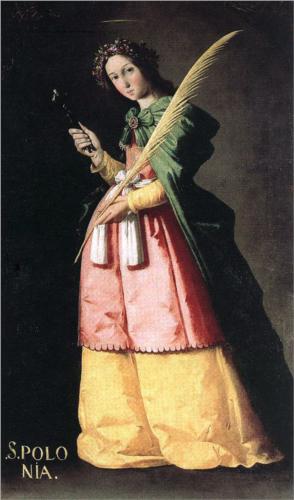
Saint Apollonia


"Saint Apollonia" - Francisco de Zurbarán

Saint Apollonia (1636)

Francisco de Zurbarán

___________

who ‘s Saint Apollonia, I asked my dentist
when he suggested I call on her to intercede
in this present mortification, I was sitting in
his chair undergoing treatment for a painful
abscess for which he’d aligned already
several instruments along my lower lip

the patron saint of toothaches, he replied,
as though she were a fairy

who knew, I marvelled, I’d only ever heard
of Saint Jude otherwise, patron saint of
lost causes, memorably

you must’ve been raised Catholic, I
interjected, Protestants don’t have
saints

yes, he stated, suggesting the shared
impact of an, however privately
relinquished, or distant, religion,
upbringing

he didn’t know about her time or place,
and counseled I should look into it

who wouldn’t

principally she lived in Alexandria, her
name alone could have given that away,
if Greeks had become Christian anywhere
it would’ve been in Alexandria then, 250,
a city close to the Christian source,
Palestine, and teeming with international
attention, though ruled long by Greeks,
you’ll remember Cleopatra had been of
Greek origin

in a wave of atrocities perpetrated by
Alexandrian mobs, unleashed during
commemorative festivities – see, for
instance, the Vancouver hockey game
riots to compare – roused by prophecies
of ill winds towards their city, set upon
Christians to appease their more raucous
gods, among them Apollonia

in Vancouver she was London Drugs
and the Bay

they pulled out her teeth, one by one,
which is why she’s represented with
pincers
, that done they threatened to
burn her alive should she not repeat
their profanities

she jumped, instead, herself, onto the
pyre

Jesus, Mary, Joseph, I exclaimed, quite,
quite uncharacteristically, but only other
too objectionable imprecations could’ve
reflected the extent of my consternation,
after that, I thought, what’s an abscess

later I brought him gratefully a bottle of
fine wine, to the fortified gate, however,
of his impervious secretary, though
serenely be she ever smiling, for having
tended with speed and alacrity to my
distress, however unworthy it may
have been of beatification

a French wine or a Marilyn Merlot, Napa
Valley, I had to ponder, bought both,
couldn’t resist, kept for myself, however,
not to render the choice to the intermediate
secretary, the Marilyn, my more familiar, and
headier, saint

cheers

Richard

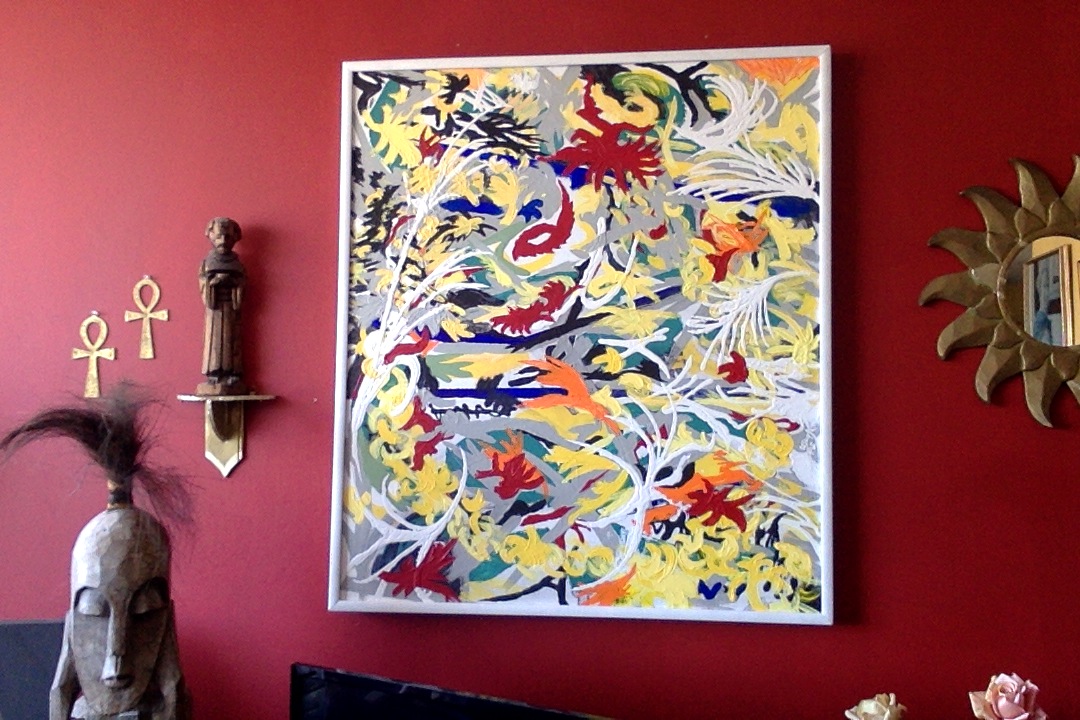
“No 7” (2014) – Apollo‏

Photo on 2014-05-13 at 12.09 PM

“No 7” (May, 2014)

Apollo

_____

Apollo, my Charioteer of the Sun, God of Music,
God of Poetry, God of Countless Other Things,
is also a painter

just recently he graced my wall, newly painted
Burning Bush in a spirit of springtime
regeneration, a colour I hadn’t been able to
resist for its beatific implications, with his
“No 7”, so named in order not to influence
the journey taken to interpret it

call it what you will, he said, and I’m still
working on it

but the other evening at his place, four of us
together for a glorious indeed dinner, I created
a party game that could offer suggestions

what would you call it, I asked, what would
you call it, I’m still asking

“Splash”, “Flurry”, and “I Don’t Know”, are
out, for being already taken

have fun

thanks

Richard

psst: the solar mirror, incidentally, is also his
invention, that’s a Manet in its reflection,
a print of course

“Miss Otis Regrets” (1934) – Cole Porter‏

while we’re on the subject of dramatic
monologue
s, here’s one, performed by
Fred Astaire, which splendidly illustrates
the intention

here’s Bette Midler doing it

and here’s more Bette, irrepressible, and
utterly irresistible, if you can stand it

or, as she would have it, the Divine,
and indeed, Miss M

just click

enjoy

Richard

psst: “Miss Otis Regrets”

Miss Otis regrets, she’s unable to lunch today, madam,
Miss Otis regrets, she’s unable to lunch today.
She is sorry to be delayed,
but last evening down in Lover’s Lane she strayed, madam,
Miss Otis regrets, she’s unable to lunch today.
When she woke up and found that her dream of love was gone, madam,
She ran to the man who had led her so far astray,
And from under her velvet gown,
She drew a gun and shot her love down, madam,
Miss Otis regrets, she’s unable to lunch today.
When the mob came and got her and dragged her from the jail, madam,
They strung her upon the old willow across the way,
And the moment before she died,
She lifted up her lovely head and cried, madam
Miss Otis regrets, she’s unable to lunch today

“Why Do I Love You?” – from “Behind the Candelabra”

just when you thought you’d never see
Elizabeth Barrett Browning again, here
she pops up in, of all places, a movie
about Liberace, Behind the Candelabra“,
a not undistinguished representation of
the high life, the over the top life, of an
aging and flamboyant superstar with his
much younger companion, feathers fly,
Ferraris too, and so do tempers

but at one point Liberace recites this
poem, “Why do I love you?”

where have I heard that line before, I
said to myself, and needed no one, of
course, to answer, here was Elizabeth
handing over her mantle to someone
in the XXlst Century, maybe

you decide

Richard

psst: Liberace also said, “too much of a good
thing is wonderful”,
I’ll drink to that

__________________

Why do I love you?

Why do I love you?
I love you not only for what you are,
but for what I am when I’m with you.
I love you not only for
what you have made of yourself
but for what you are making of me
I love you for not ignoring
the possibilities of the fool in me,
and for accepting
the possibilities of the good in me.

Why do I love you?
I love you for
closing your eyes to the discords in me,
and for adding to the music in me
by worshipful listening.
I love you
for helping me to construct my life,
not a tavern, but a temple.
I love you because
you have done so much to make me happy.
You have done it without a word,
without a touch, without a sign.
You have done it by just being yourself.
Perhaps, after all,
that is what love means,
and that is why
I love you.

“Bohemian Rhapsody” – Freddy Mercury‏


the poetic dramatic monologue, which finds
its popular source in Shakespeare, though
they are essentially introspective there,
philosophical rather than strictly narrative,
making them nevertheless, in a play, by
definition, dramatic, rightful claimants
still to that name, and which was
institutionalized as a poetic form by
Robert Browning later in the XlXth Century,
by upending the Shakespearean mode,
turning poems into plays instead of plays
into poems, makes its way into the XXth
Century, probably mostly unobtrusively,
no one really particularly notices, but
powerfully culturally nonetheless when
applied to, for instance, music, which is
to say poetry, of course, with notes

here’s “Bohemian Rhapsody”*, an abridged
version, as sung by Rose Osang Fostanes,
delivering a classic dramatic monologue

here’s Freddy Mercury’s complete version,
with a Greek chorus supplying oracular
even feedback

Richard

* Bohemian Rhapsody

Is this the real life?
Is this just fantasy?
Caught in a landslide,
No escape from reality.

Open your eyes,
Look up to the skies and see,
I’m just a poor boy, I need no sympathy,
Because I’m easy come, easy go,
Little high, little low,
Anyway the wind blows doesn’t really matter to me, to me.

Mama, just killed a man,
Put a gun against his head,
Pulled my trigger, now he’s dead.
Mama, life had just begun,
But now I’ve gone and thrown it all away.

Mama, ooh,
Didn’t mean to make you cry,
If I’m not back again this time tomorrow,
Carry on, carry on as if nothing really matters.

Too late, my time has come,
Sends shivers down my spine,
Body’s aching all the time.
Goodbye, everybody, I’ve got to go,
Gotta leave you all behind and face the truth.

Mama, ooh (anyway the wind blows),
I don’t wanna die,
I sometimes wish I’d never been born at all.

I see a little silhouetto of a man,
Scaramouche, Scaramouche, will you do the Fandango?
Thunderbolt and lightning,
Very, very frightening me.
(Galileo) Galileo.
(Galileo) Galileo,
Galileo Figaro
Magnifico.

I’m just a poor boy and nobody loves me.
He’s just a poor boy from a poor family,
Spare him his life from this monstrosity.

Easy come, easy go, will you let me go?
Bismillah! No, we will not let you go. (Let him go!)
Bismillah! We will not let you go. (Let him go!)
Bismillah! We will not let you go. (Let me go!)
Will not let you go. (Let me go!)
Never, never let you go
Never let me go, oh.
No, no, no, no, no, no, no.
Oh, mama mia, mama mia (Mama mia, let me go.)
Beelzebub has a devil put aside for me, for me, for me.

So you think you can stone me and spit in my eye?
So you think you can love me and leave me to die?
Oh, baby, can’t do this to me, baby,
Just gotta get out, just gotta get right outta here.

(Oh, yeah, oh yeah)

Nothing really matters,
Anyone can see,
Nothing really matters,
Nothing really matters to me.

Anyway the wind blows.

Freddy Mercury

“My City” – Christine Fichtner‏


at the end of her blog Christine Fichtner writes,

A fun Friday challenge by OM to describe any
city in less than 1 000 words.”

this is what she writes

” The endless rain of cars upon the streets lends a droning noise to the excited bustle of crowds that pace the streets in furious waves of cell phones and music players. Conversations you did not need to hear and lyrics you shouldn’t even be able to hear.

Up and down and across the buses loop with black coughs. At even intervals, as trains arrive with squeals as painful as aching joints, and the ground rumbles in a mockery of the earthquake that has been on its way for the last fifty years.

Around, buildings tower with promising winks and glassy eyes. Mirrors of desire. Coffee warms the hands of most who browse the streets.

Trees grow within their cages, trimmed and perfected. Blossoming in spring and illuminated in winter. They line the streets like ornamental filters. People flick their cigarette butts in appreciation.

An overpriced food truck. The same free newspaper you avoided two blocks back. No, you don’t have any spare change. You jaywalk a one way street. A car stops for you.

Every once in a while the sun deigns the city worthy of an appearance. But most days the skies mimic the cold cement, and cry for good measure. Ever followers, clothing of black and grey greet the eye like the dense fog that has been around all week.

Hard paths line the water, just beyond the shore. Bike bells and pounding steps followed by the scent of sweat. The occasional seal greets from afar, soon chased away by a ship’s horn. Gritty sand is cool in the shadow of the logs that line the beaches. Hills of grass and a spattering of trees give a semblance of privacy.

Every few months, fireworks cheer, costumes parade the streets. And sometimes birthday suits on two wheels flash past amongst cheering laughs.

Languages hum to each other. Every corner, a new one. Pointing fingers, flashing cameras, and large buses driving just a bit too slowly through the winding, illogical streets.

Yellow, red, black, signs lit, meters already running, slowing past bus stops and huffing when no one moves, speeding off for better luck elsewhere. Of course when you call, there are none available.

Because when night falls, the buses retreat and the alcohol pours and the police are unyielding with their sirens and dooming slips of paper. Stumbling from the bars and clubs, money scattered throughout the night, the cabs are there to collect the rest.

The scent of cuisines as you walk towards the water. Never the same one twice. Except for sushi.

Clothing sales as you move towards the pounding heart of traffic lights and beeping cars. Malls of stale air and clashing stores. Further away, niche boutiques and trendy wear eat away at your bank statement.

You avoid the east. The used needles that sleep beside someone who is not all there at the moment. The transactions that take mere seconds, switching hands as fast as they greet each other. And after dark, the knives that flash.

The buildings sigh downwards as you move north. Trees overtake the ground. Houses coexist among them, each with pet plants growing, well manicured and obedient. Here you hear the children playing, the dogs barking. Occasionally the complaint of a hungry cat.

Vehicles grunt their way up the steep roads. Colourful shoes flash as joggers and cyclists challenge the slopes. Up and up, until the forests swell, ripe with bird calls, dainty hooves, and snuffling snouts.

And the mountains overlook with the fondness as the city spreads like competing children. At the buildings that covet the watery view and the bright colours of the sun’s extremes.

As light fades, the clouds, in a rare moment of kindness, may choose to reveal the sky’s solemn sentries that dot the darkness in a slow, rotating guard. The city lights glimmer like a dying fire’s embers. It’s warm, and if you could, you would reach out and touch it. ”

______________

“I decided to describe my city, Vancouver.”,
she later explains, though by that time I’d
entirely, of course, got it, it should, I think,
be Vancouver’s official poem, right up there
with Chicago’s Chicago

bravo Christine

Richard

“Ambush at Five O’clock” – Stephen Dunn‏


from the New Yorker, February 3, 2014

Ambush at Five O’clock

We were by the hedge that separates our properties
when I asked our neighbors about their souls.
I said it with a smile, the way one asks such a thing.
They were somewhat like us, I thought, more
than middle-aged, less dull than most.
Yet they seemed to have no interest
in disputation, our favorite game,
or any of the great national pastimes
like gossip and stories of misfortunes
about people they disliked.

In spite of these differences, kindred
was a word we often felt and used.
The man was shy, though came to life
when he spotted an uncommon bird,
and the woman lively, sometimes even funny
about barometer readings and sudden dips
in pressure, the general state of things.
We liked their affection for each other
and for dogs. We went to their house;
they came to ours.

After I asked about their souls
they laughed and stumbled towards an answer,
then gave up, turned the question back
to me. And because I felt mine always was
in jeopardy I said it went to the movies
and hasn’t been seen since. I said gobbledy
and I said gook. I found myself needing
to fool around, avoid, stay away from myself.

But my wife said her soul suffered from neglect,
that she herself was often neglectful
of important things, but so was I.
Then she started to cry. What’s the matter? I asked.
What brought this on? She didn’t answer.
I felt ambushed, publicly insensitive
about something, whatever it was.

It was a dusky five o’clock, that time
in between one thing and another.
Our neighbors retreated to their home,
but the women returned
and without a word put her arms
around my wife as if a woman weeping
indicated something already understood
among women, that needn’t be voiced.
They held each other, rocked back and forth,

and I thought Jesus Christ, am I guilty again
of one of those small errors
I’ve repeated until it became large?
what about me? I thought. What about
the sadness of being stupid?
Why doesn’t her husband return
with maybe a beer and a knowing nod?

Stephen Dunn

____________

poetry is a conversation, of course, a poet
has with all the other poets who’ve come
before him, her, here Dunn is evidently
channelling Robert Browning, “This is
my last Duchess”,
Browning writes,
“painted on the wall / Looking as though
she were alive.”,
from his My Last
Duchess
“,
a poem I’ve never forgotten,
wherein the speaker discusses the
portrait of his earlier wife, one he’d
summarily purportedly got rid of

Robert Browning had learned his craft,
the dramatic monologue, from, of course,
Shakespeare, down to even its dramatic
content

Elizabeth meanwhile had been inspired
rather by Shakespeare’s sonnets, by his
thee, thy, thine, and thou’s

in Dunn the Browningian drama is
significantly less dour, nobody out and
out dies, though the dilemma is never
not existential, however less morally
compromised, less psychologically
and tragically fraught

neither does Dunn rhyme

but that just sends us back to Homer
of course, less epic, more, maybe,
middle class, very, and distinctively,
XXlst Century

but that’s how you read between the
lines, the verses, in this case, and
thus across the centuries

poetry is a conversation

Richard

Rose “Osang” Fontanes‏

forget the Eiffel Tower, an antiquated
relic, you’ll want to know about Rose
“Osang” Fostanes, a Philippino woman
of 46 who now lives in Tel Aviv, she
works there as a caregiver cause she
likes to take care of old people, how
can you not give her a chance

she never had time, she says, for
romantic love, I say, who’d o’
thunk it

here she is auditioning

this is what happens next

be inspired

bring Kleenex

Richard

psst: it gets better every time
you put her on