philosophers at play
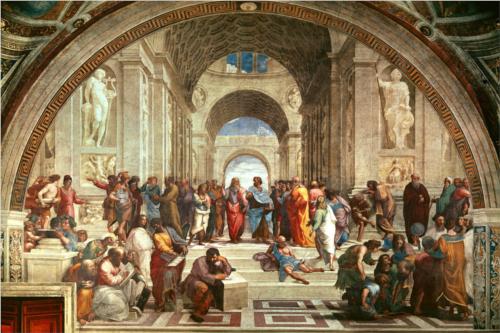
“The School of Athens“ (1510-11)
_________
the Philosophers’ World Cup – Germany vs. Greece,
enjoy the live action
the Philosophers’ World Cup – Germany vs. France,
read the debate
existentially yours
Richard
“The School of Athens“ (1510-11)
_________
the Philosophers’ World Cup – Germany vs. Greece,
enjoy the live action
the Philosophers’ World Cup – Germany vs. France,
read the debate
existentially yours
Richard
though there have been gems among
the performances presented during
Stage l of the 14th Arthur Rubinstein
International Piano Master Competition,
in Stage ll each contestant has been for
me outstanding, I’ve now seen six of
the 16 remaining contenders out of the
original 36, 20 are gone, cast away by
the 7 judges
Natalia Sokolovskaya had mightily
impressed me at Stage l with,
especially, her own “8 Variations
on a Theme of Paganini” (at 15:00
minutes on the tape), you’ll remember
Rachmaninov’s “Rhapsody“ on the
same theme, but for entire orchestra,
Sokolovskaya writes hers for piano
alone, the original theme, from
Paganini’s 24th Caprice, had been
of course for violin
at Stage ll her Rachmaninov First
Sonata (at 20:00 minutes) is
transcendent, surely definitive, this
is the one I’m going to remember
her Spanish pieces (at 10:00), a
couple of compositions by Albéniz,
are a wonderful break from the often
very abstract other works on offer,
with their immediately captivating,
beguiling, indeed seductive, rhythms
she even makes the very trite
“Reflections on Love” (at 00:00), a
condition of the competition, credible,
by spacing its interchangeable
movements, pausing between them,
letting them breathe, in order to
separate the varied “Reflections”,
instead of stringing them all together
as a continuous, rather than discrete
elements of a, considered whole, as
all the other performers have to date
reflexively done
no one has written anything pertinent
about love, musically, since Chopin,
with the exception of often enough
Rachmaninov, to presume to
significantly comment on love is, to
my mind, pretentious, calling for a
fall, this composer is no exception,
her thoughts are to be expected, love
is atonal, arhytmic, loud, soft, tender,
tempestuous, strident, placating
but everyone already knew that
Sokolovskaya gives the “Reflections”
dignity nevertheless despite their
overt pretensions
Richard
one of the benefits of watching a piano
competition, or any recital, or concert,
for that matter, is in finding gems you
wouldn’t otherwise have heard of
at the 14th Arthur Rubinstein International
Piano Master Competition held only last
month, May, Sun Yutong delivered a
riveting Ligeti, “L’escalier du diable”,“The
Devil’s Staircase”, great, incidentally, title
here’s Sean Chen doing the same piece, if
you don’t have time for the extraneous
elements of a competition, however
meritorious this exhilarating presentation
might’ve been
cheers
Richard

“The Blue Boy (Portrait of Jonathan Buttall)“ (1770)
____________
if you’ve missed me lately, it’s because I’ve been
in Tel Aviv for the past week, virtually of course,
taking in the 14th Arthur Rubinstein International
Piano Master Competition, and they’re not kidding,
every challenger to date has been at the very least
astonishingly dextrous, sparkling even, though
some have been hampered by their own dire
program, with the unfortunate added condition
that, for all, they must integrate one of two
commissioned works that, to my mind, are
completely uninspired
other performers have been astounding, lots
of Beethoven of course, Chopin, Liszt, the
technically utterly daunting
among the moderns Ravel takes centre stage
as an option, with too many, to my mind, of his
tedious pieces,“Gaspard de la nuit”, yawn,
“La [, yawn again] valse”
but Bartok pops up, and Prokofiev, a great set
of variations by Szymanowski, unexpectedly,
and, at one point, a completely irresistible
Ligeti, more of which later
Nikolay Khozyainov starts with the only Ravel
I’ve been able to sit through without getting
impatient, “Gaspard de la nuit” to my mind
should stay there, “La valse” should
immediately stop, but Khozyainov‘s “Pavane
pour une infante défunte”, or “Procession for
a Deceased Princess” was everything you
would want in a dirge, solemn, transcendental,
transfixing
he follows up with a Liszt to knock your socks
off, “Feux follets”, “Fireflies”, fleet as the night
air, as mesmerizing
the final Rachmaninov sonata reminds us of
how wonderful Rachmaninov really was
Richard
in juxtaposing inadvertently recently
Pink Floyd’s “Dark Side of the Moon”
with Beethoven’s String Quartet no 14
in C# minor, opus 131, I was once again
struck by how one resembled implicitly
the other, both had achieved structurally
an operatic concert, an original musical
form for each their epoch, a piece of
instrumental music – with, even with
Beethoven eventually, voice – see his
9th Symphony for that – in the form of
opera
stay with me
songs started off as ditties, see, for
instance, in our time, “She Loves You“,
the Beatles, in Classical music that’s
the equivalent of a Mozart sonata,
quick, easy to hum along with, and
spirited
then “MacArthur Park“ came along, in
1968, with a song twice the length,
seven minutes and some, of anything
heard before, check out Jimmy Webb,
Richard Harris, and the process
that sounds a lot like Beethoven, I
thought, throw in extrapolations of
symphonic proportions and that
sounds a lot like Beethoven too,
saying, this is not just pretty, people,
it’s potentially momentous, listen
“Sgt. Pepper’s Lonely Hearts Club
Band“ then put several compositions
together, without breaks, to give us
the first concept album, an
uninterrupted flow of various musical
ideas held together by an, however
inexplicit, theme
or “MacArthur Park“, in other words,
amplified
in 1826, it had been Beethoven’s 14th,
where all this started out, no one had
ever done this sort of thing before,
confounded so intimately contrasting
musical forms, but he’d got it from
the Christian Mass
thus Beethoven, a secular prophet
and thus, in his eminent footsteps,
Pink Floyd, solely, among
contemporary artists, addressing
God
it all seems nearly inevitable today,
but it was 1968 then, a time of, if
you’ll recall, revolution
and all of these had been, for better
or worse, once again, our rallying
cries, anthems, towards a better
world
Richard
to get your summer groove on,
you’ll surely want to listen to this,
just click
then again, you just might find
that “you may never leave”
Richard
psst: “Hotel California“, another, wonderful, dramatic monologue
On a dark desert highway, cool wind in my hair
Warm smell of colitas, rising up through the air
Up ahead in the distance, I saw a shimmering light
My head grew heavy and my sight grew dim
I had to stop for the night
There she stood in the doorway;
I heard the mission bell
And I was thinking to myself,
“This could be Heaven or this could be Hell”
Then she lit up a candle and she showed me the way
There were voices down the corridor,
I thought I heard them say…
Welcome to the Hotel California
Such a lovely place (Such a lovely place)
Such a lovely face
Plenty of room at the Hotel California
Any time of year (Any time of year)
You can find it here
Her mind is Tiffany-twisted, she got the Mercedes bends
She got a lot of pretty, pretty boys she calls friends
How they dance in the courtyard, sweet summer sweat.
Some dance to remember, some dance to forget
So I called up the Captain,
“Please bring me my wine”
He said, “We haven’t had that spirit here since nineteen sixty nine”
And still those voices are calling from far away,
Wake you up in the middle of the night
Just to hear them say…
Welcome to the Hotel California
Such a lovely place (Such a lovely place)
Such a lovely face
They livin’ it up at the Hotel California
What a nice surprise (what a nice surprise)
Bring your alibis
Mirrors on the ceiling,
The pink champagne on ice
And she said “We are all just prisoners here, of our own device”
And in the master’s chambers,
They gathered for the feast
They stab it with their steely knives,
But they just can’t kill the beast
Last thing I remember, I was
Running for the door
I had to find the passage back
To the place I was before
“Relax, ” said the night man,
“We are programmed to receive.
You can check-out any time you like,
But you can never leave! “
is this a dramatic monologue, I asked
it depends on who you think she’s
talking to, I answered
cheers
Richard
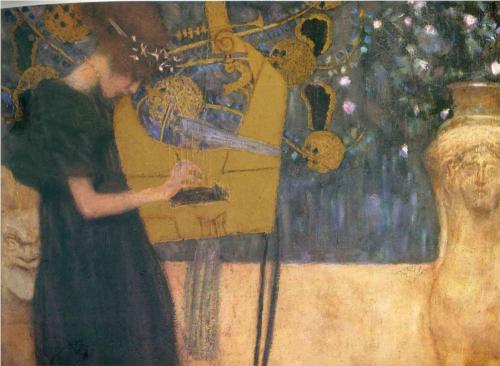
“Music“ (1895)
______
not for lack of imagination, lately, but for,
rather, lack of confidence, the complaint
of any would-be poet, the complaint of
any proponent of oneself, one’s persona,
one’s own, however benign, however even
benevolent, ideas, I retreated into myself,
surrendering to forthright inspiration for
any, elusive enough, courage
inspiration, through its usual unsuspected
channels, and as ever categorically, gave
me, reliably, “Music“, Klimt‘s ineluctable
masterpiece, not even for its iconic image,
but for its transcendental comment on
art’s interpretive counterpart, music
world’s meld
a “magical mystical miracle” happens, as
Katharine Hepburn, in her utterly
enchanting movie, “Summertime“,
would have it, irrepressible as ever
I had to share
Richard
psst: note the juxtaposition of contrasting
colours, patterns, impressions, note
the Baroque presentation of Classical
imperatives, touched with Romantic
sensibilities, kicking off, not
incidentally, Modernism
Dear Richard:
The lyrics don’t make sense to me from a Mexican perspective. They do from a Spanish Republican perspective, particularly as they were written by a European from a country which decidedly was on the Republican side in the Spanish Civil War, at a time in recent history when Spanish Republican veterans could finally come out into the open (i.e. after Franco died and a constitutional democracy was established in Spain).
It would be interesting to find out for sure.
_________________
do you think this might help, Jim, just click
Richard
psst: a great read on the consequences
of the Spanish Civil War, by Javier
Cercas, “The Anatomy of a Moment“
 Richibi's Weblog