“Poème d’amour” – Hans Hofman
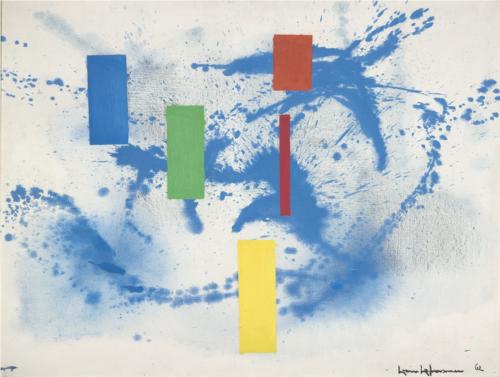
“Poème d’amour“ (1962)
______
this “Love Poem“, “Poème d’amour“,
challenges our preconceptions
is this painting a poem, what does it
say about love
you tell me
Richard
“Poème d’amour“ (1962)
______
this “Love Poem“, “Poème d’amour“,
challenges our preconceptions
is this painting a poem, what does it
say about love
you tell me
Richard
_______
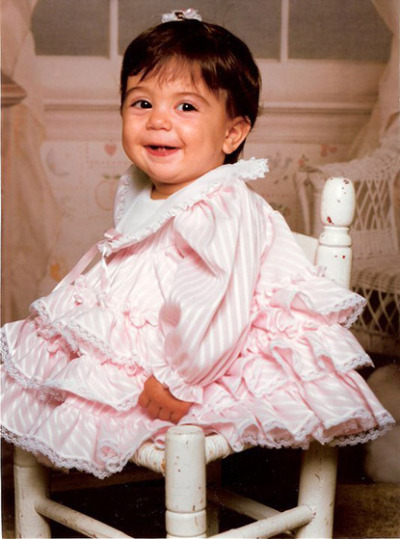
you look for poems, you find poems
this morning a friend sent me this one
can a person be a poem
you tell me
Richard
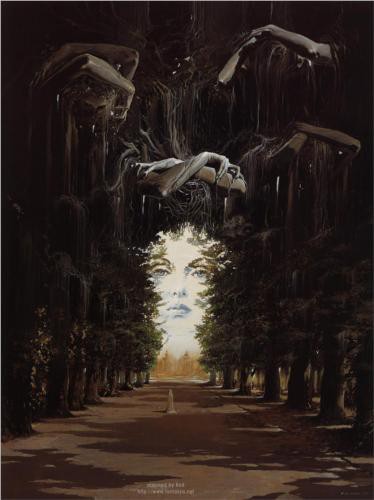
“Poème matinal“ (“Morning Poem“)
__________
looking for a poem this morning among an
array of poem paintings, I came across this
morning one to start my day, evidently also
to share
this could be any street in Vancouver right
now, where the trees overwhelm the streets,
where branches like arms bless even the
very pavement, where magic lurks in every
indentation of the leaves
you look for poems, you find poems, I say,
even in paintings, even in innocent trees
Richard

“Poèmes barbares“ (1896)
_______
if you thought that Arno Babajanian was
done with synesthetic investigations,
seeing sounds, hearing colours, here’s
his “Six Pictures for Piano“, which he
plays, all of them, himself
can a piano paint, take pictures
you tell me
something else interesting is happening
here, the six are individual pieces despite
being part of a common whole, as the title
suggests
this is the opposite of trying to integrate
movements to a continuous and unfolding
conception, something Beethoven, for
instance, pursued, indeed ardently, in his
own sublime music
dissociation seems a context, a XXth-,
a XXlst-Century, context, in our presently
more polarized world, according to, of
course, Babajanian
what might hold us together then
maybe music
incidentally, the movements to the
“Six Pictures“ here are
1 – Improvisation
2 – Folk Song
3 – Toccatine (a little toccata)
4 – Intermezzo
5 – Choral
6 – Sasoun Dance (don’t ask),
should you not be able to read Russian
note, none of these themes are
photographic
don’t either miss Babajanian‘s
“Sonata for Violin and Piano“
as played by, here again,
himself, it’s rapturous
Richard
psst: see Gauguin above paint poems
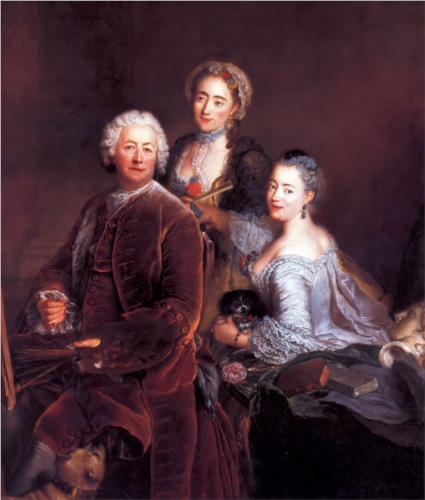
“Self-portrait with Daughters“ (1754)
______
for fathers, especially, and daughters
and all those who love them
just click
Richard
psst: in the spirit of Brain,
worthy contenders from
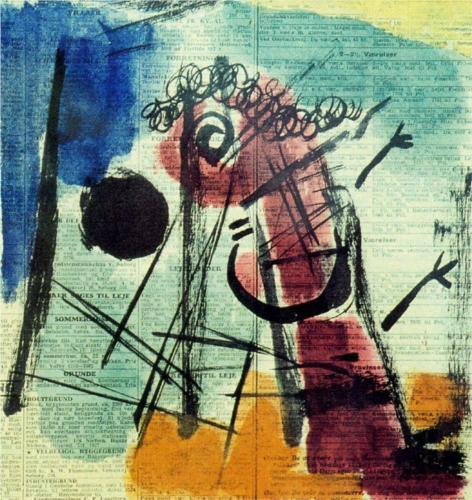
“Music“ (1949)
______
in the spirit of unusual juxtapositions,
the very stuff, let me suggest, of art,
here’s a “Poem for Piano, in C# minor“,
by Arno Babajanian, an Armenian
composer, 1921 to 1983, played by a
countryman of his, Armen Babakhanian
a “Poem for Piano“ begs the question,
what is a poem, can a poem be devoid
of stanzas and words, can music be a
poem
you tell me
Richard
psst: can music, incidentally, be a painting,
see here, or above
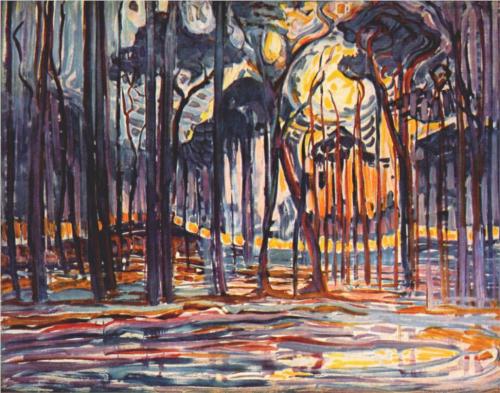
“Woods Near Oele“ (1908)
______
if my last entry was about an “Étude
in the Form of a Waltz“, an unlikely
combination, here’s an essay in the
form of a poem, kind of like my
own stuff
Richard
______________
At dawn when rowboats drum on the dock
and every door in the breathing house bumps softly
as if someone were leaving quietly, I wonder
if something in us is made of wood,
maybe not quite the heart, knocking softly,
or maybe not made of it, but made for its call.
Of all the elements, it is happiest in our houses.
It will sit with us, eat with us, lie down
and hold our books (themselves a rustling woods),
bearing our floors and roofs without weariness,
for unlike us it does not resent its faithfulness
or question why, for what, how long?
Its branchings have slowed the invisible feelings of light
into vortices smooth for our hands,
so that every fine-grained handle and page and beam
is a wood-word, a standing wave:
years that never pass, vastness never empty,
speed so great it cannot be told from peace.
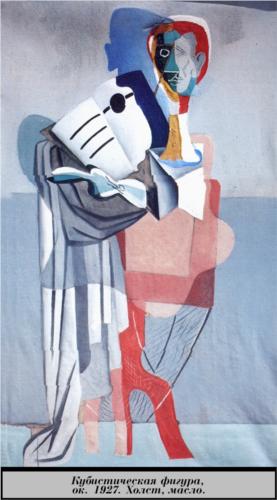
“Homage to Erik Satie“ (c. 1926)
________
the very variety, the infinite variety,
of possibilities in music, in any art,
in any craft, in any even venture,
has had me believe in a diversified
world rather than the monotheistic
one we’ve been trained to ascribe
to, I believe in Olympus rather than
in Purgatory, Hell, and Heaven, I
see many more variations on a
theme, always, than immutable
objects, we are even ourselves in
constant, ever evolving, flux, look
at me, I’m not the boy, not the even
young man I used to be, though I
was never, of course, as wise as
I am now, later in life, or so I feel
I can continue to tell myself, ha ha
on this multiplicity read the
accomplished and convincing
Martha Nussbaum, incidentally
as an example of this exuberant
fruition consider this wonderful
interplay of artists and forms,
Ysaÿe‘s “Caprice d’après l’étude
en forme de valse de Saint-Saëns“,
“Caprice on the Study in Waltz
Form of Saint-Saëns”
here’s the study, “Étude en forme
de valse, op 52, no 6“, from which
it’s taken
don’t overlook either the “exuberant
fruition” above, the Dali on Satie
or find it again right here, just click
Richard
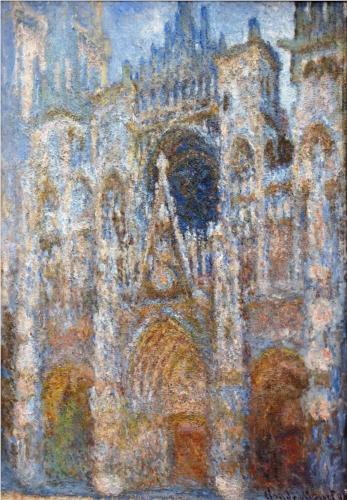
“Rouen Cathedral, Magic in Blue“ (1894)
______
up until now I’ve presented dramatic
monologues, but only to music, on my
blog, referring to Robert Browning as
their originator, but not ever producing
any representative spoken work, never
mind any of, themselves, the poet’s
seminal masterpieces, “My Last
Duchess“, “Fra Lippo Lippi“, “How
They Brought the Good News from
Ghent to Aix“, for instance, which,
granted, can be daunting now in their
breadth and erudition, the Romantics
didn’t have television, they had to
entertain themselves
here’s a poem for our time, written
in 1996, only two decades ago, gasp,
Lisel Mueller imagines herself Claude
Monet, an easier concept, after all,
who’s been to Ghent or Aix, why
would anyone want to run there,
whereas Monet‘s another story, who
doesn’t today know Monet
Monet was blind at the end of his life,
one learns from the website where I
got this, a blog with plenty of breadth
and already considerable erudition, he
received corrective surgery to be able
to continue with his work
there was, however, a limit
Doctor, you say there are no haloes
around the streetlights in Paris
and what I see is an aberration
caused by old age, an affliction.
I tell you it has taken me all my life
to arrive at the vision of gas lamps as angels,
to soften and blur and finally banish
the edges you regret I don’t see,
to learn that the line I called the horizon
does not exist and sky and water,
so long apart, are the same state of being.
Fifty-four years before I could see
Rouen cathedral is built
of parallel shafts of sun,
and now you want to restore
my youthful errors: fixed
notions of top and bottom,
the illusion of three-dimensional space,
wisteria separate
from the bridge it covers.
What can I say to convince you
the Houses of Parliament dissolve
night after night to become
the fluid dream of the Thames?
I will not return to a universe
of objects that don’t know each other,
as if islands were not the lost children
of one great continent. The world
is flux, and light becomes what it touches,
becomes water, lilies on water,
above and below water,
becomes lilac and mauve and yellow
and white and cerulean lamps,
small fists passing sunlight
so quickly to one another
that it would take long, streaming hair
inside my brush to catch it.
To paint the speed of light!
Our weighted shapes, these verticals,
burn to mix with air
and change our bones, skin, clothes
to gases. Doctor,
if only you could see
how heaven pulls earth into its arms
and how infinitely the heart expands
to claim this world, blue vapor without end.
Richard
psst: thanks Brain for this beautiful poem
this is for Brain, who, according
to its response to my last blog,
is about to explore Chopin, a
transformational experience,
which I’d like to encourage
and heartily abet
____________
watch, be transported
Evgeny Kissin at the piano, Zubin
Mehta conducts, Chopin’s First
Piano Concerto, an indisputable
masterpiece, just click
before this performance I will remain,
uncharacteristically, mum, let Chopin
speak for himself, from the early
Nineteenth Century, letting us know
what they were up to then
it appears to have been utterly
astonishing
Richard
psst: thanks Brain
 Richibi's Weblog