Richibi’s Weblog

Just another WordPress.com weblog

Category: in search of beauty

Diane Arbus – 1923-1971

     Diane Arbus, Identical Twins, Roselle, N.J.

                                    “Identical Twins, Roselle, N.J.“, 1967
 
                                                        Diane Arbus  
                                                                                                                                                                                                                                                                                                                   1923 -1971
                               
                                                          _______
 
                                                                                                                                                                                                                                                      with the camera the shutter becomes the brush, the art only a click away, the artistry, the creativity, debatable
 
where is the skill, the ingenuity, indeed the art
 
the snapshot is a picture of an imagination taken on the spot, the art must be in the very brain, not in, as one would expect, the dextrous fingers, the articulation, the prestidigitation, must be already sorted out, already calibrated, technical prowess not required, just able, artful observation
 
the shutter will do the rest
 
can a point of view then, a take, one will reasonably inquire, be art

 
Diane Arbus had been a fashion photographer, gave it up for something, it would appear, more meaningful, became thereby, in my estimation, unforgettable, broke down for me reservations about photography as art 
 
witness
 
Identical Twins, Roselle, N.J., 1967, is not about these twins, these unexceptional twins – otherwise merely a portrait, an indifferent even portrait – but about something much more relevant
 
two little girls in black and white – though this may be itself the kind of photography – look straight into the camera, you look to tell them apart
 
their little dress adorned by each the same white ruffle at the collar, recalling incidentally the Reformation Dutch, a witty touch, give no clue, they could be matching dolls, flat cut-outs, for that matter, given the minimal use of perspective
 
a matching hair band, the same hair, the same nose, the same mouth, don’t either, the eyes do but only just 

they tell though the entire story, their different light, their different incandescence, though even ever so slight, though ever even so elusive, is what finally tells them apart 

but the focus has switched, you’re observing something now immaterial, incorporeal, insubstantial, become simultaneously something mystical, metaphysical, transcendental, some might call God  
 
Michelangelo’s did the same thing for Adam, another much wittier art history touch

 
two other girls, “Untitled“, 1970-71, speak even more clearly perhaps about this 
 
note the angel come through in the girl on the left, in all its magnificent splendour


                                           Untitled“, 1970-71
 
                                                   Diane Arbus 

                                                   1923 -1971
                                                 
                                                      _______

                                                                                                                                                                                                                                                  Diane Arbus committed suicide on July 26, 1971, undoubtedly
undone by what she’d sought to witness, perhaps the too bright light
                                                                                                                                                                                                                                                     psst: why is it that those who are “Untitled” would never think of taking their own life, perhaps they’ve been blessed with an extra measure of courage


_________________________________________________
in defence of my penchant towards prose

                                                                                                                                          in defence of my penchant towards prose


the problem with poetry ‘s the rhyme,
it takes the seriousness out of the line,
it distracts from its meaning
giving bounce to the reading
forfeiting too much, I think, of the mind
 
not that I don’t like rhythm
but it shouldn’t supplant my mission
of putting the point, the more pertinent point,  
I believe, ahead of often more frivolous composition
                                                                                                                                        forgive then my impertinent prose,
I really don’t mean to oppose,
but I think it’s my lot,
to declare my thought
with less verse
than straightforward opinion


     _______________________

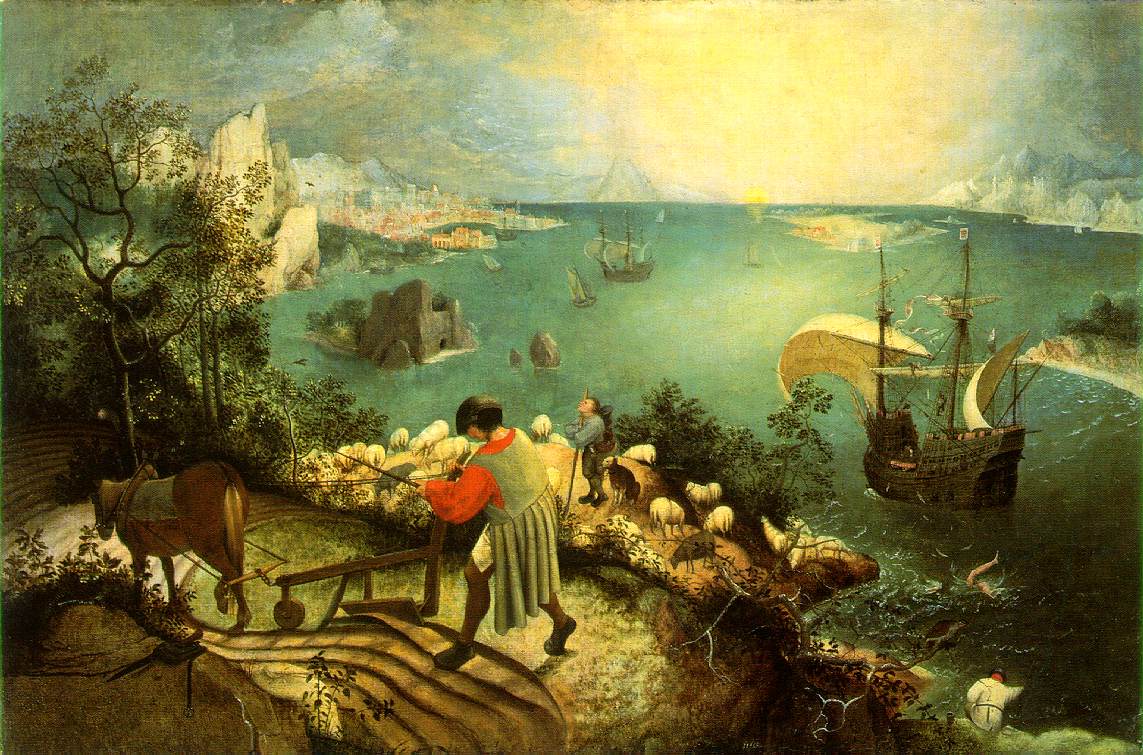
upon being asked to make a poem out of Pieter Bruegel the Elder’s “Landscape with the Fall of Icarus”

                  “Landscape with the Fall of Icarus”, c.1558

                            Pieter Bruegel, the Elder

                                    (1525-1569)

                                     __________

                                                                                                                                                                      upon being asked to make a poem out of Pieter Bruegel the Elder’s “Landscape with the Fall of Icarus”                                             

                                                                                                                                      what is a poem, the question came up around my earlier errant composition, was what I’d written a poem, though one could be made out between the, dare I say, ivied even cracks
 
something that rhymes, my mom answered when I asked, which mine of course didn’t
 
though mellifluous and rhythmic maybe, and peppered here and there with inventive and artful devices – metaphors, alliteration, onomatopeia, the like, the meat and potatoes, the very stuff, I think, of poems – I still didn’t rhyme, don’t rhyme, and run a sentence on mostly much too long for a proper pentameter
 
like, I guess, a prose poem 
 
or maybe even just prose
 

but about the Bruegel


at the back a radiant sun dominates the picture, sheds not only light but life on everything, the sky is thick with grays and blue and takes on actual dimension, whereas a more silken application of paint to the sun makes that orb evanescent, a portal into heaven, a source instead of a force, an opening instead of an engine
 
in the foreground a farmer ploughs his field, another tends his sheep, life is going on despite the splendour 
 
no one notices Icarus either, the flailing figure in the waves, bottom right, drowning, despite the might of the myth, the potency, the poignancy, of the poetry
 
but who notices even poetry 
 
 
across a stretch of water to the horizon and to at its edge the resplendent sun, ships with sails, indeed medieval galleons, sit in the placid harbour of a city in the blue crook of, upper left, a range of mountains, the City of God of Augustine maybe for its iridescent pastels, for its sunlit gold maybe the gilded Greek Atlantis  
                                                                                                                                                                       above the flailing Icarus a ship is setting joyful sail out towards the promise of the blazing sun, the way seems clear

there will be other, it appears, Icaruses

                                                                                                                                                               medieval caricaturization and perspective inextricably of course obtain throughout


    __________________________________________

ekphrasis

                                                                                                                                 ekphrasis

                                                                                                                                      poring among the possibilities the nearby university had to offer – they’re listed in a catalogue they seasonally send around – one on poetry, of course, how to make one out of a painting, stood out, how to make of something visual, a Monet, a Van Gogh, a Renoir, a poem 

ekphrasis, there’s a word for that, I thought

and ate it up

the picture I got to ekphrase, my word for that, was one of a set the teacher sent around of Kobayashis, snapshots, I’d never heard of him, her, either, Milt Kobayashi, all of them intriguing

I quickly snapped one up, letting my instinct instead of my judgment pick it out – I find it’s usually more accurate – in order to keep the ball rolling, not slow things up

a waif in especially blue, the colour also of chairs behind her – like skies in winter, I thought, when the pressure’s up and the light is pale, colours aren’t crisp but muted – making that sort of association, hoping that wouldn’t be unintelligent

rudimentary roses, wine red, spotted here and there her blue skirt, more like patches than ornamental flowers, a black top the colour of her jet black hair was cut low in a U at her neck, she leaned against a wall, itself nondescript, at the right of the picture, her left, far to that side, and in her own black shadow there splashed upon the wall, a fathomless apparently abyss, seemed to find refuge, a respite, like a womb, pushing herself and it nearly right out of the picture

her arms were crossed, but one reached for her shoulder, lightly resting there, covering inadvertently, or not, her chest, and by my inference her soul, her modesty, her bosom, whereupon, like Michelangelo’s God touched Adam, with love, light and understanding, inadvertently again or not, she touched mine

and her black, plaintive eyes were looking right back

                                                                                                                                     there’s next to nothing on the spartan walls, the table is somewhat set, but light reflected off some glasses there, and dishes, is gleaming, like in Dutch still lifes, artfully, and delightfully

“The Last Table” it’s called, though I’m not too sure what that’s about, a waitress calling it a day, a playful reference somehow to da Vinci’s “The Last Supper” maybe 

that’s what I’d have to make into a poem, ekphrase


  _____________________________________________

finding miracles

these earlier “back tracks“, of which the following is one example, are pieces I consider still to be worth your while

please enjoy

                        _______________________

                                                                                                                                                                                                                                        November 9, 2006

                                                                                                                                                                                                                                                  this has been a year of only a clutch of miracles

of course they always abound, but some years, beset by crushing ordeals, miracles seem few and far between, and pale and falter beside the anguish and despair you suffer

 yesterday I marvelled at the colours of the leaves, the reds, the golds, the purples, that still and magnificently clung to the branches of much thinner trees now that they had lost the weight and splendour of their foliage

the sun upon the colours made them quiver, gleam, glimmer

look, I told my walking mate, a painting, and spread my arm across the panoply that contained what I saw

Monet, he replied

indeed, I said, but also Klimt, the gold, the glitter

I could barely listen on for the wonder

and Van Gogh for the branches, I continued, caught up in my world of live Impressionism, crotchety, angular, mad, I described

and there are millions of these leaves, I went on, transported beyond Impressionism into verily awe, not two of them alike, an infinity of numbers

that’s a miracle

                                                                                                                                                                                                                                                     a day earlier a friend had come over to lunch, after which we’d amble on over to the art gallery for an exhibit that was on

a gull sat on the ledge of my window, at my aerie on the twelfth floor

maybe it’s your father, she said

maybe, I replied, but couldn’t then and there make the connection

it stayed long enough for her to mention it again after I’d gone on for some time more, she was facing the window, I was not, I’d returned to our conversation

the gull looked in, on, curious, spirited

but I still saw just a gull
                                                                                                                                                                                                                  

last   evening I remembered that it would’ve been my parents anniversary had my father survived, called my mom, asked her out, we had dinner nearby, the date had slipped me by

                                                                                                                                                                                                                                            later still I remembered about the gull, who perhaps had not forgotten


                              _________________________________________

Robert Frost

intent this week, as always, on filling my world with poetry, indeed on becoming, learning to be, in fact, a poet, a dream I’ve had for a long, immemorial even, time, I registered for, then found myself in, a class on five early twentieth-century American poets – Robert Frost, Ezra Pound, T.S. Eliot, e.e. cummings, Wallace Stevens – given at the university downtown, I hoped for guidance there and some inspiration

the day was promising, the clouds were rolling by that had settled over the town, clung to it for several days now tenaciously, cherry blossoms heavy on every street awaited merely the unfettered sun to become truly and magnificently enchanting, I did a stint at the courtroom in the morning where my client didn’t show, would’ve interpreted back and forth between French and English for him, her, but left after the time it took for the judge to deliver a warrant, and for the day to have become in the interim glorious  

I’d worn a blue and white check shirt, a golden tie with a spray of countless blueberries on it, under, for the sober air of the judiciary, a tweed sportsjacket, round horn-rimmed glasses made me look, I felt, intelligent, academic, professorial

but a wine-red paisley umbrella touched with royal blue and sandy squares prepared me, I was sure, for an afternoon of poetry instead, fantasy, imagination, not to mention rain should it, however improbably, turn wet, and I knew the courtroom would’ve been able to use some of its fanciful serendipity 

I’d ventured forth therefore ready for any- and everything

                                                                                                                                    not for Frost though, who left me cold

how do you make him relevant, I asked, when the professor looked to us for comments, he’d been reading him merely, one dreary poem after another, waiting for us to break in, we’d been, or I’d been, sitting patiently, deferentially silent

is he only of historical interest or is there anything for us here, in the twenty-first century

the professor, a man with impressive credentials, appeared somewhat non-plussed, expecting reverence, I suspect, for what I considered to be twaddle, the stodgy meanderings of an old colonial man scratching out awkward rhymes in the middle of the night, something Walt Whitman had done supremely well already in his inspired poems, and Mark Twain in unforgettable, witty, pithy, pungent prose   

some in the class tried to pick out some perhaps worthy passages but floundered ultimately in a dearth of them, little by little we came to find Frost not especially pertinent or memorable, not to mention mostly curmudgeonly

here’s one however I found not bad you might’ve read, maybe even enjoyed, as I in fact did

                                                                                                                                    The Road Not Taken

Two roads diverged in a yellow wood,
And sorry I could not travel both
And be one traveller, long I stood
And looked down one as far as I could
To where it bent in the undergrowth;

Then took the other, as just as fair,
And having perhaps the better claim,
Because it was grassy and wanted wear;
Though as for that the passing there
Had worn them really about the same,

And both that morning equally lay
In leaves no step had trodden black.
Oh, I kept the first for another day!
Yet knowing how way leads on to way,
I doubted if I should ever come back.

I shall be telling this with a sigh
Somewhere ages and ages hence:
Two roads diverged in a wood, and I –
I took the one less traveled by,
And that has made all the difference

Robert Frost

                                                                                                                                    later at home I took on the more promising Pound

                                                                                                                                  yours in art and poetry                                                                                                                                    richibi

                                                                                       ______________________________________


yesterday – December 28,2006

           Girl Reading a Letter at an Open Window, 1657

                                Johannes Vermeer

                                    (1632-1675)

             ______________________________________

these earlier “back tracks“, of which the following is one example, are pieces I consider still to be worth your while
please enjoy 
             
                       _______________________
December 28, 2006
                                                                                                                                                                  yesterday for the first time it snowed, as I left the apartment a light but steady moisture began to fall that I suspected might be more than rain, sure enough by the time I´d walked the several minutes to the number 8 which would take me to the Old Masters Picture Gallery, the Gemäldegalerie Alte Meister, in the Zwinger, snowflakes swirled about us like whirling dervishes, light in the flustered air and as merry and playful as the season 
I hopped the Strassenbahn, the tram, which sleekly sailed us along to, then a short length of, the river, which was shrouded there by thickets of trees, but as we turned onto the bridge, the Augustusbrücke, the stately steeples and spires of the Altstadt appeared magically transformed into the enchanted setting of a fairy tale, sprinkled with the dancing fairy dust of the very Brothers Grimm
I got off beside the Catholic Cathedral, St Trinitatis, built in 1738 to 1755, heavy with age, light with spirit, its saints and significant clergy standing watch along the balustrade that lined and determined its roof, surely the bells were ringing but I can´t say for certain, the music was all in my eyes
across the cobblestone square before the Semperoper – the Opera House that Gottfried Semper built between 1838 and 1841, rebuilt from 1871 to 1878 by his son after it burned down in ´69 – people were scurrying about, taking pictures, catching their own trains, while flanking the building´s entrance Goethe and Schiller stood watch, impervious and staunch, beneath the steady and playful flakes, they bore the white frost upon their shoulders and pates with patience and resignation
further along the walls but protected by the shelter of each their private stone niche, Sophocles and Shakespeare to one side, Euripides and Molière on the other, sat soberly watching, unruffled, the snow fall
next door the Zwinger warmly awaited, I checked my coat and scarves with the hat check girl I´ve befriended there, she eagerly announced to the others that I was her friend, I´m sure I smiled and blushed, then made my way to the section I was exploring that day
of the many paintings in a room I always choose the one that I would like to take away more than any of the others, that way I need to examine them all, sometimes even closely
yesterday I quickly passed on a Cornelis Corneliszoon van Haarlem, “Venus, Bacchus and Ceres”, all heavy-haunched and cornucopian, a bird concert complete with sheet music in the trees by a Melchior de Hondecoeter no less, I spent some time with Mathias Stom´s “Old lady with a Candle”, which seemed to owe a lot to Rembrandt or he to him, with Jakob Isaacksz Ruisdael´s “The Hunt”, a dark but stirring landscape with a huge tree dominating the centre and reflected subtly in a river that rippled at its root, a deer was trying to flee across the foreground hunters approaching
a couple of Vermeers were of consequence, one, “The Procuress”, a madam in other words, accepting guilders from a group of men, one of them being so bold as to fondle her breast, left me surprised at so untypical a work of his, but another of a girl reading a letter at a window, replete with his tapestries and textures and a more modest and composed young woman intent on the message that she held, was nearly my first choice, her soft reflection in the open latticed windowpane was genius
 
but a Salomon de Bray, a name unknown to me, had painted in the mid sixteen-hundreds a young man with a crown, but of black roses, the youth could not have been very old, an open mouth spoke of being still eager and curious, age shuts men up and makes them open up only to declare, propound, pontificate
he´d turned to one side so that his neck was lithe and swift, probably alert to a sudden sound, a staff he held in strong but still supple hands suggested he was a wanderer or a shepherd
a white undershirt was mostly buttoned up but a string had not been tied at its neck, its either ends hung loose above another darker red shirt, equally not quite fully buttoned, there was no suggestion of a breast but only the soft spread of the clavicles
I would´ve taken him home
the crown of roses of course sported thorns in fresh, clean, but unguarded hair, the reference was unmistakable
                                                                                                                                                                    from a window I watched the thick snow still fall, the ground was covered, but left were the precise lines of the pristine architecture under the icing that outlined its edges
the sages and the deities at the Zwingers own many parapets looked timelessly, unswervingly, on
                 __________________________________________                                                                                 
though the Old Masters Picture Gallery, die Gemäldegalerie Alte Meister, will not allow transfer of their artworks to personal blogs, their entire collection is available through their own website, which I’ve linked you to here, click “Online-Gallery” at the home page, there under Gemäldegalerie Alte Meister click “motivliste anzeigen“, “show collection“, make your way through the 64 “Seiten, “pages“, of masterworks
thoroughly enjoy
                                                                                                                                                                  yours in timeless art                                                                                                                                                                   richibi
                                                                                                                   __________________________________     

C*r*s*mas greetings from Dresden, December 24, 2006

Bellotto Bernardo - Dresden Elbufer

    View of Dresden from the Right Bank of the Elbe with  Augustus Bridge

                                                        (1748)                      

                                                 Bernardo Bellotto

                                                      1720 – 1780

                          _________________________________

                                                                                                                                                                                                                                           these earlier “back tracks“, of which the following is one example, are pieces I consider still to be worth your while

please enjoy

                        _______________________

                                                                                                                                                                                                                                       December 24, 2006

through the good graces of a dear friend, a lady I met last year, my teacher in German at the Goethe-Institut, I´ve been afforded the wonderful opportunity of spending the next several weeks, while she is away with her family in their hideaway in rural Belgium, here in shimmering Dresden, the jewel, I´m sure, of central Europe, I´d already rendered her the use of my own apartment in Vancouver when in September she came to visit and I could use my mom´s place while she was away touring for most of the month the Iberian peninsula, Spain, Portugal, as well as, across the strait, Morrocco

Dresden celebrated its eight hundredth anniversary this year and, though its buildings don´t date back that far, much of it has worn its architectural robes several centuries, the Zwinger, Dresden´s answer to Versailles, was built from 1609 to 1611, I was yesterday informed as I marvelled at the Bernardo Bellottos, Canaletto the Younger, the Elder´s nephew, who was court painter there, I believe I understood through a charming attendant´s perhaps too rapid German, and whose views of the city then were as detailed and precise as his uncle’s famous masterpieces of Venice, their styles are indeed so similar that until recently I´d believed, to my great embarrassment when I found out they were not, that they were one and the same, that the uncle had spent time in both Dresden and Warsaw, which he had not, the nephew rather had, I inadvertently discovered in a book I read on Dresden that cleared everything up, the one had superseded the other, channelled him there, more darkly perhaps due to those cities’ darker tones, but not at all less brilliantly 

not only the Canalettos of course but many other masters adorn the Zwinger, the city´s most sumptuous art museum, the Madonna of the Sistine Chapel of Raphael (which you’ll find below) with its couple of attendant cherubs for instance holds a place of the highest honour, and during the past couple of days I took in a wonderful exhibition of Cranachs there, both the Elder and the Younger, was mightily impressed by the latter´s “Adam” and “Eve”, which tall, naked, and still innocent beneath their modest leafy branches, graced either side of a doorway that led onward through a row of precisely positioned doors partitioning a long narrow corridor into a series of smaller rooms that seemed infinite, like a mirror reflecting itself in a mirror, in a rich burgundy throughout

but on the opposite side in the next room behind the “Eve”, a demure and elegant St Catherine stood large as life leaning upon her eponymous wheel while before her she held upright a heraldic sword whose blade rested on the pebbled ground, a work of the Elder Cranach

her medieval robes were golden, as was her headdress and hair, a prim plaited bodice attested to both her youth and modesty, her eyes shy and discreet gazed softly on the beholder and upon, as in all timeless art, I´m sure, infinity

I would´ve taken her with me but am caught up in the fleeting here and now

Dresden itself is of course much reconstructed after the scandal of its destruction, quite equal I would think to the ravages of Hiroshima and Nagasaki, its center lies across the Elbe, the river that runs through the town, from the Neustadt, the New City, so called already several centuries ago

in the Altstadt, the Old City, there along the river´s opposite bank beyond the several bridges, are the exquisite Baroque structures, churches and palaces and stately buildings, that make up her glory

in the evening as the city lights are reflected in the meandering river the shimmering city achieves the quality of high art, a tribute through the ages to the very best in culture and civilization

it hasn´t snowed here yet, already on December the 24th, Christmas won´t, it appears, be white, it´ll nevertheless be for me quite special as is evident I´m sure in my attitude of awestruck reverence

may it be as well for you, may it be happy, healthy and thoroughly blessed

                                                                                                                                                                                                                                                     with all my heart

Richard


                            _______________________________________

in defense of an intractable idiom

a friend wrote: 

        ” ‘…in unforgettable spades’? “, about my “April Showers” text, which you can find below

         ‘ Words chosen in innocence or humour? ‘, he asks

                     __________________________

I reply:

neither innocent, dear Ted, nor humourous, just inadvertent, I let myself be ruled by my enthusiasm for the punchy and precise idiom   
 
even as I watched the movie I felt shame for a place, a country, that could’ve inspired such a situation
 
transformed by Al Jolson however into a glorious tribute no less to still so beleaguered a people, imitation being of course the surest and sincerest form of flattery

I think Al Jolson helped put their art on the map, up from the cotton fields and speakeasies to which it’d been relegated, if not other countries, other even continents
 
he was great back then, this movie inspired even a sequel, nominated also for Oscars, winning a couple even for the first, one for of course its irresistible, unforgettable music

thanks to Black America

                                                                                                                                                                         thank you Black America

                                                                                                                                 sincerely

Richard


        ______________________________________ 

1564, April 23

 File:Shakespeare.jpg

           ______________________________________

                                                                                                                                                                                                                                                      a friend wrote:

       “1564, April 23, Happy Birthday Shakespeare.

         Have a great day”

                                                                                                                                                                                                                                      have a wonderful day

                                                                                                                                                                                                                                      Richard

psst: thanks, Wendy


      ______________________________________