true love – an insight
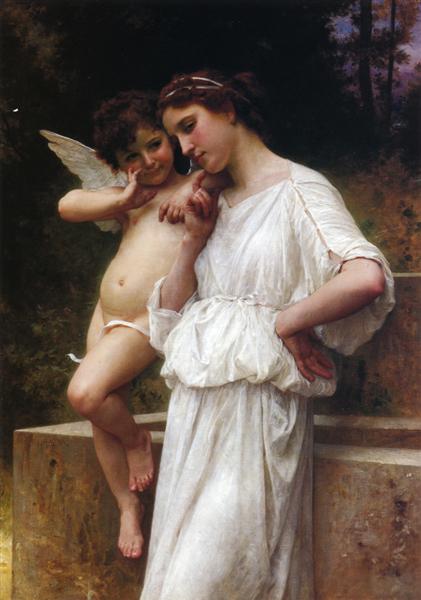
“Love’s Secrets“ (1896)
_________
the only way you can hate someone
you’ve loved is if your love was selfish,
true love can never not love, ever
Richard
“Love’s Secrets“ (1896)
_________
the only way you can hate someone
you’ve loved is if your love was selfish,
true love can never not love, ever
Richard
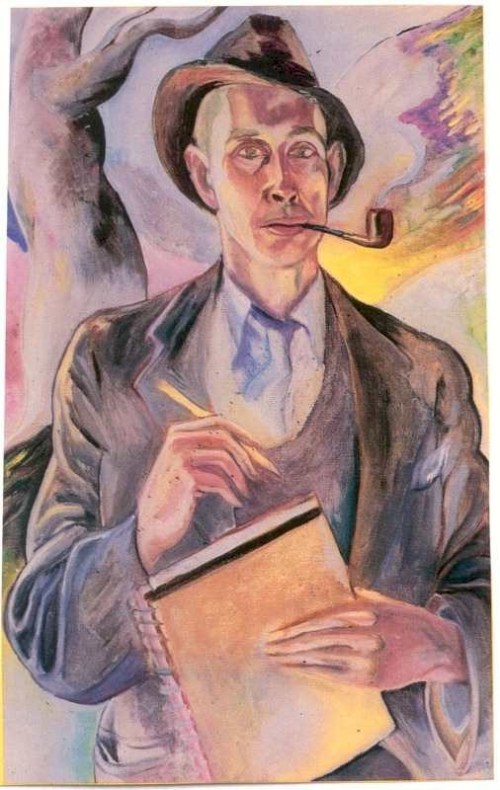
“Self-portrait with sketchpad“ (1939)
________
one of e.e. cummings‘ poems that I
didn’t know of, “i carry your heart
with me(i carry it in]“, but that is
apparently one of his most
accessible, is explored and
wonderfully deconstructed in this
video, which’ll also prove how much
we need nerds, people who’ll open
up areas of profound but murky
matter for us
[i carry your heart with me(i carry it in]
i carry your heart with me(i carry it in
my heart)i am never without it(anywhere
i go you go,my dear;and whatever is done
by only me is your doing,my darling)
i fear
no fate(for you are my fate,my sweet)i want
no world(for beautiful you are my world,my true)
and it’s you are whatever a moon has always meant
and whatever a sun will always sing is you
here is the deepest secret nobody knows
(here is the root of the root and the bud of the bud
and the sky of the sky of a tree called life;which grows
higher than soul can hope or mind can hide)
and this is the wonder that’s keeping the stars apart
i carry your heart(i carry it in my heart)
e.e. cummings
when I grow up, I want to be a nerd
Richard
psst: listen to how “the nerdwriter”, Evan Paschal,
deconstructs Donald Trump
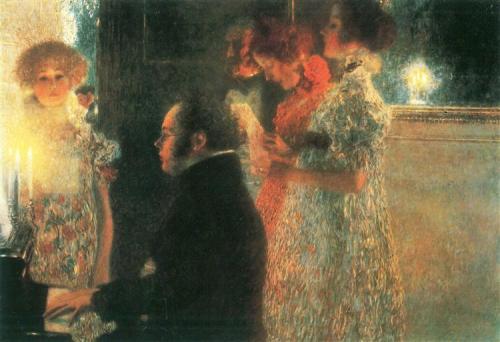
“Schubert At The Piano II“ (1899)
_______
there are reasons why an octet, a
piece for eight performers, would
be a rare occurrence in our modern
world, the most flagrant being the
sheer number of players to
assemble, all with international
commitments, and all, more
specifically, working individually,
or in smaller composites
duos can play any choice of
instruments, trios as well, but
quartets are usually, which is to
say traditionally, comprised of
only strings, first and second
violins, a viola and a cello,
these three groupings, duos,
trios, quartets, are often already
formed, play or meet together
regularly
also musical compositions for such
groupings abound, the canon is
replete with music written for two,
three or four instruments
but at five participants, a quintet,
the combinations are less stable,
there isn’t enough in the
repertoire for four strings and a
clarinet, say, to play, so that a
clarinettist must be invited in
for such an occasion, any
other alternative accompanying
instrument would be fit in as
incidentally
with six, of course, and upwards,
you get egg rolls, anything can
happen
but at eight, an octet, you need
friends, people who’ll gather from
their individual busy schedules to
perform specifically together out
of sympathy, much as friends
would’ve back in the Nineteenth
Century, before television, when
the form took shape, to socially
cut up the rug
if indeed it did take shape, cause I
can think of no other octet, off hand,
after Schubert’s glorious one
Schubert’s “Octet“, the composition,
with this particular octet, the group,
is probably the best you’ll ever hear
of either ever, Schubert’s D803 in F
major is everything you want
Schubert to be, and in a generous
indeed six movements, while
Janine Jansen and her friends, the
octet performing here, with the
requisite four strings, plus a horn,
a bassoon and a clarinet, are
magisterial, dare I say definitive,
the standard now to exceed
octets, incidentally, don’t do
encores, for obvious reasons
enjoy
Richard
psst: for a comparable congregation
of friends, see Roy Orbison’s
“Black & White Night“, equally
as improbable, epic

“The Dance of the Muses at Mount Helicon“ (1807)
________
though Zeus may preside over kings,
none other than Apollo and the Muses
preside over poets, according to
Hesiod
Kalliope, foremost of the nine Muses,
who tends specifically to kings, and
to those being born of kings, in the
company of her sisters, Kleo and
Euterpe, Thaleia and Melpomene,
Terpsichore and Erato and Polymnia
and Ourania, will pour a dew sweeter
than honey upon such a one’s tongue,
and his words become soothing,
palliative, placating
“far shooting Apollo“, however,
presides at the inspiration of poets,
lending the lyrical notes from his
representative lyre, not to mention
his lyrics, derivative both terms of
that etymological “lyre”, incidentally,
so far has Apollo “shot”, dare I say,
his spirit into our collective
unconscious
“From the Muses and far-shooting Apollo
are singers and guitar-players across the earth,
but kings are from Zeus. Blessed is he whom the Muses
love. From his mouth the streams flow sweeter than honey.
If anyone holds sorrow in his spirit from fresh grief and
is dried out in his heart from grieving, the singer,
servant of the Muses, hymns the deeds of men of the past
and the blessed gods who hold Olympus, and
right away he forgets his troubles and does not remember
a single care. Quickly do the gifts of the goddess divert him.”
Theogony (lines 94 – 103)
Hesiod
therefore poets
Richard
psst: a friend has just passed on,
it is a time for poets
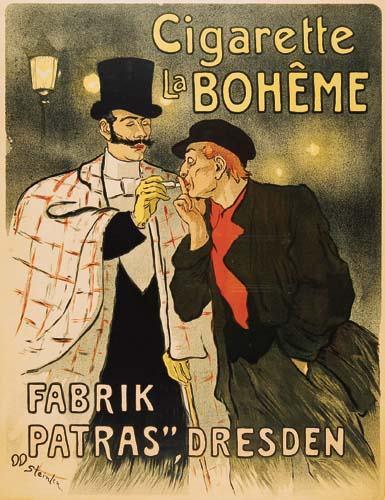
“Cigarette La Bohême“ (1879)
______
with a friend today over lunch I told
her that we’d watched, my mom and
I and a mutual friend, “La Bohème“,
an Australian production of it, Baz
Luhrmann directing, a man we both
knew, at my place last Sunday, we
were all wowed by it, I extrapolated
the only opera I’ve ever seen, she
said, was “La Bohème“
where did you see it, I asked, and
when
with my first husband, she replied,
in Vienna
was it wonderful, I inquired
it was, she answered, I had on a
long dress, my husband was in
coat and, essentially, tails, we
walked up a very long staircase,
I remember
coincidentally, the first time I’d
seen “La Bohème“ was also in
Vienna, I can’t remember the
staircase, couldn’t remember what
I wore, can’t even remember where
I was sitting, what I remember, as
though through a telescope, darkly,
was Mimi and Rodolphe looking for
the key she’d lost, on their knees
on the floor, in the dark cause her
candle ‘d gone out, he’d put his out
surreptitiously too to join her
your little hand is so cold, he sings,
when he, unforgettably, finds it
in this production, Rodolphe has
found the key but conceals it
from Mimi until she sees it in his
eyes, he pretends to return it but
instead manages to hold her
hand
your little hand is so cold, he
sings, again unforgettably
there’s nothing to fear, he
continues, the moon is out, let’s
get to know each other
who am I, he asks, to start the
conversation, I am a poet, he
declares, and proceeds to tell
us what it is to be a poet
you’ll be utterly enchanted
tell me about a world, I ask,
without poets, tell me about
a world without poetry
where would we be without
dreamers, I wonder, where would
we be without dreams
watch here, and wonder
Richard

“Colors For A Large Wall“ (1951)
__________
talking about walls, isn’t it only a few
years ago we were tearing one down
here is Roger Waters and several
other outstanding guest artists, in
very Berlin, July 21, 1990, celebrating
its demise
a little earlier, C***mas, 1989, only
moments after East Germans had
been allowed to visit West Germany,
essentially giving way to the
dissolution of the barrier, Leonard
Bernstein conducted Beethoven’s
Ninth Symphony, changing the
word “joy” from the title of Schiller’s
poem, appropriated by Beethoven
for his great fourth choral movement,
to “freedom”, giving new meaning,
and new life, and new inspiration,
to Beethoven’s always resounding
nevertheless masterpiece
how soon we’ve forgotten
Richard
psst: let’s paint the wall
“The Judgment Of Paris“ (1625)
___________
at the end of a long overdue visit to
a friend’s home the other night, she
asked me, did you notice their facial
skin, which of us do you think had
the best complexion, you can be
honest, she insisted
we had intended to watch the finals
of a voice competition we’d both
been following, over a glass of
wine, or two, each, when a friend
called, from, essentially, the door,
with a second friend in tow on their
way to a concert in the city
the friend of the friend, a lovely,
effervescent woman, from Poland
originally, with a story to tell of
growing up behind the Iron
Curtain, was also a beautician in
a spa she runs in a nearby resort
city
the first friend, equally effervescent,
had been telling my own friend of the
intervening events since last they’d
met, while I lapped up, more or less
by default, this other alternate Soviet
reality, perfumed as it was irresistibly
throughout with the friend’s
friend’s mellifluous Polish accent
I hadn’t paid any attention whatsoever
to skin quality apart from accepting
a spa courtesy card for my mother, who
would, naturally, be interested
my dearest dear, I answered, I am
not going anywhere near that one,
look what happened to Paris when
he fell into that trap
what happened, she asked
the Trojan War, I answered
the Trojan War, she asked
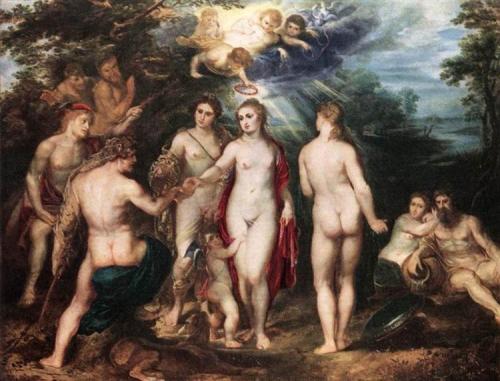
Paris was the son of Priam and Hecuba,
king and queen of Troy, I explained, he,
one of its princes, he’d been awarded
Helen, wife of Menelaus, king of Sparta,
by Aphrodite, goddess of love, he’d
chosen Aphrodite to be the most
beautiful among the goddesses, that
was her prize
but let me step back a little, I
interrupted, you need more context
Eris, goddess of discord, had not been
invited to the marriage of Peleus and
Thetis, I recounted, he a Greek hero,
she a sea nymph, parents both later to
Achilles, hero at Troy, slain, incidentally,
by that very Paris, you can read all about
it in the “Iliad“, I highly recommended
during the festivities, Eris tosses a
golden apple among the assembled
divinities, which reads
“to the fairest”
you can hear the stirrings of the much
later Sleeping Beauty, incidentally, in
this earliest of tellings, reconfigured
from the original myth
Athena, Aphrodite and Hera, all assume
they are meant to receive the apple, and
ask Zeus, father and husband, to decide
you’ll have to get someone else to touch
that one, he replies, much as I did
and delegates the task, with the help
of Hermes, the messenger god, to the
the guileless Paris, son of Priam and
Hecuba, Trojan king and queen, as I
said, he, Paris, prince
Paris was tending sheep on Mount Ida
when, fatefully, by a spring, the nubile
goddesses appeared vaunting their
unadorned splendours, stark, flagrant,
manifest, to the musical accompaniment
of the Graces, Faith, Hope and Charity,
also the Horae, the Hours, goddesses
of the seasons, maidens all in complicit
attendance
Paris, mere mortal, would never have
stood a chance
but to sweeten, nevertheless, the
deal, were it not yet sufficiently sweet,
Hera promises Paris Europe and Asia
should he choose her, Athena,
conquest in war, Aphrodite, goddess
of love, was set to give him the most
beautiful woman in the world
Paris opts for Aphrodite, and is
awarded Helen, the face that
launched the thousand proverbial
ships, the wife, not incidentally,
and completely inconveniently, of
the King of Sparta, Menelaus, who
attacks thereupon Troy with his
brother, Agamemnon, and their
allied legions, to reclaim
Menelaus’, whether abducted, or
indeed unfaithful, wife, no one
has ever conclusively determined,
Paris having been Paris
no one won
no one survived but Odysseus,
but that’s another story
I walked home shortly afterwards,
crossed my own Aegean, ten or
eleven blocks back, red lights,
nighttime traffic, watched the voice
competition I’d taped in any case at
home, whooped it up along with my
favourite contestants, drank to my
narrow miss, had gotten away, I
considered, with the equivalent of
Europe and Asia, if only in my
mind
beauty might be in the eye of the
beholder, I surmised, but it can
have its thorny indeed
consequences
Richard
“Medea“ (1898)
____________
catching up on my Greek tragedies
for a course I’m following online, I
happened upon this marvel
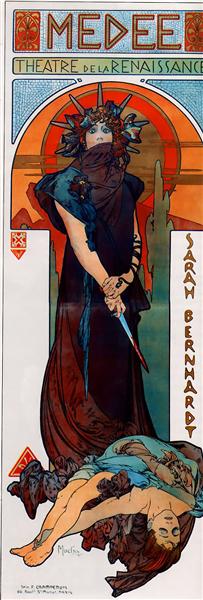
Medea, by Euripides, was written
in 431 BCE, the next significant
playwright in world history was
Shakespeare, the Dark Ages had
been “Dark” indeed, it took a
Renaissance, in fact a new
flowering of Greek and Roman
arts and institutions to get us
moving forward again, you’ll
notice how much of Euripides
there is in Shakespeare, not to
mention in the French Classicists,
Racine and Corneille
none of these, incidentally, have
yet been equalled, never mind
surpassed, except by maybe
Anton Checkov, the superb
Russian playwright
Zoe Caldwell won the 1982 Tony
Award for best actress for her
incarnation of Medea, she was
up against Katharine Hepburn
and Geraldine Page, no less,
among other distinguished
luminaries, this is, in other
words, no ordinary performance,
watch her turn a mere script,
however incandescent, into a
set of spoken arias worthy of
the most celebrated divas
everyone else in the play is also
strong, excellent, impeccable
note the application of the three
unities, of time, place, and action,
there is no set change, everything
takes place within 24 hours,
according to the dictates of the
very plot, the action surrounds
the expulsion from Corinth of
Medea and her two, and Jason’s,
sons, the restrictions of the form
put the tension, the drama, utterly
in the hands of the poet, the
success of the work depends not
on stunts, special effects, but on
words, poetry
Aristotle says in his “Poetics“,
section I, part VI, “The Spectacle has, indeed, an
emotional attraction of its own, but, of all the parts,
it is the least artistic, and connected least with the
art of poetry. … Besides, the production of
spectacular effects depends more on the art
of the stage machinist than on that of the poet.”
the three unities have no room,
therefore, for “Spectacle“, their
product must be reflections of
the poet’s humanity, heart,
straight through, if s/he can,
to ours
Richard
“The Age Of Iron“ (1637-1641)
__________
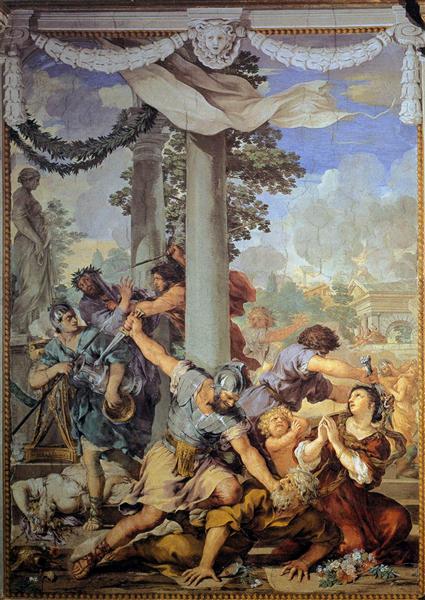
Hard steel succeeded then:
And stubborn as the metal, were the men.
Truth, modesty, and shame, the world forsook:
Fraud, avarice, and force, their places took.
Then sails were spread, to every wind that blew.
Raw were the sailors, and the depths were new:
Trees, rudely hollow’d, did the waves sustain;
E’re ships in triumph plough’d the watry plain.
Then land-marks limited to each his right:
For all before was common as the light.
Nor was the ground alone requir’d to bear
Her annual income to the crooked share,
But greedy mortals, rummaging her store,
Digg’d from her entrails first the precious ore;
Which next to Hell, the prudent Gods had laid;
And that alluring ill, to sight display’d.
Thus cursed steel, and more accursed gold,
Gave mischief birth, and made that mischief bold:
And double death did wretched Man invade,
By steel assaulted, and by gold betray’d,
Now (brandish’d weapons glittering in their hands)
Mankind is broken loose from moral bands;
No rights of hospitality remain:
The guest, by him who harbour’d him, is slain,
The son-in-law pursues the father’s life;
The wife her husband murders, he the wife.
The step-dame poyson for the son prepares;
The son inquires into his father’s years.
Faith flies, and piety in exile mourns;
And justice, here opprest, to Heav’n returns.
“Metamorphoses“ – Ovid
just saying
Richard
“The Poetess“ (1940)
_____
when Aristotle “proceeds to declare the
parameters of “Poetry” for the ages“, his
definitions of the various poetic
“manner[s] or mode[s] of imitation”
have already been established, his
categorizations are not unlike Darwin’s
categorizations of the species during
a much later age, Aristotle was a natural
scientist much more than he was our
notion of an abstract philosopher, he
traded in facts rather than in the
esoteric musings that Plato, for
instance, pursued, Virtue, Justice,
the Good, his conclusions were more
verifiable
Kant, incidentally, is also famous for
following a similar form of investigation
as he attempted, nearly, for most,
inscrutably, to categorize the elements
of our faculty of understanding
a side story
Kant had stated that at birth we already
have within our perceptual framework
implicit understanding of space and
time, these are not learned through
experience but are already
incorporated within us, he said
many years ago, coming out of a
week-long coma, not knowing where
I was but alone, at that point even
just my consciousness, cause my
body, were it there, would’ve been
under the immaculate white sheets
I could see that would’ve been
shielding my legs
I looked around, could gather motes
upon rays of light that were entering
from what appeared to be a window
on the right, behind sheer white
curtains stirred by a soft breeze,
whirling the shimmering particles
alive in the light before me like
miniature spinning galaxies moving
at the pace of their own infinity
there was no sound
white walls around me stood utterly
still in the purview of my perception,
a door, also white, stood opposite
me on the opposite wall
where am I, I wondered, could this
be heaven, an afterlife, I might’ve
died, I thought, marvelling, no fear,
regret, nothing other than curiosity,
absorption, fascination
I tried to answer my question, where
am I, two dimensions, I figured
after having watched Terence Stamp
exiled by Marlon Brando to a flat
intergalactic window pane in
“Superman“, I hadn’t excluded this
eventuality, however ingloriously
transcendental, as a possible
outcome, I might be in a world with
only two dimensions, height and
width, no depth yet without more
investigation, experience
ergo, Kant, I concluded, was wrong,
our knowledge of space is not inborn
but a product of time and thought like
everything else
later, the white door on the far wall
opened, and a nurse walked in, also,
incidentally, in incandescent white,
and I understood I was alive
Aristotle suggested that our original
double instincts towards poetry were
our propensity to imitate, children
imitating their parents’ even
idiosyncratic mannerisms, for
instance
and rhythm, repetition, preludes to
order, coherence
those two
poetry, I read, is expression
reflecting the heartbeat, essentially,
in all its myriad representations
Richard
 Richibi's Weblog
