Richibi’s Weblog

Just another WordPress.com weblog

Category: in search of beauty

an homage to the victims of the Titanic
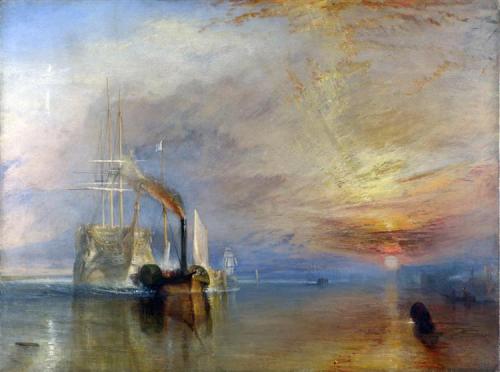
the-fighting-temeraire-tugged-to-her-last-berth-to-be-broken-up-1839.jpg!Large

  The Fighting Temeraire tugged to her last berth to be broken up (1839) 

          William Turner

                _______

while I’m on the subject of threnodies
which is to say “song[s] of lamentation
for the dead”, as I earlier statedlet me 
bring your attention to this extraordinary 
piece, an homage to the victims of the
Titanic
 
it doesn’t even have a title, much as 
Mozart and Haydn didn’t before music 
went mainstream, into public forums 
rather than merely aristocratic salons, 
and when an identifying moniker 
instead of a number became manifestly 
more practical, especially when the 
emerging Middle Classes were 
becoming the ones who were paying 
the composer’s bills, at the opera 
houses and the other sprouting 
concert venues, when some composers 
had even up to 32 sets of piano sonatas 
to remember, three and four often to 
a single set, opus number, as many as 
there are movements in a very sonata

and that’s not counting the numbered 

symphonies and string quartets of 
theirs, left to similarly calculate, 
decipher, extricate

it doesn’t have a title, I think, because
to my knowledge, it is the first of its
kind, a composition created by 
computer, for computer, an entirely 
self-contained digital work of, 
manifestly, art – I’d been waiting, 
diligently, for one – and like Beethoven, 
after the work was done, the artist(s)
just felt the title best left to the 
wordsmiths, thus – you’re welcome –  
Threnody for the Victims of the 
Titanic

sure, computers have done practical
things before, admirably, but never 
told a story, and certainly never one 
as profound as this one

these are the last moments of the 
Titanic, digitally reproduced, in real 
time, 2 hours and 40 minutes, they
are mesmerizing, you don’t want 
to miss a thing

there are no voices, apart from a 
few radio transmissions at the 
start, spotting the iceberg, calling 
out commands to beware, stop 
the engines

afterwards only silence, and the 
sound of the waves, the churning
of the engines, which have been 
restarted, sounding as rhythmic, 
incidentally, and numbing, as the 
wheels on the railroad tracks of
Steve Reich‘s Different Trains“,
another powerful threnody 

later the flash and crack of flares,
the crunch of the ship sinking  

the pervasive, however disrupted, 
silence and the inexorable passage 
of ever ticking time combine to be, 
thereafter, transfixing, meditative, 
ultimately transcendent, a fitting 
setting for a threnody 

I know of only another work to take
you to that venerable place,
Beethoven’s opus 111

and often enough Pink Floyd, for 
that matter, and the visionary 
Alan Parsons Project, of course, 
discoursing on inexorable Time 

and, now that I think of it, Elgar‘s
The Dream of Gerontius, whose 
character goes from his deathbed 
in the first act, to his afterlife in 
the second, effecting transcendence
for us by, yes, ingenious 
metaphorical proxy

but I digress

what I call Threnody for the Victims 
of the Titanic is a narrative with 
sound, not a movie, not a television
program, it has more commonality 
with a musical production than 
anything else but painting in art 
history, though its means are 
intuitively literary, ship stories go
back to The Odyssey through
Gulliver’s TravelsTreasure 
Island and to one of my very 
favourites, Ship of Fools“,
relatively recently

I could add Mutiny on the Bounty“,
Moby Dick“, “The Caine Mutiny 

in art, a precedent would’ve been set
in our collective consciousness by 
William Turner‘s celebratedThe 
Fighting Temeraire …, but I would 
mention as well Caspar David 
Friedrich‘s The Wanderer above 
the Sea of Fog for its existential
pertinence

a few literary points I’d like to stress
to back up my overt adulation, I find  
it impressive that the Classical rules
of tragedy have been maintained, 
unity of action, time, and place, 
prescriptions going back to 
Aristotle‘s Poetics in our cultural 
history, to profoundly express 
tragedy, iconic, epic, misfortune

not to mention the Classical musical
imperatives of tempo, tonality and 
repetition, none of which can be 
faulted here in this consummate 
composition

there is a no greater leveller of tempo 
than time, larghissimo here*, in the 
largest sense of that word, the 
cosmic, the inexorable pace of 
temporality in our brief heavens

a greater leveller of tonality neither  
is there than the rigorously impartial 
hum of the imperturbable Cosmos 

nor is there greater repetition than 
uniformity, however disrupted by  
however fervent ever human 
intervention, see Sisyphus, or 
Martha in “Who’s Afraid of Virginia
Woolf for iconic disrupters

R ! chard

*   Shostakovich had asked the 
     Beethoven Quartet to play the first 
     movement of his 15th String Quartet,
     “Elegy: Adagio“, so that flies 
     drop dead in mid-air, and the 
     audience start leaving the hall from 
     sheer boredom  

     well this inspired elucidation is even  
     slower than that

patience

community

      Community 

             Vicente Manansala

                         _________

in the regular line at the market today, 
not the express line, the man ahead of 
me turned towards me and looked at 
my basket quizzically

are you after my crackers, I said,
jovially, I’ve been stocking up on 
a favourite brand on sale 

no, he said, but you could be in 
the express line with your only 
five articles

I don’t mind the wait, I replied, and I 
didn’t take the time to count

I hate waiting in line, he said, I want 
to get out of here as quickly as 
possible

I’ve slowed everything down to a 
snail’s pace, I said, it makes you, 
I think, a nicer person, plus you 
get to smell the basil and the 
raspberries

I guess I’m not a nice person, he 
countered, not at all, I replied, you 
are evidently friendly, you addressed 
me, you were concerned, put forth a 
desire to help

he glistened, blushed, was manifestly 
nonplussed, speechless, then his turn 
came up at the check-out counter

at the cash he glowered at some
empty baskets that had been left
there unattended, discombobulating 
his station, I refrained from  
instinctively moving them myself, 
since I would’ve lost my place in line 
in the process, and though I might 
sometimes be gracious, I am mostly 
not subservient, though that’s up still 
for some metaphysical consideration

I made it home with my five items,
the sky was blue, but again there’s 
smoke above the mountains 
shrouding the eastern horizon, 
from forest fires burning inexorably 
in our Interior

the sky is falling, we need to take 
care of each other, ourselves

R ! chard

threnodies: to the victims of Hiroshima, of the Holocaust, and to the Canadian North

The Scream, 1893 - Edvard Munch

       The Scream (1893) 

             Edvard Munch

                    ____________

before we leave too far behind the 
anniversary of the annihilation of
Hiroshima, August 6, 1945, let me 
introduce you to a piece that 
purports to pay it homage

if I didn’t bring it up before, it’s 
because the date was wrong, but
especially because the work 
offends me, the only thing I like
about it is the title, a thing of 
beauty, poetry – Threnody to the
Victims of Hiroshima – a threnody
is a song of lamentation for the 
dead, which worked for me, this 
one, no further than its title

there is nothing remotely 
reminiscent of the tragedy
throughout the piece, it is a 
collection of academic exercises,
pretensions, I think, without a 
heartbeat 

let me compare Steve Reich’s 
threnody to the victims of the 
Holocaust, the other signature 
Twentieth Century atrocity, his 
Different Trains“, a work in three 
movements, America – Before the 
War”, “Europe – During the War”, 
and After the War”, for string 
quartet and tape, upon which 
Reich has recorded interviews 
with people relating impressions 
from before the warduring, and 
after, according to the movements

the quartet, you’ll note, must keep 
time with the tape, and in this 
production visuals have been 
effectively added 

Glenn Gould had done something 
like this several years earlier,
incidentally, in his The Idea of 
North“, a threnody itself to that 
very idea, a masterpiece, a
groundbreaking transcendental
work of the imagination, with 
overlapping voices, which is to 
say human counterpointthough 
without string quartet

you’ll note that distressing tonalities
affect throughout this other, much 
more successful however, tribute
but the different rhythms of the 
recurrent, which is to say minimalist, 
rails keep you emotionally, as it were, 
on track

Different Trains is appropriately,
and profoundly, commemorative, 
not to mention unforgettable 

Richard

on courage

aristotle-jpglarge

     “Socrates” 

            Luca Giordano

                    __________


following in the footsteps of Socrates,
who, I agree with the Oracle, has been 
ever the wisest man, one whose example 
I’ve followed since first hearing of him, let 
me query, what is courage 

a tentative definition would have one 
stating that courage is a determination
to overcome danger

but to use my own example, being called
courageous for surviving an aneurysm,
would this instance have qualified

where was my determination, apart from
waiting, submissively, for the axe to fall,
or to not fall, I felt no fear, merely time 
passing, not an ounce of determination

but what of those others who endure 
the pain often associated with dying,
agony, is that not a kind of enforced 
courage

so did I qualify

an aneurysm swells the blood vessels 
to the brain as the brain heals, but 
meanwhile the heart pumps a rhythmic
tattoo on those passages rendered 
more tenderso that a throbbing 
anguish is ever drumming its drill 
upon the cerebrum of the sufferer 

perhaps I did qualify

but Socrates brings up an interesting 
objection, can animals be brave, it 
would seem not, therefore courage 
requires self-consciousness, whether 
or not it is defiant or compliant 

and what about defiance before a lost 
cause, is that courage or doomed 
bombast

Aristotle adds to the mix the notion 
of a noble cause, not merely an 
instinctive, however, in the event, 
morally prompted, position

so what is courage, you tell me

I say that you know it when you see
it, the courageous act defines the 
word, not the other way around,

much like flowers are the result of 
their own efflorescence, not the 
manifestation of a preset Ideal

you are the measure of your own 
words

for better or for worse

Richard

psst: it is interesting to note that 
          according to the Bible, in the 
          beginning was the Word
          John 1:1, a convenient  tool  
          to impose order

“Cairo Time”

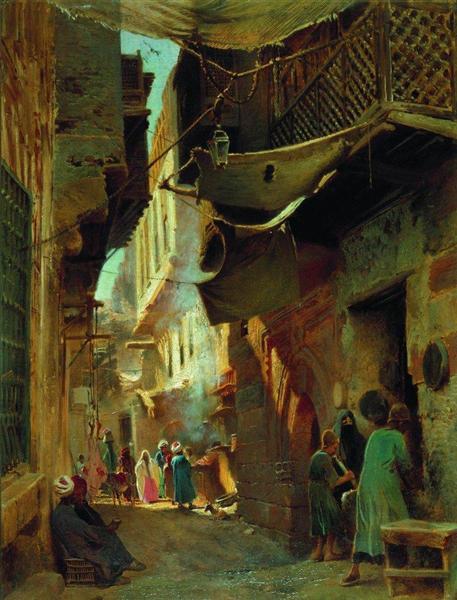
street-in-cairo.jpg!Large

     “Street In Cairo (1873)  

             Konstantin Makovsky

                         ____________

many years ago, when I was in my 
skittish twenties, and the world had 
opened up to me as I’d started work 
at an international airline, I opted 
to go to Tunisia, less harried than 
Morocco, I thought, and probably
less expensive 

a friend had asked to come along,
who worked for the same company 

Judy was my age, honey blond, lithe,
curvaceous, voluptuous, though
ever entirely unassuming, we made  
a lovely pair

but soon the locals had our number,
understood that I was merely her
friend, no challenger for her 
affections, somehow

from our seaside hotel in nearby
Hammamet, a coastal resort, we set 
out our first day for the nearby capital, 
Tunis, a dusty town, I remember, a 
cowtown, or a camel town, north of 
the Sahara Desert, with shoddy 
buildings and not much else, I was 
young

we found ourselves on the Boulevard 
Habib Bourguiba, the name of the first
President of the Republic of Tunisia,
not paved then, or with what we used  
to call soft shoulders, when the 
pavement doesn’t reach the sidewalks, 
where we looked for a restaurant or a 
coffee house to get our bearings 

inside a nondescript place we found
for lack of anything else, we sat down,
had a coffee, looked around

it didn’t take long for us to realize that
Judy was the only girl in the place, so
we finished our fare and took off

when all the men in the place followed

we found a cab to take us back to the 
hotel and didn’t return to Tunis apart  
from accompanied 

but that’s another story

it’s seemed so hard for me to explain
this to people who haven’t experienced 
this discomfort cause this kind of
indignity is so foreign to us, offensive
and hard to imagine

but a film I just saw about Cairo, 
Cairo Time“, gives a good impression 
of the differences in our cultures

were it only for this insight, I wouldn’t
suggest this movie, but because it is
a wonderful travelogue through this
remarkable city, with views of bazaars,
pyramids in the distance, and all of it 
in splendid cinemascope and colour, 
the film is a marvel 

Patricia Clarkson, an actress I greatly
admire, plays the role Katharine 
Hepburn played in Summertime“, 
one of my all-time favourite movies,
of a woman alone in a city, needing
to trust in the kindness of strangers 

Clarkson‘s kind stranger is no slouch 
either

watch

Richard

“My Romance” – Carly Simon

hot-jazz-1940.jpg!Large

       Hot Jazz (1940) 

               Franz Kline

                        _____

in this video of one of her concerts, 
Carly Simon tells the story of how
when she told her special guest on
the program, Harry Connick Jr., that
he was born the same year as 
Sgt. Pepper, he answered, Sgt. Who

   “Harry, you were born the same year that 
                     Sgt. Pepper came out”, she said
   “Sgt. Who”, he answered

the same had happened to me when  
I’d told someone, a sprite, ten years 
younger, don’t ask, about my 
admiration for Susan Hayward
Richard, he asked, who’s Susan 
Hayward, to my utter consternation

I mean, Susan Hayward

you might not know who Carly Simon
is, nor even Sgt. Pepper, but the story 
is that those who once had been our 
very idols fade and become question 
marks in the eyes of the following 
generations

you might not either know who Harry 
Connick Jr. is, but listen to both of 
them here, Carly and Harry, put 
together an entertainment enough 
to turn an otherwise lazy hour into 
an unmitigated enchantment

Richard

“Tango Lesson” – Lisa Richter

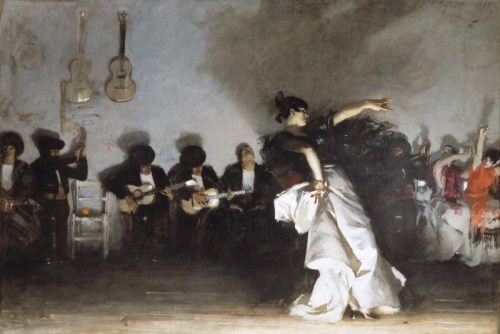
223.jpg

    El Jaleo (1882) 

          John Singer Sargent

                   _________

Tango Lesson

After a history lesson, crash course in Buenos Aires
a hundred years before our time, we begin

at last. You gently place my arm over yours, my hand
on your shoulder, our bodies distant enough 

to have an invisible body between us – this is open embrace,
you explain, abrazo abierto. We dare not dance in abrazo cerrado,

where our chests would nearly touch – I’m not single-
minded enough about learning these moves to unlock

what I fear might spill out, should I let myself fall
into your hazelnut voice – so rich and deep I might never

emerge from it. You teach me the new skill of following,
though your lead feels less like control and more

like stewardship, carving swans of negative space
that stretch their graceful necks along the diagonals 

of our bodies. We’re in a conversation of pauses
and advances. I step too soon, but you are eminently patient,

your large hand over mine, poised mid-air, a paper crane
mid-flight. As you shift your weight from side to side,

I wait, trying to sense which way we are going,
and for a moment, I have the chance to look at you not

looking at me, your calm grey eyes fixed above my head.
On the small of my back, your warm hand –

a breathing orchid, cupped flame. 

                                                    Lisa Richter 

             ____________

                                         for, especially, Tonyia

the clash of cultures is exposed to the light
here as a tango dancer teaches an English-
speaking novice how to dance 

there is no evident metre in the verse, the
poem is in prose, contained within terse, 
two-lined stanzas which act as constraints
on the forward flow, however ever fluidly 
continuous, like tenutos in music, where  
the note is held, dramatically, before a 
return to the original rhythm

but slowly this prose develops its own
irresistible rhythms, an abandonment 
to the metre of the whole, a languid 
surrender to the pulse and propulsion 
of the dance, and becomes, despite 
its, ahem, flat feet, a poem

the very vocalic construction of  
Romantic languages, abrazo abierto
for instance, or abrazo cerrado, 
propelled by vowels for their forward 
motion, in imitation of the heartbeat,  
preclude in natives unfamiliarity with 
cadence, the tango is already in their 
blood, the teacher here ineluctably 
lives, breathes, hir ethnic identity

Anglo-Saxons and Teutons excel, 
rather, at political science and 
philosophy, more sober, cerebral 
preoccupations, suppressing 
gutturally in their glut of gurgled
consonantsthe more carnal 
allure or, from a primmer
perspective, temptations, of the 
senses

which Romantic poetsincidentally
pointedly sought out in the seductive
rhythms of the Mediterranean, much 
as this very student succumbs to the 
breathing orchid’the cupped flame 
of this tantalizing tango

Richard

April 21, 2017

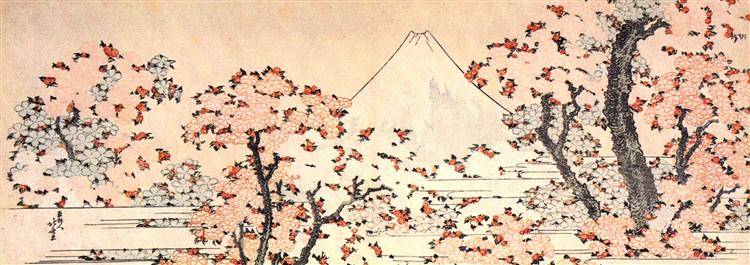
      “Mount Fuji Seen Throught Cherry Blossom

             Katsushika Hokusai

                        _____ 

walking to market today, slowly, so as to   
not upset my aching back, but conversely 
also to smell the flowers, I stopped to 
read the poetry someone, or rather, some 
people – for you could tell by the different 
literary moods and styles – had written on 
the sidewalksome not at all bad

my favourite had these lines which shall 
for me remain immortal for their verve  
as well as for their quirky ambiguity

    don’t forget to shine your light
    nothing can stop your kryptonite

kryptonite is the substance that killed 
Superman, I thought, had this been 
overlooked by the poet or had s/he 
taken this into account, is there a 
contradiction here or a paradox,
riddle or just nonsense, one could’ve 
instead used dynamite, I surmised, 
then carried on

above me the cherry blossoms bloomed,  
powder pink and white, the same colours, 
I noted, as the chalk used on the sidewalk, 
life coincidentally imitating art, reflecting, 
commenting on it

Richard


Aristotle, an objection

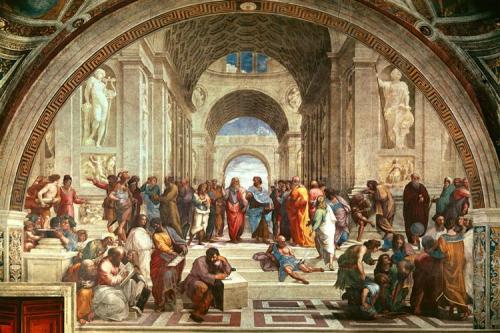
school-of-athens-detail-from-right-hand-side-showing-diogenes-on-the-steps-and-euclid-1511.jpg!Large

      “The School Of Athens (1510 – 1511) 

               Raphael

_______

upon reviewing my Socrates, Plato, and
Aristotle from a series of university  
lectures I’ve been following, I came upon 
a discovery so egregious, I couldn’t
believe I hadn’t seen it before, the old
story of the forest and the trees, I guess

upon hearing that the Oracle at Delphi
had replied that it was Socrates to those 
who’d wondered who the wisest man
was, Socrates, abashed, began to seek 
out wise men to disprove the Oracle, 
but whenever Socrates asked of them
what is virtue, what is justice, what is 
knowledge, for instance, the answers 
were always inconclusive, they always 
seemed to depend on perspective –
virtue, justice, knowledge were in the 
eye of the beholder – though Plato 
later putting in his own definitions
called them Ideals, a chair partook,
for instance, of an overarching 
chairness somewhere, as did indeed 
virtue, knowledge and justice, which 
inferred another ideal universe 
contiguously, of which our own 
universe supplied only imperfect 
renditions

you can hear the seeds of Heaven and 
God already in all of that, way before 
Christianity, not to mention Original 
Sin

it also suggests an implacable order

Socrates wouldn’t’ve liked that

but Aristotle, with a much more critical 
mind than Plato’s, less speculative, more 
akin to Socrates’, less autocratic, more 
inquisitive, begins to try to define,
nevertheless, abstractions, virtue, 
knowledge, justice, as though they
indeed existed as ideals

this is putting the cart before the horse,
I thought, in the form of a revelation

an instance exists in the act of creation,
a physical transformation produces a 
flower, the flower doesn’t happen 
because of the word

a human example

for surviving an aneurysm once, someone, 
to my astonishment, had called me 
courageous, I’d been, I thought, only
surviving, not an inch of courage, not 
even a millimetre

courage, I surmised, is in the eye of the 
beholder, it is not at all a template, an 
absolute, in my experience 

Aristotle goes on to define a host of
Virtues, indeed 11, which come out as 
essentially his Eleven Commandments,
on, in fact, courage, among others, all 
essentially, and appropriately, moral, 
thereby creating the moral realm of 
our Western world

Jesus followed

and of course God and Heaven

which, of course, still prevail despite 
sound, sober objections

as though we could know

why is this important

because, I think, we must remember 
that our assumptions are only that,
and often they’re based on only what 
we’ve been told, which is already a 
step away from incorrect 
interpretation 

in the world of false news, check 
your references, check your very 
words, our lives, it isn’t too much 
to say, I believe, depend on it

not to mention our own personal 
moral code, our soul, our purpose 
for being, which every wo/man 
must oversee for hirself

if one has the courage 

Richard

“Approaching the 45th American Presidency” – Stephen T. Berg

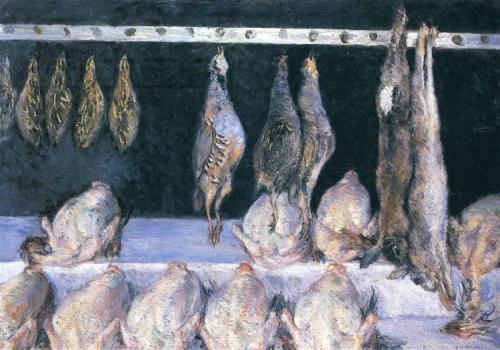
display-of-chickens-and-game-birds.jpg!Large

   “Display Of Chickens And Game Birds (c. 1882) 

            Gustave Caillebotte

                   __________

a poem should always be read at least 
twice, once for its content, then once 
again for its style, which is where you 
get the real magic

much as you’d stop to smell a rose

also a poem should be read out loud, 
for even more magic, not to mention 
more understanding

the following poem, from again the 
Westender, verily bristles with invention, 
it uses every hue of a rich grammatical 
palette from resonant onomatopoeia to 
lilting alliteration, by way of touches of 
hyphens for accent, an incidental, 
confidential set of parentheses, 
capitalized words, italics, among an 
array of other playful literary devices

I love especially its “chicken” refrain, 
which anchors it as a poem, asserting 
its proud, however unassuming, 
pedigree

I love, as well, “gelid giblets

Richard

psst: the links in the poem are mine,     
          couldn’t find a “Drumpf Meats

____________________

Approaching the 45th American Presidency

I leave Planet Earth Poetry at the Hillside Coffee
after listening to an enjambment of poets,
fervently consider the current state of the American presidency,
and on my way home remember I need to prepare and marinate
the chicken for tomorrow night’s dinner,
                that’s the chicken
I bought from Drumpf Meats earlier in the day that I thought (although
I didn’t ask) was fresh-fresh, but was in fact alternatively-fresh,
as I found remnant formations of ice crystals in the cramped cavity,
and the oblique neck, stuffed within, was polar-stiff,
and the gelid giblets, notably the orange-hued heart, was glacial-cold,
meaning this or more: that the bird hadn’t come straight from the abattoir
to its place behind glass, but had spent time in cryogenic rime
and I remembered too,
                that a chicken
can live without its head for an ungodly duration,
which beyond all reason,
made me approach the fridge
with unimpeachable apprehension.

Stephen T. Berg