Richibi’s Weblog

Just another WordPress.com weblog

Category: in search of beauty

Dmitri Shostakovich – Symphony no. 1, opus 10

portrait-of-dmitri-shostakovich-1963.jpg!Large

     “Portrait of Dmitri Shostakovich (1963) 

             Martiros Sarian

                    ______

after being transfixed, rendered aquiver, by
this mesmerizing conductor in a performance
I can only remember for his magnetism, 
expressive fingers performing arabesques of 
such exquisite sensitivity, eyes that melt, 
light up, gleam, glitter, at every ebb and flow 
of the turbulent, towering, music, eyebrows 
that, blonde, cherubic, angelic, display with 
manifest intention, the spiritual implications 
of every musical turn, a youth only, in my 
senescent estimation, taking on the conquest 
of the 21st-Century world, lately installed as 
conductor, most illustriously, of both the 
Royal Liverpool, in 2005, and the Oslo, in 
2011, Philharmonics

Vasily Petrenko led me back to Shostakovich,
after his monumental Tchaikovsky 5th,
whereupon I’ve undertaken a chronological 
review of all Shostakovich’s symphonies, 
something I did long ago with Beethoven’s 
sonatas, to my great cultural advantage, it 
was a journey that informed me not only 
intellectually but, even more significantly, 
spiritually, taught me about patience, tumult, 
and the wisdom, even glory, one acquires in 
resignation, so long as you hold onto your 
principles, your core 

you look back, I told a man once, and you 
see what you’ve come through, and you 
are proud, you recognize the hero that 
you are, or weren’t

we have only our poise and grace to lend 
to the world, or our venom and invective

but I digress

here’s Shostakovich, his First, in a line 
of Shostakovichian explorations

if you’ll join me

R ! chard

the “wall”

study-for-a-sunday-on-la-grande-jatte-1885(1).jpg!Large

    “A Sunday on La Grande Jatte (1884)

           Georges Seurat

                 ________

should you know Vancouver, you’ll
recognize, nearly immediately, the 
Seawall on this video, before even 
a minute has elapsed you spot the 
Westin Bayshore coming at you, 
nearly perilously, before the speeding 
bullet that takes you on the journey 
turns the crucial corner on the paved 
path that wends its way afterwards
around the peninsula

on foot, this takes about three hours,
but here, inspired by the music of Pink 
Floyd, on a deft reinterpretation of the 
title and music from The Wall“, their 
oracular masterpiece, an inspired 
cyclist brings this local trajectory to 
psychedelic life, if you can stand the 
unsettling disjunction between his 
dizzying speed and the grandeur 
of the transcendent, immutable,  
coastlines

you’ll need, I suggest, seatbelt,
but the ride is wild

the journey ends abruptly, both 
geographically and musically, 
just down the street from my place, 
across the road from recently 
favourite restaurant, with a view, 
just as transcendent, however not
at all disappointingly mutable, of 
the Pacific sunset, whenever we, 
family and friends, eat there

R ! chard

the milonga

for-a-better-life-iii.jpg

   For a Better Life III 

          Fabian Perez

             ________

milonga, a song with a syncopated 
beat, is the musical form that gave 
birth to the tango, I wondered what 
one could be after my mom brought
my attention to one in a program for 
an upcoming event in our cityI had 
to look it up 

my only clue was that it was by 
Astor Piazzolla, the Argentinian who 
in the 20th Century reinvigorated the 
tango nearly all by himself, but in 
translation from Spanish to English,
milonga still came up milonga, what 
could milonga be, I asked 

here then, by Astor Piazzolla, is
what we’d be hearing

you’ll want to pay attention too to  
the paintings of Fabian Perez, also 
an Argentinian, which visually 
accompany the music, they are 
equally as seductive as the 
irresistible Piazzollan rhythms  

on the program as well, for a 
completely different musical 
experience, is Mozart’s Clarinet
Quintet, a piece I wrote about 
several years ago here, but must 
revisit, there is no more beautiful 
clarinet quintet, in my estimation,
and not many musical pieces are 
either as beautiful 

I won’t say a word about the other 
piece on this eclectic upcoming
programbut to say that I’d arrive 
after the intermission

R ! chard

on “Aristotle” – Billy Collins

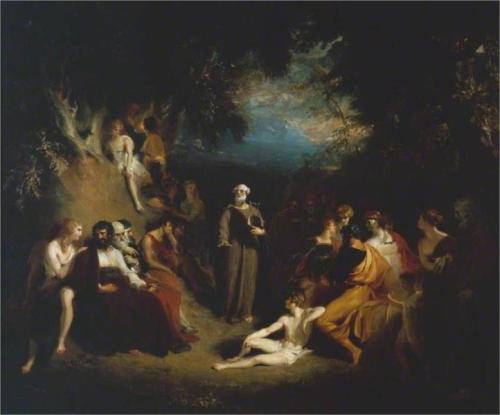
homer-reciting-his-poems-1790.jpg!Large.jpg

      Homer Reciting his Poems (1790) 

             Thomas Lawrence

                    _________

thanks Collin

hot on the heels of my paean to
Billy Collins, his my favourite 
poem of the year, a friend sent 
me Aristotle“, saying, hey, you 
might like this, like this, Aristotle 
has been my rebuke to Plato for 
a while now, latent even in my 
least metaphysical speculations

in his poem, Collins goes back 
to the earliest definitions of the
structure of literary works as 
anticipated, or defined even, by
arbiters who were trying to 
understand their place and 
function, the poems’, in the 
culture, Aristotle’s Poetics is 
the very source, 350 BCE, the 
diagram, for our understanding, 
even in the present age, of what 
we mean, in the West, by art, 
we’ve been answering him ever 
since, it’s genetic  

Billy Collins‘ description is not 
chronological, it’s poetic, 
appropriate to its topic

its structure nevertheless 
follows specifically Aristotelian 
logic, shedding glory, 
coincidentally, on both prophets

for a special treat, listen to the 
poet’s audio recording at the
poem’s site – which delivers 
even more compelling 
information – by clicking the 
red arrow pointing right 
beside Aristotle“, the title

R ! chard

           ___________ 

Aristotle

This is the beginning.
Almost anything can happen.
This is where you find
the creation of light, a fish wriggling onto land,
the first word of Paradise Lost on an empty page.
Think of an egg, the letter A,
a woman ironing on a bare stage
as the heavy curtain rises.
This is the very beginning.
The first-person narrator introduces himself,
tells us about his lineage.
The mezzo-soprano stands in the wings.
Here the climbers are studying a map
or pulling on their long woolen socks.
This is early on, years before the Ark, dawn.
The profile of an animal is being smeared
on the wall of a cave,
and you have not yet learned to crawl.
This is the opening, the gambit,
a pawn moving forward an inch.
This is your first night with her,
your first night without her.
This is the first part
where the wheels begin to turn,
where the elevator begins its ascent,
before the doors lurch apart. 

This is the middle.
Things have had time to get complicated,
messy, really. Nothing is simple anymore.
Cities have sprouted up along the rivers
teeming with people at cross-purposes—
a million schemes, a million wild looks.
Disappointment unshoulders his knapsack
here and pitches his ragged tent.
This is the sticky part where the plot congeals,
where the action suddenly reverses
or swerves off in an outrageous direction.
Here the narrator devotes a long paragraph
to why Miriam does not want Edward’s child.
Someone hides a letter under a pillow.
Here the aria rises to a pitch,
a song of betrayal, salted with revenge.
And the climbing party is stuck on a ledge
halfway up the mountain.
This is the bridge, the painful modulation.
This is the thick of things.
So much is crowded into the middle—
the guitars of Spain, piles of ripe avocados,
Russian uniforms, noisy parties,
lakeside kisses, arguments heard through a wall—
too much to name, too much to think about.

And this is the end,
the car running out of road,
the river losing its name in an ocean,
the long nose of the photographed horse
touching the white electronic line.
This is the colophon, the last elephant in the parade,
the empty wheelchair,
and pigeons floating down in the evening.
Here the stage is littered with bodies,
the narrator leads the characters to their cells,
and the climbers are in their graves.
It is me hitting the period
and you closing the book.
It is Sylvia Plath in the kitchen
and St. Clement with an anchor around his neck.
This is the final bit
thinning away to nothing.
This is the end, according to Aristotle,
what we have all been waiting for,
what everything comes down to,
the destination we cannot help imagining,
a streak of light in the sky,
a hat on a peg, and outside the cabin, falling leaves.


                                         Billy Collins

on Billy Collins – “Safe Travels”

Photo on 2016-05-24 at 6.31 PM.jpg

          me, May 24, 2016

               __________

I save all the New Yorker poems  
to read after I’ve been through
everything else in the issue, 
like dessert after a meal, icing 
on the cake, sometimes too 
heavy, sometimes too light,
sometimes too rich, sometimes
just right

today, I found my favourite poem,
period, this year, stepped right 
into its shoes, like old slippers, 
the only difference being my 
walls are painted a variety of
contrasting colours, studded 
with memorabilia, treasured 
artefacts, see above

also, no one’s translating my 
poems, though even our metre
is the same, try it, sing us out 
loud, you’ll dance 

R ! chard

_____________

Safe Travels

Every time Gulliver travels
into another chapter of “Gulliver’s Travels” 
I marvel at how well travelled he is
despite his incurable gullibility.

I don’t enjoy travelling anymore
because, for instance,
I still don’t know the difference
between a “bloke” and a “chap.”

And I’m embarrassed
whenever I have to hold out a palm
of loose coins to a cashier
as if I were feeding a pigeon in a park.

Like Proust, I see only trouble
in store if I leave my room,
which is not lined with cork,
only sheets of wallpaper

featuring orange flowers
and little green vines.
Of course, anytime I want
I can travel in my imagination

but only as far as Toronto,
where some graduate students
with goatees and snoods
are translating my poems into Canadian.

Billy Collins

__________

psst: I said just recently to a poet 
          acquaintance that what poetry 
          needed in the 21st Century is 
          humour, the only art form not 
          catching up with the rest,
          otherwise it’ll die of, indeed
          succumb to, its own 
          lugubriousness

          thank you again, Billy Collins

on the origins of the waltz

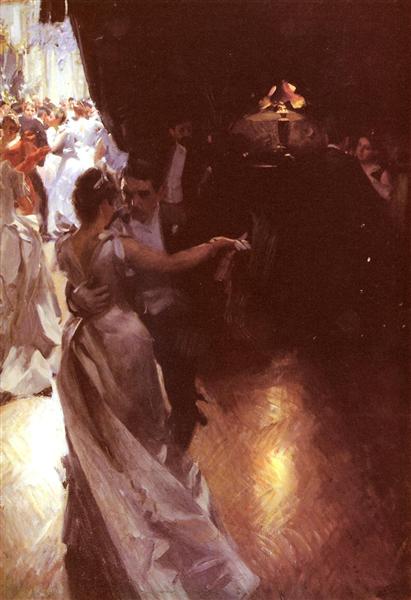
waltz-1891.jpg!Large.jpg

       Waltz (1891) 

         Anders Zorn

        ____________

had the waltz been confided to any 
other but the Johann Strausses, 
father and inveterate son, we may
never have distinguished it from 
the polka 

at the start, this amorphous new 
dance was deemed shameless, 
even shocking, by a scandalized
apparently, aristocracy, used to 
the more discreet, less conjugal, 
minuet

some nobles, sowing wild
irresistible oats, however, at the
festivities of their more irreverent 
servants, brought the new dance 
back home to their more informal, 
less stuffy, entertainments, avidly, 
though surely under their hats

to BelvedereSchönbrunneven 
Schloss EsterházyHaydn‘s  
stately old stomping haunt

thus was the waltz born, whirling 
indiscriminately like a polka at first
with indefinite stillhowever, timing

which then was reduced to only ever 
3/4 time, by the Strausses, the metre 
in which this comment, coincidentally, 
is written

read it aloud, you’ll want to wrap 
your arms around the nearest  
partner, assure you, and whirl, 
twirl, deliriously surrender

had we not had the Strausses, neither 
had we had Fred AstaireGinger Rogers,
Shall We Dance” from the glorious 
“The King and I”, nor the irrepressible 
So You Think You Can Dance either

nor me, for that matter, writing in 3/4 
verse, essentially, dactylic poetic metre 
about these celebrated accomplishments, 
something I deem eminently worthy of
reporting 

such is the impact of veritable art, I
warrant, the waltz was not inevitable

listen to Strauss Jr’s’ “Wiener Blut”, 
Viennese Blood“, or … Spirit
in English, for instance, for 
corroborating confirmation, and
corresponding, however inadvertent,
even, inspiration   

ever 

R ! chard

Nobuyuki Tsujii / Chopin

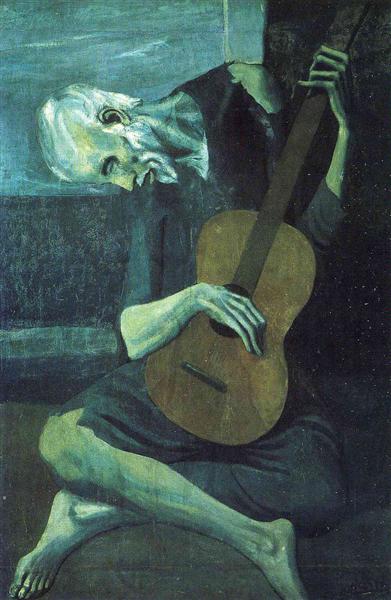
the-old-blind-guitarist-1903.jpg!Large.jpg

     “The Old Blind Guitarist (1903) 

               Pablo Picasso

                      ________

to watch Nobuyuki Tsujii play the 
piano, a piano he cannot see, nor
anything else around him, not 
even his fingers, is a wonder, 
one beholds the work of the 
imagination taking place inside 
tenebrous, one would’ve 
supposed, cerebellum, a place 
without height, depth, width, 
without the idea, even, of, verily, 
spatial dimensions

not only has he had to imagine 
Chopin’s extraordinary, admit it, 
First Piano Concerto therehe’s  
had to imagine himself playing  
it, playing it before even 
international audiences – here
the 2009 Van Cliburn Competition, 
in which he tied for first place – 
despite surely profound physical, 
moral, emotional impediments, 
mountains most, I’m sure, 
couldn’t climb

it is to see the face of an angel
think, to watch him, only angels,
I believe, can do this sort of thing

watch, be inspired

and the Chopin is terrific

R ! chard

a contemporary haiku, on wine

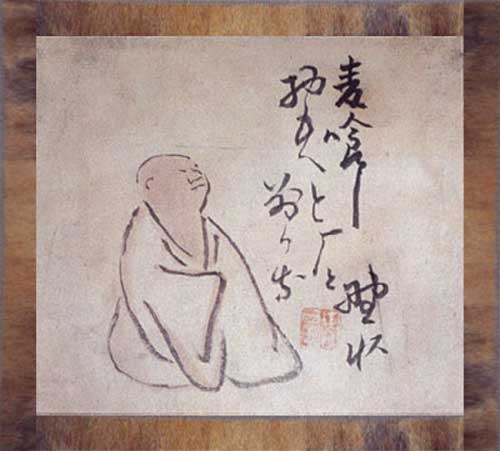
haiku-poet-and-his-poem

     “Haiku Poet and His Poem (?) 

            Yosa Buson

               ________

a glass of wine, I sing,
two, in German,
go figure

R ! chard

on “Elegy for the Victims of the Tsunami of March 11, 2011 in Japan” – Nobuyuki Tsujii

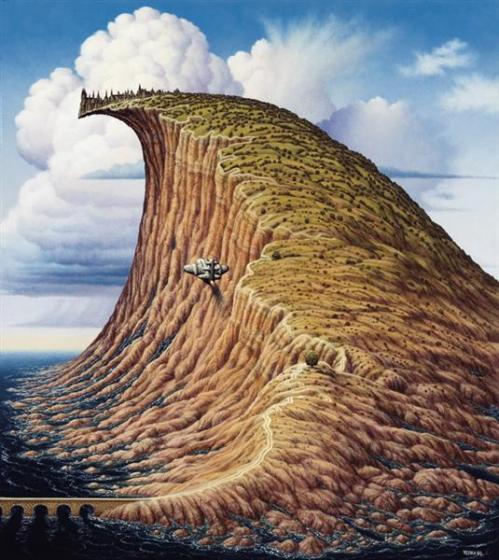
tsunami-1998.jpg!Large

    Tsunami (1998) 

         Jacek Yerka

          __________

while watching Nobuyuki Tsujii play the
extraordinarily demanding Tchaikovsky 
First Piano Concerto on television the 
other night, with no less than Valery
Gergiev, conducting the resident 
orchestra at the Mariinsky Theatre in 
Moscow, for its White NightsI was 
wonderstruck by the challenges a 
visually handicapable pianist would 
have to conquer in order to reach 
such an apogee 

everything must be learned by ear, all
items must be discovered tactually, 
from the piano itself to the very 
individual keys, not to mention 
the player’s very own fingers

there can be no visual contact with a 
conductor, either, for cues, for 
instance, nor for any other 
accompaniment, for neither even an 
audience, it would all take place in 
the dark recesses of the head, the 
amorphous and, I suppose, 
confounding, cerebellum

later he played for an encore his own 
composition, Elegy for the Victims of
the Tsunami of March 11, 2011 in Japan“,
a fine addition to my budding collection 
of threnodies

and a very, very moving piece

an elegy, incidentally, is usually written,
while a threnody is composed, but these 
terms are often used interchangeably, as, 
indeed, they are here

you’ll note the utterly Classical mode of
composition of the Elegy“, it adheres to  
a uniform tonality, a consistent tempo, 
and the grounding and comfort of 
repetition, returning always to the main, 
endearing air, rather than more modern 
tripwires and stridencies, traditionalism 
being not an inappropriate, nor ineffective,
mode of address for honoured forebears 

long live Classicism


R ! chard

on “Song to the Moon” – Antonin Dvořák

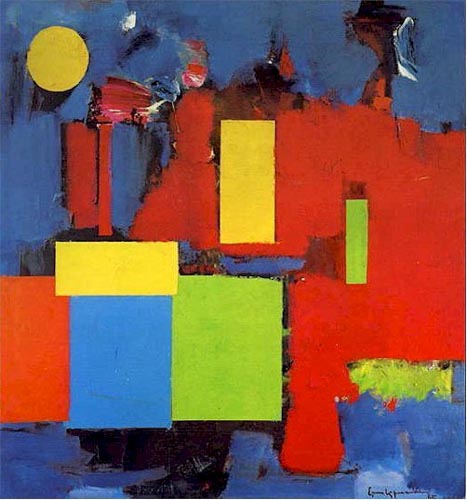
rising-moon-1964

   “Rising Moon (1964)

          Hans Hofmann

              __________

the moon was out last night, grand
upon the starlit evening, either 
waxing or waning, I’m not sure, but
not full, a gibbous moon, above the 
buildings that scrape, in my big city 
neighbourhood, in the very Cubist 
manner, the night sky, see above

I’d been listening to Renée Fleming
singing Dvořák‘s Song to the Moon
in my head since I’d seen her do it, 
on television, in a summer evening 
concert at Schönbrunn, Vienna, some
few days ago, sheit, had been utterly, 
sublimely, enchanting, I’m a Cancer, a
moon child, I speak to the moon

to the moon, I said, moon in the dark
heavens, who steal into every home
and hearth at night, find my beloved
and tell him what is in my heart, rapt 
as I was in the spell of my special
planet, my personal orb, and the 
enveloping Dvořákian magic, though 
there’s been no beloved lately, just 
trailings of the latest one who broke, 
of course, my heart, which gives more 
pathos, however, incidentally, to my 
singing, I’ve giddily gathered

at home, I found Renée Fleming doing 
the piece on the Internet, entirely as 
splendidly, earlier, at London’s Royal
Albert Hall, September, 2010

listen

R ! chard