Richibi’s Weblog

Just another WordPress.com weblog

Category: in search of beauty

Piano Sonata no 17, opus 31, no 2 “The Tempest” – Beethoven

tempest-on-the-northern-sea-1865.jpg!Large

    “Tempest on the Northern Sea (1865) 

             Ivan Aivazovsky

                  __________

                               for Judy, who “glimpses“, she says,
                                   “a kinder world, that [my] missives
                                          provide” – thank you, Judy                            


just as I was being called on the 
carpet for my constant returns to 
Beethoven, none other than Glenn 
Gould should show up, in my 
cavern of wonders, to absolve me, 
or at least to stand stolidly by my 
side

let him talk

had I written, however, his 
observations, I’m sure you’d’ve  
balkedhe’s a product, after all,  
of the priggish pretensions that  
prevailed in my neck of the woods 
at the time, Southern Ontario, a  
product of British Imperialism  
of which I am myself, I avow,  
incontrovertibly subject, but due  
to the strength of his celebrity,  
one is likely to listen to Gould  
more attentively, I’m not 
sufficiently yetsuspect,  
significant, nor influential
 
he is, one way or the other, I concur,
absolutely right

about his Tempest“, though, I’ll say, 
even object, as Stravinsky and John 
Cage did, according to Gouldabout 
the commanding Beethoven, that 
Gould is dripping in Romantic
sentiment here, his rubato in the 
first movement tests the limits of   
our forbearance, and his second  
movement is so slow as to have 
one fall off the page

but his last movement, the allegretto,
is brilliant

Gould’s idiosyncratic, dare I say, 
eccentric, performance will 
throughout, nevertheless, 
astonish, indeed electrify, even,
I’m sure, inspire, watch, listen

and thanks ever, especially, for 
dropping by 


R ! chard

psst: here’s another version of the 17th,  
          to my mind, less self-indulgent, but 
          you be the judge, don’t think about 
          it, just ask yourself which one  
          would you want to hear a next time,  
          that’ll be your, gloriously personal,   
          reply

          enjoy

Piano Concerto no. 9 – Mozart

clown-with-flowers-1963.jpg!Blog

   “Clown with Flowers (1963)

           Marc Chagall

                _______

                                with the greatest respect for all
                                     who read me, and especially 
                                         for those who are least 
                                             convincedthe way also, 
                                                 I note, to a conscious, 
                                                    and entirely personal,  
                                                          aesthetic


let me once again insist that my 
commentaries here are not at all
the last word on any of what I’ve 
discussed, they’ve been merely 
my opinion, according to my own 
particular aesthetic, my comments 
have been rather to excite curiosity
about, for some, an esoteric topic, 
to awaken interest in a field, to my 
mind, strewn with marvels, and 
never to dictate, art, as I often
remind, is in the eye of the 
beholder

I think of myself as company in 
an art gallery, viewing a 
succession of works, musical 
here, expressing notions, either 
specifically to do with the exhibit
or, personal, but somehow related, 
then moving on, just enough to 
whet the appetite, or, of course, 
not

here’s an instance

I’d been waiting for the sales clerk 
to box some fresh pasta for me I 
was buying at an eatery down the 
street when a line of piped in music 
from their overhead system swept 
me off my disconcerted feet, which 
I recognized to be Mozart, but as
I’d never heard him, ever

can you tell me who’s playing that,
I asked the cashier, many stores 
played their own tapes back then,
some still indeed even do, 
19-eighty, at that time, something

he replied, Mitsuko Uchida
what she’d done was to not stress
the bar line, the natural beat, to, 
in fact, eliminate it, so that a flight
of notes went on like an unfettered 
and iridescent miracle, prompted 
by its own irrepressible momentum,
I was flabbergasted

Beethoven later on would do that
nearly consistently

where Glenn Gould would remove 
his foot from the sustain pedal to 
channel Bach while he played 
Beethoven, an atavism, Mitsuko
Uchida was reversing the process
and using Beethoven‘s own 
unleashing of rhythms to shed 
light on her Classically otherwise 
bound Mozart, a telling 
anachronismI nearly screamed

here, in the event, is the next work 
of musical art in my idiosyncratic 
gallery, the richibi galleri, I call it, 
Mitsuko Uchida herself illuminating 
gloriously, as ever, Mozart, his 
splendid, as she reminds us, Piano
Concerto no 9 

thanks so much for stopping by


ever 

R ! chard

Piano Concerto no. 5, opus 73, “Emperor” – Beethoven

v1.bTsxMTIxMTMxNztqOzE3ODE0OzEyMDA7MTEyNTsxNTAw

     All About Eve (1950)

            _______

while I’m on the subject of concertos,
there’s one concerto that cannot be 
overlooked, the very epitome of 
concerti, their summit, apex, their 
very pinnacle, Olympus, compared 
to other less mighty compositions,
Beethoven’s Fifth Piano Concerto,
the piece I would take with me to a 
desert island, used to even walk 
along the seashore in the privacy of 
my headphones nights, after dinner, 
taking in its cadences, its wisdom,
under the moon, the stars, along 
the, however temperamental, 
ocean waters, transported 

indeed this very version of it, Glenn
Gould’s, Beethoven’s, in my mind,  
oracular equal

Beethoven made literature out of 
music, progressed to the point of
delivering a very philosophy, 
Gould took the prevailing 
Romantic aesthetic of the time,
Arthur Rubinstein being a prime
example, for instance, and gave 
us the music of the Information 
Age, the mathematical precision 
of computers, people could hear 
it, perhaps not even knowing how,
why

briefly, Gould eschews – Gesundheit
the hold pedal, the sustain pedal, on 
the piano, he’d grown up on Bach, 
made him his specialty, but Bach
had no sustain pedal on his 
harpsichord, Gould transferred this 
process to later, more rhythmically 
malleable, works, making obvious 
thereby their inner workings, 
something like reading blueprints, 
his interpretations give us the bare, 
and revelatory, bones of these later 
masterpieces, without the sometimes 
facile effects of Romanticism, think 
of rubato, for instance, the ability to 
stretch a note, not possible on the 
harpsichord, but often overused in 
Romantic renderings, a cheap trick, 
like paintings on velvet

Gould would have none of that, he
shows you the composer’s 
compositional brilliance, without 
fanfare, just the facts, no pedal, 
which at the time was completely 
revolutionary, much like computer 
science was thenand algorithms 

here’s something else about Gould,
more savourymaybe, he was called 
in at the last minute to perform this
piece when the planned pianist, of 
considerable renown, wasn’t able to 
make it, Gould hadn’t played it in a 
number of years, but showed up the 
next morning to deliver, the rest is,
as they say, history

that’s All About Eve up there, but 
for pianists, Glenn Gould is Eve 
Harrington, though without her
predatory instincts, nobody now 
remembers the other pianist
unless you were there, interested,  
listening, piano’s Margo Channing, 
even if I named himhowever 
consummately accomplished he 
might’ve been, a man I profoundly 
admire, remains, cruelly, essentially 
unremembered 

imagine


R ! chard

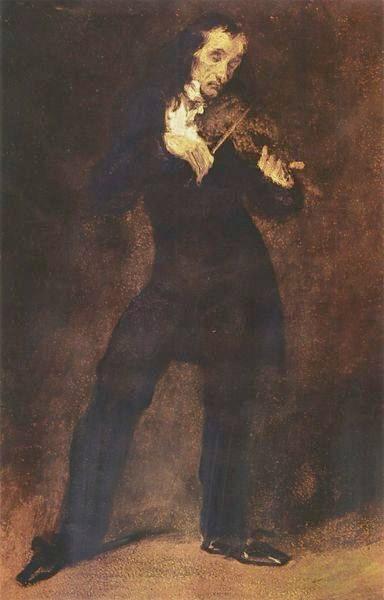
Violin Concerto no. 1 – Paganini

portrait-of-paganini-1832(1).jpg!Large

   “Portrait of Paganini (1832) 

          Eugene Delacroix

               ___________

before you start thinking that, because 
of my recent comparisons, Paganini is
a nobody, look what I found, had 
stupidly forgotten about, among the 
multiplicity of wondrous examples
concertos have to offer 

this will attest, as well, to my fallibility,
which I unreservedly confess, in many,
even familiar, matters, I used to not 
much remember the last time I was 
wrong, but writing makes one more 
aware of one’s even egregious 
insufficiencies, I love, I must say, 
that it makes one humble

meanwhile, Paganini’s First Violin 
Concerto has absolutely no faults,
it’ll run through your cultural veins 
like water, you’ll probably be able 
to sing all the notes, apart, of course, 
from the cadenza, which, in this 
instance, is the soloist’s, not
Paganini’sa not unusual occurence, 
indeed a common one, though it’s 
nice when they tell you who wrote it, 
the composer or the player, as they 
do in this case, cause unless you’re 
a total nerd you mostly wouldn’t be 
able to tell the difference 

the cadenza is the part, incidentally, 
where near the end of a movement, 
any movement, though usually not 
the slow one – think about it – the 
soloist struts hir improvisational 
stuff, independently from the 
orchestra, till s/he signals it back in 

I’ve said before that Paganini’s 
Caprices are a series, essentially,
of cadenzas, not at all such shabby 
stuff

meanwhile, I think Paganini is back 
in the running, what do you think


R ! chard

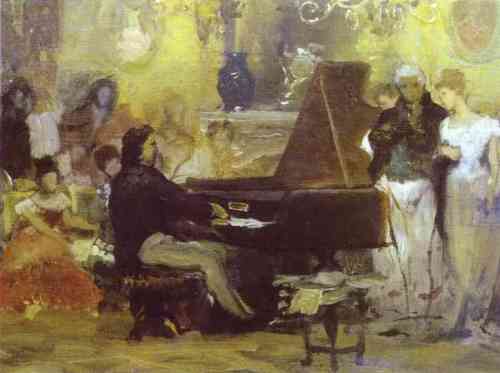
so you think you can be a soloist – Beethoven / Paganini / Chopin

chopin-performing-in-the-guest-hall-of-anton-radziville-in-berlin-in-1829.jpg

Chopin Performing in the Guest-Hall of Anton Radziville in Berlin in 1829” 
    (1887)                                                                                                                

        Henryk Siemiradzki

                 ________

Chopin’s Piano Concerto no 1, written 
in 1830, is in the same mold as both
the Beethoven Violin Concerto, 1806, 
and Paganini’s 5th, a synchronous 
1830, three movements, fast, slow, 
fast, long symphonic introduction,
followed by miracles of articulation 
by the virtuosic soloist, with, however, 
differing degrees of emotional impact

Beethoven is evidently the source, 
and model, for both later compositions
having clearly preceded them by a 
number of years, but neither Chopin  
nor Paganini have the chops to match
his magisterial orchestration

Chopin, like Paganini, was confined to
essentially one instrument, of which,
however, both were utter masters, and 
manifestly and profoundly there inspired, 
but in either, once the solo part takes 
flight, the symphony is merely 
packaging, no longer an equal partner 

Beethoven has parts for all his players,
his is a conversation, not a declamation

but Chopin, 1830, had learned by then,
and integrated from Beethoven the 
lesson of how to incorporate drama
into his high wire act, the constant 
repetition of a melting air, a musical 
motive, which Paganini hadn’t, Chopin 
not only could fly, but also knew how 
to dress for it, to become a virtual 
angel of mercy and compassion up
there under the biggest of tops, his
immortality 

don’t take my word for it, though, 
you’ve probably heard already Chopin‘s 
work, a very emblem of 19th Century 
Romanticism, somewhere in your 
subconscious you know this melody,
heard it before, it’s part of our Western 
culture

not so the Paganini

what’s kicked

see above

you’ll hear your senses talking, the 
language of music and art, more
accurate eventually than any of my, 
however erudite, however informed,  
but merely ruminative, words, art 
being, once again, in the eye, the 
ear, in this case, of the beholder, 
or here, the be-hearer

listen


R ! chard

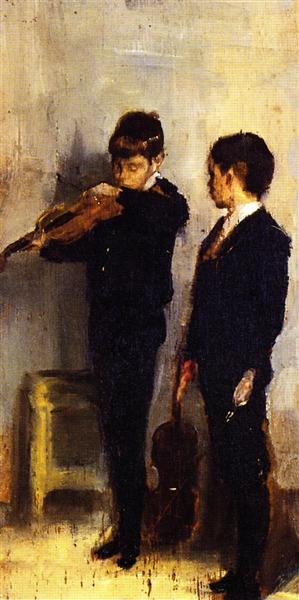
twice upon a violin concerto – Beethoven / Paganini

the-violin-lesson-1889.jpg!Large

  “The Violin Lesson (1889) 

         Tom Roberts

              _______

to juxtapose two things for consideration
to my mind, is the best way to sharpen 
both one’s aesthetic and, therefore, 
spiritual personality, here, thus, are 
two contemporaneous, essentially,  
violin concertos, concerti, if you like, 
Paganini’s 5th, 1830, Beethoven’s
Only, 1806

let me point out that the Classical Era
is over at this point, this isn’t music 
for the courts any longer, but music 
as spectacle, you can hear it, it’s like 
moving from Frank Sinatra‘s 
nightclubs to David Bowie’s stadiums

noteworthy about these two pieces is 
that the structure in each is identical, 
the same lengthy introduction in the 
first movement, followed by an 
articulate, and eventually mesmerizing, 
elaboration on the initial melody by 
the soloist, with divergent, however, 
intentions, Paganini starts with a 
fanfare, promises histrionics, delivers
fireworks, Beethoven begins with 
portent, goes instead for drama, 
which is to say, your heart, as well

both their second and third movements 
are essentially, then, indistinguishable 
conceptuallytheir last movement in 
either is even a rondo

the challenge in the Paganini is physical,
the glory is in the player’s technical 
prowess

with Beethoven the requirements are 
both physical and emotional, he 
punches for the heart, which the 
player musttherefore, with equally 
astounding panache, incidentally, 
also conquer 

style, in other words, over substance,
substance over style, which is to say
The Phantom of the Opera“, for
instance, or Cirque du Soleil,
Rachmaninov, maybe, versus 
Liberaceyou are the judge

history has sided, however, with 
substance, Beethoven’s Violin  
Concerto is everywhere, it isn’t at 
all easy, conversely, to come up  
with any of Paganini’s, despite 
their incontestable magnificence

maybe it’s time for a Paganini 
revival, they did that several years 
ago for the inimitable Rossini, an 
effervescent light in an otherwise 
mostly dour 19th Century, listen,
with counts and countesses here  
in attendance, at very, can you 
believe it, Versailleswow

 
R ! chard

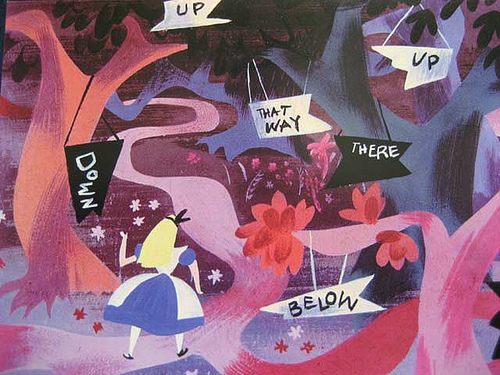
off my top – from Bach to Beethoven

6.jpg

    “Alice in Wonderland” 

             Mary Blair

               _______

when I listen to Bach, I feel like I’m 
on a train – from Leipzig to Dresden, 
say, his territory – the constancy of
his rhythms, modified only by 
accidentals along the way, the 
particular condition of the rails, that 
indeed decorate an otherwise 
monotonous clockwork progression, 
beat upon beat, there is neither an 
increase in volume, which hadn’t been 
formally invented yet as a principal 
musical implement – and I’m only 
partially joking here – the music is 
horizontal, not focused on reiteration, 
but on getting there, accomplishing 
mission, upon which the outcome is
even spiritual – it’s Dresden, I get off 
at the Neustadt Station, am not only 
refreshed but utterly inspired, 
reminded of my position in the world, 
and my place in this novel, but
ordered, and pious, environment 

listen to Bach, his Sonata for Violin
and Piano, B minor, BWV 10141717 
to 1723 approximately, for instance

with Mozart, I get on a merry-go-round,
at a carnival, the clockwork has become 
circular, you can sing the tune, and sing 
it again without a problem, the wooden
horses fly by, one after the other, entirely 
recognizable, though ever magical and
entertaining, but you get off at exactly 
the same untransformed station, 
however delightedly

Mozart’s Sonata for Violin and Piano,
no 18 in G major, K301, 1778, say

with Beethoven, though, it’s like going 
through the looking glass, if you’ve ever 
been through one, the direction is 
horizontal again, you might try singing 
along, but get only so far, until you’re 
utterly confounded, what happened, 
where am I, you wonder, when 
suddenly a Mad Hatter comes along, 
or a Queen of Heartsand speechless, 
you hold onto your seat, it’s 
Disneyland, but without the usual 
safeguards

later, after however many movements,
you’re returned to, if you’ll permit in 
its American transliteration, Kansas, 
from Oz, and Dorothy’s tornado, her 
equally transformational journey, 
safe and wondrously sound, but with 
extraordinary benefits, mystical, 
even transcendental 

but, o my goodness, you think, it’s 
late, I’ve got to get the supper on, 
and, did that really just happen, a 
blip in the order of consciousness, 
a very illumination, a transcendence, 
however secular, however 
non-denominational a take on the 
question of our shared fate, our 
shared humanity, our manifest 
and sublime glories, our profound 
and wrenching tragedies, as 
probing, and indeed as oracular 
as the words of any of the other 
propounding pastors, indeed 
philosophers, then, in a world 
coming to grips with the debate 
around God, and by extension,  
I might extrapolate, my own 
God/dess

for by this time, that had become
a concern, Science, which is to say, 
the Enlightenment, the Age of 
Reasonhad provided a convincing 
counterpoint to the various takes on 
an, even just Christian, Supreme 
Deity, Who’s very viability was up,
in the 18th Century, for grabs

Beethoven provides the first 
personal option, his version of the 
Ten Commandments, for the later
non-denominational ages, our 
souls, our individual agonies, he 
demonstrates, are enough of an 
argument for our unconditional 
salvation, our personal, and 
resplendent souls are not not to
be discounted, their poetry, their 
truth and beauty, are the heaven 
towards which we can existentially 
all aspire, for better, of course, or  
for worse

Beethoven, his Sonata for Violin 
and Piano in G major, no 10
Opus 96, 1812, listen 


R ! chard

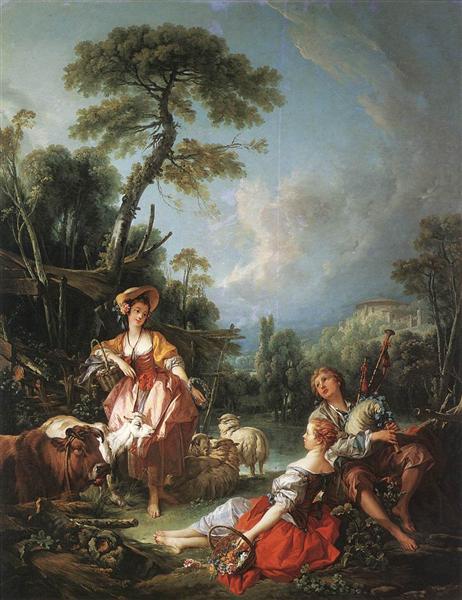
twice upon a “Pastorale” – Beethoven

summer-pastoral-1749.jpg!Large   

    “Summer Pastoral (1749)

          Francois Boucher

                __________

on my way to my metaphorical 
Eiffel Tower, Beethoven’s Piano
Sonata no 15, the “Pastorale”,
his first to impress me, his 
Opus 28despite the notoriety 
of the earlier “Pathétique”, 
Opus 13and of the “Moonlight”
his Opus 27, no 2, splashy 
showpieces, those last twoto 
my mind, rather than revelatory,  
knew I was going to stop at the 
Arche de Triomphe, if you’ll 
allow me the developing allegory
to visit the other “Pastorale”, the 
6th, and my favourite, Symphony
one of the few works which he 
named, but where he also gives, 
apart from tempoin the usual 
Italian, descriptive headings in 
German, the culture that had 
taken over the arts, essentially, 
from the Italians, during the 
18th Century

Erwachen heiterer Empfindungen 
bei der Ankunft auf dem Lande, 
he, for instance, instructs, or
Awakening of cheerful feelings on 
arrival in the countryside, then
Scene by the brook, Merry 
gathering of country folk, Thunder. 
Storm, and finally Shepherd’s song. 
Cheerful and thankful feelings after 
the storm – five, unconventionally 
already, movements, instead of the 
usual three, or four, with headings 
that look a lot like stage settings,
cues for a play, chapters in a story

it’s evident that music has explicitly 
become, hereliterature, movements 
have been given a specific thrust, 
particular direction to follow, not  
dance, but emotive, appealing to the 
vocabulary of the senses, the 
grammar of the heart, music as 
graphic description, later we’ll even 
get tone poems 

sure, Vivaldi had written his Four 
Seasons“, 1723, but never, ever, 
as precisely rendered as here,
Beethoven brings to life an actual 
storm, bing, bang, pow, you hear, 
as thunder cracks, rumbles, 
crashesnot to mention the virtual 
call, chirp, twitter of the various 
birds he elicits bristling in the 
rustling leaves, you’ll even hear 
in the recovering countryside 
rainbow if you listen

music has become a language, a
medium of direct intelligent 
communication, enough, indeed, 
to verily inspire century, indeed,
as well, beyond


you’ll also fall in love with Leonard 
Bernstein here, who shows why 
Leonard Bernstein remains ever, 
indisputably, Leonard Bernstein,
beautiful, angelic, inspired

R ! chard

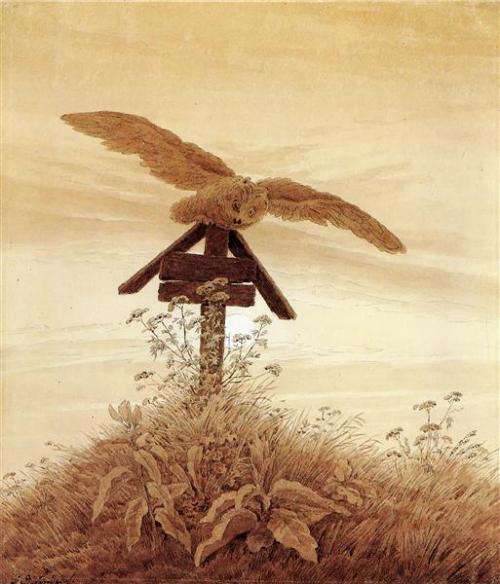
twice upon a dirge – Beethoven / Chopin

owl-on-a-grave-1837.jpg!Large

   Owl on a Grave” / “Eule am Grab (c.1836 – c.1837) 

          Caspar David Friedrich

                   _______

following my nose rather than 
my intellect in my exploration 
of musical treasures, like a very 
Aladdin uncovering at the click 
of my password a cave full of 
priceless wonders, I might find 
stuff out of sequence, but gems
nevertheless, and I can’t just 
whisk by without acknowledging 
them, however peripheral to my 
main task  

it’s like heading towards the Eiffel
Tower in Paris, and not stopping 
at the Arche de Triomphe

though I’d debated so soon 
presenting these two pieces, 
not because of their chronology 
especially, though also that, but 
mostly because of their dour 
content, I’ll point out that the 
move from Classicism to 
Romanticism is the transition 
from dance music, delightful 
music, to drama, passion, 
powerful emotions, dirges, 
therefore, are not out of place, 
however mournful

thus the two most famous 
funeral marches, Beethoven’s,
Chopin’s, the third movement 
in either of their home sonatas

the clincher for me was the 
immaculate performance of 
the Chopin herea revelatory 
moment, though the Beethoven
significantly earlier, the tune, 
1801, 1837, is nevertheless 
unimpeachable, however still 
underdeveloped – four variations 
only in the first movement, for 
instance, and all of them 
elementary – the caterpillar had 
not yet become the butterfly, the 
apple blossom the apple

note that each movement in the 
Chopin, apart from the last, has
two distinct tempi, executed 
effortlessly and nearly 
imperceptibly, a total of six, you 
can’t see, you can’t hear, the 
seams as you listen, which, with 
its virtual therefore episodes, 
conflicting and tortuous 
emotions, constitute collectively 
a drama, a narrative, music has 
become literature

the last movement of the Chopin
moves beyond even tempo – 
Beethoven’s also, incidentally, 
nearly – creating therefore 
very challenge to it, both trying 
to transcend tempi, an area to 
closely watch

Beethoven’s Piano Sonata no 12

Chopin’s Piano Sonata no 2

take your pick

both are supremely, mark, 
instructive


R ! chard

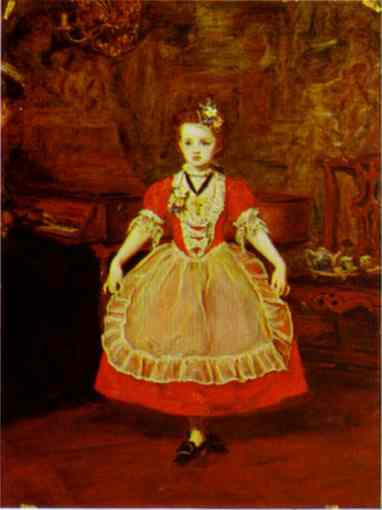
Minuets in G – Bach / Mozart / Beethoven

not_detected_236478.jpg

    The Minuet (1866) 

          John Everett Millais

                  _________

having pointed out that the minuet 
and the waltz were historically 
related, let me somewhat 
extrapolate

they are both in 3/4 time, which is 
to say, three quarter-notes to the 
bar, which means that when 
you’re dancing, your beat is one,
two, three, one two three, with 
the accent, usually, on the first 
note

so what happened, how could two
identical frameworks turn out so 
differently 

here’s Bach, 1725, his Minuet in G
the first thing you’ll think is, o, so
that’s what that is, it is an iconic 
number written on our collective
consciousness

the second thing you’ll notice is
that it is choppy, however delightful, 
that it is written for a harpsichord,
and that it’s probably not ready, 
despite it’s 3/4 time, to be a waltz,
too many curtsies

here’s Mozart, 1762, his Minuet in G
though you might not want to admit 
it, I suspect this number is much
more present in your subconscious
than you’d think, see if you don’t 
find yourself later on humming it

but it’s still way too polite to be a
waltz, you can easily imagine the 
partners, hands held high together
around their imaginary maypole,
courting, but there’s a touch more 
fluidity in the progression of the
notes, it is written for a fortepiano,
an instrument that has added the
hold, or the sustain, pedal to the 
harpsichord to increase a note’s
resonance, a loosening of the 
earlier constraints of that 
quintessentially Baroque 
instrument, a cannily apt 
metaphor, take into account, for 
the unfolding cultural r/evolution

here’s Beethoven, 1796, his Minuet 
in Gyou’ve heard this one too

the Revolution has taken place, 
but entrenched in the music of an
earlier era, the beat remains the 
same, this is not a waltz, despite 
it’s 3/4 progression

you’ll note, however, more spin 
to the cadences, more give, more
elasticity, much of this has to do 
with the development of the 
central instrument, which was 
about to become a pianoforte,
instead of a fortepiano, but 
‘nough said about that, I’ll let 
you feel it

here’s Chopin, 1833, his Grande 
valse brillante, Opus 18, written
for itself, the piano, it is indeed 
a waltz, the difference is in the 
piano’s ever evolving flexibility, 
again a metaphorical expression 
of, or an avatar for, the unleashing 
of personal freedom, an idea spun 
ineradicably from the lessons of
the French, and the, incidentally, 
nearly simultaneous, 1776, 1789, 
American Revolutions

for better or for worse 


R ! chard