sonatas, continued (Bach – “Goldberg Variations”)

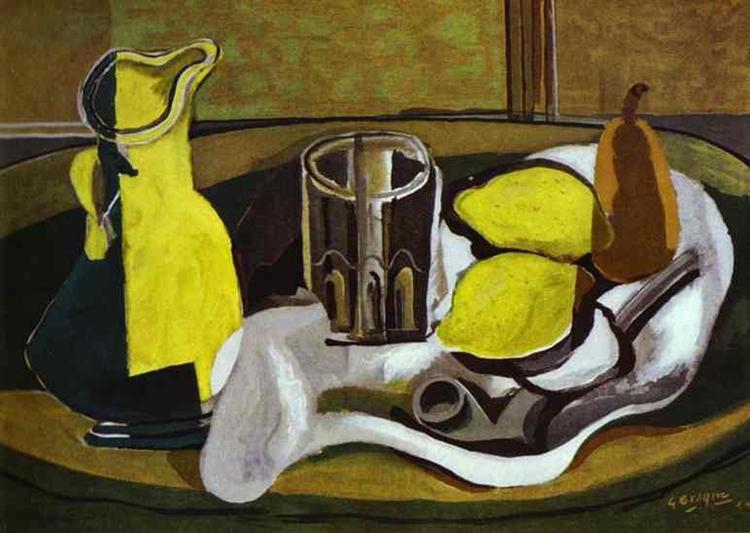
“Lemons“ (1929)
___________
watching one of my cooking competition
shows on television the other day, the
twelve contestants were called upon in
pairs to create, each couple, one of the
six elements in a degustation menu
a degustation menu – I raised an eyebrow
at that one – is the same as a tasting menu,
but at a finer, it is implied, restaurant
the theme was citrus fruit, each service
had to highlight one of them, a mandarin,
a lemon, an orange, a lime, a tangelo,
a grapefruit, in that order
my goodness, I thought, a set of
variations on edibles, I was delighted,
not to mention synesthetically
titillated, all my senses were alive
the first course was a mandarin-cured
prawn ceviche, with pesto, something
to tease one’s palate, leaving plenty of
room, however, for what was to follow,
the second course, an equally light
lemon-cured salmon with smoked
crème fraîche and decorative
translucent radish slices, in again but
polite allotments
the third service introduces the protein,
duck with the nearly ever requisite
orange, but with beets, in this instance,
on an underlying sheen of all their
accumulated and colourful juices,
bread, I would imagine, would’ve been
gluttonously required
beef then followed, to fill the second
of the more substantial and filling
elements of the meal, with a lime
reduction and beets
for dessert, the fifth service presented
a tangelo cup with a surprise chocolate
truffle meant to burst in one’s mouth
with iced tangelo flavour, refreshing
and unexpectedly delightful, followed
by a grapefruit sorbet with chocolate
ganache and meringue shards as a
finale
not all contestants reached the heights
wished for, but some were memorable,
much as in any set of, even noteworthy,
variations
here’s Glenn Gould playing Beethoven’s
Six Variations in F major, Opus 34, each
variation is comparable to a culinary
experience, but for piano
listen, compare
these are preceded here by a late, and
haunting, Beethoven bagatelle, his
Opus 126, however, after which the
variations themselves are conveniently
spliced in the editing process to help
distinguish each movement from the
other
Glenn Gould doesn’t hit a note wrong,
but I think Beethoven’s introductory
aria, upon which the variations are
built, and which is repeated at the end
after a coda, or final interpolated wave,
is slow, a more engaging opening
would’ve been, to my mind, more
effective
I also would’ve, however peripherally,
degusted especially the lime beef
R ! chard
psst: incidentally, all Bach’s Cello Suites
are in six segments, their common
theme is dance, each one is a
scintillating Baroque example
“Tempest on the Northern Sea“ (1865)
__________
for Judy, who “glimpses“, she says,
“a kinder world, that [my] missives
provide” – thank you, Judy
just as I was being called on the
carpet for my constant returns to
Beethoven, none other than Glenn
Gould should show up, in my
cavern of wonders, to absolve me,
or at least to stand stolidly by my
side
let him talk
had I written, however, his
observations, I’m sure you’d’ve
balked, he’s a product, after all,
of the priggish pretensions that
prevailed in my neck of the woods
at the time, Southern Ontario, a
product of British Imperialism,
of which I am myself, I avow,
incontrovertibly subject, but due
to the strength of his celebrity,
one is likely to listen to Gould
more attentively, I’m not
sufficiently yet, I suspect,
significant, nor influential
he is, one way or the other, I concur,
absolutely right
about his “Tempest“, though, I’ll say,
even object, as Stravinsky and John
Cage did, according to Gould, about
the commanding Beethoven, that
Gould is dripping in Romantic
sentiment here, his rubato in the
first movement tests the limits of
our forbearance, and his second
movement is so slow as to have
one fall off the page
but his last movement, the allegretto,
is brilliant
Gould’s idiosyncratic, dare I say,
eccentric, performance will
throughout, nevertheless,
astonish, indeed electrify, even,
I’m sure, inspire, watch, listen
and thanks ever, especially, for
dropping by
R ! chard
psst: here’s another version of the 17th,
to my mind, less self-indulgent, but
you be the judge, don’t think about
it, just ask yourself which one
would you want to hear a next time,
that’ll be your, gloriously personal,
reply
enjoy
“Clown with Flowers“ (1963)
_______
with the greatest respect for all
who read me, and especially
for those who are least
convinced, the way also,
I note, to a conscious,
and entirely personal,
aesthetic
let me once again insist that my
commentaries here are not at all
the last word on any of what I’ve
discussed, they’ve been merely
my opinion, according to my own
particular aesthetic, my comments
have been rather to excite curiosity
about, for some, an esoteric topic,
to awaken interest in a field, to my
mind, strewn with marvels, and
never to dictate, art, as I often
remind, is in the eye of the
beholder
I think of myself as company in
an art gallery, viewing a
succession of works, musical
here, expressing notions, either
specifically to do with the exhibit,
or, personal, but somehow related,
then moving on, just enough to
whet the appetite, or, of course,
not
here’s an instance
I’d been waiting for the sales clerk
to box some fresh pasta for me I
was buying at an eatery down the
street when a line of piped in music
from their overhead system swept
me off my disconcerted feet, which
I recognized to be Mozart, but as
I’d never heard him, ever
can you tell me who’s playing that,
I asked the cashier, many stores
played their own tapes back then,
some still indeed even do,
19-eighty, at that time, something
he replied, Mitsuko Uchida
what she’d done was to not stress
the bar line, the natural beat, to,
in fact, eliminate it, so that a flight
of notes went on like an unfettered
and iridescent miracle, prompted
by its own irrepressible momentum,
I was flabbergasted
Beethoven later on would do that
nearly consistently
where Glenn Gould would remove
his foot from the sustain pedal to
channel Bach while he played
Beethoven, an atavism, Mitsuko
Uchida was reversing the process
and using Beethoven‘s own
unleashing of rhythms to shed
light on her Classically otherwise
bound Mozart, a telling
anachronism, I nearly screamed
here, in the event, is the next work
of musical art in my idiosyncratic
gallery, the richibi galleri, I call it,
Mitsuko Uchida herself illuminating
gloriously, as ever, Mozart, his
splendid, as she reminds us, Piano
Concerto no 9
thanks so much for stopping by
ever
R ! chard

“All About Eve“ (1950)
_______
while I’m on the subject of concertos,
there’s one concerto that cannot be
overlooked, the very epitome of
concerti, their summit, apex, their
very pinnacle, Olympus, compared
to other less mighty compositions,
Beethoven’s Fifth Piano Concerto,
the piece I would take with me to a
desert island, I used to even walk
along the seashore in the privacy of
my headphones nights, after dinner,
taking in its cadences, its wisdom,
under the moon, the stars, along
the, however temperamental,
ocean waters, transported
indeed this very version of it, Glenn
Gould’s, Beethoven’s, in my mind,
oracular equal
Beethoven made literature out of
music, progressed to the point of
delivering a very philosophy,
Gould took the prevailing
Romantic aesthetic of the time,
Arthur Rubinstein being a prime
example, for instance, and gave
us the music of the Information
Age, the mathematical precision
of computers, people could hear
it, perhaps not even knowing how,
why
briefly, Gould eschews – Gesundheit –
the hold pedal, the sustain pedal, on
the piano, he’d grown up on Bach,
made him his specialty, but Bach
had no sustain pedal on his
harpsichord, Gould transferred this
process to later, more rhythmically
malleable, works, making obvious
thereby their inner workings,
something like reading blueprints,
his interpretations give us the bare,
and revelatory, bones of these later
masterpieces, without the sometimes
facile effects of Romanticism, think
of rubato, for instance, the ability to
stretch a note, not possible on the
harpsichord, but often overused in
Romantic renderings, a cheap trick,
like paintings on velvet
Gould would have none of that, he
shows you the composer’s
compositional brilliance, without
fanfare, just the facts, no pedal,
which at the time was completely
revolutionary, much like computer
science was then, and algorithms
here’s something else about Gould,
more savoury, maybe, he was called
in at the last minute to perform this
piece when the planned pianist, of
considerable renown, wasn’t able to
make it, Gould hadn’t played it in a
number of years, but showed up the
next morning to deliver, the rest is,
as they say, history
that’s “All About Eve“ up there, but
for pianists, Glenn Gould is Eve
Harrington, though without her
predatory instincts, nobody now
remembers the other pianist,
unless you were there, interested,
listening, piano’s Margo Channing,
even if I named him, however
consummately accomplished he
might’ve been, a man I profoundly
admire, remains, cruelly, essentially
unremembered
imagine
R ! chard
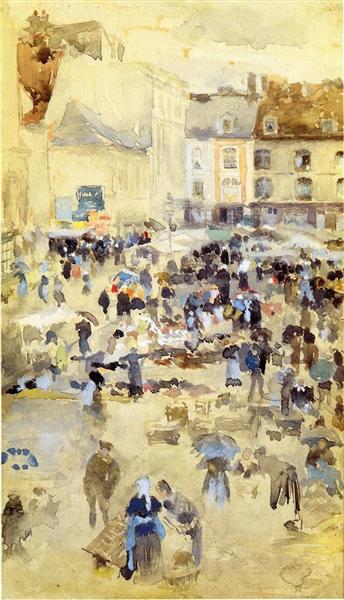
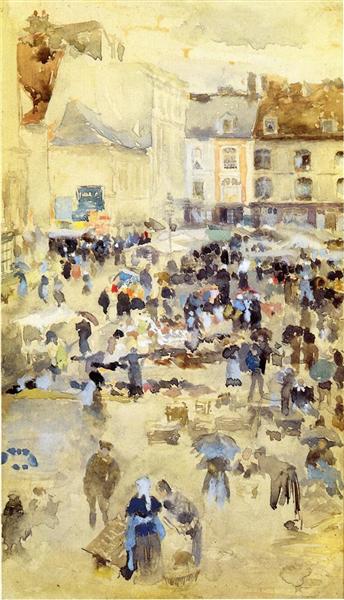
“Variations in Violet and Grey – Market Place“ (1885)
___________
strolling through my virtual musical park
today, in, indeed, the very merry month
of May, I was taken by surprise by, nearly
tripped over, in fact, a Beethoven work,
written in the very year, 1806, of the
“Razumovsky”s
I’d overlooked it cause it is without an
opus number, is listed, therefore, as
WoO.80, and is, consequently, easily
lost in the wealth of Beethoven’s
more prominently identified pieces,
but it is utterly miraculous, I think,
and entirely indispensable
I’d said something about it in an earlier
text, back when I was somewhat more
of a nerd, it would appear, perhaps even
a little inscrutable, though it’s
nevertheless, I think, not uninformative,
you might want to check it out, despite
its platform difficulties
the 32 Variations in C Minor are shorter,
at an average of 11 minutes, than Chopin’s
“Minute Waltz”, relatively, a variation every
half minute, where Chopin’s nevertheless
magical invention takes twice that to
complete its proposition
but in this brief span of time, this more
or less 11 minutes, Beethoven takes
you to the moon and back
a few things I could add to my earlier
evaluation, could even be reiterating,
Beethoven in his variations explores a
musical idea, turns it in every which
direction, not much different from what
he does in the individual movements of
his string quartets, his trios, his
symphonies, concertos and sonatas,
with their essential themes, motives,
they’re all – if you’ll permit an idea I got
from Paganini’s “Caprices” – cadenzas,
individual musings inspirationally
extrapolated, which, be they for
technical brilliance, or for a yearning
for a more spiritual legacy, set the
stage for a promise of forthcoming
excellence
this dichotomy will define the
essential bifurcated paths of the
musical industry, during, incidentally,
the very Industrial Revolution, their
mutual history, confrontation, for the
centuries to follow, which is to say,
their balance between form and
function, style versus substance,
Glenn Gould versus Liberace, say,
or Chopin, Liszt
before this, it’d been the more
sedate, less assertive evenings at
the Esterházys, to give you some
perspective, mass markets were
about to come up, not least in the
matter of entertainment
Beethoven was, as it were, already
putting on a show
R ! chard
psst: these alternate “Variations” put you in
the driver’s seat, a pilot explains the
procedures, it’s completely absorbing,
insightful, listen

“Masked Harlequin Violinists“ (1944)
________
the Opus 77, no 2, of Haydn is the last
full string quartet of his, his very last
remaining unfinished, the Opus 103,
written in 1803
Haydn died in 1809, the Opus 77, no 2
was composed in 1799, he would’ve
been 67
but by then, he had established the
form that music would take for the
next over two hundred years
call, response, and recapitulation is
the house that Haydn built, and verily
cemented, you can hear it in our own
period’s “Love Me Tender“, for
instance, if you’ll also permit me here
its irresistible elaboration, to today’s
top hits, like my own most recent
favourite such contemporary iteration,
released in 2014, “Photograph“
we could be listening otherwise to
Bach right now, counterpoint,
fugues, intricate, linear music,
however powerfully transcendental,
instead of recurring music, call,
response, as I said, and
recapitulation, something like how
a clock works
but already Haydn is testing the
waters, in the Opus 77, no 2, the
andante, a step up from an adagio,
is in third place, something we
haven’t heard before, and not, to
my mind, especially effective, like
his mixture of tempos in the Opus
54, no 2, which was disconcerting,
however masterfully resolved we
find those to be in this very Opus
77, no 2, notably in the second
movement’s “Minuet, Presto – Trio”,
where the tempo change is nearly
imperceptible
art works on contravention, but
the affronts are to established
conventions, which are very
hard to overturn
watch Haydn here continue to
do just that, for better or for
worse
R ! chard
psst: listen to Bach here, incidentally,
put his largo, or slow movement,
right where he wants to, at the
very top of the bill, does it work,
you tell me, a trivial pursuit,
you’ll ask, I say not, you are
defining your own aesthetic
sensibility, something
profoundly, I think, important,
who it is, with perspective, you
want to be
.jpg!Large.jpg "The Scream, 1893 - Edvard Munch")
“The Scream“ (1893)
____________
before we leave too far behind the
anniversary of the annihilation of
Hiroshima, August 6, 1945, let me
introduce you to a piece that
purports to pay it homage
if I didn’t bring it up before, it’s
because the date was wrong, but
especially because the work
offends me, the only thing I like
about it is the title, a thing of
beauty, poetry – Threnody to the
Victims of Hiroshima – a threnody
is a song of lamentation for the
dead, which worked for me, this
one, no further than its title
there is nothing remotely
reminiscent of the tragedy
throughout the piece, it is a
collection of academic exercises,
pretensions, I think, without a
heartbeat
let me compare Steve Reich’s
threnody to the victims of the
Holocaust, the other signature
Twentieth Century atrocity, his
“Different Trains“, a work in three
movements, “America – Before the
War”, “Europe – During the War”,
and “After the War”, for string
quartet and tape, upon which
Reich has recorded interviews
with people relating impressions
from before the war, during, and
after, according to the movements
the quartet, you’ll note, must keep
time with the tape, and in this
production visuals have been
effectively added
Glenn Gould had done something
like this several years earlier,
incidentally, in his “The Idea of
North“, a threnody itself to that
very idea, a masterpiece, a
groundbreaking transcendental
work of the imagination, with
overlapping voices, which is to
say human counterpoint, though
without string quartet
you’ll note that distressing tonalities
affect throughout this other, much
more successful however, tribute,
but the different rhythms of the
recurrent, which is to say minimalist,
rails keep you emotionally, as it were,
on track
“Different Trains“ is appropriately,
and profoundly, commemorative,
not to mention unforgettable
Richard
_______
 Richibi's Weblog