Richibi’s Weblog

Just another WordPress.com weblog

Category: from my dictionary

Aristotle on poetry

aristotle-jpglarge

      Aristotle” (1653)

        Luca Giordano

          ___________

so what’s a poem

in an attempt to get a clearer picture 
of what a poem should be, rather 
than trust only my own, however 
informed perhaps, opinion – though 
it must be added that we all bring 
something to that word’s definition, 
mine no less worthy than yours, 
yours no less worthy than mine – 
thought I’d go back to authoritative 
sources to see what they might 
have said

and it doesn’t get any earlier and 
authoritative than Aristotlewriting 
in 350 B.C.E., at the height of 
Ancient Greek preeminence, 
dissecting the term in his 
penetrating and perspicacious, 
ahem, Poetics” 

I propose to treat of Poetry in itself and of its various kinds,
noting the essential quality of each, to inquire into the
structure of the plot as requisite to a good poem; into the
number and nature of the parts of which a poem is
composed; and similarly into whatever else falls within
the same inquiry.“, he says in Part 1 of his 
magisterial treatise

and proceeds to declare the parameters 
of “Poetry” for the ages  

Poetry in general seems to have sprung from two causes“, 
he proceeds, imitation and rhythm 

by imitation I think it best to think of 
representation, which is another way, 
anyway, of saying imitation, but 
much more evocative in this instance,
more attuned to our sense of his word 

a poem is a representation then, a 
reproduction of something other than 
itself 

while its rhythm is what George
Gershwin‘s got, and by extension, as  
you can see from this videoGene Kelly

and yes, that means that “Epic poetry and Tragedy, Comedy also
and Dithyrambic poetry, and the music of the flute and of the lyre in
most of their forms, are all in their general conception modes of
imitation.” 

so, according to Aristotle, is dance 

all, therefore, poems

an interesting elaboration about “Tragedy” 
states that it should have the three unities 
that I grew up with during my French 
Canadian upbringing, the unity of time, of
space, and of action the famous French 
Classical dramatists, Racine and Corneille,
applied under the aegis of Louis XlV

not to mention Tragedy’s use of iambic 
pentameter, Shakespeare’s ubiquitous 
beat, a beat that persevered into the very 
Nineteenth Century, in France with 
Rostand‘s Cyrano de Bergerac“, for 
instance, and into the Twentieth Century 
with Eliot‘s Murder in the Cathedral“, 
about the assassination of Archbishop
Thomas Becket at Canterbury in 1170 
under Henry the Second‘s own aegis,
all written as poetry 

the most famous play to follow the 
three unities in the modern era is 
Who’s Afraid of Virginia Woolf?“,
the play which I think defines the 
Twentieth Century, which takes 
place overnight somewhere in 
New England college town, mid-
century, at George and Martha’s 

though followed closely by O’Neill‘s 
Long Day’s Journey int Night“, 
which transpires from morning, one 
day in August, 1912, till midnight, at 
the home ofunity of space, note, 
the dysfunctional Tyrones

so it appears not much has changed
about poetry, Aristotle got a lot of 
mileage out of his early definition, 
nearly 2500 years 

makes you wonder  why so much 
attention was paid instead to 
Platohis contemporary, the 
mystic, who would’ve banned
poetry, he thought it was 
subversive
 
Richard

psst: for a modern day application
          of the three unities, watch 
          In Treatment“, a television
          series, which takes place 
          in a psychotherapist’s office,
          each episode a session,  
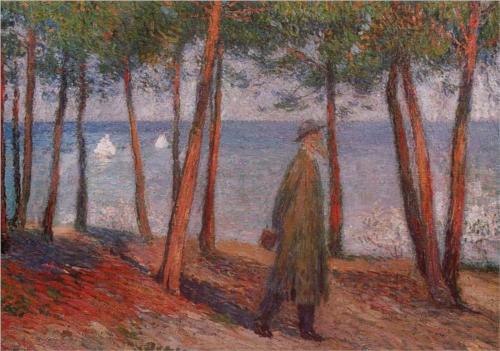
   

what is a philosopher‏

Henri Martin - "Philosopher"

Philosopher

Henri Martin

________

considering the response below too
forthright for a discussion we were
having on a university course website,
interactively dealing with the question
of free will, I nevertheless found worthy
my opinion of what a philosopher is,
which I deign to mount here on my,
less discreet, canvas

if you’ll allow

it is evidently a dramatic monologue

Richard

__________

what is a philosopher

you are not a philosopher, sir, to take
offence so quickly, a philosopher is
objective, and wouldn’t allow for
emotion to get in the way of even an
offensive argument

but with irrefutable logic simply
expose his, her sound position

indeterminacy would be encountered
with humility first, then grace, only
ever consummate deference

if you’ll allow

cheers

Richard

psst: see, for more on indeterminacy,
Socrates, ever catering to objections

a poem without words

 
poetry: when Beauty touches Truth, producing
                incandescent transcendence 
 
                and an inadvertent, and privileged, view
                of the sublime
 
                just click
 
 
Richard


how to read a poem – “Alchemy” – Stephen Sandy‏


when I looked up “philodendron” in the dictionary,
it said it was an “arum” with a particular “foliage”,
I thought what kind of a dictionary is that, then
found out “arum” was a flower whose leaves have 
a particular shape, of a heart or a sword, but didn’t
take that conjunction further than to cock a wry eye
and wonder, briefly, heart or sword, that’s some
conjunction
 
we are inches away from being a philodendron, it
would appear, purportedly a “single atom” 
 
 
let me relate that when I worried about my position
in the universe, existentially, aesthetically, morally,
thinking that being no more, but also no less, than a
flower, really helped, was indeed the only thing that
helped, I didn’t want to imagine a world without
flowers, and I was a part of that 
 
 
Richard
 
            _____________________________
 
 
from the New Yorker, November 5, 2012
 
 
Alchemy
 
Chlorophyll C55H72N4O5Mg
differs from human blood
only by substitution of one
atom of magnesium
in philodendron
for the single atom of iron
in Keats.
 
 
                    Stephen Sandy 


true happiness

 
in the movie Never on Sunday” Homer Thrace, an American moralist and armchair philosopher, objects to the libertine ways of the modern Greeks, Ilya especially, a whore, disconcerts him, she likes her job, so do the dockworkers, and the other women who ply her trade at the port of Piraeus, near Athens 
  
Homer Thrace accuses them all righteously of pursuing the Stoic and Epicurean philosophies that came out of the fall of Greece, instead of the true and noble ideals of the more upstanding Socrates, Plato, and Aristotle, who believed that the greatest happiness comes from the joy of understanding  
  
when he tells Taki, who plays the bouzouki, that he can never be a true musician because he can’t read music, Taki, who is too old now to learn, hides in the bathroom forlornly, and says he will never play again 
  
Ilya, Melina Mercouri, in a star turn, tells him composers need his music to be able to write his notes down, what would composers do without him, if birds can’t read music, she asks, should they stop singing  
  
Taki comes out of the bathroom
  
so had I   

  
Richard


                       ______________________________