sonatas, continued (Beethoven – Opus 44)
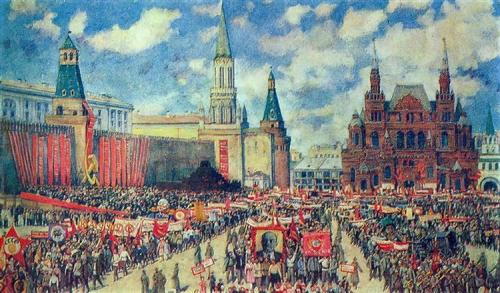
“The 1st May Demonstration on The Red Square, 1929“ (1930)
__________
let me correct something I wrote in my
last comment, inadvertently, misleading
you somewhat with my inappropriate
use of the word “movement”, that the
Symphony no 2 had only one, I stated,
by which I meant that there were no
pauses throughout, there are, however,
indeed four movements in the Second,
four distinct sections that have been
joined together, such an uninterrupted
piece would usually have been given
an appropriate title, or an opus number,
to identify it, but would not have been
called a symphony, a symphony is by
very definition a clearly segmented
composition, like chapters in a book,
they might follow a theme, though not
necessarily, see Mozart, but the breaks
are integral, where you get a chance to
cough, or to get up and replenish your
glass of wine
the Second could have been, should
have been, called simply, “October“,
and, ergo, left at that
but it wasn’t
the very same must be said about the
Third Symphony, “The First of May”,
you can already probably hear the
jubilation and fanfare in just the title,
another milestone of the Revolution,
the anniversary of Lenin’s death, the
final chorus sings a lyric of a poet of
the Revolution, Semyon Kirsanov, a
sure nod to the symphony‘s political,
however peripheral, intent
what you’ll note, however, is the
sensuality of the music, above
whatever weight of a, perhaps
more fitting, dirge, or the bombast
even of a commemorative, an exalting
tribute – though these are determinedly
there – going back to the orchestral
triumphs of the Romantic Era, with
its lush rallentandos and its voluptuous
ritardandos, the better to seduce
Shostakovich is getting ready for the
real thing, a piece with any partisan
message, he must sense, can never
work
by the way, should you disagree
with any of my evaluations, this
would not at all be offensive, but
even wonderful, I have been
wrong, I can prove it, I have the
dates, they are listed somewhere
in my papers, but it would mean
you’re paying attention, listening,
which is the entire purpose, more
than anything else, of this
exploratory exercise, should you
wish to participate
R ! chard
.jpg!Large.jpg "The Scream, 1893 - Edvard Munch")
“The Scream“ (1893)
____________
before we leave too far behind the
anniversary of the annihilation of
Hiroshima, August 6, 1945, let me
introduce you to a piece that
purports to pay it homage
if I didn’t bring it up before, it’s
because the date was wrong, but
especially because the work
offends me, the only thing I like
about it is the title, a thing of
beauty, poetry – Threnody to the
Victims of Hiroshima – a threnody
is a song of lamentation for the
dead, which worked for me, this
one, no further than its title
there is nothing remotely
reminiscent of the tragedy
throughout the piece, it is a
collection of academic exercises,
pretensions, I think, without a
heartbeat
let me compare Steve Reich’s
threnody to the victims of the
Holocaust, the other signature
Twentieth Century atrocity, his
“Different Trains“, a work in three
movements, “America – Before the
War”, “Europe – During the War”,
and “After the War”, for string
quartet and tape, upon which
Reich has recorded interviews
with people relating impressions
from before the war, during, and
after, according to the movements
the quartet, you’ll note, must keep
time with the tape, and in this
production visuals have been
effectively added
Glenn Gould had done something
like this several years earlier,
incidentally, in his “The Idea of
North“, a threnody itself to that
very idea, a masterpiece, a
groundbreaking transcendental
work of the imagination, with
overlapping voices, which is to
say human counterpoint, though
without string quartet
you’ll note that distressing tonalities
affect throughout this other, much
more successful however, tribute,
but the different rhythms of the
recurrent, which is to say minimalist,
rails keep you emotionally, as it were,
on track
“Different Trains“ is appropriately,
and profoundly, commemorative,
not to mention unforgettable
Richard

“Socrates”
__________
following in the footsteps of Socrates,
who, I agree with the Oracle, has been
ever the wisest man, one whose example
I’ve followed since first hearing of him, let
me query, what is courage
a tentative definition would have one
stating that courage is a determination
to overcome danger
but to use my own example, being called
courageous for surviving an aneurysm,
would this instance have qualified
where was my determination, apart from
waiting, submissively, for the axe to fall,
or to not fall, I felt no fear, merely time
passing, not an ounce of determination
but what of those others who endure
the pain often associated with dying,
agony, is that not a kind of enforced
courage
so did I qualify
an aneurysm swells the blood vessels
to the brain as the brain heals, but
meanwhile the heart pumps a rhythmic
tattoo on those passages rendered
more tender, so that a throbbing
anguish is ever drumming its drill
upon the cerebrum of the sufferer
perhaps I did qualify
but Socrates brings up an interesting
objection, can animals be brave, it
would seem not, therefore courage
requires self-consciousness, whether
or not it is defiant or compliant
and what about defiance before a lost
cause, is that courage or doomed
bombast
Aristotle adds to the mix the notion
of a noble cause, not merely an
instinctive, however, in the event,
morally prompted, position
so what is courage, you tell me
I say that you know it when you see
it, the courageous act defines the
word, not the other way around,
much like flowers are the result of
their own efflorescence, not the
manifestation of a preset Ideal
you are the measure of your own
words
for better or for worse
Richard
psst: it is interesting to note that
according to the Bible, in the
beginning was the Word,
John 1:1, a convenient tool
to impose order
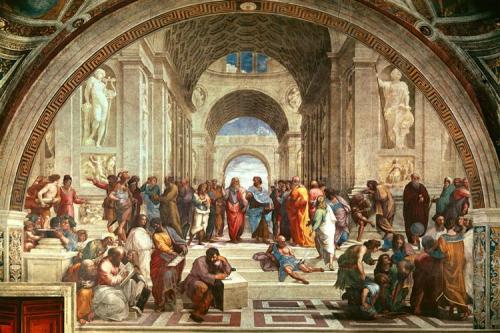
“The School Of Athens“ (1510 – 1511)
_______
upon reviewing my Socrates, Plato, and
Aristotle from a series of university
lectures I’ve been following, I came upon
a discovery so egregious, I couldn’t
believe I hadn’t seen it before, the old
story of the forest and the trees, I guess
upon hearing that the Oracle at Delphi
had replied that it was Socrates to those
who’d wondered who the wisest man
was, Socrates, abashed, began to seek
out wise men to disprove the Oracle,
but whenever Socrates asked of them
what is virtue, what is justice, what is
knowledge, for instance, the answers
were always inconclusive, they always
seemed to depend on perspective –
virtue, justice, knowledge were in the
eye of the beholder – though Plato
later putting in his own definitions
called them Ideals, a chair partook,
for instance, of an overarching
chairness somewhere, as did indeed
virtue, knowledge and justice, which
inferred another ideal universe
contiguously, of which our own
universe supplied only imperfect
renditions
you can hear the seeds of Heaven and
God already in all of that, way before
Christianity, not to mention Original
Sin
it also suggests an implacable order
Socrates wouldn’t’ve liked that
but Aristotle, with a much more critical
mind than Plato’s, less speculative, more
akin to Socrates’, less autocratic, more
inquisitive, begins to try to define,
nevertheless, abstractions, virtue,
knowledge, justice, as though they
indeed existed as ideals
this is putting the cart before the horse,
I thought, in the form of a revelation
an instance exists in the act of creation,
a physical transformation produces a
flower, the flower doesn’t happen
because of the word
a human example
for surviving an aneurysm once, someone,
to my astonishment, had called me
courageous, I’d been, I thought, only
surviving, not an inch of courage, not
even a millimetre
courage, I surmised, is in the eye of the
beholder, it is not at all a template, an
absolute, in my experience
Aristotle goes on to define a host of
Virtues, indeed 11, which come out as
essentially his Eleven Commandments,
on, in fact, courage, among others, all
essentially, and appropriately, moral,
thereby creating the moral realm of
our Western world
Jesus followed
and of course God and Heaven
which, of course, still prevail despite
sound, sober objections
as though we could know
why is this important
because, I think, we must remember
that our assumptions are only that,
and often they’re based on only what
we’ve been told, which is already a
step away from incorrect
interpretation
in the world of false news, check
your references, check your very
words, our lives, it isn’t too much
to say, I believe, depend on it
not to mention our own personal
moral code, our soul, our purpose
for being, which every wo/man
must oversee for hirself
if one has the courage
Richard
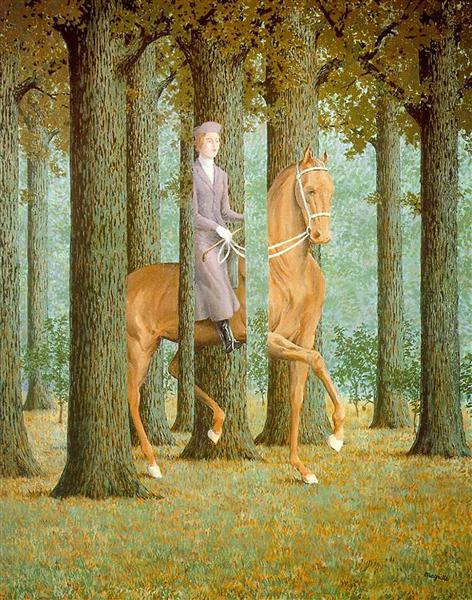
“La carte blanche” (“The Blank Signature”) (1965)
_________
being part of the truth, or Truth, we can’t
see the forest for the trees, ever
Richard

“Paradise”
__________
“Is Art Truth?“, a friend asks after speaking of
its benefits, “Art accepts and tells the truth-Is
that it ?“, she inquires, wonders
art, like truth itself and beauty, is in the eye
of the beholder, I submit, and therefore my
definition is, once again, entirely personal,
though I’ve rigorously plumbed it
it requires background
art died for a thousand years, it was
essentially unrecorded, dormant from
the fall of Rome to the Renaissance, nor
promoted but for Catholic purposes,
hence the majestic cathedrals and the
magisterial altarpieces, works produced
by, however, communities until eventually
certain artisans were recognized as more
inspired than others, and given autonomy
enter Duccio, for instance
in time these new, necessarily idiosyncratic
perspectives – see Hieronymus Bosch, Dante
Alighieri – dominated, veering in their search
for truth in their art and beauty – selling points,
incidentally – towards less strictly orthodox
utterances
see above
art, and its contemporary science, were
chipping away at ecclesiastical dogma
till God died, and artists continued their
prescient march forward, shaping our
zeitgeist, our spirit of the times, with
their pronouncements for lack of any
other guides
but the voices grew personal, see Mozart,
often profound and prophetic, see
Beethoven, till the confluence of disparate
realities gave us secularism, each soul for
itself as a tenet, a credo, a belief, a truth
what did they have in common
I believe it was their quest for beauty
through truth, their quest for truth
through beauty, with a nod here to
the salient Keats
art is prayer, a search for, as well as a
manifestation of, one’s personal
identification with the sacred
it is not truth, it is not beauty, it is the
fervent intention itself, linked with a
correspondent workmanship, craft,
which inspires
see for instance van Gogh for this, who,
remember, nevertheless shot himself,
artists are mortal, merely, messengers,
ever, therefore, fallible, unsure, fearful
even, often, of their, perhaps
Promethean, fire
for consolation, or even maybe
transcendence, see again,
pertinently here, Beethoven
Richard
psst: thanks, Joan
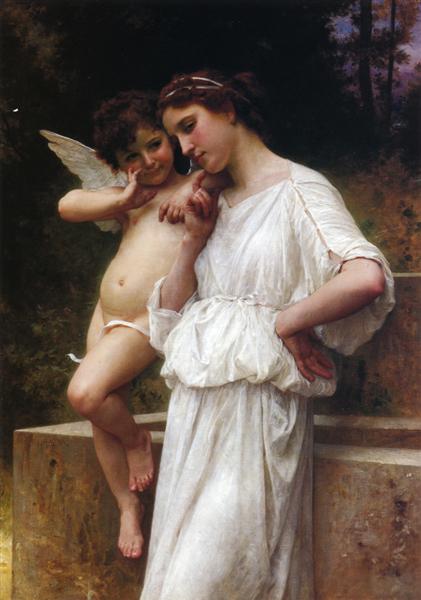
“Love’s Secrets“ (1896)
_________
the only way you can hate someone
you’ve loved is if your love was selfish,
true love can never not love, ever
Richard
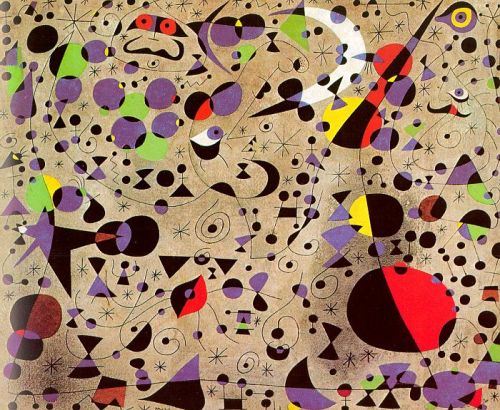
“The Poetess“ (1940)
_____
when Aristotle “proceeds to declare the
parameters of “Poetry” for the ages“, his
definitions of the various poetic
“manner[s] or mode[s] of imitation”
have already been established, his
categorizations are not unlike Darwin’s
categorizations of the species during
a much later age, Aristotle was a natural
scientist much more than he was our
notion of an abstract philosopher, he
traded in facts rather than in the
esoteric musings that Plato, for
instance, pursued, Virtue, Justice,
the Good, his conclusions were more
verifiable
Kant, incidentally, is also famous for
following a similar form of investigation
as he attempted, nearly, for most,
inscrutably, to categorize the elements
of our faculty of understanding
a side story
Kant had stated that at birth we already
have within our perceptual framework
implicit understanding of space and
time, these are not learned through
experience but are already
incorporated within us, he said
many years ago, coming out of a
week-long coma, not knowing where
I was but alone, at that point even
just my consciousness, cause my
body, were it there, would’ve been
under the immaculate white sheets
I could see that would’ve been
shielding my legs
I looked around, could gather motes
upon rays of light that were entering
from what appeared to be a window
on the right, behind sheer white
curtains stirred by a soft breeze,
whirling the shimmering particles
alive in the light before me like
miniature spinning galaxies moving
at the pace of their own infinity
there was no sound
white walls around me stood utterly
still in the purview of my perception,
a door, also white, stood opposite
me on the opposite wall
where am I, I wondered, could this
be heaven, an afterlife, I might’ve
died, I thought, marvelling, no fear,
regret, nothing other than curiosity,
absorption, fascination
I tried to answer my question, where
am I, two dimensions, I figured
after having watched Terence Stamp
exiled by Marlon Brando to a flat
intergalactic window pane in
“Superman“, I hadn’t excluded this
eventuality, however ingloriously
transcendental, as a possible
outcome, I might be in a world with
only two dimensions, height and
width, no depth yet without more
investigation, experience
ergo, Kant, I concluded, was wrong,
our knowledge of space is not inborn
but a product of time and thought like
everything else
later, the white door on the far wall
opened, and a nurse walked in, also,
incidentally, in incandescent white,
and I understood I was alive
Aristotle suggested that our original
double instincts towards poetry were
our propensity to imitate, children
imitating their parents’ even
idiosyncratic mannerisms, for
instance
and rhythm, repetition, preludes to
order, coherence
those two
poetry, I read, is expression
reflecting the heartbeat, essentially,
in all its myriad representations
Richard
 Richibi's Weblog