Richibi’s Weblog

Just another WordPress.com weblog

Category: Franz Schubert

a veritable Schubertiade

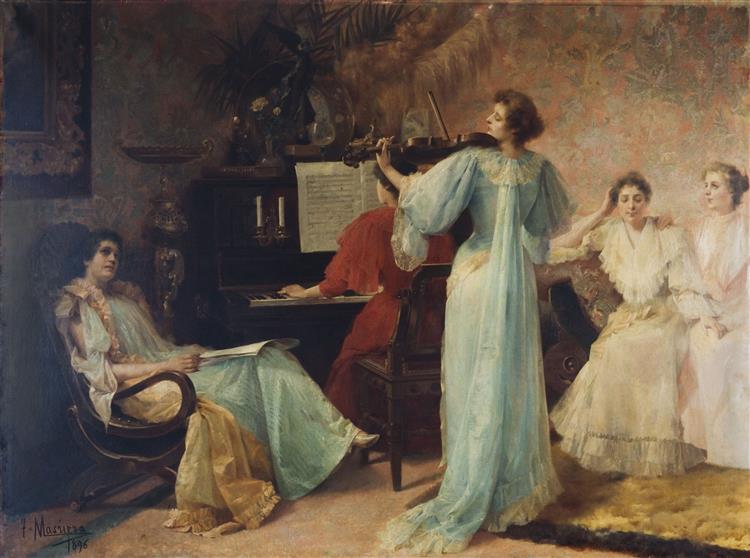
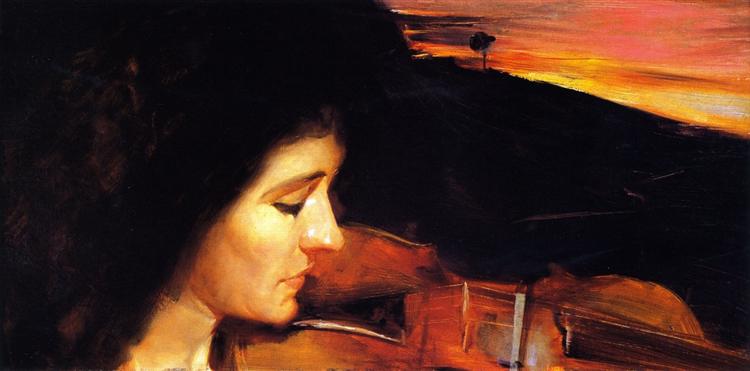
Una melodia de Schubert, c.1896 - Francesc Masriera

            Una melodia de Schubert” (c.1896)                   

                        Francesc Masriera             

                              ___________

in May, the recital society of my city is featuring

an internationally famous pianist doing several

Schubert sonatas, twelve of them, spread out 

across four evenings, a veritable Schubertiade,

I’ve got tickets for all of them


maybe you’d like to join me


I always do my research before attending any

cultural event, much like reading up on Italy, 

for instance, before going there


the program seems to be more or less

chronological, the first night featuring

earlier Schubert sonatas 


his D568, his Seventh, composed in 1817, 

is, to my mind, enchanting, but not yet 

reaching the heights of his later

transcendental productions, more of 

which later, should you stick around


Schubert always sounds a lot like Beethoven, 

but with more civility, less confrontation, 

Schubert is still chamber music, and, in this

outing, I find he sounds a lot like Mozart even, 

dexterous, delightful, but fundamentally 

frivolous


it’s the difference between dessert and food 

that will sustain you, that’ll speak to your soul, 

more about which later, should you stick 

around


meanwhile, D568, enjoy


R ! chard

sonatas, continued (String Quintet in C, D. 956 – Schubert)


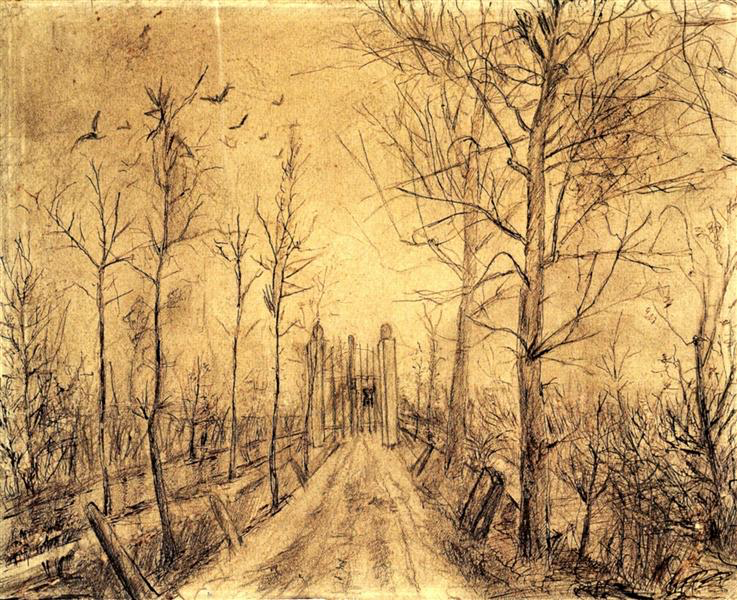
     Driveway (1872 – 1873) 

           Vincent van Gogh 

                  ________

if a quartet is a piece of music for four instruments,

if a quartet is also a piece of music consisting of 

more than one segment of music, movements –

two definitions just to confuse things – a quintet is, 

in the same manner, a piece of music written for 

five instruments, as well as a piece of music 

consisting of more than one segment of music, 

as a trio is for three, a sextet, yes, a sextet, is 

for six, and so forth


any of these groupings can nevertheless do 

nocturnes, tangos, ballades, pieces of music

consisting of only one segment, movements 


here is perhaps the most influential quintet of

all time, Schubert’s D956, you will have heard 

it, at least some of it, somewhere, probably, as 

part of the cultural heritage of the West, should 

your heritage be of the West, hearing it is as if 

coming upon, musically speaking, any one

of, for instance, Van Gogh’s masterpieces, 

see above, we still bathe in its, their, 

however subconscious, impact


listen


R ! chard

November / Month of the Sonata – 18 

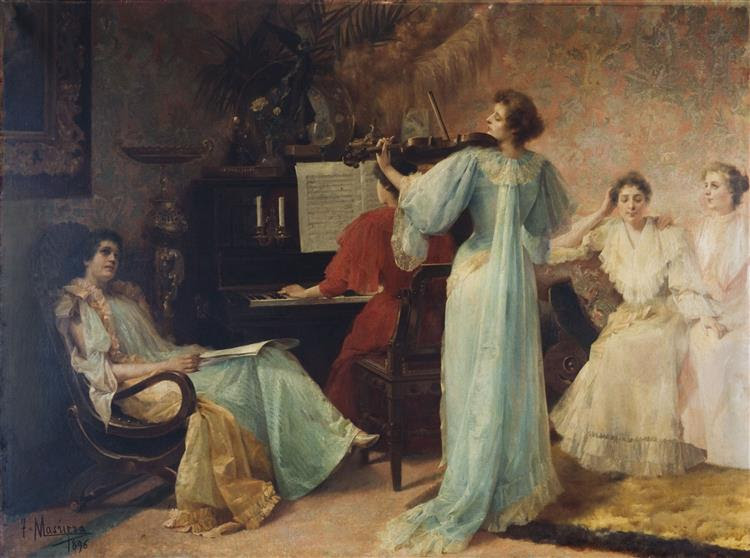
Una melodia de Schubert, c.1896 - Francesc Masriera

    A Melody of Schubert (c.1896) 


           Francesc Masriera


                  ________


though there are other, and quite significant, 

composers who fit into this category, 

Beethoven, Schubert, and Chopin pretty

much define, all by themselves, the 

Romantic Period


Chopin composed only two sonatas of note,

plus one more that is overlooked for being 

an early, student effort, not up to the

standard of his later ones, Chopin, rather, 

wrote mostly shorter pieces, nocturnes, 

études, preludes, polonaises, and more, 

that later became the very stuff of his 

reputation


Schubert wrote enough sonatas that he 

could be compared to Beethoven, indeed

it can be difficult to tell one from the other,

much as it can be difficult to tell Haydn 

from Mozart, products in either case of 

being both of their respective eras


when I was much younger, a guest among

a group of academics, where I’d been invited 

by the host’s wife, a co-worker, what I knew  

of Classical music, in the large sense, which 

is to say comprising all of the musical periods, 

Classicism, Romanticism, Impressionism, 

and beyond, was all self-taught


is that Beethoven, I asked the host, about 

a piece of music he’d put on


that’s Schubert, he replied, aghast, as 

though I’d just farted


I blushed, deep red, confounded


Schubert, having great admiration for 

Beethoven, took on many of the older

composer’s lessons, four movements

instead of the Classical three, for 

instance, and many of the technical 

tricks of his forebear


but there’s an essential component of

their styles that marks one from the

other, an easy way to tell them apart, 

Beethoven always composes against 

the beat, Schubert following it


listen to the first few notes of Beethoven’s 

“Pathétique”, for instance, the beats are  

erratic, confrontational, the mark of a 

revolutionary, Beethoven was brashly 

proclaiming his worth, he had something 

to prove


Schubert, who was essentially playing

for friends, just wanted to entertain

them, which he did in spades, without

bombast or bluster


listen to his Piano Sonata in A major,

D959, for example, no swagger, no 

ostentation, delivering nevertheless 

something quite, and utterly, 

enchanting, everything following, 

unobtrusively, the beat


enjoy


R ! chard

November / Month of the Sonata – 9

      Jules Delsart


           ______


at the end of the Romantic Period, 1886, and

encroaching on the upcoming Impressionistic

Era, César Frank wrote his Violin Sonata in

A major, a musical glimpse into a new age,

this is not Chopin, not Beethoven, not 

Schubert, despite obvious, if you’re 

listening, homages, references


you’ll note the atonality, musical progressions 

that seem askew, eccentric, not as harmonious 

as those earlier composers, like a neurosis 

taking over


tempo, a second essential element of music 

in the West, however changeable might it be, 

even within the individual movements, is 

recognizable


repetition, the third pillar of Western music 

is keeping us on track, bringing us back to

the original statement, to the air each 

movement presents at their several 

introductions 


Frank’s sonata was so appreciated by an

accomplished cellist friend, Jules Delsart,

that he asked if he would transcribe it for 

cello, their joint Sonata in A major for 

Cello and Piano remains to this day a 

stalwart on the cello circuit


compare, an exercise in sharpening your

aesthetic pencil, try it, enjoy


R ! chard

November / Month of the Sonata – 8

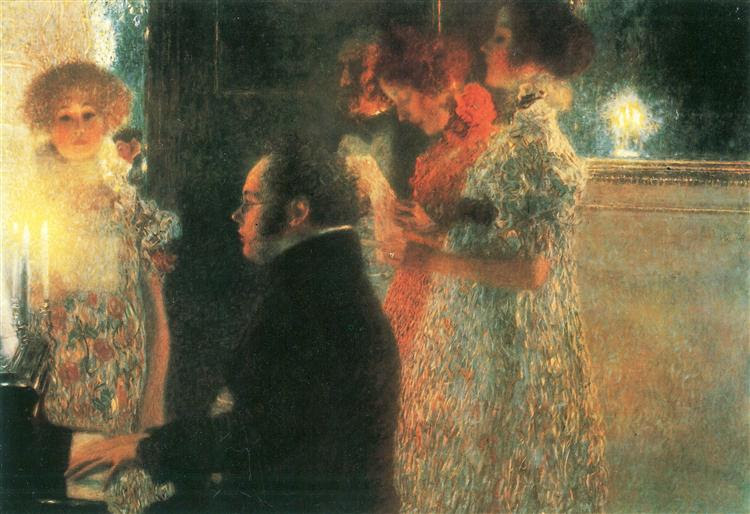
Schubert at the Piano II, 1899 - Gustav Klimt

    Schubert at the Piano II  (1899)


           Gustav Klimt


                 ______


before going any further, it’s about time

I brought up Schubert, had he survived, 

he might, I think, however conservatively,

have rivalled Beethoven


he died at the age of 31, of a sexually

transmitted disease, I believe the reason

for his relative obscurity


but he is titanic


listen to one only here of his sublime piano 

sonatas, his Piano Sonata No 21 in B-flat 

major


though one mustn’t discount his other 

transcendental masterpieces, his D956

for instance, for string quintet, is, well, 

characteristically, transcendental, 

you’ll leave the planet, I promise 


listen 


enjoy


R ! chard

how to listen to music if you don’t know your Beethoven from your Bach, Vl

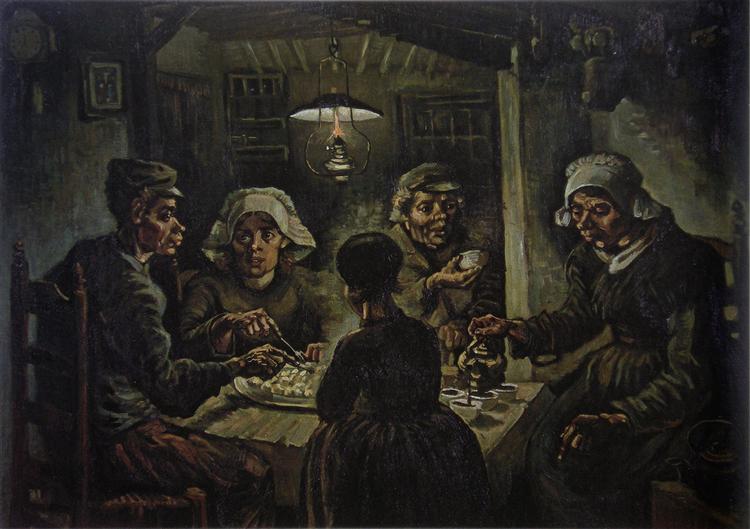
The Potato Eaters, 1885 - Vincent van Gogh

            The Potato Eaters” (1885)


                   Vincent van Gogh


                        ___________


where do you start with Chopin, he is

in our Western cultural bloodstream,

as identifiable in music as, say, van

Gogh is in painting, you don’t need 

to be interested in any kind of art to

have not been given even only a

whiff of these iconic artists


nearly anything I might present here

of Chopin you’ve probably already

heard somewhere before, if only in

bits


of van Gogh, well, he goes back in

the public imagination to at least

Vincent1971, the song, no one

doesn’t know about him, when I

heard it playing in Amsterdam at

the museum, with the first piece I

saw, The Potato Eatersdominating

the first wall, insisting on van Gogh’s

vision, his prophecy, his profound

compassion, I cried, I understood

what art is, see above


Chopin exerts a different kind of,

however equally potent, magic


Mozart might sound like Haydn,

Beethoven might sound like

Schubert, all of the Impressionists

sound like all of the Impressionists,

be they Ravel, Debussy, Satie, or

Saint-Saëns, to the untrained ear


but no one sounds like Chopin,

he’s, culturally, a North Star


here’s one of his nocturnes, the

moonlit one, in E flat major  


here’s a polonaisehere’s an étude,  

in English, a study, a finger exercise,

an iconic, here, prestidigitation


here’s an impromptu, his very,

indeed, Fantaisie-Impromptu, just

to get your categories going


consider its construction, having

some information already about

fantasias, a work of the imagination,

open to any experimentation within

the confines of one movement, with

an impromptu, something purported

to have been created on the spot,

also in one movement


the answer requires you to sharpen

your aesthetic pencil, always a

delight – an impromptu, a

spontaneous invention, a fantaisie,

a work of the imagination, how do

they differ, which part is a fantaisie,

which an impromptu, how do they

nevertheless coalesce


this exercise is the first step in

listening


enjoy


R ! chard

allegros – Mozart / Schubert quintets

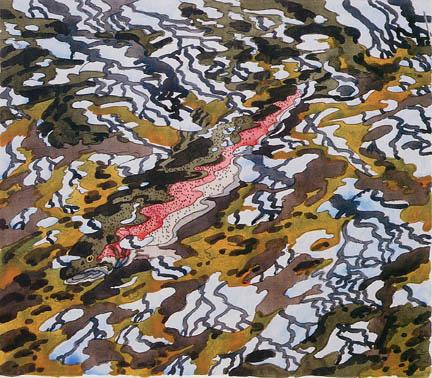
trout-and-reflected-tree.jpg

                     Trout and Reflected Tree (1985) 


                                    Neil Welliver


                                       ________


allegros are ubiquitous in the repertory,

you can find them everywhere, so I won’t

say much about them but that they’re 

the next step up from andante, therefore 

sprightly, energized, they’ll often start, 

or end, sonatas, and their derivatives, 

string quartets, concertos, symphonies, 

et cetera, engaging listeners, at first,

then wishing them a cheery farewell, 

after an often melancholy middle spell, 

they’re here again in the two following 

quintets, not unexpectedly, at the 

beginning of each, and at their end


Mozart’s Clarinet Quintet in A major,

KV 581


           l – Allegro

          ll – Larghetto 

         lll – Menuetto

         lV – Allegretto con Variazioni


allegretto is slightly slower than 

allegro


larghetto, meanwhile, is slightly faster 

than largo, largo is slower even than 

adagio, so that larghetto is somewhere 

between the two, you’ll melt, believe 

me, at this one


Schubert’s Piano Quintet, also in

A major, D 667, “The Trout”


           l – Allegro vivace

          ll – Andante

         lll – Scherzo (Presto)

         lV – Theme and Variations (Andantino)

          V – Allegro giusto


thirty years have elapsed between 

them, from 1789 to 1819, listen for

the Classical Period becoming the

Romantic Era


a clue, you can sing along with the

Mozart, you can’t anymore with the

Romantics


a quintet, incidentally, was usually 

comprised of a string quartet,

however varied these strings, note,

might have been, with whichever 

instrument would make up a fifth, 

according to which the quintet was 

identified, thus a clarinet quintet was 

clarinet with a string quartet, piano 

quintet, a string quartet plus a piano


other variants will follow


enjoy


R ! chard


psst: the theme in the fourth movement 

          variations of The Trout is from a

          lied, or song, Schubert had earlier

          composed around a poem of

          Christian Friedrich Daniel Schubart

          hence the quintet‘s nickname  


adagios

adagio-1899.jpg!Large

   Adagio (1899) 


       Tom Roberts


           _______


                           for my mom


my mom, the other day, said she’d

looked up adagio in the dictionary, 

after having read a recent post I’d

submittedas well, andante, and 

allegro 


well, that took long enough, I 

thought, but concluded that we all 

get the information we need in our 

own good time, and it’s never, ever, 

too late 


they’re all tempi, of course, adagio 

is slow, from ad agio in Italian, in 

English, at ease, the other two are 

incrementally faster  


the adagio doesn’t usually stand 

alone, it is too somber a pace to

immediately attract attention, it

therefore mostly fits into other 

compositions that have a more 

vigorous, a more engaging, 

introduction, usually as its 

second movement 


but here’s Albinoni’s Adagio in G 

minor, a work of only one segment, 

which indeed would’ve been part  

of a trio sonata, purportedly, had 

Albinoni lived to complete it


the rule is not fast, Beethoven 

starts his “Moonlight” Sonata with 

an adagio, for instance, boldly and 

unforgettably, indeed immortally


here’s the adagio that always 

stops my breath, from Schubert’s

masterpiece for string quintet, his

D956


listen


R ! chard

Piano Concerto no 1 in D minor, opus 15 – Brahms

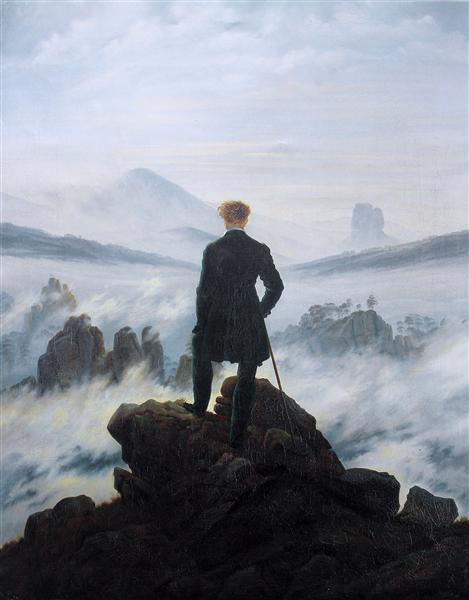
the-wanderer-above-the-sea-of-fog.jpg!Large

    “The Wanderer above the Sea of Fog (1818)

         Caspar David Friedrich

                  _____________

if Beethoven built the Church, along 
with Goethe maybe, of Romanticism, 
and be assured Romanticism is an 
ideology, a moral outlook, a 
motivational perspective, much like 
the economy is nowadays, 
supplanting any more humanistic 
imperatives, Brahms put up one of its 
Cathedrals, just listen, the First Piano
Concerto is a monument, as mighty 
as the Cologne Cathedral musically,
right next to Bonn, incidentally,  
Brahms‘ birthplace

with the disintegration of the 
supremacy of the Catholic deity 
at the onset of the Protestant 
Reformation, Luther, Calvin
Henry Vlll and all that, bolstered
by new discoveries in scientific
speculation, that the earth wasn’t 
flat, for instance, that it revolved 
around the sun rather than the 
other way around, contradictory, 
though convincing, voices began 
to abound, excite question  

in the 18th Century, the Age of 
Reason, the Christian Deity fell,
never effectively to be put back 
together again, see for Its final
sundering, Nietzsche

in France, after the Revolution
the Church was officially removed 
from political consideration, 
countermanding its centuries of 
morally heinous depredations, 
the United States had already at 
its own Revolution separated it 
from State  

Romanticism was an answer to 
a world wherein there might not 
be a God, a world with, however,  
a spiritual dimension, to respond 
to the clockwork universe 
envisioned by the earlier epoch,
the Enlightenmenta world where 
everything could be categorized,
analyzed, predicted

Romanticism called for the 
inclusion of inspiration in the mix,
there are more things in heaven 
and earth, Horatio, than are 
dreamt of in your philosophy, 
as Shakespeare would, for 
instance, have it – “Hamlet”,
1.5.167-8 
 
poets became prophets thereby, 
if they could manage it, very 
oracles, the world was blessed 
with, at that very moment, 
Beethoven, far outstripping the 
likes of, later, for example, Billy
Graham, or other such, however
galvanizing, proselytizers, 
whose messages would’ve been 
too, to my mind,  literal

for music cannot lie, obfuscate, 
prevaricate, music cannot be 
fake  

and then there was Schubert
and Chopin, TolstoyDickens
Elizabeth Barrett Browning
Roberther husband, 
TchaikovskyCaspar David
Friedrich, the Johann Strausses,  
ByronShelley, Keats, whose 
artworks, all, are as profoundly 
in our blood, our cultural system,
as, if not more so than, our 
present information about the 
details of our Christian myths, 
despite superfluity of them 
even, throughout the long 
indeed Middle Ages, and right 
up to, and including, the still 
fervent then Renaissancefor 
better or for worse still, for us

what Romanticism did, and 
specifically through the work 
of these seminal artists, was 
give each of us a chance, 
show us how to come 
through trial and tribulation,
what a faith does, any faith

it said, here, this is my dilemma, 
and this is how I deal with it

for me, Beethoven’s 32nd
Piano Sonata is, soundly, the 
epitome of that, but listen to 
Brahms put a stamp on it
with undaunted authority

we might be ultimately of no 
consequence in an indifferent 
universe, they say, but, hey, 
this is what we can do, and 
do gloriously, while we are 
at it

Woody Allen picks up the 
purpose in our own recent 
20th Century, following in 
the earnest footsteps of his 
Existential mentor, the much 
too dour, think, Ingmar 
Bergman  

but that’s another story
entirely 


meanwhile, listen

also watch, the conductor here
complete delight, is right out 
of Alice in Wonderland“, 
promise you’ll love it


R ! chard 
“Grand Piano Sonata” in G major, opus 37 – Tchaikovsky

blossoming-almond-branch-in-a-glass-with-a-book-1888(1).jpg!Large.jpg

  “Blossoming Almond Branch in a Glass with a Book (1888)

       Vincent van Gogh

             __________

if Tchaikovsky’s 2nd Piano Sonata hasn’t
remained in the canon, if it isn’t one of 
the pieces you’ve heard if only through
the grapevine, it’s, I suspect, cause it’s 
essentially not an advance on other more 
prescient works in the form, other more 
oracular compositions

Beethoven had paved the way for the 
Romantic Period, nearly invented it,
established incontrovertibly the 
dimensions of the sonata, notably its 
purpose, its structure, Schubert had, 
however belatedly, confirmed it, with 
works equal to his, and even, here 
and there, superior, listen

but having reached the summit of 
what a sonata could say, the form 
little by little withered in its several
Romantic permutations, Tchaikovsky
here, for example, and became mere
elaborations upon a waning theme 
rather than exciting, and revelatory, 
productions 

the sonata would survive, but  
transformed by another era, 
Impressionism, Tchaikovsky would
as well, of course, but not through 
his sonatas

his Second, however, is not not 
worth a listen, would you pass, 
for instance, on a less celebrated
perhaps, van Goghsee above

Tchaikovsky’s, therefore, Second

 
R ! chard