“In Memoriam A. H. H.” – Alfred, Lord Tennyson
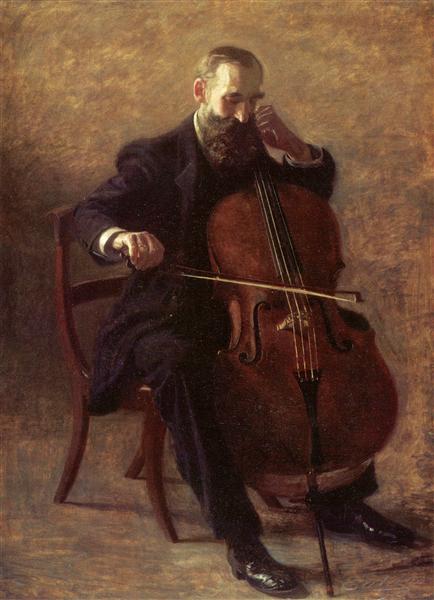
“The Cello Player“ (1896)
________
though I’d considered presenting all six
of Bach’s Cello Suites – your one stop
shopping for these extraordinary
compositions – even one only of these
masterpieces floored me each time I
individually listened
why the Suites, cause I couldn’t follow
up on Beethoven’s Opus 5, for cello
and piano accompaniment, without
saying more about the cello, by then
an instrument of some significance,
and who could argue, it’s resonance
thrills you in your bones, in your very
being
Frederick ll, King of Prussia, played it,
earning for him tailored compositions,
however controversial, from both
Mozart and Haydn, but even earlier,
Bach had composed definitive pieces
for it, much as he’d done for the
harpsichord, precursor to the piano,
students of either still go to Bach for
their basics, their intricate, exquisite,
technical proficiency
the cello can play one note only at a
time, which means that, like a voice,
you’re working without harmony,
you need to make your own,
otherwise your performance is
boring, no one else, as far as I know,
has ever written anything else for
unaccompanied cello, not even
Beethoven
I find most performers lend Bach a
more Romantic air, torrid emotion,
excesses of volume, pauses to the
pace, ritardandos, rallentandos,
which aren’t appropriate to the
more genteel Baroque period,
something I usually find
unwelcome
but in this performance, I’m sure
not even Bach would object
I’m offering up first the Sixth Cello
Suite, D major, played by Jian Wang,
someone I’d never heard of, in a
dazzling performance in Pyeongchang,
a place I’d neither ever heard of, until
only very recently
it appears both of these new kids on
the block ought to be on the map
R ! chard
me, May 24, 2016
__________
I save all the New Yorker poems
to read after I’ve been through
everything else in the issue,
like dessert after a meal, icing
on the cake, sometimes too
heavy, sometimes too light,
sometimes too rich, sometimes
just right
today, I found my favourite poem,
period, this year, stepped right
into its shoes, like old slippers,
the only difference being my
walls are painted a variety of
contrasting colours, studded
with memorabilia, treasured
artefacts, see above
also, no one’s translating my
poems, though even our metre
is the same, try it, sing us out
loud, you’ll dance
R ! chard
_____________
Every time Gulliver travels
into another chapter of “Gulliver’s Travels”
I marvel at how well travelled he is
despite his incurable gullibility.
I don’t enjoy travelling anymore
because, for instance,
I still don’t know the difference
between a “bloke” and a “chap.”
And I’m embarrassed
whenever I have to hold out a palm
of loose coins to a cashier
as if I were feeding a pigeon in a park.
Like Proust, I see only trouble
in store if I leave my room,
which is not lined with cork,
only sheets of wallpaper
featuring orange flowers
and little green vines.
Of course, anytime I want
I can travel in my imagination
but only as far as Toronto,
where some graduate students
with goatees and snoods
are translating my poems into Canadian.
__________
psst: I said just recently to a poet
acquaintance that what poetry
needed in the 21st Century is
humour, the only art form not
catching up with the rest,
otherwise it’ll die of, indeed
succumb to, its own
lugubriousness
thank you again, Billy Collins
___________
The Westender, our community paper,
which comes out every Thursday and
has done so for years, and which you
can pick up throughout the week, free,
on street corners in its assigned boxes,
has only recently started a new section
showcasing local poets, not to mention,
itself, poetry
you’ll be impressed
here’s the first instalment
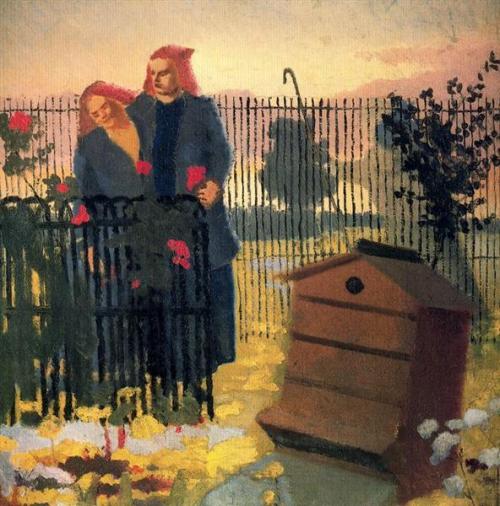
The farmer asked me to host a hive
and I said yes thinking honey,
without the sting, thinking
do your small
part and let the bees do theirs.
The hive was a box of many rooms
hot with life.
It throbbed under its tin roof.
All summer their flight path
hung its line of light across the deck.
Those gold cells swam to the door
of the hive, dusted with lust from blossom.
If a wasp dared come, they were ready
to kamikaze down, force the intruder out
in a buzz-tussle to the death. I crouched.
I watched the stinger torn from the bee’s body
trailing cream. Even in death, bees are never lonely.
The hive is myriad.
The hive is more than the bees.
Sometimes I stood close to vibrate with them,
drone of sun, pleasure of reaching beyond the limited
human. O stamen, pistil, I let them tangle in my hair
I hung up their flight path. Then came the virus,
and then the wasps. There was no keeping them out.
I crushed a few invaders, before I stopped,
stupid human, helpless as any God
before the laws of relativity.
The farmer and I could barely look at each other
and the leaves fell and brought winter.
But can we try again? I begged, like a woman
who wakes to a bed of blood, can we try again?
The serious farmer said, Of course. The struggle
is all that keeps me here, in this plague time
where bees drop, the hive is cold, a few hornets
drift, a virus drifts, pesticides drift over lawns
lush as death, fields of strawberries so poisoned
and perfect one bite brings the sleep
of a hundred years. Can we try again?
Richard
psst: Pat would’ve liked this
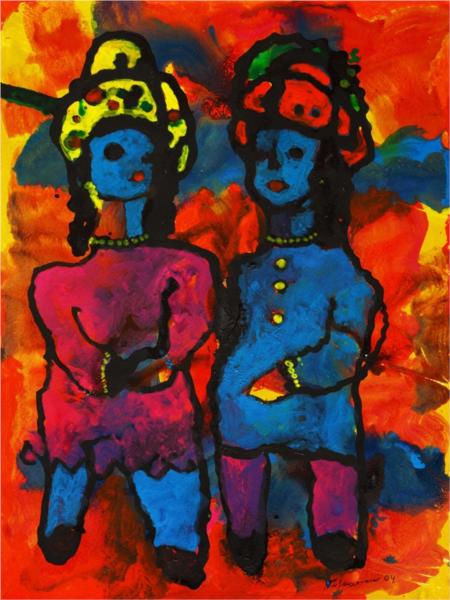
“Friends Since Childhood” (2004)
__________
having disparaged the only translation
I could find on the Internet of a poem
that is in French as famous as in
English Elizabeth Barrett Browning‘s
“How do I love thee? Let me count the
ways.“, her 43rd “Sonnet[ ] from the
Portuguese”, I decided to translate
myself the excerpt from “La Complainte
Rutebeuf“, of Rutebeuf himself, 1245 –
1285, which became its indelible, and
apparently timeless, virtual
manifestation
Rutebeuf’s entire poem is written in
Old French, and excerpts of it were
adapted into an updated French in
1956 by Léo Ferré, a French
troubadour of the time, who then
made it into a song that everyone
French remembers, despite, or
maybe because of, its archaisms
though Ferré familiarized the French
for his listeners, it was still in an older
French, like rendering Chaucer‘s
14th-Century English into Shakespeare‘s
17th-Century counterpart tongue, “But
look, the morn, in russet mantle clad, /
Walks o’er the dew of yon high eastern
hill”, “Hamlet”, act l, scene l, lines 166
and 167, for instance
in my translation below, I eschew –
Gesundheit – such a daunting
challenge, but have chosen rather
to highlight the humanity that I find
especially compelling in the original
composition
Rutebeuf today would sound
something of a cross between Harry
Nilsson and Bob Dylan, I think, of my
generation, the one for his
straightforward simplicity, his crushing
intimacy, the other for his social
consciousness and probable greater,
therefore, longevity
but will even Bob Dylan endure 800
years
some will, some have, some do
but who
we will never know
Richard
______________
Rutebeuf’s Lament
What has become of my friends
that I had held to be so close
and loved so dearly,
they were too carelessly tended,
I think the wind has blown them away,
friendship has been forsaken.
And as the wind passed by my door,
took all of them away.
As time strips the trees of their leaves,
when not a leaf on a branch remains
that will not hasten to the ground,
and poverty befalling me,
from every corner appalling me,
as winter edges on.
These do not lend themselves well to my telling
of how I courted disgrace,
nor of the manner.
What has become of my friends
that I had held to be so close
and loved so dearly,
they were too carelessly tended,
I think the wind has blown them away,
friendship has been forsaken.
And as the wind passed by my door,
took all of them away.
Sorrows do not show up on their own,
everything that was ever to happen
has happened.
Not much of common sense, a poor memory
has God granted me, that God of Glory,
not much in sustenance either,
and it’s straight up my butt when the North wind blows,
sweeping right through me,
friendship has been forsaken.
And as the wind passed by my door,
took all of them away.
Richard
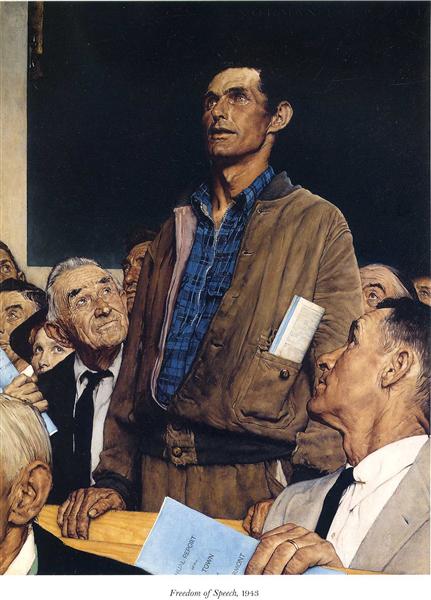
“Freedom Of Speech“ (1943)
________
it’s been a while since I’ve featured
a poem, but this one tickled me
positively pink
see if you’ll agree
Richard
__________
Instructions to a Speaker
analyze the seated audience
each face a complex sentence
parse the roaming eyes
and conjugate restless hands
let the grammar of their bodies
straighten under your voice
until words slough into the book
you have created page by face
from the biographies extending
lip-by-line across the room
“The Poetess“ (1940)
_____
when Aristotle “proceeds to declare the
parameters of “Poetry” for the ages“, his
definitions of the various poetic
“manner[s] or mode[s] of imitation”
have already been established, his
categorizations are not unlike Darwin’s
categorizations of the species during
a much later age, Aristotle was a natural
scientist much more than he was our
notion of an abstract philosopher, he
traded in facts rather than in the
esoteric musings that Plato, for
instance, pursued, Virtue, Justice,
the Good, his conclusions were more
verifiable
Kant, incidentally, is also famous for
following a similar form of investigation
as he attempted, nearly, for most,
inscrutably, to categorize the elements
of our faculty of understanding
a side story
Kant had stated that at birth we already
have within our perceptual framework
implicit understanding of space and
time, these are not learned through
experience but are already
incorporated within us, he said
many years ago, coming out of a
week-long coma, not knowing where
I was but alone, at that point even
just my consciousness, cause my
body, were it there, would’ve been
under the immaculate white sheets
I could see that would’ve been
shielding my legs
I looked around, could gather motes
upon rays of light that were entering
from what appeared to be a window
on the right, behind sheer white
curtains stirred by a soft breeze,
whirling the shimmering particles
alive in the light before me like
miniature spinning galaxies moving
at the pace of their own infinity
there was no sound
white walls around me stood utterly
still in the purview of my perception,
a door, also white, stood opposite
me on the opposite wall
where am I, I wondered, could this
be heaven, an afterlife, I might’ve
died, I thought, marvelling, no fear,
regret, nothing other than curiosity,
absorption, fascination
I tried to answer my question, where
am I, two dimensions, I figured
after having watched Terence Stamp
exiled by Marlon Brando to a flat
intergalactic window pane in
“Superman“, I hadn’t excluded this
eventuality, however ingloriously
transcendental, as a possible
outcome, I might be in a world with
only two dimensions, height and
width, no depth yet without more
investigation, experience
ergo, Kant, I concluded, was wrong,
our knowledge of space is not inborn
but a product of time and thought like
everything else
later, the white door on the far wall
opened, and a nurse walked in, also,
incidentally, in incandescent white,
and I understood I was alive
Aristotle suggested that our original
double instincts towards poetry were
our propensity to imitate, children
imitating their parents’ even
idiosyncratic mannerisms, for
instance
and rhythm, repetition, preludes to
order, coherence
those two
poetry, I read, is expression
reflecting the heartbeat, essentially,
in all its myriad representations
Richard
 Richibi's Weblog