November / Month of the Sonata – 7
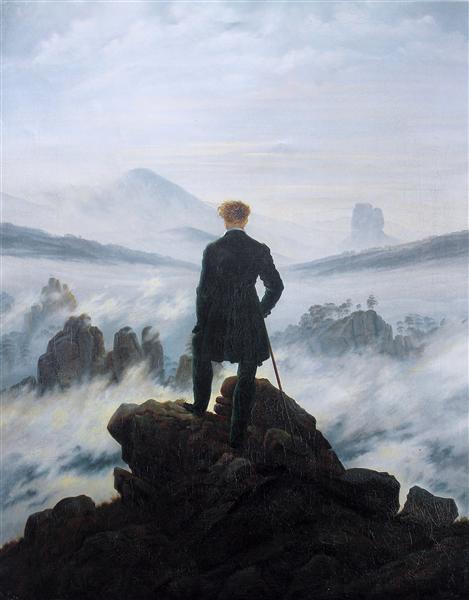
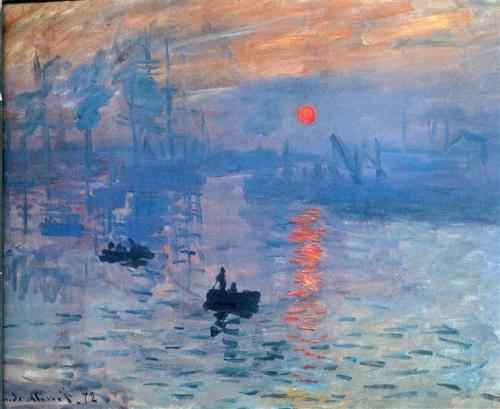
“Impression, Sunrise” (1873)
________
who’s afraid of the subjunctive
much like Elizabeth Taylor as Martha
in “Who’s Afraid of Virginia Woolf?”,
my answer is, I am, George, I am
the subjunctive is an esoteric mood,
even more abstruse in English than
in other languages, where the verb’s
conjugation highlights its presence,
in English, it’s nearly identical to the
indicative, the mood everybody
instinctively speaks in, facts
the subjunctive is about aspiration,
like the conditional, abstract, not
real, but its intention, rather than
the conditional’s inherent
impediment, a condition, shoots
for the stars, isn’t introspective,
but adamant, imperative
it is necessary that one be, it is
urgent that one have, it is
important that one effect, a
particular thing or event, all
subjunctives after the
doorkeeper word, “that”
one finds the subjunctive in
Shakespeare, master of grammar,
perhaps unparalleled in English,
a lot – O, that this too solid flesh
would melt, / Thaw and resolve
itself into a dew! – and follows
with Elizabeth Barrett Browning –
Pardon, o pardon that my soul
should make, / Of all that strong
divineness which I know / For
thine and thee …, for instance,
who is so profoundly indebted to
Shakespeare for her aesthetics
one wondrous day, I realized that
Proust’s entire “À la recherche du
temps perdu“, his “In Search of
Lost Time“, my Bible, was set in
the, French however, subjunctive,
the mood, there as well, of
possibility, therefore rather than
the definitive recreation of an
earlier time, Proust was
describing a sensibility, a personal
interpretation of a previous reality,
however bolstered by intimate and
apparently precise recollection of
shimmeringly imprecise, though
personally accurate, impressions
note here the similar preoccupations
of Proust’s contemporaries, the, aptly
named, Impressionists
everything, Proust was saying, as
were also the Impressionists, is in
the eye of the beholder
the subjunctive is the mood that
sets this instinct in motion
R ! chard
psst: Somerset Maugham I remember
being noteworthy as well for his
immaculate use, in his South
Pacific tales, of the subjunctive,
extremely elegant in its refined
construction, even with its
English austerities, like making
lace out of mere cloth, impressive
despite its impracticality, or
perhaps even because of it
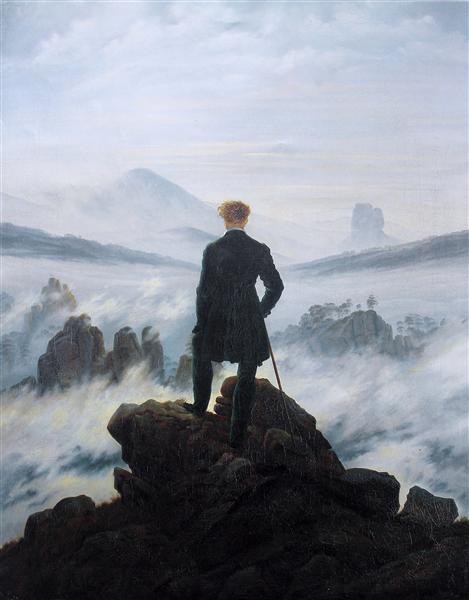
“The Wanderer above the Sea of Fog“ (1818)
_____________
if Beethoven built the Church, along
with Goethe maybe, of Romanticism,
and be assured Romanticism is an
ideology, a moral outlook, a
motivational perspective, much like
the economy is nowadays,
supplanting any more humanistic
imperatives, Brahms put up one of its
Cathedrals, just listen, the First Piano
Concerto is a monument, as mighty
as the Cologne Cathedral musically,
right next to Bonn, incidentally,
Brahms‘ birthplace
with the disintegration of the
supremacy of the Catholic deity
at the onset of the Protestant
Reformation, Luther, Calvin,
Henry Vlll and all that, bolstered
by new discoveries in scientific
speculation, that the earth wasn’t
flat, for instance, that it revolved
around the sun rather than the
other way around, contradictory,
though convincing, voices began
to abound, excite question
in the 18th Century, the Age of
Reason, the Christian Deity fell,
never effectively to be put back
together again, see for Its final
sundering, Nietzsche
in France, after the Revolution,
the Church was officially removed
from political consideration,
countermanding its centuries of
morally heinous depredations,
the United States had already at
its own Revolution separated it
from State
Romanticism was an answer to
a world wherein there might not
be a God, a world with, however,
a spiritual dimension, to respond
to the clockwork universe
envisioned by the earlier epoch,
the Enlightenment, a world where
everything could be categorized,
analyzed, predicted
Romanticism called for the
inclusion of inspiration in the mix,
there are more things in heaven
and earth, Horatio, than are
dreamt of in your philosophy,
as Shakespeare would, for
instance, have it – “Hamlet”,
1.5.167-8
poets became prophets thereby,
if they could manage it, very
oracles, the world was blessed
with, at that very moment,
Beethoven, far outstripping the
likes of, later, for example, Billy
Graham, or other such, however
galvanizing, proselytizers,
whose messages would’ve been
too, to my mind, literal
for music cannot lie, obfuscate,
prevaricate, music cannot be
fake
and then there was Schubert,
and Chopin, Tolstoy, Dickens,
Elizabeth Barrett Browning,
Robert, her husband,
Tchaikovsky, Caspar David
Friedrich, the Johann Strausses,
Byron, Shelley, Keats, whose
artworks, all, are as profoundly
in our blood, our cultural system,
as, if not more so than, our
present information about the
details of our Christian myths,
despite a superfluity of them
even, throughout the long
indeed Middle Ages, and right
up to, and including, the still
fervent then Renaissance, for
better or for worse still, for us
what Romanticism did, and
specifically through the work
of these seminal artists, was
give each of us a chance,
show us how to come
through trial and tribulation,
what a faith does, any faith
it said, here, this is my dilemma,
and this is how I deal with it
for me, Beethoven’s 32nd
Piano Sonata is, soundly, the
epitome of that, but listen to
Brahms put a stamp on it
with undaunted authority
we might be ultimately of no
consequence in an indifferent
universe, they say, but, hey,
this is what we can do, and
do gloriously, while we are
at it
Woody Allen picks up the
purpose in our own recent
20th Century, following in
the earnest footsteps of his
Existential mentor, the much
too dour, I think, Ingmar
Bergman
but that’s another story
entirely
meanwhile, listen
also watch, the conductor here,
a complete delight, is right out
of “Alice in Wonderland“, I
promise you’ll love it
R ! chard
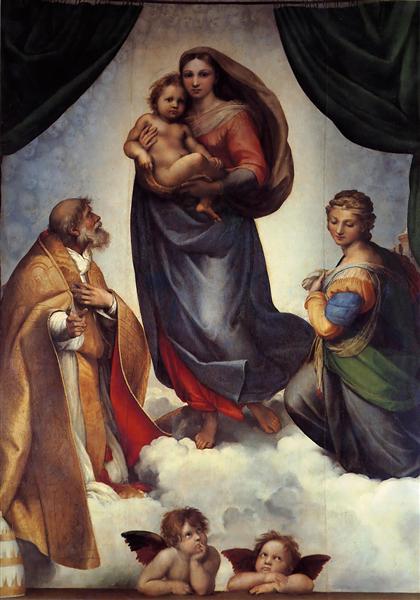
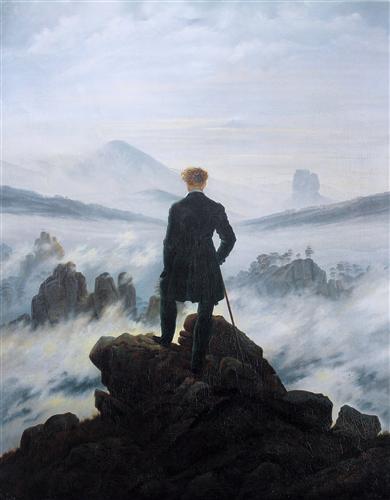
“The Wanderer above a Sea of Fog“ /
“Der Wanderer über dem Nebelmeer“ (1818)
___________
for Collin, who’ll appreciate
especially, I’m sure, the
Chopin
while I’m on the subject of clarinet quintets,
since there are so few significant ones, let
me pull Brahms’ out of my hat and celebrate
it, a worthy challenge to Mozart’s own utter
masterpiece
but over a century has gone by, it’s 1891,
Beethoven, the French Revolution, the
Romantic Era is reaching its end, ceding
to Impressionism, after the disruptions of
rampant industrialization, and its
consequent effects on the social contract
Marx has proposed a theoretical master
plan to equitably protect the rest of us
from the 1%, however too politically
fraught, eventually, such a system – see
Communism
furthermore, Darwin had suggested that
we weren’t all descended from Adam and
Eve, but from larvae, which is to say,
millennially morphed, modified, through
time, genetically, leading to festering still
ideological objections
Elizabeth Barrett Browning had written
her unadulterated love poems to her
husband, Robert, Caspar David
Friedrich had shown us his wanderer’s
back while facing the mountainous
challenges of the upcoming world,
godless now after Nietzsche, Anna
Karenina had thrown herself in front
of a train, Madame Bovary had taken
poison, and Ibsen‘s Nora had left her
husband for a fraught, if not even
dangerous, life on her own, to escape
his safe but insufferable dominance,
while Jane Eyre was finding ghosts
in her cobwebbed, and insufferable,
to my mind, though admittedly
aristocratic, attic
you’ll note the clarinet is not sitting
centre stage, but has nevertheless
a place at the table, by this time,
though not not honoured, familiar,
and is more integrated to the
conversation, the idea of democracy
has taken hold, with everyone having
an equal, and even a vociferous, say
Brahms modelled his Clarinet Quintet,
on Mozart’s, the Classical structure is
still the same, movements, tonality,
musical recurrence, all to wonderful
effect
that he would do that is not a given,
but a tribute to the power of that form,
take the waltz for instance, alive from
even before Strauss, not to mention
Chopin, to approximately the middle
of the Twentieth Century
think about it, who waltzes anymore,
though they might’ve enchanted still,
residually, the 50’s – see Patti Page,
for instance – its lustre having
dissipated, with the wind, as it were,
the gust, before us, of the unending
ages
R ! chard
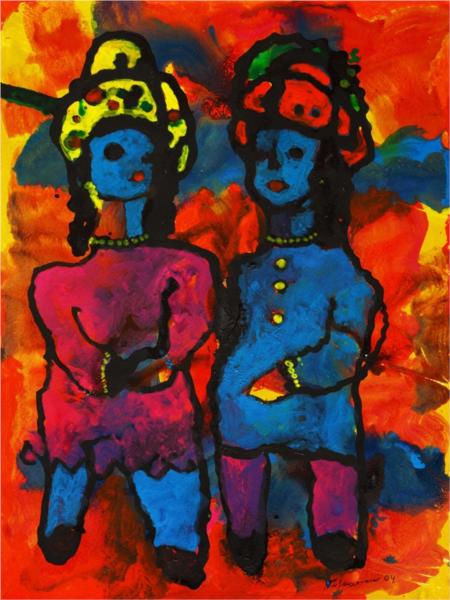
“Friends Since Childhood” (2004)
__________
having disparaged the only translation
I could find on the Internet of a poem
that is in French as famous as in
English Elizabeth Barrett Browning‘s
“How do I love thee? Let me count the
ways.“, her 43rd “Sonnet[ ] from the
Portuguese”, I decided to translate
myself the excerpt from “La Complainte
Rutebeuf“, of Rutebeuf himself, 1245 –
1285, which became its indelible, and
apparently timeless, virtual
manifestation
Rutebeuf’s entire poem is written in
Old French, and excerpts of it were
adapted into an updated French in
1956 by Léo Ferré, a French
troubadour of the time, who then
made it into a song that everyone
French remembers, despite, or
maybe because of, its archaisms
though Ferré familiarized the French
for his listeners, it was still in an older
French, like rendering Chaucer‘s
14th-Century English into Shakespeare‘s
17th-Century counterpart tongue, “But
look, the morn, in russet mantle clad, /
Walks o’er the dew of yon high eastern
hill”, “Hamlet”, act l, scene l, lines 166
and 167, for instance
in my translation below, I eschew –
Gesundheit – such a daunting
challenge, but have chosen rather
to highlight the humanity that I find
especially compelling in the original
composition
Rutebeuf today would sound
something of a cross between Harry
Nilsson and Bob Dylan, I think, of my
generation, the one for his
straightforward simplicity, his crushing
intimacy, the other for his social
consciousness and probable greater,
therefore, longevity
but will even Bob Dylan endure 800
years
some will, some have, some do
but who
we will never know
Richard
______________
Rutebeuf’s Lament
What has become of my friends
that I had held to be so close
and loved so dearly,
they were too carelessly tended,
I think the wind has blown them away,
friendship has been forsaken.
And as the wind passed by my door,
took all of them away.
As time strips the trees of their leaves,
when not a leaf on a branch remains
that will not hasten to the ground,
and poverty befalling me,
from every corner appalling me,
as winter edges on.
These do not lend themselves well to my telling
of how I courted disgrace,
nor of the manner.
What has become of my friends
that I had held to be so close
and loved so dearly,
they were too carelessly tended,
I think the wind has blown them away,
friendship has been forsaken.
And as the wind passed by my door,
took all of them away.
Sorrows do not show up on their own,
everything that was ever to happen
has happened.
Not much of common sense, a poor memory
has God granted me, that God of Glory,
not much in sustenance either,
and it’s straight up my butt when the North wind blows,
sweeping right through me,
friendship has been forsaken.
And as the wind passed by my door,
took all of them away.
Richard
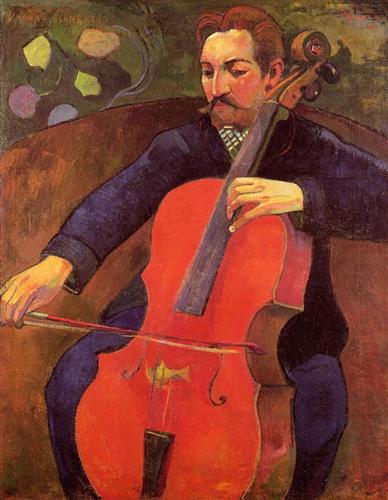
“The Cellist (Portrait of Upaupa Scheklud)“ (1894)
_______
what are you reading, Terry asked,
I’d been riffling through the pages
of a book I’d just finished, trying to
find a particular bit I wanted for
firm ground later in conversations
a man in Sarajevo during the siege,
July 5, 1992 to February 29, 1996,
the bit I’d been looking for, had seen
neighbours, 22 of them, killed when
a mortar from the surrounding hills
had, as they waited in line for a much
depleted market, a consequence of
the siege, obliterated them, arms,
feet everywhere, as well as the
wounded
the man, a cellist with a Sarajevo
symphony, probably its finest, had
resolved, in honour of the victims,
to come out to play each day, at
the very time, in the very place of
the atrocity, for 22 days, one for
each of the victims, despite being
each time in the very eye of a
sniper’s bullet, Albinoni’s haunting
Adagio, listen
he made it out eventually to Ireland,
it is later indicated
“The Cellist of Sarajevo“, I replied,
I’m taking it back to the library, I
needed to check some dates, I
write, I want to talk about it
I’ve been talking about walking in
beauty, I said, incorporating it into
one’s life, this man overcame his
fear of death so profoundly as to
deliver a very dirge, an act of
prodigious, even transcendental
meditation, to sit and play midst
the rubble and ashes of his friends
this tribute, how sound must’ve
been his conviction
walking in beauty, I said, it’s a
Navajo prayer
Wordsworth has a poem like that he
said, and recited it word for word
“She walks in beauty, like the night
Of cloudless climes and starry skies;
And all that’s best of dark and bright
Meet in her aspect and her eyes;
Thus mellowed to that tender light
Which heaven to gaudy day denies.
One shade the more, one ray the less,
Had half impaired the nameless grace
Which waves in every raven tress,
Or softly lightens o’er her face;
Where thoughts serenely sweet express,
How pure, how dear their dwelling-place.
And on that cheek, and o’er that brow,
So soft, so calm, yet eloquent,
The smiles that win, the tints that glow,
But tell of days in goodness spent,
A mind at peace with all below,
A heart whose love is innocent!”, he said
I was flabbergasted, I had only my
few lines of Shakespeare to compare
I’m Richard, I said
Terry, he retorted
I can’t talk now, I’m off, if you can
believe it, to read Shakespeare with
a friend, we’ll meet again, you’re easy
to spot, you’ve got no shoes, you’re
barefoot, my mom has talked about
you, you always say hello, she says,
she thinks you’re a nice man
Terry had his sandals in his hand,
he stood under his umbrella, I
hadn’t opened mine, he was trying
to shield me also from, for me, the
merely mist, not rain, despite a
rod stretched unhooked from his
otherwise sufficient cover from
the wet
can you remember my e-mail, he
offered, it’s easy
I wrote it on the battered flyleaf
of my Shakespeare
that’s a relic, he said
my International Collector’s Library,
I answered, that’s where I got my
literature when I was a boy, in my
little town of Timmins, an outpost,
I’d get a classic every month, each
bound distinctively, their gimmick
you could get money for that, he
suggested
not, like this, I said, it’s in tatters
I’ll tell my mom I talked to you, I said,
she’ll be delighted
Tony, right
Terry, he corrected
Richard, I said
Richard
later he thought I’d been Michael
Richard
psst: it turns out the poem is by Byron,
not Wordsworth, not surprising,from
this distance all the Romantic poets
sound alike, except for, of course,
the Brownings, an inconsequential
gaffe
 Richibi's Weblog