Richibi’s Weblog

Just another WordPress.com weblog

Category: Debussy

“Syrinx” – Claude Debussy‏

big

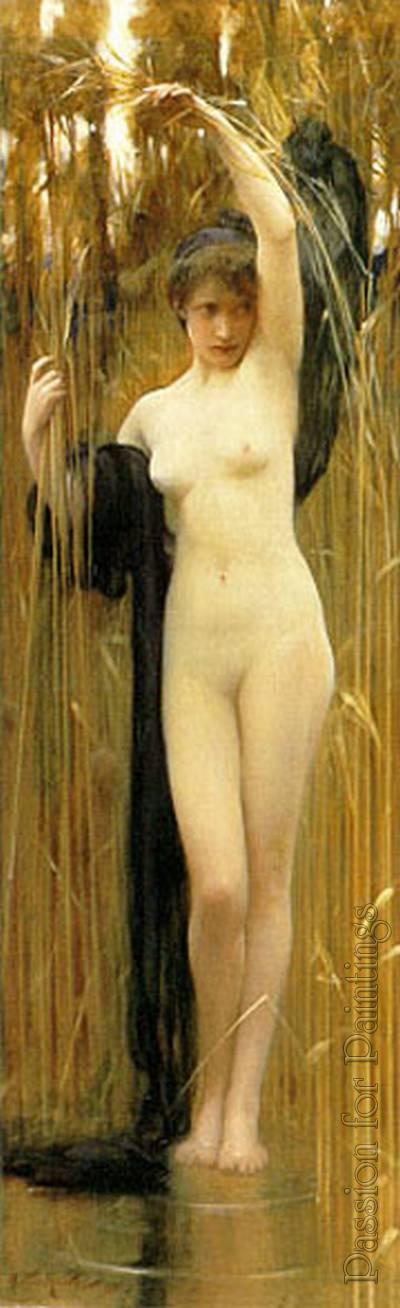
         Syrinx (1892)
 
          Arthur Hacker
 
            __________
 
 
though Debussy would’ve called his
Syrinx “Flûte de Pan”, “Pan Flute”,
alas, the name had already been 
taken, he therefore came up with the 
much more inspired Syrinx
 
Syrinx, with the help of other nymphs, 
who’d come at her cry for help as she 
fled the god Pan, a pursuer, had been 
turned into a bush of reeds, its canes 
producing a song so sweet as to 
confound and disarm him, impelling
him to create of them that sublime 
instrument  
 
Hermes had been telling Argus, Argus 
Panoptes, the giant with the hundred 
eyes, the story about the pipes he  
was playing, an implement received 
from Jove, apparently, god of all the 
gods, who wanted him to kill Argus, 
for confining Io, who’d been turned 
into a heifer by Juno, Jove’s wife, 
who’d caught him chasing her, Io’s 
plaintive lows had been getting to 
Juno as Io fretted unfettered through 
the fields too close to Olympus 
 
when Hermes’ music finally closed the
giant’s last two eyes, he beheaded him,
but Juno, in merciful recognition of his
service, however ultimately ineffectual, 
set them into the variegated tail of the 
peacock
 
are you kidding me, I always think when
I read Ovid’s “Metamorphoses”, and am
ever nevertheless entirely enchanted
 
a flute solo had not been composed in
over 150 years when Debussy composed
his Syrinx“, 1913, after C.P.E. Bach’s not  
at all unimpressive Sonata in A Minor 
of 1747, it duly set off a new life for the 
long overlooked flute, a reed which 
Mozart famously didn’t like
 
note the tonal, rhythmic, and repetition 
shifts from the rigid Classical model, 
where these are much more strict, 
Impressionism was not only breaking 
down pictures, the pictorial arts, but its
sound world as well, it was an utterly
new era, new sensibility, new zeitgeist, 
and you can feel it, though you might
not be quite able to immediately 
verbalize it, the arts were again, as
they ever ‘ve been, the canary in the 
gold mine
 
 
Richard
 
psst:
 
   The Transformation of Syrinx into Reeds 
 
Then Hermes thus: A nymph of late there was 
Whose heav’nly form her fellows did surpass. 
The pride and joy of fair Arcadia’s plains, 
Belov’d by deities, ador’d by swains: 
Syrinx her name, by Sylvans oft pursu’d, 
As oft she did the lustful Gods delude: 
The rural, and the woodland Pow’rs disdain’d; 
With Cynthia hunted, and her rites maintain’d: 
Like Phoebe clad, even Phoebe’s self she seems, 
So tall, so streight, such well-proportion’d limbs: 
The nicest eye did no distinction know, 
But that the goddess bore a golden bow: 
Distinguish’d thus, the sight she cheated too. 
Descending from Lycaeus, Pan admires 
The matchless nymph, and burns with new desires. 
A crown of pine upon his head he wore; 
And thus began her pity to implore. 
 
Now while the lustful God, with speedy pace, 
Just thought to strain her in a strict embrace, 
He fill’d his arms with reeds, new rising on the place. 
And while he sighs, his ill success to find, 
The tender canes were shaken by the wind; 
And breath’d a mournful air, unheard before; 
That much surprizing Pan, yet pleas’d him more. 
Admiring this new musick, Thou, he said, 
Who canst not be the partner of my bed, 
At least shall be the confort of my mind: 
And often, often to my lips be joyn’d. 
He form’d the reeds, proportion’d as they are, 
Unequal in their length, and wax’d with care, 
They still retain the name of his ungrateful fair.
 
                                                  Ovid
Bassoon Sonata, opus 168 – Camille Saint-Saëns

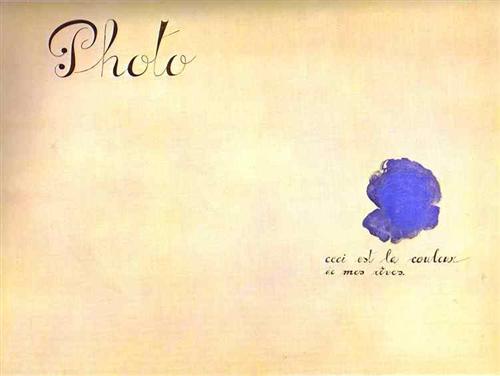
photo-this-is-the-color-of-my-dreams.jpg!Blog

                  Photo; This is the Color of My Dreams (1925)
 
                                                Joan Miró 
 
                                                   ______


 for  my sister

a competition program that pits
youngsters against each other,
but on a variety of instruments,
with some operatic voice, has
riveted us to our sets on Friday
evenings, seven o’clock local
time throughout Canada

out of the province of Quebec,
however, and therefore in
French

Virtuose lives up to its name
with extraordinary performances
from mere children, and some
adolescents, you can catch all of
the past episodes, and performers,
on their website

last week a young man delighted
us with a movement from a bassoon
sonata
, an unlikely instrument, of 

Saint-Saëns, his opus 168

my sister expressed surprise,
un basson, she marvelled

quickly I sought out, of course, the
full composition, it’s otherwise for
me like reading one chapter only
out of a book

it’s a short piece, no longer the
grand statements of the earlier
Romantic Period, but a series of
pastiches, fleeting impressions,
impromptu ruminations rather
than extended dissertations,
something like what I’m doing
here with these texts

you’ll recognize also a similar
approach in other composers of
the period, Debussy especially,
but too Satie, Ravel, Poulenc to
name only a few, the speed of
the new century precluded
extended musical peregrinations,
you’ll remark on the dearth of
symphonies, concertos,
composed during this epoch

the composition is in G major, my
cleaning lady had come over, was
already busy in an adjoining room
at the time, I was nearing the
end of the first movement, the
allegro moderato, a wistful
evocation of spring, I thought,
an innocent, fragile blossom
unfurling its delicate petals
with unaffected grace and
unconscious poetry

the final note sounded, the
bassoonist removed his lips from
the tube, but the note kept on
playing, coming, as I soon
understood, not from the video I
was watching, but from the other
room, Jo had turned on the
vacuum cleaner

o my god/dess, I uttered, hurried
over to where she was, subdued
my enthusiasm in order not to
unduly rattle her, as I brimmed
with my scintillating insight

your vacuum cleaner vacuums in
G, I gushed when she turned to
acknowledge me, it continued the
last note, I explained, of the first
movement of my sonata, Saint-
Saëns’ – say that three times with
a lisp, I interjected – until you
turned your vacuum cleaner off,
which is also, I pointed out, a
wind instrument

her delight was modest compared
to mine, however ever nevertheless
congenial, and quickly she returned
to her duties

I went back tickled pink to my
monitor and the following
movement, the sprightly and equally
enchanting allegro scherzando

Richard

String Quartet in G minor, opus 10‏ – Claude Debussy

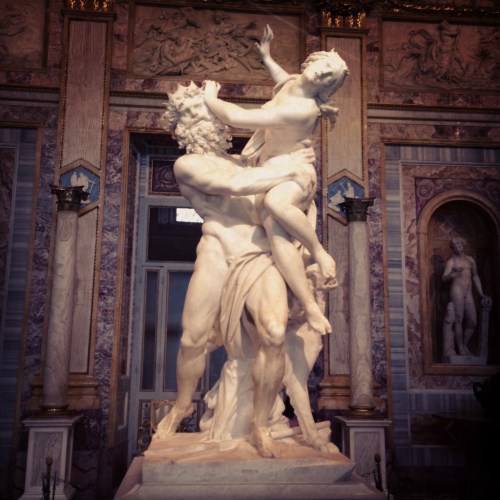
Il-ratto-di-Proserpina-Galleria-Borghese
                                        
                                    “Pluto and Persephone” (1522)
 
                                               Gian Lorenzo Bernini
 
                                                  ______________
 
 
if I’ve been away from my post for so long,
it’s either because my muse had left me, 
abandoned me to the rigours of an 
especially inclement winter, cold, driving 
rain, short somber days, weather for 
isolation, insulation, hibernation
 
or, like Persephone, I’d been abducted 
as to an Underworld, moral as well as 
meteorologicalhowever cosseted might’ve 
been there my stay, eiderdown pillows, 
blankets, books, Internet movies, concerts, 
plays, until by permission of Plutofateful 
consort, God of the Netherworld, by the
intercession of Mother Demeter, Queen of 
the Harvest, I’ve been allowed, even urged, 
to return for spring
 
where cherry blossoms are burgeoning, 
flowers bud in their variety of colours, 
birds sing, trees, like myself, begin to 
scratch out their brimming script onto 
the open-armed page of heaven
 
 
I’d left the string quartet evolving towards
Bohemia and Russia, in the capable hands 
of Smetana and Borodin respectively, from 
its solid roots in Vienna with Haydn and 
 
it would evolve westwards, of course, too 
to France eventually, as the centre of art 
shifted somewhat from Vienna to Paris in 
the late 19th Century, and spread, through 
paint mostly, the eye superseding the ear, 
wresting the cultural reins from music as 
oracle for the times, the new perspective 
of Impressionism
 
minor, his opus 10, a world away from 
the emotional seductiveness of 
Romanticism, but rather driving, electric, 
cosmopolitanteeming with traffic, it’s 
1893, the zeitgeist has changed
 
 
Richard

at the XVth International Tchaikovsky Competition – Maria Mazo

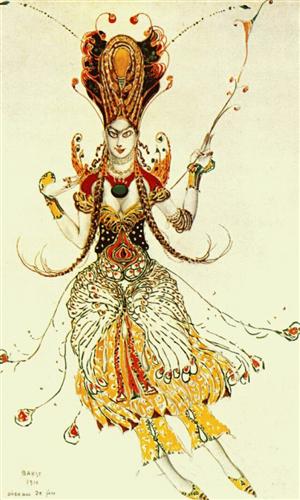
  "L'oiseau de feu" -  Leon Bakst

L’oiseau de feu (1910)

Leon Bakst

________

after playing Scriabin’s 4th Sonata,
in F# major, opus 30, a passionate
but poised performance of a work
dated 1903, Ravel maybe, or
Debussy, at first I thought, though
neither had ever been so furious in
my recollection, then a transcription
for piano of the last movements of
Stravinsky’s “Firebird”, a work as
obstreperous as the Scriabin, and
as revolutionary, relentless and
brash, much more audacity than
diplomacy however ultimately
treasured universally and celebrated,
Maria Mazo undertakes no less than
the mightiest of the mighty, gasp,
Beethoven’s “Hammerklavier”

she takes on the first two movements
at something of a clip, not an
unwelcome occurence so long as you
have the fingers for it, which on the
strength of her earlier numbers I
deemed she would, and did, which
only added to the gravitas of her then
largo, which thereby became
resplendent, luminous, utterly and
verily, indeed, transcendental, note
the cherubs twittering halfway
through, just before Beethoven
enters the portals of very Heaven
and is transformed into radiance and
incandescent light before your
very astonished sensibilities

Maria Mazo should win

Richard

miracles‏

when I started looking for miracles,
I found out that there indeed were
some, as a matter of fact, many

here’s another, in case you missed
the last one

Richard

Rachmaninoff: Piano Concerto no 3, in D minor, opus 30

fully 150 years after Mozart the concerto was still a thriving
musical form though it had undergone some modifications,
you’ll hear a more passionate account in Rachmaninoff than
the more lyrical, less emotionally overt compositions of
Mozart, the variations in volume, tempo, tonality, the play
of harmonization and discords, all incidentally within a single
movement, show the passage of time, of Beethoven, of Chopin,
of Debussy between Mozart and the more Romantic, Impressionistic
Rachmaninoff, note the sweeping ritardandos, where the beat is
drawn out, stretched for pathos, a Chopinesque insinuation into
music not found in earlier stuff, one imagines torrid expressions
of fervent sentiment, note the evanescent flurry of notes passing
by like the fleeting glitter of stars, the ephemerality of an
incorporeal idea that Debussy originated and brought to music,
and of course note the irrepressibility, the authority, the masculinity
of a volcanic Beethoven underpinning the lot, you can hear them all

the Vladimir Horowitz Piano Concerto no 3 of Rachmaninoff at
Carnegie Hall, January 8, 1978, with Eugene Ormandy leading the
New York Philharmonic Orchestra is, after Van Cliburn’s historic
1950s account, May 19, 1958, again at Carnegie Hall but under Kiril
Kondrashin this time, and the now defunct Symphony of the Air,
don’t ask, the one I then grew up with, it was riveting even without
the pictures

with pictures here he is again a few months later at Avery Fisher
Hall in New York, September 24, 1978, under Zubin Mehta with
again the New York Philharmonic, so good you’ll even forgive
Mehta his usual sentimental excesses

incidentally Horowitz was 74 at this concert, he is astounding

Vladimir Horowitz, colossus and legend, 1903 -1989

enjoy, be transported, be transfixed, you have been warned

Richard