Richibi’s Weblog

Just another WordPress.com weblog

Category: concerts to ponder

Dmitri Shostakovich – Symphony no. 1, opus 10, continued
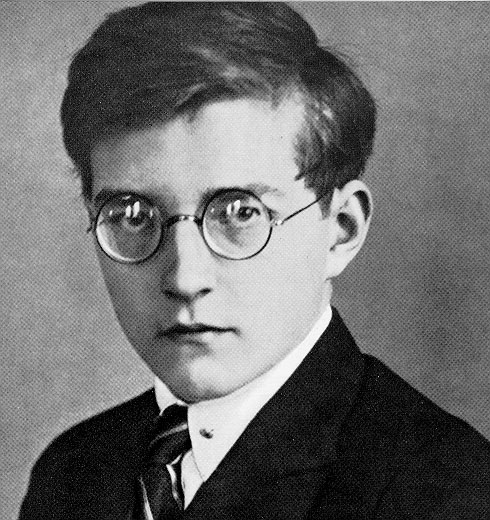
Dmitrij_Dmitrijevič_Šostakovič_(Дми́трий_Дми́триевич_Шостако́вич)

        Shostakovich in 1925

                   __________

                                        for Barbara, who died recently,
                                                 she would’ve loved this 

Shostakovich was just nineteen when
his Symphony No.1, opus 10 was 
first performed – it had been his 
graduation piece the previous year
from the Petrograd Conservatory –  
by, then, which is to say 1926, the 
Leningrad Philharmonicrenamed the 
Saint Petersburg after the fall of the 
U.S.S.R., the name it had held before 
the Bolshevik Revolution, the oldest 
philharmonic orchestra, therefore, 
incidentally, in our Russia, going  
back to 1882 

the work was a complete success, not 
surprisingly, if you’ll consider its scope, 
its power, and its novel musical 
interpolations, I mean a piano as an 
integral orchestral instrument rather 
than as a distinct, however interrelated, 
component, a pas de 40 instead of 
pas de deuxsomething I can’t remember 
anywhere else having seen for piano 

not to mention the drum roll between 
the last two movements, drums making 
splash in an orchestral setting, who’d 
‘a’ thunk it, though Richard Strauss had
done just that in his extraordinary 
Burleske” several decades earlier,  
another youthful work, Strauss only 21

but meanwhile back in Russia, before 
too seriously digress, Shostakovich  
was immediately compared to another 
earlier young prodigy there, Alexander 
Glazunovwho’d himself put out his 
own First Symphony, the Slavonic“,
at age 16, introducing, incidentally, his 
own instrumental novelty then, an oboe 
obbligato, which by very definition is 
lovely
  
Glazunov also mentored, by the way, 
Shostakovich at the Petrograd, proved
to be instrumental indeed in his 
progress

it’s interesting to put these last two 
together, to compare, the Glazunov, 1881,
follows the traditional Romantic 
imperatives, tempo, tonality and 
repetition, but with more bombast, to my
mind, than its European counterparts,
its fields are the Russian steppes with 
troikas, horse-drawn carriages, flying 
across vast unhampered vistas of the 
Russian snow-covered, therefore 
pristine, tundra, to whet the unbridled 
Russian spirit, the Europeans, Brahms,
MendelssohnMahler, conversely, 
are confined to the hunt, however ever
glorious, but with shrubs, copses,   
thickets, if not veritable forests, to blur
the sonic arena, inspire dreams, 
consequently, less far-reaching than  
those of Johnny Appleseed even, of 
the North American Prairies poets,    
their own far-flung, boundless  
imaginations, inspiration, you can 
hear it all, blatantly, in the resonance
of the horns

you’ll note the movements follow 
essentially the same rhythmic order 
in either symphony, the first two fast 
enough, then a third that’s somewhat 
slower, a variation from the strictly 
Classical order of fast, slow, fast, then
a last, eclectic, movement 

but Shostakovich is more atonal, 
melodically divergent, an eccentricity 
he’ll later polish to a degree of 
politically subversive brilliance

for not submitting, however, to the rule 
of repetition, which is manifest, though,  
in GlazunovShostakovichI find, leaves
us trying to find our bearings as his music 
rolls along, kind of like in biographical 
movies, when you start looking at your 
watch to determine how many life 
incidents remain in this particular, 
however significant, existential drama

as spectacle – and it must be noted that 
symphonic displays were at the time 
indeed spectacles – there was no 
phonographic, photographic 
equipment to transmit such 
experiences, the symphony itself was 
the show, it had, right there, itself, to 
wow the audience

in all of these cases, all of them did 

Shostakovich, however, of all of them 
remained eventually potently 
pertinent, powerfully paramount, 
watch

R ! chard

Dmitri Shostakovich – Symphony no. 1, opus 10

portrait-of-dmitri-shostakovich-1963.jpg!Large

     “Portrait of Dmitri Shostakovich (1963) 

             Martiros Sarian

                    ______

after being transfixed, rendered aquiver, by
this mesmerizing conductor in a performance
I can only remember for his magnetism, 
expressive fingers performing arabesques of 
such exquisite sensitivity, eyes that melt, 
light up, gleam, glitter, at every ebb and flow 
of the turbulent, towering, music, eyebrows 
that, blonde, cherubic, angelic, display with 
manifest intention, the spiritual implications 
of every musical turn, a youth only, in my 
senescent estimation, taking on the conquest 
of the 21st-Century world, lately installed as 
conductor, most illustriously, of both the 
Royal Liverpool, in 2005, and the Oslo, in 
2011, Philharmonics

Vasily Petrenko led me back to Shostakovich,
after his monumental Tchaikovsky 5th,
whereupon I’ve undertaken a chronological 
review of all Shostakovich’s symphonies, 
something I did long ago with Beethoven’s 
sonatas, to my great cultural advantage, it 
was a journey that informed me not only 
intellectually but, even more significantly, 
spiritually, taught me about patience, tumult, 
and the wisdom, even glory, one acquires in 
resignation, so long as you hold onto your 
principles, your core 

you look back, I told a man once, and you 
see what you’ve come through, and you 
are proud, you recognize the hero that 
you are, or weren’t

we have only our poise and grace to lend 
to the world, or our venom and invective

but I digress

here’s Shostakovich, his First, in a line 
of Shostakovichian explorations

if you’ll join me

R ! chard

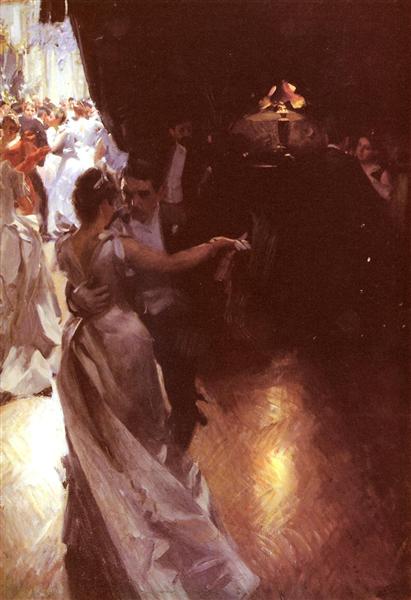
on the origins of the waltz

waltz-1891.jpg!Large.jpg

       Waltz (1891) 

         Anders Zorn

        ____________

had the waltz been confided to any 
other but the Johann Strausses, 
father and inveterate son, we may
never have distinguished it from 
the polka 

at the start, this amorphous new 
dance was deemed shameless, 
even shocking, by a scandalized
apparently, aristocracy, used to 
the more discreet, less conjugal, 
minuet

some nobles, sowing wild
irresistible oats, however, at the
festivities of their more irreverent 
servants, brought the new dance 
back home to their more informal, 
less stuffy, entertainments, avidly, 
though surely under their hats

to BelvedereSchönbrunneven 
Schloss EsterházyHaydn‘s  
stately old stomping haunt

thus was the waltz born, whirling 
indiscriminately like a polka at first
with indefinite stillhowever, timing

which then was reduced to only ever 
3/4 time, by the Strausses, the metre 
in which this comment, coincidentally, 
is written

read it aloud, you’ll want to wrap 
your arms around the nearest  
partner, assure you, and whirl, 
twirl, deliriously surrender

had we not had the Strausses, neither 
had we had Fred AstaireGinger Rogers,
Shall We Dance” from the glorious 
“The King and I”, nor the irrepressible 
So You Think You Can Dance either

nor me, for that matter, writing in 3/4 
verse, essentially, dactylic poetic metre 
about these celebrated accomplishments, 
something I deem eminently worthy of
reporting 

such is the impact of veritable art, I
warrant, the waltz was not inevitable

listen to Strauss Jr’s’ “Wiener Blut”, 
Viennese Blood“, or … Spirit
in English, for instance, for 
corroborating confirmation, and
corresponding, however inadvertent,
even, inspiration   

ever 

R ! chard

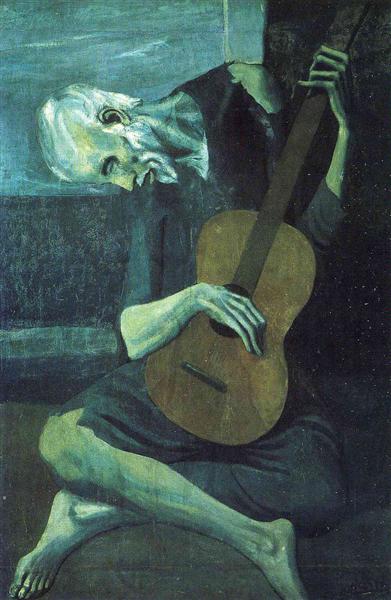
Nobuyuki Tsujii / Chopin

the-old-blind-guitarist-1903.jpg!Large.jpg

     “The Old Blind Guitarist (1903) 

               Pablo Picasso

                      ________

to watch Nobuyuki Tsujii play the 
piano, a piano he cannot see, nor
anything else around him, not 
even his fingers, is a wonder, 
one beholds the work of the 
imagination taking place inside 
tenebrous, one would’ve 
supposed, cerebellum, a place 
without height, depth, width, 
without the idea, even, of, verily, 
spatial dimensions

not only has he had to imagine 
Chopin’s extraordinary, admit it, 
First Piano Concerto therehe’s  
had to imagine himself playing  
it, playing it before even 
international audiences – here
the 2009 Van Cliburn Competition, 
in which he tied for first place – 
despite surely profound physical, 
moral, emotional impediments, 
mountains most, I’m sure, 
couldn’t climb

it is to see the face of an angel
think, to watch him, only angels,
I believe, can do this sort of thing

watch, be inspired

and the Chopin is terrific

R ! chard

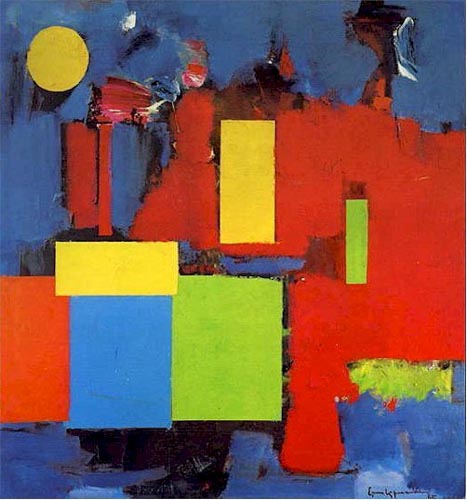
on “Song to the Moon” – Antonin Dvořák

rising-moon-1964

   “Rising Moon (1964)

          Hans Hofmann

              __________

the moon was out last night, grand
upon the starlit evening, either 
waxing or waning, I’m not sure, but
not full, a gibbous moon, above the 
buildings that scrape, in my big city 
neighbourhood, in the very Cubist 
manner, the night sky, see above

I’d been listening to Renée Fleming
singing Dvořák‘s Song to the Moon
in my head since I’d seen her do it, 
on television, in a summer evening 
concert at Schönbrunn, Vienna, some
few days ago, sheit, had been utterly, 
sublimely, enchanting, I’m a Cancer, a
moon child, I speak to the moon

to the moon, I said, moon in the dark
heavens, who steal into every home
and hearth at night, find my beloved
and tell him what is in my heart, rapt 
as I was in the spell of my special
planet, my personal orb, and the 
enveloping Dvořákian magic, though 
there’s been no beloved lately, just 
trailings of the latest one who broke, 
of course, my heart, which gives more 
pathos, however, incidentally, to my 
singing, I’ve giddily gathered

at home, I found Renée Fleming doing 
the piece on the Internet, entirely as 
splendidly, earlier, at London’s Royal
Albert Hall, September, 2010

listen

R ! chard

an homage to the victims of the Titanic

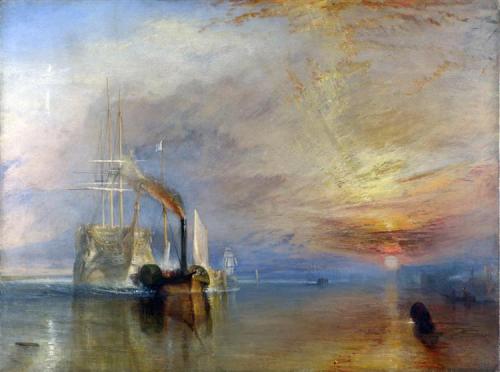
the-fighting-temeraire-tugged-to-her-last-berth-to-be-broken-up-1839.jpg!Large

  The Fighting Temeraire tugged to her last berth to be broken up (1839) 

          William Turner

                _______

while I’m on the subject of threnodies
which is to say “song[s] of lamentation
for the dead”, as I earlier statedlet me 
bring your attention to this extraordinary 
piece, an homage to the victims of the
Titanic
 
it doesn’t even have a title, much as 
Mozart and Haydn didn’t before music 
went mainstream, into public forums 
rather than merely aristocratic salons, 
and when an identifying moniker 
instead of a number became manifestly 
more practical, especially when the 
emerging Middle Classes were 
becoming the ones who were paying 
the composer’s bills, at the opera 
houses and the other sprouting 
concert venues, when some composers 
had even up to 32 sets of piano sonatas 
to remember, three and four often to 
a single set, opus number, as many as 
there are movements in a very sonata

and that’s not counting the numbered 

symphonies and string quartets of 
theirs, left to similarly calculate, 
decipher, extricate

it doesn’t have a title, I think, because
to my knowledge, it is the first of its
kind, a composition created by 
computer, for computer, an entirely 
self-contained digital work of, 
manifestly, art – I’d been waiting, 
diligently, for one – and like Beethoven, 
after the work was done, the artist(s)
just felt the title best left to the 
wordsmiths, thus – you’re welcome –  
Threnody for the Victims of the 
Titanic

sure, computers have done practical
things before, admirably, but never 
told a story, and certainly never one 
as profound as this one

these are the last moments of the 
Titanic, digitally reproduced, in real 
time, 2 hours and 40 minutes, they
are mesmerizing, you don’t want 
to miss a thing

there are no voices, apart from a 
few radio transmissions at the 
start, spotting the iceberg, calling 
out commands to beware, stop 
the engines

afterwards only silence, and the 
sound of the waves, the churning
of the engines, which have been 
restarted, sounding as rhythmic, 
incidentally, and numbing, as the 
wheels on the railroad tracks of
Steve Reich‘s Different Trains“,
another powerful threnody 

later the flash and crack of flares,
the crunch of the ship sinking  

the pervasive, however disrupted, 
silence and the inexorable passage 
of ever ticking time combine to be, 
thereafter, transfixing, meditative, 
ultimately transcendent, a fitting 
setting for a threnody 

I know of only another work to take
you to that venerable place,
Beethoven’s opus 111

and often enough Pink Floyd, for 
that matter, and the visionary 
Alan Parsons Project, of course, 
discoursing on inexorable Time 

and, now that I think of it, Elgar‘s
The Dream of Gerontius, whose 
character goes from his deathbed 
in the first act, to his afterlife in 
the second, effecting transcendence
for us by, yes, ingenious 
metaphorical proxy

but I digress

what I call Threnody for the Victims 
of the Titanic is a narrative with 
sound, not a movie, not a television
program, it has more commonality 
with a musical production than 
anything else but painting in art 
history, though its means are 
intuitively literary, ship stories go
back to The Odyssey through
Gulliver’s TravelsTreasure 
Island and to one of my very 
favourites, Ship of Fools“,
relatively recently

I could add Mutiny on the Bounty“,
Moby Dick“, “The Caine Mutiny 

in art, a precedent would’ve been set
in our collective consciousness by 
William Turner‘s celebratedThe 
Fighting Temeraire …, but I would 
mention as well Caspar David 
Friedrich‘s The Wanderer above 
the Sea of Fog for its existential
pertinence

a few literary points I’d like to stress
to back up my overt adulation, I find  
it impressive that the Classical rules
of tragedy have been maintained, 
unity of action, time, and place, 
prescriptions going back to 
Aristotle‘s Poetics in our cultural 
history, to profoundly express 
tragedy, iconic, epic, misfortune

not to mention the Classical musical
imperatives of tempo, tonality and 
repetition, none of which can be 
faulted here in this consummate 
composition

there is a no greater leveller of tempo 
than time, larghissimo here*, in the 
largest sense of that word, the 
cosmic, the inexorable pace of 
temporality in our brief heavens

a greater leveller of tonality neither  
is there than the rigorously impartial 
hum of the imperturbable Cosmos 

nor is there greater repetition than 
uniformity, however disrupted by  
however fervent ever human 
intervention, see Sisyphus, or 
Martha in “Who’s Afraid of Virginia
Woolf for iconic disrupters

R ! chard

*   Shostakovich had asked the 
     Beethoven Quartet to play the first 
     movement of his 15th String Quartet,
     “Elegy: Adagio“, so that flies 
     drop dead in mid-air, and the 
     audience start leaving the hall from 
     sheer boredom  

     well this inspired elucidation is even  
     slower than that

threnodies: to the victims of Hiroshima, of the Holocaust, and to the Canadian North

The Scream, 1893 - Edvard Munch

       The Scream (1893) 

             Edvard Munch

                    ____________

before we leave too far behind the 
anniversary of the annihilation of
Hiroshima, August 6, 1945, let me 
introduce you to a piece that 
purports to pay it homage

if I didn’t bring it up before, it’s 
because the date was wrong, but
especially because the work 
offends me, the only thing I like
about it is the title, a thing of 
beauty, poetry – Threnody to the
Victims of Hiroshima – a threnody
is a song of lamentation for the 
dead, which worked for me, this 
one, no further than its title

there is nothing remotely 
reminiscent of the tragedy
throughout the piece, it is a 
collection of academic exercises,
pretensions, I think, without a 
heartbeat 

let me compare Steve Reich’s 
threnody to the victims of the 
Holocaust, the other signature 
Twentieth Century atrocity, his 
Different Trains“, a work in three 
movements, America – Before the 
War”, “Europe – During the War”, 
and After the War”, for string 
quartet and tape, upon which 
Reich has recorded interviews 
with people relating impressions 
from before the warduring, and 
after, according to the movements

the quartet, you’ll note, must keep 
time with the tape, and in this 
production visuals have been 
effectively added 

Glenn Gould had done something 
like this several years earlier,
incidentally, in his The Idea of 
North“, a threnody itself to that 
very idea, a masterpiece, a
groundbreaking transcendental
work of the imagination, with 
overlapping voices, which is to 
say human counterpointthough 
without string quartet

you’ll note that distressing tonalities
affect throughout this other, much 
more successful however, tribute
but the different rhythms of the 
recurrent, which is to say minimalist, 
rails keep you emotionally, as it were, 
on track

Different Trains is appropriately,
and profoundly, commemorative, 
not to mention unforgettable 

Richard

“My Romance” – Carly Simon

hot-jazz-1940.jpg!Large

       Hot Jazz (1940) 

               Franz Kline

                        _____

in this video of one of her concerts, 
Carly Simon tells the story of how
when she told her special guest on
the program, Harry Connick Jr., that
he was born the same year as 
Sgt. Pepper, he answered, Sgt. Who

   “Harry, you were born the same year that 
                     Sgt. Pepper came out”, she said
   “Sgt. Who”, he answered

the same had happened to me when  
I’d told someone, a sprite, ten years 
younger, don’t ask, about my 
admiration for Susan Hayward
Richard, he asked, who’s Susan 
Hayward, to my utter consternation

I mean, Susan Hayward

you might not know who Carly Simon
is, nor even Sgt. Pepper, but the story 
is that those who once had been our 
very idols fade and become question 
marks in the eyes of the following 
generations

you might not either know who Harry 
Connick Jr. is, but listen to both of 
them here, Carly and Harry, put 
together an entertainment enough 
to turn an otherwise lazy hour into 
an unmitigated enchantment

Richard

“First Piano Concerto” – Pyotr Ilyich Tchaikovsky

concerto-1975

      “Concerto (1975) 

               Jack Bush

                         _____

if there’s a piece that defines Classical music
for most people, encapsulates it, even for 
those who aren’t especially interested in 
Classical music, that piece would be, I think,
Tchaikovsky‘s First Piano Concerto

strictly speaking Tchaikovsky isn’t a Classical
composer, but a Romantic one, the Classical 
period in music having been transformed 
some years earlier into the Romantic period
by none other than Beethoven1770 – 1827, 
perhaps the most transformative composer 
of all time – Tchaikovsky‘s First Piano Concerto
was written in the winter of 1874 – 1875, pretty
well at the end of the Romantic Period, which 
then ceded to the Impressionists, just to get 
our periods right

what the Romantic Period added to the 
Classical Era was emotion, sentiment – note 
the use of tenuto, for instance, beats being 
drawn out, languidly, longingly, for pathos – 
what it maintained was the structure, the 
trinity of Classical conditions, rhythm, tonality, 
and repetition, which is why even the most 
uninformed listener will usually be able to 
sing along throughout the entire performance
the blueprint is in our collective blood, in the 
DNA of our culture

to remain present a piece must remain 
relevant to the promoter, an interpreter must
have reason to play it, substance surely plays 
a big part, but technical considerations play 
perhaps an even greater role towards a great
work’s longevityChopsticks“, for instance, 
is good but it won’t fill a concert hall  

unless, of course, it’s with Liberace

the “First Piano Concerto” of Tchaikovsky is 
the Everest of compositions, emotionally
complex and technically forbidding, nearly 
impossible, it would seem, were it not for 
those few who’ve mastered its treacherous 
challenges, conquered its nearly indomitable  
spirit

Van Cliburn put it on the map for my 
generation, with a ticker tape parade in 
New York to confirm it

Martha Argerich later on kept the ball rolling

and now Behzod Abduraimov, a mere youth, 
born in 1990 in UzbekistanTashkent, delivers 
by far the best performance I’ve seen since,
giving it new life for the new millenium
 
behold, be moved, be dazzled, be bewitched  

Behzod Abduraimov, watch

Richard

“Symphonie espagnole” – Édouard Lalo

the-treachery-of-images-this-is-not-a-pipe-19482-jpglarge

          La Trahison des images (Ceci n’est pas une pipe)
           / “The Treachery Of Images (This Is Not A Pipe) – (1948) 

                    René Magritte

                     ___________

                                                     paintings don’t lie,
                                                          music doesn’t either,
                                                              only words do 

                                                                                me

in this age of fake news, maybe the 
following piece of musicological 
misinformation shouldn’t be so 
surprising, yet there it is, flagrant,
disturbing and disorienting, and 
apparently irreversible

Édouard Lalo‘s Symphonie espagnole“, 
however acclaimed as such, is still to my
mind, and to several others concerned, a
misnomer, the Symphonie is actually a 
concerto, and can’t think for moment 
why Lalo would’ve called it otherwise

a symphony is an aggregation of sounds
to produce melodies and harmonies, a 
concerto spotlights a soloist, who 
generally determines the direction the 
music will follow

or soloists

once you have a concerto, you can no 
longer call it a symphony, it would be 
to disregard a defining element, like 
calling someone a girl once she’s 
become princessfor instance, 
complete with glass slippers and a 
tiara, it would be at the very least 
disrespectful, if not out and out 
dishonest

Lalo here is, however, magisterial, all 
five movements glitter with, for the 
violin, utterly magical moments, the 
violinist weaving wizardry minute by 
electrifying minute

after such a turn, one must allow 
Lalo to call his opus what he will,
I guess, forgive him his linguistic
trespasses

listen

Richard

psst: I have not accorded Bartók the same leniency
        for his Concerto for Orchestra, 
        however – the Lalo dilemma but in reverse,  
       an orchestra is by definition not a soloist 
         – for I’ve always found Bartók inscrutable, 
         sound and fury, here specifically, though 
         uncharacteristically scrutable in this 
         particular instance, signifying nevertheless,  
         I’m afraid, still nothing, no underlying animus, 
         philosophical, or existential, underpinning 
         but to kill time, a tragic and disqualifying, 
         flaw, unfortunately, in my, however humble  
         everopinion 

         but you be the judge