Richibi’s Weblog

Just another WordPress.com weblog

Category: concerts to ponder

at the movies – “Phaedra”

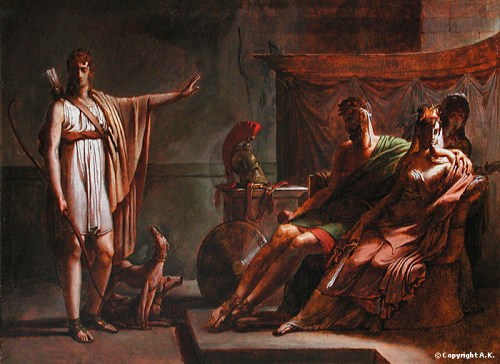
phaedra-and-hippolytus-1802.jpg

     “Phaedra and Hippolytus (1802) 

            Pierre-Narcisse Guérin

                   _____________

Phaedra, according to Greek myth, fell
in love with her stepson, and, of course,
ruined, for everyone, everything 

she’s been represented in music by
composers from, at least, Rameau,
1733, to, here, now, Benjamin Britten,  
1976by way of even Tangerine
Dream, 1973, however peripherally, 
and the hits just keep on coming

in literature, the story goes back to 
Euripides, 480 – 406 BCE, through
Jean Racine, 1639 – 1699, poet at 
the court of Louis XlV, the version 
that I studied in French Literature,
along with, in English, Shakespeare,
who was doing courtiers, rather, 
and royalty there, then, incidentally, 
instead of the Continent’s iconic 
Mediterranean figures – it remains 
my favourite play in my mother 
tongue, next to, for me, its only 
other equal, Cyrano de Bergerac

but I’d never seen a production of 
Phaedra until this searing, 
modern, rendition, set in, relatively 
contemporary, Greece, London, 
and Paris, with the irrepressible, 
the irresistible, Melina Mercouri
torrid temptress, the very goddess 
Herahereand Anthony Perkins
perfect as her suitor, a youth still, 
pulsing with a young man’s 
unbridled intentions

sparks fly, from moment to 
incendiary moment – I had often 
to pause to catch my breath – 
portents of an inescapable, and 
eventually epic, indeed mythic, 
apocalypse

watch, if you dare


R ! chard

why I believe in music, or “I Was Born For This” – Austin Wintory

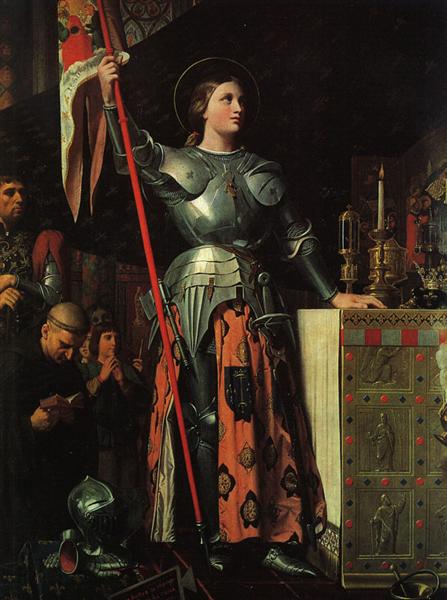
joan-of-arc-on-corronation-of-charles-vii-in-the-cathedral-of-reims.jpg!Large

  “Joan of Arc upon Coronation of Charles VII in the Cathedral of Reims (1854) 

        Jean Auguste Dominique Ingres

                ____________________

many years ago, while I was volunteering 
at our hospital’s palliative care unit, nearby, 
recently installed as a response to, among 
other pressing preoccupations, but most 
urgently then, the AIDS crisis, I was asked 
to sit by a lady in profound distress, her 
family, Western Buddhists, would go to 
lunch while I would sit by her to comfort 
her as much as I could

she was dishevelled, of course, completely 
disconcerted, all ajitter, lost, and evidently
confused, in her profound isolation, not to 
mention in the crumpled state of her 
harried bedunable to communicate, or
reason

I found a chair, sat by her with earnest 
concentration, my partner had died 
there, only recently, on that very unit, 
and I was expressing, to all of those 
concerned in his unparalleled care, 
my unlimited appreciation

I lay a hand gently upon her arm, to let
her feel, at least, the safety that my 
touch could allow, to let it settle on 
her, however removed might be her 
remaining consciousness, began to 
sing quietly a chant I’d been intoning   
from a creed I’d turned to for comfort 
in my own personal anguish, at the 
loss of my own friend, a call, an 
invocation, the continuous iteration 
of a line that brought solace, Om Nama
Shivaya, I prayed, over and over again, 
with the greatest intention, whatever
that phrase might’ve, I’ve forgotten, 
meant

she relented, found her space, little by
little she became, as though grace had 
descended upon her, calm, by however  
infinitesimal degrees, while I continued, 
now, my hopeful, helpful, it appeared,
manifestly mystical, intervention

she had become restful, I’d 
accomplished essentially, I gathered, 
my primary mission, though I 
continued, with some sense, perhaps
even a glow, of personal pridemy 
soulful incantation

then in a voice not much louder than a 
whisper, but much less distraught than 
a moan, she began to join in with row, 
row, row your boat, tunefully, over and 
over again, accommodating herself,
though, naturally, exceedingly weakly,   
to my rhythm, I felt I was experiencing,  
right there, and then, through the    
power of cadence, a miracle

when I looked back, upon hearing 
behind me a rustle, standing at the 
door was her family, wrapped in 
equal consternation 


here’s something with someone singing 
in several inscrutable languages for 
most of us, mostly, words from historical 
texts, in Greek, Latin, Olde English, 
Japanese, and French, I Was Born For 
This

that title, of one of the segments of 
longer work, Journey“, by a contemporary 
composer, Austin Wintoryis indeed a 
translation of Joan of Arc‘s words on the 
cross, “Ne me plaignez pas. C’est pour cela 
que je suis née.”, do not pity me, she says, 
I was born for this, Joan of Arc, my own 
personal Jesus

Shostakovich has an entire symphony,
his 14thcomposed of music to 
accompany classic poems, all in a 
variety of foreign, to him, tongues, but
translated back into Russian for his 
purpose in this particular, and not 
uncommon, instance, nevertheless 
pointed reference to music as superior
more direct, communication – note, here, 
the word, communication – it, the 14th,
is profound, extraordinary, read here 
first, then listen


R ! chard
Piano Concerto no. 9 – Mozart

clown-with-flowers-1963.jpg!Blog

   “Clown with Flowers (1963)

           Marc Chagall

                _______

                                with the greatest respect for all
                                     who read me, and especially 
                                         for those who are least 
                                             convincedthe way also, 
                                                 I note, to a conscious, 
                                                    and entirely personal,  
                                                          aesthetic


let me once again insist that my 
commentaries here are not at all
the last word on any of what I’ve 
discussed, they’ve been merely 
my opinion, according to my own 
particular aesthetic, my comments 
have been rather to excite curiosity
about, for some, an esoteric topic, 
to awaken interest in a field, to my 
mind, strewn with marvels, and 
never to dictate, art, as I often
remind, is in the eye of the 
beholder

I think of myself as company in 
an art gallery, viewing a 
succession of works, musical 
here, expressing notions, either 
specifically to do with the exhibit
or, personal, but somehow related, 
then moving on, just enough to 
whet the appetite, or, of course, 
not

here’s an instance

I’d been waiting for the sales clerk 
to box some fresh pasta for me I 
was buying at an eatery down the 
street when a line of piped in music 
from their overhead system swept 
me off my disconcerted feet, which 
I recognized to be Mozart, but as
I’d never heard him, ever

can you tell me who’s playing that,
I asked the cashier, many stores 
played their own tapes back then,
some still indeed even do, 
19-eighty, at that time, something

he replied, Mitsuko Uchida
what she’d done was to not stress
the bar line, the natural beat, to, 
in fact, eliminate it, so that a flight
of notes went on like an unfettered 
and iridescent miracle, prompted 
by its own irrepressible momentum,
I was flabbergasted

Beethoven later on would do that
nearly consistently

where Glenn Gould would remove 
his foot from the sustain pedal to 
channel Bach while he played 
Beethoven, an atavism, Mitsuko
Uchida was reversing the process
and using Beethoven‘s own 
unleashing of rhythms to shed 
light on her Classically otherwise 
bound Mozart, a telling 
anachronismI nearly screamed

here, in the event, is the next work 
of musical art in my idiosyncratic 
gallery, the richibi galleri, I call it, 
Mitsuko Uchida herself illuminating 
gloriously, as ever, Mozart, his 
splendid, as she reminds us, Piano
Concerto no 9 

thanks so much for stopping by


ever 

R ! chard

Piano Concerto no. 5, opus 73, “Emperor” – Beethoven

v1.bTsxMTIxMTMxNztqOzE3ODE0OzEyMDA7MTEyNTsxNTAw

     All About Eve (1950)

            _______

while I’m on the subject of concertos,
there’s one concerto that cannot be 
overlooked, the very epitome of 
concerti, their summit, apex, their 
very pinnacle, Olympus, compared 
to other less mighty compositions,
Beethoven’s Fifth Piano Concerto,
the piece I would take with me to a 
desert island, used to even walk 
along the seashore in the privacy of 
my headphones nights, after dinner, 
taking in its cadences, its wisdom,
under the moon, the stars, along 
the, however temperamental, 
ocean waters, transported 

indeed this very version of it, Glenn
Gould’s, Beethoven’s, in my mind,  
oracular equal

Beethoven made literature out of 
music, progressed to the point of
delivering a very philosophy, 
Gould took the prevailing 
Romantic aesthetic of the time,
Arthur Rubinstein being a prime
example, for instance, and gave 
us the music of the Information 
Age, the mathematical precision 
of computers, people could hear 
it, perhaps not even knowing how,
why

briefly, Gould eschews – Gesundheit
the hold pedal, the sustain pedal, on 
the piano, he’d grown up on Bach, 
made him his specialty, but Bach
had no sustain pedal on his 
harpsichord, Gould transferred this 
process to later, more rhythmically 
malleable, works, making obvious 
thereby their inner workings, 
something like reading blueprints, 
his interpretations give us the bare, 
and revelatory, bones of these later 
masterpieces, without the sometimes 
facile effects of Romanticism, think 
of rubato, for instance, the ability to 
stretch a note, not possible on the 
harpsichord, but often overused in 
Romantic renderings, a cheap trick, 
like paintings on velvet

Gould would have none of that, he
shows you the composer’s 
compositional brilliance, without 
fanfare, just the facts, no pedal, 
which at the time was completely 
revolutionary, much like computer 
science was thenand algorithms 

here’s something else about Gould,
more savourymaybe, he was called 
in at the last minute to perform this
piece when the planned pianist, of 
considerable renown, wasn’t able to 
make it, Gould hadn’t played it in a 
number of years, but showed up the 
next morning to deliver, the rest is,
as they say, history

that’s All About Eve up there, but 
for pianists, Glenn Gould is Eve 
Harrington, though without her
predatory instincts, nobody now 
remembers the other pianist
unless you were there, interested,  
listening, piano’s Margo Channing, 
even if I named himhowever 
consummately accomplished he 
might’ve been, a man I profoundly 
admire, remains, cruelly, essentially 
unremembered 

imagine


R ! chard

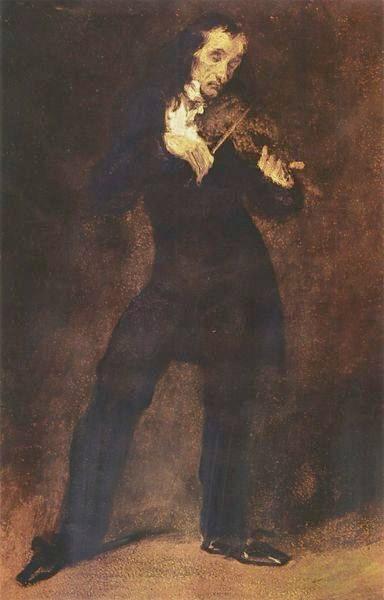
Violin Concerto no. 1 – Paganini

portrait-of-paganini-1832(1).jpg!Large

   “Portrait of Paganini (1832) 

          Eugene Delacroix

               ___________

before you start thinking that, because 
of my recent comparisons, Paganini is
a nobody, look what I found, had 
stupidly forgotten about, among the 
multiplicity of wondrous examples
concertos have to offer 

this will attest, as well, to my fallibility,
which I unreservedly confess, in many,
even familiar, matters, I used to not 
much remember the last time I was 
wrong, but writing makes one more 
aware of one’s even egregious 
insufficiencies, I love, I must say, 
that it makes one humble

meanwhile, Paganini’s First Violin 
Concerto has absolutely no faults,
it’ll run through your cultural veins 
like water, you’ll probably be able 
to sing all the notes, apart, of course, 
from the cadenza, which, in this 
instance, is the soloist’s, not
Paganini’sa not unusual occurence, 
indeed a common one, though it’s 
nice when they tell you who wrote it, 
the composer or the player, as they 
do in this case, cause unless you’re 
a total nerd you mostly wouldn’t be 
able to tell the difference 

the cadenza is the part, incidentally, 
where near the end of a movement, 
any movement, though usually not 
the slow one – think about it – the 
soloist struts hir improvisational 
stuff, independently from the 
orchestra, till s/he signals it back in 

I’ve said before that Paganini’s 
Caprices are a series, essentially,
of cadenzas, not at all such shabby 
stuff

meanwhile, I think Paganini is back 
in the running, what do you think


R ! chard

so you think you can be a soloist – Beethoven / Paganini / Chopin

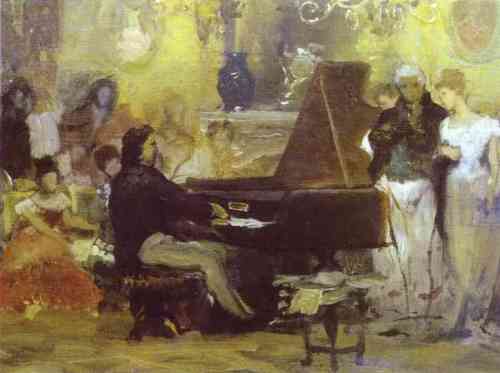
chopin-performing-in-the-guest-hall-of-anton-radziville-in-berlin-in-1829.jpg

Chopin Performing in the Guest-Hall of Anton Radziville in Berlin in 1829” 
    (1887)                                                                                                                

        Henryk Siemiradzki

                 ________

Chopin’s Piano Concerto no 1, written 
in 1830, is in the same mold as both
the Beethoven Violin Concerto, 1806, 
and Paganini’s 5th, a synchronous 
1830, three movements, fast, slow, 
fast, long symphonic introduction,
followed by miracles of articulation 
by the virtuosic soloist, with, however, 
differing degrees of emotional impact

Beethoven is evidently the source, 
and model, for both later compositions
having clearly preceded them by a 
number of years, but neither Chopin  
nor Paganini have the chops to match
his magisterial orchestration

Chopin, like Paganini, was confined to
essentially one instrument, of which,
however, both were utter masters, and 
manifestly and profoundly there inspired, 
but in either, once the solo part takes 
flight, the symphony is merely 
packaging, no longer an equal partner 

Beethoven has parts for all his players,
his is a conversation, not a declamation

but Chopin, 1830, had learned by then,
and integrated from Beethoven the 
lesson of how to incorporate drama
into his high wire act, the constant 
repetition of a melting air, a musical 
motive, which Paganini hadn’t, Chopin 
not only could fly, but also knew how 
to dress for it, to become a virtual 
angel of mercy and compassion up
there under the biggest of tops, his
immortality 

don’t take my word for it, though, 
you’ve probably heard already Chopin‘s 
work, a very emblem of 19th Century 
Romanticism, somewhere in your 
subconscious you know this melody,
heard it before, it’s part of our Western 
culture

not so the Paganini

what’s kicked

see above

you’ll hear your senses talking, the 
language of music and art, more
accurate eventually than any of my, 
however erudite, however informed,  
but merely ruminative, words, art 
being, once again, in the eye, the 
ear, in this case, of the beholder, 
or here, the be-hearer

listen


R ! chard

twice upon a violin concerto – Beethoven / Paganini

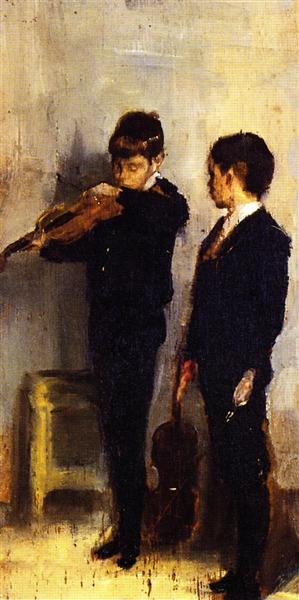
the-violin-lesson-1889.jpg!Large

  “The Violin Lesson (1889) 

         Tom Roberts

              _______

to juxtapose two things for consideration
to my mind, is the best way to sharpen 
both one’s aesthetic and, therefore, 
spiritual personality, here, thus, are 
two contemporaneous, essentially,  
violin concertos, concerti, if you like, 
Paganini’s 5th, 1830, Beethoven’s
Only, 1806

let me point out that the Classical Era
is over at this point, this isn’t music 
for the courts any longer, but music 
as spectacle, you can hear it, it’s like 
moving from Frank Sinatra‘s 
nightclubs to David Bowie’s stadiums

noteworthy about these two pieces is 
that the structure in each is identical, 
the same lengthy introduction in the 
first movement, followed by an 
articulate, and eventually mesmerizing, 
elaboration on the initial melody by 
the soloist, with divergent, however, 
intentions, Paganini starts with a 
fanfare, promises histrionics, delivers
fireworks, Beethoven begins with 
portent, goes instead for drama, 
which is to say, your heart, as well

both their second and third movements 
are essentially, then, indistinguishable 
conceptuallytheir last movement in 
either is even a rondo

the challenge in the Paganini is physical,
the glory is in the player’s technical 
prowess

with Beethoven the requirements are 
both physical and emotional, he 
punches for the heart, which the 
player musttherefore, with equally 
astounding panache, incidentally, 
also conquer 

style, in other words, over substance,
substance over style, which is to say
The Phantom of the Opera“, for
instance, or Cirque du Soleil,
Rachmaninov, maybe, versus 
Liberaceyou are the judge

history has sided, however, with 
substance, Beethoven’s Violin  
Concerto is everywhere, it isn’t at 
all easy, conversely, to come up  
with any of Paganini’s, despite 
their incontestable magnificence

maybe it’s time for a Paganini 
revival, they did that several years 
ago for the inimitable Rossini, an 
effervescent light in an otherwise 
mostly dour 19th Century, listen,
with counts and countesses here  
in attendance, at very, can you 
believe it, Versailleswow

 
R ! chard

twice upon a “Pastorale” – Beethoven

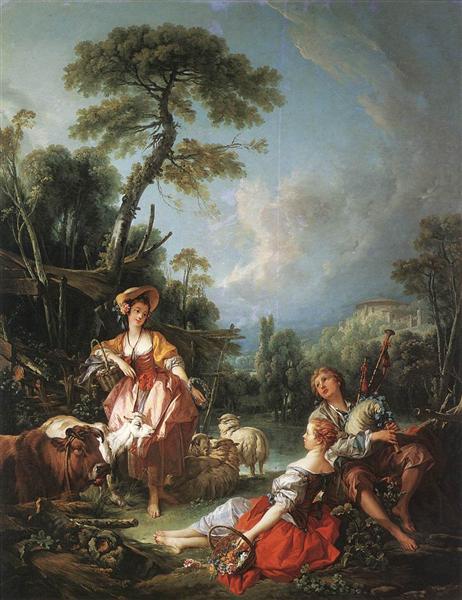
summer-pastoral-1749.jpg!Large   

    “Summer Pastoral (1749)

          Francois Boucher

                __________

on my way to my metaphorical 
Eiffel Tower, Beethoven’s Piano
Sonata no 15, the “Pastorale”,
his first to impress me, his 
Opus 28despite the notoriety 
of the earlier “Pathétique”, 
Opus 13and of the “Moonlight”
his Opus 27, no 2, splashy 
showpieces, those last twoto 
my mind, rather than revelatory,  
knew I was going to stop at the 
Arche de Triomphe, if you’ll 
allow me the developing allegory
to visit the other “Pastorale”, the 
6th, and my favourite, Symphony
one of the few works which he 
named, but where he also gives, 
apart from tempoin the usual 
Italian, descriptive headings in 
German, the culture that had 
taken over the arts, essentially, 
from the Italians, during the 
18th Century

Erwachen heiterer Empfindungen 
bei der Ankunft auf dem Lande, 
he, for instance, instructs, or
Awakening of cheerful feelings on 
arrival in the countryside, then
Scene by the brook, Merry 
gathering of country folk, Thunder. 
Storm, and finally Shepherd’s song. 
Cheerful and thankful feelings after 
the storm – five, unconventionally 
already, movements, instead of the 
usual three, or four, with headings 
that look a lot like stage settings,
cues for a play, chapters in a story

it’s evident that music has explicitly 
become, hereliterature, movements 
have been given a specific thrust, 
particular direction to follow, not  
dance, but emotive, appealing to the 
vocabulary of the senses, the 
grammar of the heart, music as 
graphic description, later we’ll even 
get tone poems 

sure, Vivaldi had written his Four 
Seasons“, 1723, but never, ever, 
as precisely rendered as here,
Beethoven brings to life an actual 
storm, bing, bang, pow, you hear, 
as thunder cracks, rumbles, 
crashesnot to mention the virtual 
call, chirp, twitter of the various 
birds he elicits bristling in the 
rustling leaves, you’ll even hear 
in the recovering countryside 
rainbow if you listen

music has become a language, a
medium of direct intelligent 
communication, enough, indeed, 
to verily inspire century, indeed,
as well, beyond


you’ll also fall in love with Leonard 
Bernstein here, who shows why 
Leonard Bernstein remains ever, 
indisputably, Leonard Bernstein,
beautiful, angelic, inspired

R ! chard

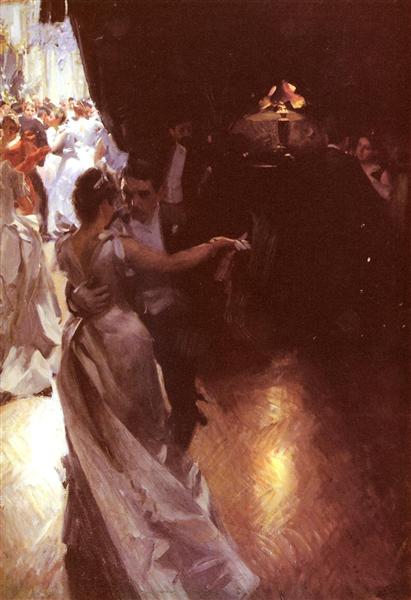
a short history of the waltz

waltz-1891-1.jpg!Large

  “Waltz (1891) 

    Anders Zorn

       ________

inadvertently, during my last comments
I let slip, perhaps, prematurely – cause I
thought I’d explore earlier Romantic 
pieces first, more Beethoven, more 
Paganini – the word waltz, when I 
referenced the “Minute Waltz”, a dance 
which expressed a sea change in 
Western cultural history made 
manifest through music 

though the waltz was already the rage
in lowlier social circles in the late 
1700’s, the minuet still held sway in 
the more aristocratic salons, whose 
young swains nevertheless would 
skip out to ferret out the servants’ 
quarters, as young swains do

slowly the dance, for its more 
informal aspects, not to mention 
its sensuous intimacy, became so 
astonishingly mainstream as to 
define pretty well the very century, 
Chopin and the Strausses, Father 
and Son, would take care of that, 
the last two making a carnival out 
of very Vienna

but until the late 1820’s, not much 
was heard of the waltz in the 
musical curriculum, at which 
point it’ll come in with a vengeance  

not much from Beethoven, who, in 
his fifties, was probably about as ,
interested in waltzes as I am in hip 
hop, a ditty only, a trifle, this one,
1824, one of only two waltzes 
from him 

here’s Johann Strauss l, however, 
his Carnival in Venice, 1828, is a 
waltz in Carnival clothing, like 
cadenzas, for instance, in the 
guise of Paganini “Caprices”

here’s Johann Strauss ll, the son,
with his Wiener Blut“, “The Spirit 
of Vienna“, electrifying, 1873, the 
late already 19th Century

but here’s Chopin doing his stuff
1847, right in the middle of both, 
from far away Paris, which was 
going through its list of Empire 
changes right about then, his
Waltz in C-sharp minor

Chopin’s waltz is a more decorous 
composition, more courtly, more 
also introspective, contemplative, 
private, indeed Romantic

note how strongly the Classical 
unities still apply here, tempo, 
tonality and repetition, even more 
markedly than in Beethoven, Chopin 
is Mozart, but with more sentiment, 
and perhaps more rubato, stretching 
the rhythm in composition to 
accommodate a dancer’s presumed 
dip, in his otherwise meditational 
compositions 

the waltz will undergo trials and 
tribulations later, as the world 
turns, but I’ll keep those 
reflections for later

meanwhile, choose your partner


R ! chard

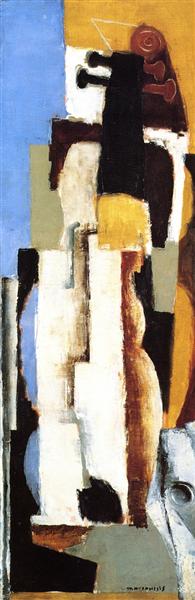
Cello Concerto no 2 in D major – Haydn

a-cello-1921.jpg!Large

         A Cello (1921)

        Louis Marcoussis

             ___________

between Bach’s transcendent Suites for
Cello and Beethoven’s reinvention of that 
instrument, two only cello works occupy
the last half of that century, both by
Haydn

his Second, however, Concerto, written 
several years later than his First, 1783, 
indeed nearly twenty years later, seems 
to me less accomplished, though ever, 
nevertheless, unimpeachably, and 
impressively, Haydn 

the first movement is long, long works 
only until you start thinking it’s long

the initial melody in the adagio, the 
second movement, struck me as artificial, 
saccharine, though Haydn weaves magic, 
not unexpectedly, still, and  
continuously, around it in its 
development, his elaboration of it

and the pace of the third movement, 
following the second, is disconcerting 
rather than surprising, rather than, 
were it effective, delightful

Mozart wrote a Cello Concerto too, 
apparently, but, if so, it is lost

otherwise we’re on to the next historical
epoch, Beethoven’s, after this inauspicious 
turn at this generation for the cello, lost 
for a while among the more assertive 
instruments of that prim, and proper,
Classical Era


R ! chard