Richibi’s Weblog

Just another WordPress.com weblog

Category: concerts to ponder

Ran Dank

Mount  Everest

Mount Everest

_________

though I’d only just listened to a full
recital at the Rubinstein Piano
Competition
, a peek at the next
performer’s program, left me unable
to not watch another, Ran Dank would
be playing, along with four pieces of
Chopin, three mazurkas and his A flat
major Polonaise, itself a towering
musical monument, Beethoven’s
“Hammerklavier”, the very pinnacle
of piano music, nothing surpasses in
majesty and stature the
“Hammerklavier”, the Mt. Everest of
music, a competent reading will
change your life, it is that good

Ran Dank doesn’t disappoint, I left
the planet

Richard

Natalia Sokolovskaya


though there have been gems among
the performances presented during
Stage l of the 14th Arthur Rubinstein
International Piano Master Competition
,
in Stage ll each contestant has been for
me outstanding, I’ve now seen six of
the 16 remaining contenders out of the
original 36, 20 are gone, cast away by
the 7 judges

Natalia Sokolovskaya had mightily
impressed me at Stage l with,
especially, her own 8 Variations
on a Theme of Paganini
” (at 15:00
minutes on the tape)
, you’ll remember

Rachmaninov’s Rhapsody on the
same theme, but for entire orchestra,
Sokolovskaya writes hers for piano
alone, the original theme, from
Paganini’s 24th Caprice, had been
of course for violin

at Stage ll her Rachmaninov First
Sonata (at 20:00 minutes)
is

transcendent, surely definitive, this
is the one I’m going to remember

her Spanish pieces (at 10:00), a
couple of compositions by Albéniz
,

are a wonderful break from the often
very abstract other works on offer,
with their immediately captivating,
beguiling, indeed seductive, rhythms

she even makes the very trite
“Reflections on Love” (at 00:00)
, a

condition of the competition, credible,
by spacing its interchangeable
movements, pausing between them,
letting them breathe, in order to
separate the varied “Reflections”,
instead of stringing them all together
as a continuous, rather than discrete
elements of a, considered whole, as
all the other performers have to date
reflexively done

no one has written anything pertinent
about love, musically, since Chopin,
with the exception of often enough
Rachmaninov, to presume to
significantly comment on love is, to
my mind, pretentious, calling for a
fall, this composer is no exception,
her thoughts are to be expected, love
is atonal, arhytmic, loud, soft, tender,
tempestuous, strident, placating

but everyone already knew that

Sokolovskaya gives the “Reflections”
dignity nevertheless despite their
overt pretensions

a recital to write home about

Richard

“L’escalier du diable” – György Ligeti‏

one of the benefits of watching a piano
competition, or any recital, or concert,
for that matter, is in finding gems you
wouldn’t otherwise have heard of

at the 14th Arthur Rubinstein International
Piano Master Competition
held only last
month, May, Sun Yutong delivered a
riveting Ligeti, “L’escalier du diable”,“The
Devil’s Staircase”,
great, incidentally, title

here’s Sean Chen doing the same piece, if
you don’t have time for the extraneous
elements of a competition, however
meritorious this exhilarating presentation
might’ve been

cheers

Richard

psst: find Yutong doing the Ligeti at 28:00

the 14th Arthur Rubinstein International Piano Master Competition

Thomas Gainsborough - "The Blue Boy (Portrait of Jonathan Buttall" (1770)

The Blue Boy (Portrait of Jonathan Buttall) (1770)

Thomas Gainsborough

____________


if you’ve missed me lately, it’s because I’ve been
in Tel Aviv for the past week, virtually of course,
taking in the 14th Arthur Rubinstein International
Piano Master Competition
, and they’re not kidding,
every challenger to date has been at the very least
astonishingly dextrous, sparkling even, though
some have been hampered by their own dire
program, with the unfortunate added condition
that, for all, they must integrate one of two
commissioned works that, to my mind, are
completely uninspired

other performers have been astounding, lots
of Beethoven of course, Chopin, Liszt, the
technically utterly daunting

among the moderns Ravel takes centre stage
as an option, with too many, to my mind, of his
tedious pieces,“Gaspard de la nuit”, yawn,
“La [, yawn again] valse”

but Bartok pops up, and Prokofiev, a great set
of variations by Szymanowski, unexpectedly,
and, at one point, a completely irresistible
Ligeti, more of which later

Nikolay Khozyainov starts with the only Ravel
I’ve been able to sit through without getting
impatient, “Gaspard de la nuit” to my mind
should stay there, “La valse” should
immediately stop, but Khozyainov‘s “Pavane
pour une infante défunte”
, or “Procession for
a Deceased Princess” was everything you
would want in a dirge, solemn, transcendental,
transfixing

he follows up with a Liszt to knock your socks
off, “Feux follets”, “Fireflies”, fleet as the night
air, as mesmerizing

the final Rachmaninov sonata reminds us of
how wonderful Rachmaninov really was

watch, listen

Richard

the Eagles, and the dramatic monologue‏


to get your summer groove on,
you’ll surely want to listen to this,
just click

then again, you just might find
that “you may never leave”

Richard

psst: Hotel California“, another, wonderful, dramatic monologue

On a dark desert highway, cool wind in my hair
Warm smell of colitas, rising up through the air
Up ahead in the distance, I saw a shimmering light
My head grew heavy and my sight grew dim
I had to stop for the night
There she stood in the doorway;
I heard the mission bell
And I was thinking to myself,
“This could be Heaven or this could be Hell”
Then she lit up a candle and she showed me the way
There were voices down the corridor,
I thought I heard them say…

Welcome to the Hotel California
Such a lovely place (Such a lovely place)
Such a lovely face
Plenty of room at the Hotel California
Any time of year (Any time of year)
You can find it here

Her mind is Tiffany-twisted, she got the Mercedes bends
She got a lot of pretty, pretty boys she calls friends
How they dance in the courtyard, sweet summer sweat.
Some dance to remember, some dance to forget

So I called up the Captain,
“Please bring me my wine”
He said, “We haven’t had that spirit here since nineteen sixty nine”
And still those voices are calling from far away,
Wake you up in the middle of the night
Just to hear them say…

Welcome to the Hotel California
Such a lovely place (Such a lovely place)
Such a lovely face
They livin’ it up at the Hotel California
What a nice surprise (what a nice surprise)
Bring your alibis

Mirrors on the ceiling,
The pink champagne on ice
And she said “We are all just prisoners here, of our own device”
And in the master’s chambers,
They gathered for the feast
They stab it with their steely knives,
But they just can’t kill the beast

Last thing I remember, I was
Running for the door
I had to find the passage back
To the place I was before
“Relax, ” said the night man,
“We are programmed to receive.
You can check-out any time you like,
But you can never leave! “

Tchaikowsky piano concerto no 1 in B flat minor, opus 23‏

the piano concerto no 3 of Rachmaninoff was written in 1909,
a hundred years after Beethoven’s piano concerto no 5, the
“Emperor”
, 1811, to the attentive ear the intervening years
are present in the evolution of the music

the most evident structural alteration, sensed now rather
than consciously heard, though this change would’ve been
glaring during that period, is the often elastic rhythm, the
hesitation, the reserve, the recapitulation of forces before
a surging onslaught, before a turbulent apotheosis, as a
movement returns to its fundamental tempo

the beat ever essentially reigns

this will change

let me point out here that this rallentando wouldn’t’ve been
even conceivable before the invention of the piano, which
happened around the time of Mozart, the harpsichord before
that couldn’t do that, it was confined, you might say, to
only rallentandon’ts, the harpsichord didn’t provide the
possibility of resounding a note, neither of moderating of
course its volume, which the piano, by very definition, did,
“piano” means “soft”, “pianoforte” “soft loud”, the very
foundational elements of the instrument, the elaboration
of beat would thus perforce henceforward play a major role

between Rachmaninoff and Beethoven, these two pillars of
our musical Trinity, there is the mighty, the third supreme
immortal, Tchaikowsky, a Late Romantic, of all composers
perhaps to us the most familiar, his piano concerto no 1 in
B flat minor, opus 23, written in 1875, is the concerto most
associated with my generation, Van Cliburn was a rock star
then, after winning the Tchaikowsky Piano Competition in
Moscow, 1958, an achievement of the very highest order
for an American in that historical context

and his performance of it was spectacular

the most salient aspect of Tchaikowsky‘s music to my mind
is the charged dramatics, which is not surprising when you
consider that he wrote the music for “The Nutcracker”,
“Swan Lake”, musical story-telling, you’ll note he evokes
this dramatic tension by sustaining, withholding, then
unleashing the beat before a storm of prestidigitatori

Tchaikowsky tells grandiose stories, Rachmaninoff opens
an anguished heart, Beethoven speaks with God, they are
our foundational musical poets, our sonic oracles

the formidable Emil Gilels, 1916 – 1985, plays Tchaikowsky,
he is electric, he is epic, he is extraordinary

Alfred Wallenstein conducts

Richard

Beethoven: piano concerto no 5, in E flat major, opus 73‏

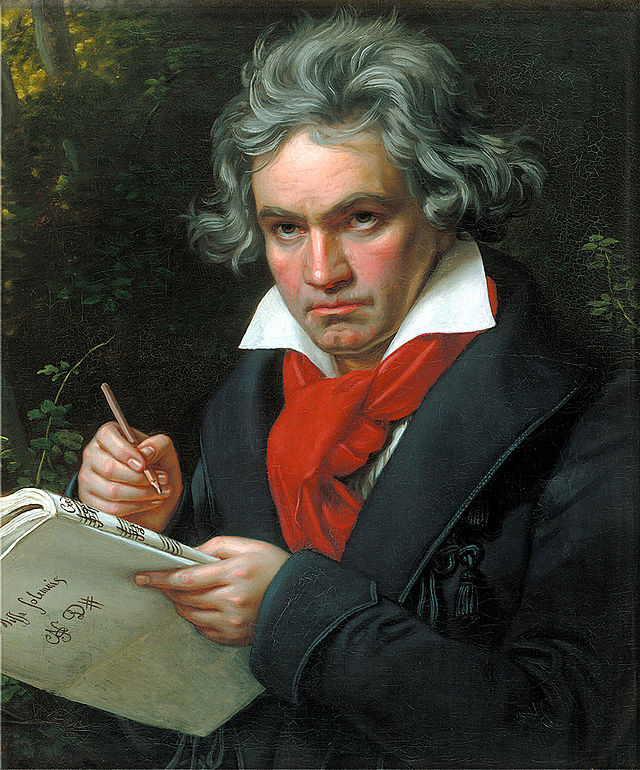
"Beethoven" - Joseph Karl Stieler

A portrait of Ludwig van Beethoven (1820)

Joseph Karl Stieler

_____________

you might say a triumvirate of piano concertos dominate
our Western musical culture, a veritable trinity of pianistic
masterworks that tower over, and have ruled, our musical
consciousness throughout the modern epoch, the
Rachmaninoff 3 has been one of them, but the 5th of
Beethove
n is surely the granddaddy, the “Guppa” as a
favourite grandchild I know would say, the Olympian
Zeus, the Christian God the Father, of them all, in majesty
and authority, others quake in its overwhelming aura, it is
the sun to all the other stars

Glenn Gould is the standard still by which it should be
played, none yet, to my mind, has surpassed him

Karel Ancerl conducts the Toronto Symphony Orchestra,
a competent orchestration, overshadowed inevitably by
this prodigy, who nevertheless doesn’t ever flaunt his
finger play but remains faithful throughout to the
dictates, the tonal balances, of the music, it is 1972

I had mentioned “variations in volume, tempo, tonality,
the play of harmonization and discords” in Rachmaninoff
,
note the strict adherence to tempo here, even the fastest
runs of notes are grounded in beat, more solid, less elusive
than the iridescent Rachmaninoffian allusions to Debussy,
you could set a metronome to the appropriate tempo of
each individual movement in Beethoven, it would remain
constant, apart from a few restrained ritardandos near
the end of some musical elaborations, until its very final
apotheosis, beat was ever an anchor for the fulgurating
Beethoven, an article of faith from which he strayed only
with great circumspection

note the language is not emotional, passionate and ardent,
but philosophical, metaphysical, Beethoven is confronting
cosmological considerations, existential realities, not the
more emotional concerns that confound us every day, it’s
God he’s talking to, eternity, not the incarnate tendrils
of the moment, not the poignant stuff even of soon
through Schubert a Chopin, Beethoven was at the start
of that Romantic Movement, indeed its very first
proponent, but not quite ready to wear his heart itself
on his sleeve, but a more spiritual, probing reason, whose
ardent metaphysical ratiocinations would set all the others
on fire, setting the stage for all the other stars

later, if you haven’t guessed what it’ll be already, I’ll
supply you with the third concerto, the Holy Ghost, of
the trinity, the Apollo, god of music and the sun, among
our concert greats

Richard

Rachmaninoff: Piano Concerto no 3, in D minor, opus 30

fully 150 years after Mozart the concerto was still a thriving
musical form though it had undergone some modifications,
you’ll hear a more passionate account in Rachmaninoff than
the more lyrical, less emotionally overt compositions of
Mozart, the variations in volume, tempo, tonality, the play
of harmonization and discords, all incidentally within a single
movement, show the passage of time, of Beethoven, of Chopin,
of Debussy between Mozart and the more Romantic, Impressionistic
Rachmaninoff, note the sweeping ritardandos, where the beat is
drawn out, stretched for pathos, a Chopinesque insinuation into
music not found in earlier stuff, one imagines torrid expressions
of fervent sentiment, note the evanescent flurry of notes passing
by like the fleeting glitter of stars, the ephemerality of an
incorporeal idea that Debussy originated and brought to music,
and of course note the irrepressibility, the authority, the masculinity
of a volcanic Beethoven underpinning the lot, you can hear them all

the Vladimir Horowitz Piano Concerto no 3 of Rachmaninoff at
Carnegie Hall, January 8, 1978, with Eugene Ormandy leading the
New York Philharmonic Orchestra is, after Van Cliburn’s historic
1950s account, May 19, 1958, again at Carnegie Hall but under Kiril
Kondrashin this time, and the now defunct Symphony of the Air,
don’t ask, the one I then grew up with, it was riveting even without
the pictures

with pictures here he is again a few months later at Avery Fisher
Hall in New York, September 24, 1978, under Zubin Mehta with
again the New York Philharmonic, so good you’ll even forgive
Mehta his usual sentimental excesses

incidentally Horowitz was 74 at this concert, he is astounding

Vladimir Horowitz, colossus and legend, 1903 -1989

enjoy, be transported, be transfixed, you have been warned

Richard